To save content items to your account,
please confirm that you agree to abide by our usage policies.
If this is the first time you use this feature, you will be asked to authorise Cambridge Core to connect with your account.
Find out more about saving content to .
To save content items to your Kindle, first ensure no-reply@cambridge.org
is added to your Approved Personal Document E-mail List under your Personal Document Settings
on the Manage Your Content and Devices page of your Amazon account. Then enter the ‘name’ part
of your Kindle email address below.
Find out more about saving to your Kindle.
Note you can select to save to either the @free.kindle.com or @kindle.com variations.
‘@free.kindle.com’ emails are free but can only be saved to your device when it is connected to wi-fi.
‘@kindle.com’ emails can be delivered even when you are not connected to wi-fi, but note that service fees apply.
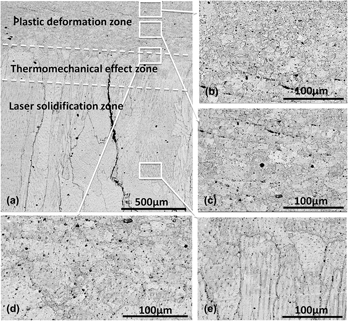
Although laser solid forming (LSF) has a wide range of applications in material manufacturing, the technique has been severely limited due to the solidification cracks during rapid laser melting/solidification. In this paper, an LSF technology assisted by friction stir processing (FSP) is proposed to eliminate the LSF crack through the FSP thermomechanical coupling effect, with the Ni–16Cr–8Fe alloy as a representative material. By FSP-assisted LSF, the cracks at the top surface of the Ni–16Cr–8Fe alloy layer were eliminated. Meanwhile, the severe plastic deformation layers can be observed and gradient grains with tens of nanometers to tens of micrometers from the top surface to the inner. The LSF-printed dendrite microstructure was transformed into nanocrystals or nanotwins in the deformation zone with twining as the main deformation mechanism. The grain refinement results in the increase of hardness about 30%.
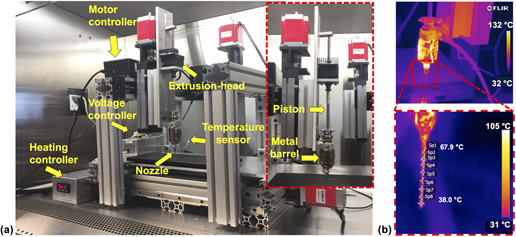
Three-dimensional (3D) printing technology is a promising method for bone tissue engineering applications. For enhanced bone regeneration, it is important to have printable ink materials with appealing properties such as construct interconnectivity, mechanical strength, controlled degradation rates, and the presence of bioactive materials. In this respect, we develop a composite ink composed of polycaprolactone (PCL), poly(D,L-lactide-co-glycolide) (PLGA), and hydroxyapatite particles (HAps) and 3D print it into porous constructs. In vitro study revealed that composite constructs had higher mechanical properties, surface roughness, quicker degradation profile, and cellular behaviors compared to PCL counterparts. Furthermore, in vivo results showed that 3D-printed composite constructs had a positive influence on bone regeneration due to the presence of newly formed mineralized bone tissue and blood vessel formation. Therefore, 3D printable ink made of PCL/PLGA/HAp can be a highly useful material for 3D printing of bone tissue constructs.
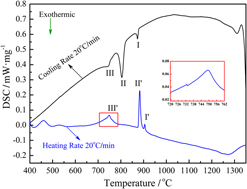
In this work, differential scanning calorimetry (DSC) was used to characterize and analyze the precipitation/dissolution kinetics of second phase particles during the cooling/reheating process in a vanadium microalloyed steel. The results indicated that three obvious exothermic peaks were detected on the cooling DSC curve. Furthermore, three corresponding endothermic peaks were also detected on the heating DSC curve. Combined with thermodynamic calculation and transmission electron microscopy analysis, these three exothermic peaks along cooling DSC curve were defined as the precipitation reaction of V(CN), the reaction of austenite transformation into ferrite and the precipitation reaction of VC, respectively. Meanwhile, three corresponding reverse reactions for cooling were also defined along the reheating DSC curve. The linear regression result revealed that the precipitation activation energies for V(CN) and VC were identified as 311.2 kJ/mol and 167.6 kJ/mol, respectively. The dissolution activation energies for VC and V(CN) were identified as 255.4 kJ/mol and 592.6 kJ/mol, respectively.
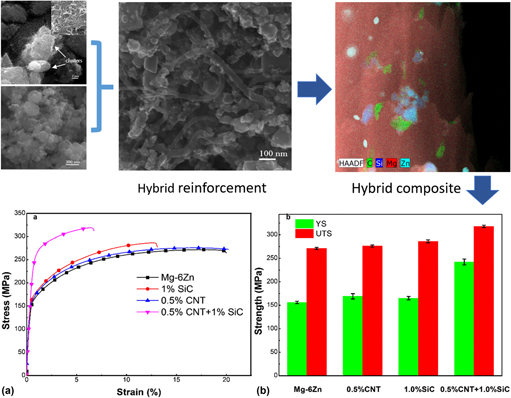
Carbon nanotubes (CNTs) and silicon carbide nanoparticle (nano-SiCp)-reinforced magnesium (Mg) matrix hybrid composites were prepared through a three-step melt spinning process (ball milling, mechanical stirring, and ultrasonic vibration processing). The hybrid nanoreinforcements showed high strengthening efficiency by which the yield and tensile strength of the hybrid composites experienced 46.7 and 15.2% increment, respectively, compared with the matrix alloy. Obviously, the mixed ball-milling process of SiC nanoparticles and CNTs promoted the dispersion of each other, and both the uniformly distributed SiC nanoparticles and CNTs contributed to the enhanced mechanical performance of the hybrid composites. Besides, the addition of the hybrid nanoreinforcements induced the precipitation of nanosized rod-like MgZn2 phases in the as-extruded composites which also made a contribution to the enhanced performance of the composites. Investigations on the strengthening mechanisms of the hybrid composites show that it originates from grain refinement, load transfer, precipitation enhancement, and Orowan reinforcing. More importantly, the contribution made by each part was analyzed in detail.
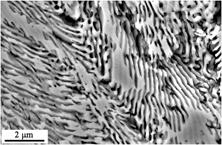
A series of CoCrFeNiMox (x = 0.2, 0.4, 0.6, 0.8, 1.0, and 1.2) high-entropy alloys were designed to develop a eutectic high-entropy alloy system and to acquire a superfine eutectic structure. The results show that for the CoCrFeNiMox alloys, with the increase of Mo content from 0.2 to 1.2, the microstructures shift from a typical dendrite structure to a hypoeutectic microstructure (x = 0.6), and then to a fully eutectic microstructure (x = 0.8) with a lamellar spacing only 110 nm, and finally culminate in the hypereutectic structure (x = 1.0, x = 1.2). The XRD results show that CoCrFeNiMox alloys have a single FCC phase when x is 0.2 or 0.4. When Mo content is over 0.6, it begins to separate Cr9Mo21Ni20 intermetallic compounds. The hardness of the CoCrFeNiMox alloys is increasing significantly from 172.8 to 763.7 HV with the increase of Mo content. Meanwhile, the fracture strength increased but the ductility decreases. Among these alloys, the CoCrFeNiMo0.6 alloy shows excellent integrated mechanical properties of compressive fracture strength and strain, which are 2051 Mpa and 23%, respectively.
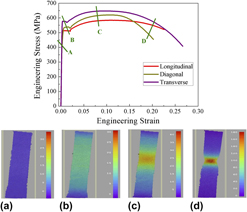
Tensile properties of different directions of X70 pipeline steel plate were tested, and microstructural evolutions of different zones along the transverse direction (TD) were also investigated using electron backscatter diffraction. The highest strength values (yield strength and ultimate strength) appear at TD, and the diagonal direction shows the largest uniform elongation. The elongations of the polygonal ferrite and quasi polygonal ferrite grains increase with the decrease in the distance to the fracture zone. The ratio between high-angle grain boundaries and low-angle grain boundaries in the as-received steel is about 7/3 and starts to decrease from the fillet zone to the fracture zone. The refinement of grains occurs adjacent to the fracture section with the formation of subgrains. With the increase in tensile strain, the intensities of cube and γ-fiber textures increase sharply, and the reinforcement of the (111)$\left[ {\bar{1}\bar{1}2} \right]$ component was obviously larger than the (111)$\left[ {1\bar{2}1} \right]$ component in the γ-fiber texture during tensile deformation.
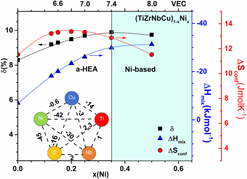
The atomic structure, electronic structure, and physical properties of (TiZrNbCu)1−xNix (x ≤ 0.5) metallic glasses (MGs) were studied in both the high-entropy (0 < x < 0.35) and the higher Ni concentration range (x ≥ 0.35). Atomic structure studies performed with X-ray diffraction and synchrotron powder diffraction provided average atomic volumes, structure factors, radial distribution functions, coordination numbers, and packing densities. Electronic structure studies performed using photoemission spectroscopy and low-temperature specific heat provided information about the electronic density of states within the valence band and at the Fermi level and also about interatomic bonding and atomic vibrations [from the Debye temperature and the boson peak (BP)]. Variations of both atomic structure and electronic structure with x showed a clear change for x ≥ 0.35, which corresponds to a valence electron number ≥7.4. All physical properties, namely, thermal stability parameters, Debye temperatures, BPs, magnetic, elastic, and electronic transport properties, change their concentration-dependence for x ≥ 0.35. The results are compared with those for binary and ternary MGs of the same elements.
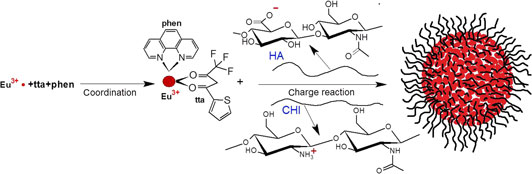
This paper presents new water-soluble bio-polyelectrolyte-based nanoparticles, formed from lanthanide-induced polysaccharide aggregates (LIPAs). These new nano-aggregates are formed by coordinating a photoluminescent lanthanide–ligand complex to a single polyelectrolyte [i.e. polyanionic hyaluronic acid (HA)] or to two oppositely charged polyelectrolytes [i.e. HA and polycationic chitosan (CHI)]. We demonstrate that photoluminescent Eu3+–ligand complexes, which are dispersed homogeneously in aqueous solution by the association with water-soluble HA. The polysaccharide supermolecular assembly can be tuned to obtain nanoparticles of different sizes and surface charges. The preparation of stable and water-soluble lanthanide complexes via Eu3+–LIPAs opens opportunities for use of luminescent lanthanides in aqueous environments, for biosensing and bioimaging applications.
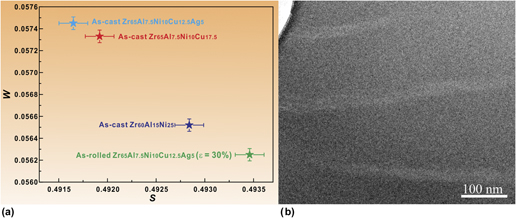
Positron annihilation spectroscopy and differential scanning calorimetry were used to evaluate the changes of the atomic configurations in Zr-based metallic glasses (MGs) due to alloying and plastic deformation. The correlation between the atomic configurations of MGs and the amorphous-to-icosahedral phase transition due to heating was investigated. The results indicate that the free volume frozen in the as-cast Zr60Al15Ni25, Zr65Al7.5Ni10Cu17.5, and Zr65Al7.5Ni10Cu17.5Ag5 MGs substantially decreases in sequence. More excess free volume is introduced in Zr65Al7.5Ni10Cu17.5Ag5 MG due to cold rolling and milling. The annihilation of free volume due to alloying considerably stabilizes the icosahedral structure of MGs, which enhances the nucleation and growth of quasicrystals upon heating. However, the nucleation and growth of quasicrystals are considerably suppressed in Zr65Al7.5Ni10Cu17.5Ag5 MG due to cold rolling and milling, during which the more introduced excess free volume results in substantial destruction of short-range order with 5-fold symmetry. The present work further provides direct evidence for the prevalence of icosahedral short-range order in MGs.
In the emerging era of Internet of Things (IoT), power sources for wireless sensor nodes in conjunction with efficient and secure wireless data transfer are required. Energy harvesting technologies are promising solution toward meeting the requirements for sustainable power sources for the IoT. In this review, we focus on approaches for harvesting stray vibrations and magnetic field due to their abundance in the environment. Piezoelectric materials and piezoelectric–magnetostrictive [magnetoelectric (ME)] composites can be used to harvest vibration and magnetic field, respectively. Currently, such harvesters use modified lead zirconate titanate (or lead-based) piezoelectric materials and ME composites. However, environmental concerns and government regulations require the development of a suitable lead-free replacement for lead-based piezoelectric materials. In the past decade, several lead-free piezoelectric compositions have been developed and demonstrated with promising piezoelectric response. This paper reviews the significant results reported on lead-free piezoelectric materials with respect to high-density energy harvesting, covering novel processing techniques for improving the piezoelectric response and temperature stability. The review of the state-of-the-art studies on vibration and magnetic field harvesting is provided and the results are used to discuss various strategies for designing high-performance energy harvesting devices.
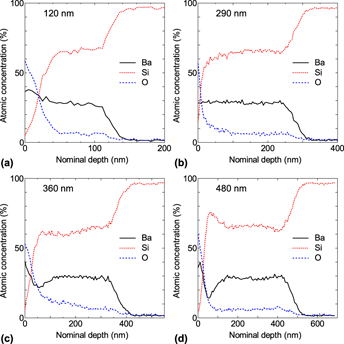
For fabricating photovoltaic BaSi2 films with controlled carrier density and suppressed oxidation by thermal evaporation, the mechanism determining the film composition from incongruently evaporated BaSi2 must be elucidated. We investigated the effects of source premelting, substrate temperature, and thickness on the structural and electrical properties of evaporated BaSi2 films. It is found by room-temperature deposition that the vapor composition continuously changes from being Ba-rich to being Si-rich. Source premelting suppresses the deposition of Ba-rich vapor. Deposition at 600–700 °C shows that BaSi2 forms through the mutual diffusion of Ba and Si, followed by surface oxidation by residual gas. Surface oxidation can be suppressed by a-axis-oriented growth. By changing the film thickness, the optimum thickness to obtain homogeneous films with suppressed oxidation is revealed. Sufficient diffusion leads to high film resistivities and low electron densities, which demonstrates a close relationship between the film composition and the electrical properties.
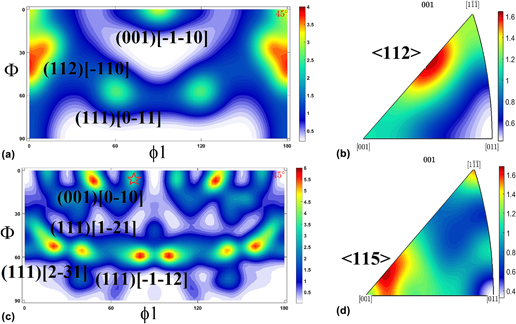
Carbon is doped into a CoCrFeMnNi high-entropy alloy as an interstitial atom, improving the single phase solid solution alloy with a good combination of strength and ductility at room temperature by introducing deformation twins. In situ neutron diffraction (ND) is applied to investigate the carbon-doped CoCrFeMnNi deformation mechanism and micromechanical behaviors during uniaxial tension at room and elevated temperatures. With in situ results accompanied with the microstructure and texture measurement, it is found that the plastic deformation is dominated by dislocation slip at an early stage at both temperatures. However, at high strain level, deformation is mediated simultaneously by deformation twins and microbands at room temperature, while it is governed solely by microbands at elevated temperature of 573 K. The evolution of lattice strain, peak intensity, and peak width from in situ ND elucidates the micromechanical behaviors regarding the role of slips and twins. The texture represented by orientation distribution function indicates that the initial specimen possesses a relatively strong {112}〈110〉 texture component, and the room-temperature tension deformed texture comprises of slip-induced fiber texture and twinning-induced {115}〈552〉 texture component.
Advanced alloys with both high strength and ductility are highly desirable for a wide range of engineering applications. Conventional alloy design strategies based on the single-principle element are approaching their limits in further optimization of their performances. Precipitation-hardened high-entropy alloys (HEAs), especially those strengthened by coherent L12-nanoparticles, have received considerable interest in recent years, enabling a new space for the development of advanced structural materials with superior mechanical properties. In this review, we highlight recent important advances of the newly developed L12-strengthened HEAs, including the aspects of computation-aided alloy design, unique properties, atomic-level characterization, phase evolution, and stability. In particular, we focus our attention on elucidating fundamental scientific issues involving the alloying effects, precipitation behaviors, mechanical performances, and the corresponding deformation mechanisms, all of which provide a comprehensive metallurgical understanding and guidance for the design of this new class of HEAs. Finally, future research directions and prospects are also critically assessed.
Nanosize SiCp (n-SiCp) reinforced Mg–9Al matrix composites (Mg–9Al–xSiC, x = 2.5, 5, 7.5, 10 wt%) with nearly full densification are fabricated by the semisolid powder hot pressing technique assisted with ultrasonic. The effect of SiC nanoparticle contents on microstructures and mechanical properties of the composites is systematically investigated. Grain size and density of Mg–9Al–xSiC composites and morphology of bonding interfacial between the n-SiCp and matrix are found to be greatly dependent on the n-SiCp contents, resulting in the strength and ductility of the composites increase first and then decrease as the increase of n-SiCp contents. As the SiCp content increasing to 7.5 wt%, superior mechanical properties with the yield strength of 191 MPa, ultimate tensile strength of 248 MPa, and elongation to failure of 5.3% are achieved. The improved mechanical properties could be attributed to grain boundary strengthening, Orowan strengthening, and load transfer strengthening.
The valence states, the distribution of Co ions, and defect structures in the Co-doped ITO films with Co concentrations of 5–13 at.% were examined by X-ray absorption spectroscopy (XAS) at Co, K, and L-edges. The structural analyses and ab initio calculations reveal that the Co atoms are substantially incorporated into the ITO lattice and form cobalt–vacancy complexes, while partial formation of Co0 species is observed for all the films. The analyses of Co–K edge XAS reveal that the Co–O bond length RCo–O is shortened and the corresponding Debye–Waller factor (σ2) obviously increases with Co doping, implying the relaxation of oxygen environment around the substitutional Co ions. The qualitative fitting of Co L3-edge XAS further confirms the coexistence of Co0 and Co2+ in the films. The Co atoms mainly occupy the substitutional sites of In2O3 lattices with the metallic Co clusters being about 20–43 at.% for the 5, 7, and 8.5 at.% Co-doped ITO films. However, a significant fraction (∼57 at.%) of metallic Co clusters is found in the 13 at.% Co-doped ITO film.
Photovoltaic organic semiconductors are emerging in many therapeutic applications, including drug delivery and optical control of cell function. However, for their safe use the possible concomitant elicitation of undesired responses in target cells need to be carefully evaluated. Here we describe molecular responses activated by semiconducting polymer nanoparticles based on poly(3-hexyl)thiophene (P3HT) in the model Hydra vulgaris, previously shown to respond to P3HT-NP photostimulation and showed a decrease in the total antioxidant capacity and an increase in the DNA and protein oxidation levels, paving the way to a novel use of photovoltaic devices to control intracellular redox equilibrium.
In this study, we report on the mechanical cleavage of conductive metal-based aluminum diboride (AlB2) flakes. The cleavage resulted in a highly single crystalline 2D material and had an atomically flat and smooth surface as shown by atomic force microscopy (AFM) and secondary ion mass spectrometry. Nanoindentation and AFM imaging of freshly cleaved specimens revealed sub-nm roughness and 30% improvement in the nanomechanical properties as compared to the as-grown AlB2 flakes. Once exposed to ambient air, the cleaved AlB2 flakes formed a superficial oxidation layer of less than 1 nm thickness within 5 min. Owing to the smooth surface, ultra-thin and stable oxide layer, and the excellent mechanical and electrical characteristics of AlB2, the cleaved flakes present an ideal 2D material for emerging applications in microfabrication such as the growth of epitaxial thin films. To prove the sub-nm surface characteristics of cleaved AlB2, a 10-nm thick TiO2 film was deposited on a freshly cleaved AlB2 using atomic layer deposition. Surface roughness and compositional consistency of this film were compared with a control sample deposited on Si. The TiO2 film on AlB2 showed a distinct thin interface layer with fewer defects than TiO2 on Si and superior flatness.
This work is part of the interlaboratory collaboration to study the stability of organic solar cells containing PCDTBT polymer as a donor material. The varieties of the OPV devices with different device architectures, electrode materials, encapsulation, and device dimensions were prepared by seven research laboratories. Sets of identical devices were aged according to four different protocols: shelf lifetime, laboratory weathering under simulated illumination at ambient temperature, laboratory weathering under simulated illumination, and elevated temperature (65 °C) and daylight outdoor weathering under sunlight. The results generated in this study allow us to outline several general conclusions related to PCDTBT-based bulk heterojunction (BHJ) solar cells. The results herein reported can be considered as practical guidance for the realization of stabilization approaches in BHJ solar cells containing PCDTBT.
Monosized spherical Cu–20% Sn (wt%) alloy particles with diameter ranging from 70.6 to 334.0 μm were prepared by the pulsated orifice ejection method (termed “POEM”). Fully dense without pores and bulk inclusions, the cross-sectional micrographs of the spherical alloy particles indicate an even distribution of Cu and Sn. These spherical Cu–Sn alloy particles exhibit a good spherical shape and a narrow size distribution, suggesting that the liquid Cu–Sn alloy can completely break the balance between the surface tension and the liquid static pressure in the crucible micropores and accurately control the volume of the droplets. Furthermore, the cooling rate of spherical Cu–20% Sn alloy particles is estimated by a Newton’s cooling model. The cooling rate of the Cu–20% Sn alloy particle decreases gradually with the particle diameter increasing. Smaller particles have higher cooling rates and when the particle diameter is less than 70 μm, the cooling rate of particles can reach more than 3.3 × 10⁴ K/s. The secondary dendrite arm spacing has strong dependence on particle diameter which increases gradually with the increase of particle diameter. The results demonstrate that POEM is an effective route for fabrication of high-quality monosized Cu–20% Sn alloy particles.
The elastic properties and solid-solution strengthening (SSS) of the binary Ni–Co and Ni–Cr, and ternary Ni–Co–Cr alloys were investigated by the first-principles method. The results show that both Co and Cr increase lattice parameters of the binary alloys linearly. However, nonlinearity is found in compositional dependence of lattice parameters in the ternary Ni–Co–Cr alloys, that is, Co increases but decreases the lattice parameter at low and high Cr concentrations, respectively. Co increases the bulk, shear, and Young’s moduli (B, G, and E), while Cr increases B but decreases G and E in the binary alloys. In the ternary Ni–Co–Cr alloys, G and E have a similar compositional dependence to those in the binary alloys, except for B. Based on the Labusch model, the SSS parameter of Ni–Cr is larger than that of Ni–Co. The SSS effect increases significantly with Cr addition, especially at low Co concentrations in the ternary Ni–Co–Cr alloys. Meanwhile, it increases mildly with Co addition at low Cr concentrations but decreases with Co addition at high Cr concentrations.