Refine search
Actions for selected content:
26063 results in Abstract analysis
Stable minimizers of functionals of the gradient
- Part of
-
- Journal:
- Proceedings of the Royal Society of Edinburgh. Section A: Mathematics / Volume 150 / Issue 5 / October 2020
- Published online by Cambridge University Press:
- 05 July 2019, pp. 2642-2655
- Print publication:
- October 2020
-
- Article
- Export citation
-
Let Ω ⊂ ℝn be a bounded Lipschitz domain. Let $L: {\mathbb R}^n\rightarrow \bar {\mathbb R}= {\mathbb R}\cup \{+\infty \}$ be a continuous function with superlinear growth at infinity, and consider the functional $\mathcal {I}(u)=\int \nolimits _\Omega L(Du)$, u ∈ W1,1(Ω). We provide necessary and sufficient conditions on L under which, for all f ∈ W1,1(Ω) such that $\mathcal {I}(f) < +\infty $, the problem of minimizing $\mathcal {I}(u)$ with the boundary condition u|∂Ω = f has a solution which is stable, or – alternatively – is such that all of its solutions are stable. By stability of $\mathcal {I}$ at u we mean that $u_k\rightharpoonup u$ weakly in W1,1(Ω) together with $\mathcal {I}(u_k)\to \mathcal {I}(u)$ imply uk → u strongly in W1,1(Ω). This extends to general boundary data some results obtained by Cellina and Cellina and Zagatti. Furthermore, with respect to the preceding literature on existence results for scalar variational problems, we drop the assumption that the relaxed functional admits a continuous minimizer.


Scattering coefficients of inhomogeneous objects and their application in target classification in wave imaging
- Part of
-
- Journal:
- European Journal of Applied Mathematics / Volume 31 / Issue 4 / August 2020
- Published online by Cambridge University Press:
- 03 July 2019, pp. 553-573
-
- Article
- Export citation
LOCALIZATIONS OF THE HEARTS OF COTORSION PAIRS
- Part of
-
- Journal:
- Glasgow Mathematical Journal / Volume 62 / Issue 3 / September 2020
- Published online by Cambridge University Press:
- 03 July 2019, pp. 564-583
-
- Article
-
- You have access
- Export citation
-
In this article, we study localizations of hearts of cotorsion pairs ( $\mathcal{U}, \mathcal{V}$) where $\mathcal{U}$ is rigid on an extriangulated category $\mathcal{B}$. The hearts of such cotorsion pairs are equivalent to the functor categories over the stable category of $\mathcal{U}$ ( $\bmod \underline{\mathcal{U}}$). Inspired by Marsh and Palu (Nagoya Math. J. 225(2017), 64–99), we consider the mutation (in the sense of Iyama and Yoshino, Invent. Math. 172(1) (2008), 117–168) of $\mathcal{U}$ that induces a cotorsion pair ( $\mathcal{U}^{\prime}, \mathcal{V}^{\prime}$). Generally speaking, the hearts of ( $\mathcal{U}, \mathcal{V}$) and ( $\mathcal{U}^{\prime}, \mathcal{V}^{\prime}$) are not equivalent to each other, but we will give a generalized pseudo-Morita equivalence between certain localizations of their hearts.


α-TYPE CHEVALLEY–EILENBERG COHOMOLOGY OF HOM-LIE ALGEBRAS AND BIALGEBRAS
- Part of
-
- Journal:
- Glasgow Mathematical Journal / Volume 62 / Issue S1 / December 2020
- Published online by Cambridge University Press:
- 03 July 2019, pp. S108-S127
-
- Article
-
- You have access
- Export citation
ZERO-POINTED MANIFOLDS
- Part of
-
- Journal:
- Journal of the Institute of Mathematics of Jussieu / Volume 20 / Issue 3 / May 2021
- Published online by Cambridge University Press:
- 02 July 2019, pp. 785-858
- Print publication:
- May 2021
-
- Article
- Export citation
-
We formulate a theory of pointed manifolds, accommodating both embeddings and Pontryagin–Thom collapse maps, so as to present a common generalization of Poincaré duality in topology and Koszul duality in ${\mathcal{E}}_{n}$-algebra.

ON LOCAL ENERGY DECAY ESTIMATE OF THE OSEEN SEMIGROUP IN TWO DIMENSIONS AND ITS APPLICATION
- Part of
-
- Journal:
- Journal of the Institute of Mathematics of Jussieu / Volume 20 / Issue 3 / May 2021
- Published online by Cambridge University Press:
- 01 July 2019, pp. 859-891
- Print publication:
- May 2021
-
- Article
- Export citation
-
We study the temporal decay estimate of the Oseen semigroup in a two-dimensional exterior domain. We establish the local energy decay estimate with a suitable dependence on the small translation speed, which is a significant improvement of Hishida’s result in 2016. As an application, we prove the $L^{q}$- $L^{r}$ estimates of the Oseen semigroup uniformly in the small translation speed.


Coprime subdegrees of twisted wreath permutation groups
- Part of
-
- Journal:
- Proceedings of the Edinburgh Mathematical Society / Volume 62 / Issue 4 / November 2019
- Published online by Cambridge University Press:
- 28 June 2019, pp. 1137-1162
-
- Article
- Export citation
-
Dolfi, Guralnick, Praeger and Spiga asked whether there exist infinitely many primitive groups of twisted wreath type with non-trivial coprime subdegrees. Here, we settle this question in the affirmative. We construct infinite families of primitive twisted wreath permutation groups with non-trivial coprime subdegrees. In particular, we define a primitive twisted wreath group G(m, q) constructed from the non-abelian simple group PSL(2, q) and a primitive permutation group of diagonal type with socle PSL(2, q)m, and determine many subdegrees for this group. A consequence is that we determine all values of m and q for which G(m, q) has non-trivial coprime subdegrees. In the case where m = 2 and $q\notin \{7,11,29\}$, we obtain a full classification of all pairs of non-trivial coprime subdegrees.
A natural barrier in random greedy hypergraph matching
- Part of
-
- Journal:
- Combinatorics, Probability and Computing / Volume 28 / Issue 6 / November 2019
- Published online by Cambridge University Press:
- 27 June 2019, pp. 816-825
-
- Article
- Export citation
-
Let r ⩾ 2 be a fixed constant and let $ {\cal H} $ be an r-uniform, D-regular hypergraph on N vertices. Assume further that D → ∞ as N → ∞ and that degrees of pairs of vertices in $ {\cal H} $ are at most L where L = D/( log N)ω(1). We consider the random greedy algorithm for forming a matching in $ {\cal H} $. We choose a matching at random by iteratively choosing edges uniformly at random to be in the matching and deleting all edges that share at least one vertex with a chosen edge before moving on to the next choice. This process terminates when there are no edges remaining in the graph. We show that with high probability the proportion of vertices of $ {\cal H} $ that are not saturated by the final matching is at most (L/D)(1/(2(r−1)))+o(1). This point is a natural barrier in the analysis of the random greedy hypergraph matching process.


CLASSIFICATION OF FINITE GROUPS VIA THEIR BREADTH
- Part of
-
- Journal:
- Glasgow Mathematical Journal / Volume 62 / Issue 3 / September 2020
- Published online by Cambridge University Press:
- 27 June 2019, pp. 544-563
-
- Article
-
- You have access
- Export citation
On the union of intersecting families
- Part of
-
- Journal:
- Combinatorics, Probability and Computing / Volume 28 / Issue 6 / November 2019
- Published online by Cambridge University Press:
- 27 June 2019, pp. 826-839
-
- Article
- Export citation
-
A family of sets is said to be intersecting if any two sets in the family have non-empty intersection. In 1973, Erdős raised the problem of determining the maximum possible size of a union of r different intersecting families of k-element subsets of an n-element set, for each triple of integers (n, k, r). We make progress on this problem, proving that for any fixed integer r ⩾ 2 and for any
 $$k \le ({1 \over 2} - o(1))n$$, if X is an n-element set, and
  $${\cal F} = {\cal F}_1 \cup {\cal F}_2 \cup \cdots \cup {\cal F}_r $$, where each
  $$ {\cal F}_i $$ is an intersecting family of k-element subsets of X, then
 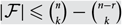 $$|{\cal F}| \le \left( {\matrix{n \cr k \cr } } \right) - \left( {\matrix{{n - r} \cr k \cr } } \right)$$, with equality only if
  $${\cal F} = \{ S \subset X:|S| = k,\;S \cap R \ne \emptyset \} $$ for some R ⊂ X with |R| = r. This is best possible up to the size of the o(1) term, and improves a 1987 result of Frankl and Füredi, who obtained the same conclusion under the stronger hypothesis
  $$k < (3 - \sqrt 5 )n/2$$, in the case r = 2. Our proof utilizes an isoperimetric, influence-based method recently developed by Keller and the authors.

PEM series 2 volume 62 issue 3 Cover and Back matter
-
- Journal:
- Proceedings of the Edinburgh Mathematical Society / Volume 62 / Issue 3 / August 2019
- Published online by Cambridge University Press:
- 26 June 2019, pp. b1-b2
-
- Article
-
- You have access
- Export citation
Toeplitz operators on Bergman spaces of polygonal domains
- Part of
-
- Journal:
- Proceedings of the Edinburgh Mathematical Society / Volume 62 / Issue 4 / November 2019
- Published online by Cambridge University Press:
- 26 June 2019, pp. 1115-1136
-
- Article
- Export citation
PEM series 2 volume 62 issue 3 Cover and Front matter
-
- Journal:
- Proceedings of the Edinburgh Mathematical Society / Volume 62 / Issue 3 / August 2019
- Published online by Cambridge University Press:
- 26 June 2019, pp. f1-f2
-
- Article
-
- You have access
- Export citation
SYMMETRIC OPERADS IN ABSTRACT SYMMETRIC SPECTRA – ERRATUM
-
- Journal:
- Journal of the Institute of Mathematics of Jussieu / Volume 18 / Issue 5 / September 2019
- Published online by Cambridge University Press:
- 26 June 2019, p. 1113
- Print publication:
- September 2019
-
- Article
-
- You have access
- Export citation
Actions of skew braces and set-theoretic solutions of the reflection equation
- Part of
-
- Journal:
- Proceedings of the Edinburgh Mathematical Society / Volume 62 / Issue 4 / November 2019
- Published online by Cambridge University Press:
- 25 June 2019, pp. 1089-1113
-
- Article
- Export citation
On Erdős–Ko–Rado for random hypergraphs I
- Part of
-
- Journal:
- Combinatorics, Probability and Computing / Volume 28 / Issue 6 / November 2019
- Published online by Cambridge University Press:
- 25 June 2019, pp. 881-916
-
- Article
- Export citation
-
A family of sets is intersecting if no two of its members are disjoint, and has the Erdős–Ko–Rado property (or is EKR) if each of its largest intersecting subfamilies has non-empty intersection.
Denote by ${{\cal H}_k}(n,p)$ the random family in which each k-subset of {1, …, n} is present with probability p, independent of other choices. A question first studied by Balogh, Bohman and Mubayi asks:
 \begin{equation} {\rm{For what }}p = p(n,k){\rm{is}}{{\cal H}_k}(n,p){\rm{likely to be EKR}}? \end{equation}
Here, for fixed c < 1/4, and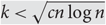 $k \lt \sqrt {cn\log n} $ we give a precise answer to this question, characterizing those sequences p = p(n, k) for which
 \begin{equation} {\mathbb{P}}({{\cal H}_k}(n,p){\rm{is EKR}}{\kern 1pt} ) \to 1{\rm{as }}n \to \infty . \end{equation}

THE DYNAMICAL MORDELL–LANG CONJECTURE FOR ENDOMORPHISMS OF SEMIABELIAN VARIETIES DEFINED OVER FIELDS OF POSITIVE CHARACTERISTIC
- Part of
-
- Journal:
- Journal of the Institute of Mathematics of Jussieu / Volume 20 / Issue 2 / March 2021
- Published online by Cambridge University Press:
- 24 June 2019, pp. 669-698
- Print publication:
- March 2021
-
- Article
- Export citation
-
Let $K$ be an algebraically closed field of prime characteristic $p$, let $X$ be a semiabelian variety defined over a finite subfield of $K$, let $\unicode[STIX]{x1D6F7}:X\longrightarrow X$ be a regular self-map defined over $K$, let $V\subset X$ be a subvariety defined over $K$, and let $\unicode[STIX]{x1D6FC}\in X(K)$. The dynamical Mordell–Lang conjecture in characteristic $p$ predicts that the set $S=\{n\in \mathbb{N}:\unicode[STIX]{x1D6F7}^{n}(\unicode[STIX]{x1D6FC})\in V\}$ is a union of finitely many arithmetic progressions, along with finitely many $p$-sets, which are sets of the form $\{\sum _{i=1}^{m}c_{i}p^{k_{i}n_{i}}:n_{i}\in \mathbb{N}\}$ for some $m\in \mathbb{N}$, some rational numbers $c_{i}$ and some non-negative integers $k_{i}$. We prove that this conjecture is equivalent with some difficult diophantine problem in characteristic 0. In the case $X$ is an algebraic torus, we can prove the conjecture in two cases: either when $\dim (V)\leqslant 2$, or when no iterate of $\unicode[STIX]{x1D6F7}$ is a group endomorphism which induces the action of a power of the Frobenius on a positive dimensional algebraic subgroup of $X$. We end by proving that Vojta’s conjecture implies the dynamical Mordell–Lang conjecture for tori with no restriction.


A multiplier inclusion theorem on product domains
- Part of
-
- Journal:
- Proceedings of the Edinburgh Mathematical Society / Volume 62 / Issue 4 / November 2019
- Published online by Cambridge University Press:
- 20 June 2019, pp. 1073-1088
-
- Article
-
- You have access
- Open access
- Export citation
-
In this note it is shown that the class of all multipliers from the d-parameter Hardy space $H_{{\rm prod}}^1 ({\open T}^d)$ to L2 (𝕋d) is properly contained in the class of all multipliers from L logd/2L (𝕋d) to L2(𝕋d).

Topological rigidity for closed hypersurfaces of elliptic space forms
- Part of
-
- Journal:
- Proceedings of the Edinburgh Mathematical Society / Volume 62 / Issue 4 / November 2019
- Published online by Cambridge University Press:
- 20 June 2019, pp. 1063-1072
-
- Article
- Export citation
ON THE RECOGNITION OF RIGHT-ANGLED ARTIN GROUPS
- Part of
-
- Journal:
- Glasgow Mathematical Journal / Volume 62 / Issue 2 / May 2020
- Published online by Cambridge University Press:
- 19 June 2019, pp. 473-475
-
- Article
-
- You have access
- Export citation
