To save content items to your account,
please confirm that you agree to abide by our usage policies.
If this is the first time you use this feature, you will be asked to authorise Cambridge Core to connect with your account.
Find out more about saving content to .
To save content items to your Kindle, first ensure no-reply@cambridge.org
is added to your Approved Personal Document E-mail List under your Personal Document Settings
on the Manage Your Content and Devices page of your Amazon account. Then enter the ‘name’ part
of your Kindle email address below.
Find out more about saving to your Kindle.
Note you can select to save to either the @free.kindle.com or @kindle.com variations.
‘@free.kindle.com’ emails are free but can only be saved to your device when it is connected to wi-fi.
‘@kindle.com’ emails can be delivered even when you are not connected to wi-fi, but note that service fees apply.
We show that the class of unital C*-algebras is an elementary class in the language of operator systems and that the algebra multiplication is a definable function in this language. Moreover, we prove a general model theoretic fact which implies that the aforementioned class is ∀∃∀-axiomatizable. We conclude by showing that this class is, however, neither ∀∃-axiomatizable nor ∃∀-axiomatizable.
Metastable transitions in Langevin dynamics can exhibit rich behaviours that are markedly different from its overdamped limit. In addition to local alterations of the transition path geometry, more fundamental global changes may exist. For instance, when the dissipation is weak, heteroclinic connections that exist in the overdamped limit do not necessarily have a counterpart in the Langevin system, potentially leading to different transition rates. Furthermore, when the friction coefficient depends on the velocity, the overdamped limit no longer exists, but it is still possible to efficiently find instantons. The approach, we employed for these discoveries, was based on (i) a simple rewriting of the Freidlin–Wentzell action in terms of time-reversed dynamics and (ii) an adaptation of the string method, which was originally designed for gradient systems, to this specific non-gradient system.
This paper is concerned with two frequency-dependent susceptible–infected–susceptible epidemic reaction–diffusion models in heterogeneous environment, with a cross-diffusion term modelling the effect that susceptible individuals tend to move away from higher concentration of infected individuals. It is first shown that the corresponding Neumann initial-boundary value problem in an n-dimensional bounded smooth domain possesses a unique global classical solution which is uniformly in-time bounded regardless of the strength of the cross-diffusion and the spatial dimension n. It is further shown that, even in the presence of cross-diffusion, the models still admit threshold-type dynamics in terms of the basic reproduction number $\mathcal {R}_0$ – i.e. the unique disease-free equilibrium is globally stable if $\mathcal {R}_0\lt1$, while if $\mathcal {R}_0\gt1$, the disease is uniformly persistent and there is an endemic equilibrium (EE), which is globally stable in some special cases with weak chemotactic sensitivity. Our results on the asymptotic profiles of EE illustrate that restricting the motility of susceptible population may eliminate the infectious disease entirely for the first model with constant total population but fails for the second model with varying total population. In particular, this implies that such cross-diffusion does not contribute to the elimination of the infectious disease modelled by the second one.
We analyse a class of chemical reaction networks under mass-action kinetics involving multiple time scales, whose deterministic and stochastic models display qualitative differences. The networks are inspired by gene-regulatory networks and consist of a slow subnetwork, describing conversions among the different gene states, and fast subnetworks, describing biochemical interactions involving the gene products. We show that the long-term dynamics of such networks can consist of a unique attractor at the deterministic level (unistability), while the long-term probability distribution at the stochastic level may display multiple maxima (multimodality). The dynamical differences stem from a phenomenon we call noise-induced mixing, whereby the probability distribution of the gene products is a linear combination of the probability distributions of the fast subnetworks which are ‘mixed’ by the slow subnetworks. The results are applied in the context of systems biology, where noise-induced mixing is shown to play a biochemically important role, producing phenomena such as stochastic multimodality and oscillations.
The present work is part of a series of studies conducted by the authors on analytical models of avascular tumour growth that exhibit both geometrical anisotropy and physical inhomogeneity. In particular, we consider a tumour structure formed in distinct ellipsoidal regions occupied by cell populations at a certain stage of their biological cycle. The cancer cells receive nutrient by diffusion from an inhomogeneous supply and they are subject to also an inhomogeneous pressure field imposed by the tumour microenvironment. It is proved that the lack of symmetry is strongly connected to a special condition that should hold between the data imposed by the tumour’s surrounding medium, in order for the ellipsoidal growth to be realizable, a feature already present in other non-symmetrical yet more degenerate models. The nutrient and the inhibitor concentration, as well as the pressure field, are provided in analytical fashion via closed-form series solutions in terms of ellipsoidal eigenfunctions, while their behaviour is demonstrated by indicative plots. The evolution equation of all the tumour’s ellipsoidal interfaces is postulated in ellipsoidal terms and a numerical implementation is provided in view of its solution. From the mathematical point of view, the ellipsoidal system is the most general coordinate system that the Laplace operator, which dominates the mathematical models of avascular growth, enjoys spectral decomposition. Therefore, we consider the ellipsoidal model presented in this work, as the most general analytic model describing the avascular growth in inhomogeneous environment. Additionally, due to the intrinsic degrees of freedom inherited to the model by the ellipsoidal geometry, the ellipsoidal model presented can be adapted to a very populous class of avascular tumours, varying in figure and in orientation.
Applications of a WKBJ-type ‘ray ansatz’ to obtain asymptotic solutions of the Helmholtz equation in the high-frequency limit are now standard and underpin the construction of ‘geometrical optics’ ray diagrams in many electromagnetic, acoustic and elastic reflection, transmission and other scattering problems. These applications were subsequently extended by Keller to include other types of rays – called ‘diffracted’ rays – to provide an accessible and impressively accurate theory which is relevant in wide-ranging sets of circumstances. Friedlander and Keller then introduced a modified ray ansatz to extend yet further the scope of ray theory and its applicability to certain other classes of diffraction problems (tangential ray incidence upon an obstructing boundary, for instance) and did so by the inclusion of an extra term proportional to a power of the wave number within the exponent of the initial ansatz. Our purpose here is to generalise this further still by the inclusion of several such terms, ordered in a natural sequence in terms of strategically chosen fractional powers of the large wave number, and to derive a systematic sequence of boundary value problems for the coefficient phase functions that arise within this generalised exponent, as well as one for the leading-order amplitude occurring as a pre-exponential factor. One particular choice of fractional power is considered in detail, and waves with specified radially symmetric or planar wavefronts are then analysed, along with a boundary value problem typifying two-dimensional radiation whereby arbitrary phase and amplitude variations are specified on a prescribed boundary curve. This theory is then applied to the scattering of plane and cylindrical waves at curved boundaries with small-scale perturbations to their underlying profile.
Critical transitions (or tipping points) are drastic sudden changes observed in many dynamical systems. Large classes of critical transitions are associated with systems, which drift slowly towards a bifurcation point. In the context of stochastic ordinary differential equations, there are results on growth of variance and autocorrelation before a transition, which can be used as possible warning signs in applications. A similar theory has recently been developed in the simplest setting for stochastic partial differential equations (SPDEs) for self-adjoint operators in the drift term. This setting leads to real discrete spectrum and growth of the covariance operator via a certain scaling law. In this paper, we develop this theory substantially further. We cover the cases of complex eigenvalues, degenerate eigenvalues as well as continuous spectrum. This provides a fairly comprehensive theory for most practical applications of warning signs for SPDE bifurcations.
The linear Schrödinger equation with piecewise constant potential in one spatial dimension is a well-studied textbook problem. It is one of only a few solvable models in quantum mechanics and shares many qualitative features with physically important models. In examples such as ‘particle in a box’ and tunnelling, attention is restricted to the time-independent Schrödinger equation. This paper combines the unified transform method and recent insights for interface problems to present fully explicit solutions for the time-dependent problem.
An approximate analytical solution is derived for a certain class of stochastic differential equations with constant diffusion, but nonlinear drift coefficients. Specifically, a closed form expression is derived for the response process transition probability density function (PDF) based on the concept of the Wiener path integral and on a Cauchy–Schwarz inequality treatment. This is done in conjunction with formulating and solving an error minimisation problem by relying on the associated Fokker–Planck equation operator. The developed technique, which requires minimal computational cost for the determination of the response process PDF, exhibits satisfactory accuracy and is capable of capturing the salient features of the PDF as demonstrated by comparisons with pertinent Monte Carlo simulation data. In addition to the mathematical merit of the approximate analytical solution, the derived PDF can be used also as a benchmark for assessing the accuracy of alternative, more computationally demanding, numerical solution techniques. Several examples are provided for assessing the reliability of the proposed approximation.
This study investigates the phenomenon of targeted energy transfer (TET) from a linear oscillator to a nonlinear attachment behaving as a nonlinear energy sink for both transient and stochastic excitations. First, the dynamics of the underlying Hamiltonian system under deterministic transient loading is studied. Assuming that the transient dynamics can be partitioned into slow and fast components, the governing equations of motion corresponding to the slow flow dynamics are derived and the behaviour of the system is analysed. Subsequently, the effect of noise on the slow flow dynamics of the system is investigated. The Itô stochastic differential equations for the noisy system are derived and the corresponding Fokker–Planck equations are numerically solved to gain insights into the behaviour of the system on TET. The effects of the system parameters as well as noise intensity on the optimal regime of TET are studied. The analysis reveals that the interaction of nonlinearities and noise enhances the optimal TET regime as predicted in deterministic analysis.
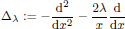
be the Bessel operator on ℝ+ := (0,∞). We show that the oscillation operator 𝒪(RΔλ,∗) and variation operator 𝒱ρ(RΔλ,∗) of the Riesz transform RΔλ associated with Δλ are both bounded on Lp(ℝ+, dmλ) for p ∈ (1,∞), from L1(ℝ+, dmλ) to L1,∞(ℝ+, dmλ), and from L∞(ℝ+, dmλ) to BMO(ℝ+, dmλ), where ρ ∈ (2,∞) and dmλ(x) := x2λ dx. As an application, we give the corresponding Lp-estimates for β-jump operators and the number of up-crossings.
This work is devoted to the study of an integro-differential system of equations modelling the genetic adaptation of a pathogen by taking into account both mutation and selection processes. First, we study the asymptotic behaviour of the system and prove that it eventually converges to a stationary state. Next, we more closely investigate the behaviour of the system in the presence of multiple EAs. Under suitable assumptions and based on a small mutation variance asymptotic, we describe the existence of a long transient regime during which the pathogen population remains far from its asymptotic behaviour and highly concentrated around some phenotypic value that is different from the one described by its asymptotic behaviour. In that setting, the time needed for the system to reach its large time configuration is very long and multiple evolutionary attractors may act as a barrier of evolution that can be very long to bypass.
Results on the behaviour of a pendulum which is parametrically excited by large amplitude random loads at its pivot are presented, including a novel experimental case study. Thereby, it is dealt with a random excitation by a non-white Gaussian stochastic process with prescribed spectral density. Special focus is devoted to stochastic processes resulting from random sea wave elevation and the question whether random sea waves can lead to rotational motion of the parametrically excited pendulum. The motivation for such an experimental study is energy harvesting from ocean waves.
We describe completely the link invariants constructed using Markov traces on the Yokonuma–Hecke algebras in terms of the linking matrix and the Hoste–Ocneanu–Millett–Freyd–Lickorish–Yetter–Przytycki–Traczyk (HOMFLY-PT) polynomials of sublinks.
This textbook offers a compact introductory course on Malliavin calculus, an active and powerful area of research. It covers recent applications, including density formulas, regularity of probability laws, central and non-central limit theorems for Gaussian functionals, convergence of densities and non-central limit theorems for the local time of Brownian motion. The book also includes a self-contained presentation of Brownian motion and stochastic calculus, as well as Lévy processes and stochastic calculus for jump processes. Accessible to non-experts, the book can be used by graduate students and researchers to develop their mastery of the core techniques necessary for further study.
In this paper, we first construct π-type Fermions. According to these, we define π-type Boson–Fermion correspondence which is a generalization of the classical Boson–Fermion correspondence. We can obtain π-type symmetric functions Sλπ from the π-type Boson–Fermion correspondence, analogously to the way we get the Schur functions Sλ from the classical Boson–Fermion correspondence (which is the same thing as the Jacobi–Trudi formula). Then as a generalization of KP hierarchy, we construct the π-type KP hierarchy and obtain its tau functions.
In the present paper we deal with a quasilinear problem involving a singular term. By combining truncation techniques with variational methods, we prove the existence of three weak solutions. As far as we know, this is the first contribution in this direction in the high-dimensional case.
In this paper, we study the initial boundary value problem for a class of fourth order damped wave equations with arbitrary positive initial energy. In the framework of the energy method, we further exploit the properties of the Nehari functional. Finally, the global existence and finite time blow-up of solutions are obtained.
In this paper, we will consider derived equivalences for differential graded endomorphism algebras by Keller's approaches. First, we construct derived equivalences of differential graded algebras which are endomorphism algebras of the objects from a triangle in the homotopy category of differential graded algebras. We also obtain derived equivalences of differential graded endomorphism algebras from a standard derived equivalence of finite dimensional algebras. Moreover, under some conditions, the cohomology rings of these differential graded endomorphism algebras are also derived equivalent. Then we give an affirmative answer to a problem of Dugas (A construction of derived equivalent pairs of symmetric algebras, Proc. Amer. Math. Soc. 143 (2015), 2281–2300) in some special case.
We propose a numerical method for the simulation of a quasi-linear parabolic biofilm model that exhibits three non-linear diffusion effects: (i) a power law degeneracy, (ii) a super diffusion singularity and (iii) non-linear cross-diffusion. The method is based on a spatial Finite Volume discretisation in which cross-diffusion terms are formally treated as convection terms. Time-integration of the resulting semi-discretised system is carried out using an error-controlled, time-adaptive, embedded Rosenbrock–Wanner method. We compare several variants of the method and two variants of the model to investigate how details such as the choice cross-diffusion coefficients, and specific variants of the time integrator affect simulation time.