Refine search
Actions for selected content:
26077 results in Abstract analysis
Packing Loose Hamilton Cycles
-
- Journal:
- Combinatorics, Probability and Computing / Volume 26 / Issue 6 / November 2017
- Published online by Cambridge University Press:
- 01 August 2017, pp. 839-849
-
- Article
- Export citation
-
A subset C of edges in a k-uniform hypergraph H is a loose Hamilton cycle if C covers all the vertices of H and there exists a cyclic ordering of these vertices such that the edges in C are segments of that order and such that every two consecutive edges share exactly one vertex. The binomial random k-uniform hypergraph H k n,p has vertex set [n] and an edge set E obtained by adding each k-tuple e ∈ ( $\binom{[n]}{k}$ ) to E with probability p, independently at random.
Here we consider the problem of finding edge-disjoint loose Hamilton cycles covering all but o(|E|) edges, referred to as the packing problem. While it is known that the threshold probability of the appearance of a loose Hamilton cycle in H k n,p is
the best known bounds for the packing problem are around p = polylog(n)/n. Here we make substantial progress and prove the following asymptotically (up to a polylog(n) factor) best possible result: for p ≥ logC n/n k−1, a random k-uniform hypergraph H k n,p with high probability contains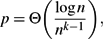 $p=\Theta\biggl(\frac{\log n}{n^{k-1}}\biggr),$ edge-disjoint loose Hamilton cycles.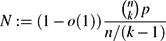 $N:=(1-o(1))\frac{\binom{n}{k}p}{n/(k-1)}$
 Our proof utilizes and modifies the idea of ‘online sprinkling’ recently introduced by Vu and the first author.

Super-Exponential Extinction Time of the Contact Process on Random Geometric Graphs
-
- Journal:
- Combinatorics, Probability and Computing / Volume 27 / Issue 2 / March 2018
- Published online by Cambridge University Press:
- 01 August 2017, pp. 162-185
-
- Article
- Export citation
Correlation Bounds for Distant Parts of Factor of IID Processes
-
- Journal:
- Combinatorics, Probability and Computing / Volume 27 / Issue 1 / January 2018
- Published online by Cambridge University Press:
- 01 August 2017, pp. 1-20
-
- Article
- Export citation
-
We study factor of i.i.d. processes on the d-regular tree for d ≥ 3. We show that if such a process is restricted to two distant connected subgraphs of the tree, then the two parts are basically uncorrelated. More precisely, any functions of the two parts have correlation at most $k(d-1) / (\sqrt{d-1})^k$ , where k denotes the distance between the subgraphs. This result can be considered as a quantitative version of the fact that factor of i.i.d. processes have trivial 1-ended tails.
Induced Subgraphs With Many Distinct Degrees
- Part of
-
- Journal:
- Combinatorics, Probability and Computing / Volume 27 / Issue 1 / January 2018
- Published online by Cambridge University Press:
- 01 August 2017, pp. 110-123
-
- Article
- Export citation
Corrigendum to ‘Mixing, Communication Complexity and Conjectures of Gowers and Viola’
-
- Journal:
- Combinatorics, Probability and Computing / Volume 26 / Issue 6 / November 2017
- Published online by Cambridge University Press:
- 01 August 2017, pp. 954-955
-
- Article
-
- You have access
- Export citation
Asymptotic Enumeration of Difference Matrices over Cyclic Groups
-
- Journal:
- Combinatorics, Probability and Computing / Volume 27 / Issue 1 / January 2018
- Published online by Cambridge University Press:
- 01 August 2017, pp. 84-109
-
- Article
- Export citation
The Structure of Typical Eye-Free Graphs and a Turán-Type Result for Two Weighted Colours
-
- Journal:
- Combinatorics, Probability and Computing / Volume 26 / Issue 6 / November 2017
- Published online by Cambridge University Press:
- 31 July 2017, pp. 886-910
-
- Article
- Export citation
JMJ volume 16 Issue 4 Cover and Back matter
-
- Journal:
- Journal of the Institute of Mathematics of Jussieu / Volume 16 / Issue 4 / September 2017
- Published online by Cambridge University Press:
- 28 July 2017, pp. b1-b8
- Print publication:
- September 2017
-
- Article
-
- You have access
- Export citation
JMJ volume 16 Issue 4 Cover and Front matter
-
- Journal:
- Journal of the Institute of Mathematics of Jussieu / Volume 16 / Issue 4 / September 2017
- Published online by Cambridge University Press:
- 28 July 2017, pp. f1-f2
- Print publication:
- September 2017
-
- Article
-
- You have access
- Export citation
Maximal Steiner Trees in the Stochastic Mean-Field Model of Distance
- Part of
-
- Journal:
- Combinatorics, Probability and Computing / Volume 26 / Issue 6 / November 2017
- Published online by Cambridge University Press:
- 27 July 2017, pp. 826-838
-
- Article
- Export citation
Asymptotic analysis of the attractors in two-dimensional Kolmogorov flow
-
- Journal:
- European Journal of Applied Mathematics / Volume 29 / Issue 3 / June 2018
- Published online by Cambridge University Press:
- 24 July 2017, pp. 393-416
-
- Article
- Export citation
A CATEGORIFICATION OF A QUANTUM FROBENIUS MAP
- Part of
-
- Journal:
- Journal of the Institute of Mathematics of Jussieu / Volume 18 / Issue 5 / September 2019
- Published online by Cambridge University Press:
- 20 July 2017, pp. 899-939
- Print publication:
- September 2019
-
- Article
- Export citation
-
A quantum Frobenius map a la Lusztig for $\mathfrak{s}\mathfrak{l}_{2}$ is categorified at a prime root of unity.

A new analytical approach to consistency and overfitting in regularized empirical risk minimization
- Part of
-
- Journal:
- European Journal of Applied Mathematics / Volume 28 / Issue 6 / December 2017
- Published online by Cambridge University Press:
- 20 July 2017, pp. 886-921
-
- Article
-
- You have access
- Export citation
A Stronger Bound for the Strong Chromatic Index
-
- Journal:
- Combinatorics, Probability and Computing / Volume 27 / Issue 1 / January 2018
- Published online by Cambridge University Press:
- 19 July 2017, pp. 21-43
-
- Article
- Export citation
Travelling wave solutions for a thin-film equation related to the spin-coating process
-
- Journal:
- European Journal of Applied Mathematics / Volume 29 / Issue 3 / June 2018
- Published online by Cambridge University Press:
- 17 July 2017, pp. 369-392
-
- Article
- Export citation
From Hankel Operators to Carleson Measures in a Quaternionic Variable
- Part of
-
- Journal:
- Proceedings of the Edinburgh Mathematical Society / Volume 60 / Issue 3 / August 2017
- Published online by Cambridge University Press:
- 17 July 2017, pp. 565-585
-
- Article
- Export citation
Creeping flow of a Herschel–Bulkley fluid with pressure-dependent material moduli
-
- Journal:
- European Journal of Applied Mathematics / Volume 29 / Issue 2 / April 2018
- Published online by Cambridge University Press:
- 11 July 2017, pp. 352-368
-
- Article
- Export citation
ALGEBRAIC AND NORI FUNDAMENTAL GERBES
- Part of
-
- Journal:
- Journal of the Institute of Mathematics of Jussieu / Volume 18 / Issue 4 / July 2019
- Published online by Cambridge University Press:
- 07 July 2017, pp. 855-897
- Print publication:
- July 2019
-
- Article
- Export citation
Antony G. O'Farrell and Ian Short, Reversibility in Dynamics and Group Theory, London Mathematical Society Lecture Notes Series, Volume 416 (Cambridge University Press, 2015), 294 pp., 978-1-107-44288-7 (paperback), £40.99.
-
- Journal:
- Proceedings of the Edinburgh Mathematical Society / Volume 60 / Issue 3 / August 2017
- Published online by Cambridge University Press:
- 06 July 2017, pp. 811-812
-
- Article
- Export citation
Finite speed of propagation and waiting time for a thin-film Muskat problem
- Part of
-
- Journal:
- Proceedings of the Royal Society of Edinburgh. Section A: Mathematics / Volume 147 / Issue 4 / August 2017
- Published online by Cambridge University Press:
- 05 July 2017, pp. 813-830
- Print publication:
- August 2017
-
- Article
- Export citation
