Refine search
Actions for selected content:
26077 results in Abstract analysis
Triangle-Free Subgraphs of Random Graphs
- Part of
-
- Journal:
- Combinatorics, Probability and Computing / Volume 27 / Issue 2 / March 2018
- Published online by Cambridge University Press:
- 14 August 2017, pp. 141-161
-
- Article
- Export citation
Generalized Majority Colourings of Digraphs
- Part of
-
- Journal:
- Combinatorics, Probability and Computing / Volume 26 / Issue 6 / November 2017
- Published online by Cambridge University Press:
- 14 August 2017, pp. 850-855
-
- Article
- Export citation
Discreteness of spectrum for Schrödinger operators with δʹ-type conditions on infinite regular trees
- Part of
-
- Journal:
- Proceedings of the Royal Society of Edinburgh. Section A: Mathematics / Volume 147 / Issue 5 / October 2017
- Published online by Cambridge University Press:
- 14 August 2017, pp. 1091-1117
- Print publication:
- October 2017
-
- Article
- Export citation
Minimizing the Number of Triangular Edges
- Part of
-
- Journal:
- Combinatorics, Probability and Computing / Volume 27 / Issue 4 / July 2018
- Published online by Cambridge University Press:
- 14 August 2017, pp. 580-622
-
- Article
- Export citation
Existence and properties of semi-bounded global solutions to the functional differential equation with Volterra-type operators on the real line
- Part of
-
- Journal:
- Proceedings of the Royal Society of Edinburgh. Section A: Mathematics / Volume 147 / Issue 6 / December 2017
- Published online by Cambridge University Press:
- 14 August 2017, pp. 1119-1168
- Print publication:
- December 2017
-
- Article
- Export citation
-
Consider the equation

where
 are linear positive continuous operators and f : C loc(ℝ;ℝ) → L loc(ℝ;ℝ) is a continuous operator satisfying the local Carathéodory conditions. Efficient conditions guaranteeing the existence of a global solution, which is bounded and non-negative in the neighbourhood of –∞, to the equation considered are established provided that ℓ 0, ℓ 1 and f are Volterra-type operators. The existence of a solution that is positive on the whole real line is discussed as well. Furthermore, the asymptotic properties of such solutions are studied in the neighbourhood of –∞. The results are applied to certain models appearing in the natural sciences.
 are linear positive continuous operators and f : C
 A VARIANT OF HARISH-CHANDRA FUNCTORS
- Part of
-
- Journal:
- Journal of the Institute of Mathematics of Jussieu / Volume 18 / Issue 5 / September 2019
- Published online by Cambridge University Press:
- 14 August 2017, pp. 993-1049
- Print publication:
- September 2019
-
- Article
- Export citation
-
Harish-Chandra induction and restriction functors play a key role in the representation theory of reductive groups over finite fields. In this paper, extending earlier work of Dat, we introduce and study generalisations of these functors which apply to a wide range of finite and profinite groups, typical examples being compact open subgroups of reductive groups over non-archimedean local fields. We prove that these generalisations are compatible with two of the tools commonly used to study the (smooth, complex) representations of such groups, namely Clifford theory and the orbit method. As a test case, we examine in detail the induction and restriction of representations from and to the Siegel Levi subgroup of the symplectic group $\text{Sp}_{4}$ over a finite local principal ideal ring of length two. We obtain in this case a Mackey-type formula for the composition of these induction and restriction functors which is a perfect analogue of the well-known formula for the composition of Harish-Chandra functors. In a different direction, we study representations of the Iwahori subgroup $I_{n}$ of $\text{GL}_{n}(F)$, where $F$ is a non-archimedean local field. We establish a bijection between the set of irreducible representations of $I_{n}$ and tuples of primitive irreducible representations of smaller Iwahori subgroups, where primitivity is defined by the vanishing of suitable restriction functors.


The initial-value problem for a fourth-order dispersive closed curve flow on the 2-sphere
- Part of
-
- Journal:
- Proceedings of the Royal Society of Edinburgh. Section A: Mathematics / Volume 147 / Issue 6 / December 2017
- Published online by Cambridge University Press:
- 14 August 2017, pp. 1243-1277
- Print publication:
- December 2017
-
- Article
- Export citation
Log-concavity and strong q-log-convexity for Riordan arrays and recursive matrices
- Part of
-
- Journal:
- Proceedings of the Royal Society of Edinburgh. Section A: Mathematics / Volume 147 / Issue 6 / December 2017
- Published online by Cambridge University Press:
- 14 August 2017, pp. 1297-1310
- Print publication:
- December 2017
-
- Article
-
- You have access
- Export citation
-
Let [An,k ]n,k ⩾0 be an infinite lower triangular array satisfying the recurrence

for n ⩾ 1 and k ⩾ 0, where A 0,0 = 1, A 0,k = A k,–1 = 0 for k > 0. We present some criteria for the log-concavity of rows and strong q-log-convexity of generating functions of rows. Our results can be applied to many well-known triangular arrays, such as the Pascal triangle, the Stirling triangle of the second kind, the Bell triangle, the large Schröder triangle, the Motzkin triangle, and the Catalan triangles of Aigner and Shapiro, in a unified approach. In addition, we prove that the binomial transformation not only preserves the strong q-log-convexity property, but also preserves the strong q-log-concavity property. Finally, we demonstrate that the strong q-log-convexity property is preserved by the Stirling transformation and Whitney transformation of the second kind, which extends some known results for the strong q-log-convexity property.
Morse index and symmetry breaking for an elliptic equation with negative exponent in expanding annuli
- Part of
-
- Journal:
- Proceedings of the Royal Society of Edinburgh. Section A: Mathematics / Volume 147 / Issue 6 / December 2017
- Published online by Cambridge University Press:
- 14 August 2017, pp. 1215-1232
- Print publication:
- December 2017
-
- Article
- Export citation
-
Bifurcation of non-radial solutions from radial solutions of a semilinear elliptic equation with negative exponent in expanding annuli of ℝ2 is studied. To obtain the main results, we use a blow-up argument via the Morse index of the regular entire solutions of the equation
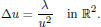
The main results of this paper can be seen as applications of the results obtained recently for finite Morse index solutions of the equation
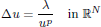
with N ⩾ 2 and p > 0.
Geometric aspects of self-adjoint Sturm–Liouville problems
- Part of
-
- Journal:
- Proceedings of the Royal Society of Edinburgh. Section A: Mathematics / Volume 147 / Issue 6 / December 2017
- Published online by Cambridge University Press:
- 14 August 2017, pp. 1279-1295
- Print publication:
- December 2017
-
- Article
- Export citation
Surface energies emerging in a microscopic, two-dimensional two-well problem
- Part of
-
- Journal:
- Proceedings of the Royal Society of Edinburgh. Section A: Mathematics / Volume 147 / Issue 5 / October 2017
- Published online by Cambridge University Press:
- 14 August 2017, pp. 1041-1089
- Print publication:
- October 2017
-
- Article
- Export citation
Some sharp results about the global existence and blowup of solutions to a class of pseudo-parabolic equations
- Part of
-
- Journal:
- Proceedings of the Royal Society of Edinburgh. Section A: Mathematics / Volume 147 / Issue 6 / December 2017
- Published online by Cambridge University Press:
- 14 August 2017, pp. 1311-1331
- Print publication:
- December 2017
-
- Article
- Export citation $K$-THEORY OF MONOID ALGEBRAS AND A QUESTIONOF GUBELADZE
- Part of
-
- Journal:
- Journal of the Institute of Mathematics of Jussieu / Volume 18 / Issue 5 / September 2019
- Published online by Cambridge University Press:
- 10 August 2017, pp. 1051-1085
- Print publication:
- September 2019
-
- Article
- Export citation
-
We show that for any commutative Noetherian regular ring $R$ containing $\mathbb{Q}$, the map $K_{1}(R)\rightarrow K_{1}\left(\frac{R[x_{1},\ldots ,x_{4}]}{(x_{1}x_{2}-x_{3}x_{4})}\right)$ is an isomorphism. This answers a question of Gubeladze. We also compute the higher $K$-theory of this monoid algebra. In particular, we show that the above isomorphism does not extend to all higher $K$-groups. We give applications to a question of Lindel on the Serre dimension of monoid algebras.


Anagram-Free Colourings of Graphs
- Part of
-
- Journal:
- Combinatorics, Probability and Computing / Volume 27 / Issue 4 / July 2018
- Published online by Cambridge University Press:
- 08 August 2017, pp. 623-642
-
- Article
- Export citation
BETTI NUMBER ESTIMATES IN $p$-ADIC COHOMOLOGY
- Part of
-
- Journal:
- Journal of the Institute of Mathematics of Jussieu / Volume 18 / Issue 5 / September 2019
- Published online by Cambridge University Press:
- 07 August 2017, pp. 957-991
- Print publication:
- September 2019
-
- Article
- Export citation
-
In the framework of Berthelot’s theory of arithmetic ${\mathcal{D}}$-modules, we prove the $p$-adic analogue of Betti number estimates and we give some standard applications.


Diameter of the Stochastic Mean-Field Model of Distance
- Part of
-
- Journal:
- Combinatorics, Probability and Computing / Volume 26 / Issue 6 / November 2017
- Published online by Cambridge University Press:
- 07 August 2017, pp. 797-825
-
- Article
- Export citation
Exact Minimum Codegree Threshold for K − 4-Factors
-
- Journal:
- Combinatorics, Probability and Computing / Volume 26 / Issue 6 / November 2017
- Published online by Cambridge University Press:
- 04 August 2017, pp. 856-885
-
- Article
- Export citation
GMJ volume 59 issue 3 Cover and Back matter
-
- Journal:
- Glasgow Mathematical Journal / Volume 59 / Issue 3 / September 2017
- Published online by Cambridge University Press:
- 03 August 2017, pp. b1-b2
-
- Article
-
- You have access
- Export citation
GMJ volume 59 issue 3 Cover and Front matter
-
- Journal:
- Glasgow Mathematical Journal / Volume 59 / Issue 3 / September 2017
- Published online by Cambridge University Press:
- 03 August 2017, pp. f1-f2
-
- Article
-
- You have access
- Export citation
CM RELATIONS IN FIBERED POWERS OF ELLIPTIC FAMILIES
- Part of
-
- Journal:
- Journal of the Institute of Mathematics of Jussieu / Volume 18 / Issue 5 / September 2019
- Published online by Cambridge University Press:
- 02 August 2017, pp. 941-956
- Print publication:
- September 2019
-
- Article
- Export citation
-
Let $E_{\unicode[STIX]{x1D706}}$ be the Legendre family of elliptic curves. Given $n$ points $P_{1},\ldots ,P_{n}\in E_{\unicode[STIX]{x1D706}}(\overline{\mathbb{Q}(\unicode[STIX]{x1D706})})$, linearly independent over $\mathbb{Z}$, we prove that there are at most finitely many complex numbers $\unicode[STIX]{x1D706}_{0}$ such that $E_{\unicode[STIX]{x1D706}_{0}}$ has complex multiplication and $P_{1}(\unicode[STIX]{x1D706}_{0}),\ldots ,P_{n}(\unicode[STIX]{x1D706}_{0})$ are linearly dependent over End $(E_{\unicode[STIX]{x1D706}_{0}})$. This implies a positive answer to a question of Bertrand and, combined with a previous work in collaboration with Capuano, proves the Zilber–Pink conjecture for a curve in a fibered power of an elliptic scheme when everything is defined over $\overline{\mathbb{Q}}$.


