Refine search
Actions for selected content:
243575 results in Mathematics
Direct numerical simulation of supersonic boundary layers over a microramp: effect of the Reynolds number
-
- Journal:
- Journal of Fluid Mechanics / Volume 974 / 10 November 2023
- Published online by Cambridge University Press:
- 06 November 2023, A44
-
- Article
-
- You have access
- Open access
- HTML
- Export citation
-
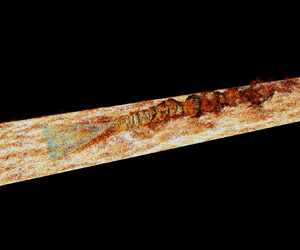
Microvortex generators are passive control devices smaller than the boundary layer thickness that energise the boundary layer to prevent flow separation with limited induced drag. In this work, we use direct numerical simulations (DNS) to investigate the effect of the Reynolds number in a supersonic turbulent boundary layer over a microramp vortex generator. Three friction Reynolds numbers are considered, up to $Re_\tau = 2000$, for fixed free stream Mach number $M_\infty =2$ and fixed relative height of the ramp with respect to the boundary layer thickness. The high-fidelity data set sheds light on the instantaneous and highly three-dimensional organisation of both the wake and the shock waves induced by the microramp. The full access to the flow field provided by DNS allows us to develop a qualitative model of the near wake, explaining the internal convolution of the Kelvin–Helmholtz vortices around the low-momentum region behind the ramp. The overall analysis shows that numerical results agree excellently with recent experimental measurements in similar operating conditions and confirms that microramps effectively induce a significantly fuller boundary layer even far downstream of the ramp. Moreover, results highlight significant Reynolds number effects, which in general do not scale with the ramp height. Increasing Reynolds number leads to enhanced coherence of the typical vortical structures in the field, faster and stronger development of the momentum deficit region, increased upwash between the primary vortices from the sides of the ramp – and thus increased lift-up of the wake – and faster transfer of momentum towards the wall.


Eisenstein congruences among Euler systems
- Part of
-
- Journal:
- Canadian Mathematical Bulletin / Volume 67 / Issue 2 / June 2024
- Published online by Cambridge University Press:
- 06 November 2023, pp. 425-446
- Print publication:
- June 2024
-
- Article
- Export citation
Bohr radius for Banach spaces on simply connected domains
- Part of
-
- Journal:
- Proceedings of the Edinburgh Mathematical Society / Volume 67 / Issue 1 / February 2024
- Published online by Cambridge University Press:
- 03 November 2023, pp. 113-141
-
- Article
- Export citation
-
Let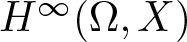 $H^{\infty}(\Omega,X)$ be the space of bounded analytic functions $f(z)=\sum_{n=0}^{\infty} x_{n}z^{n}$ from a proper simply connected domain Ω containing the unit disk $\mathbb{D}:=\{z\in \mathbb{C}:|z| \lt 1\}$ into a complex Banach space X with $\left\lVert f\right\rVert_{H^{\infty}(\Omega,X)} \leq 1$. Let $\phi=\{\phi_{n}(r)\}_{n=0}^{\infty}$ with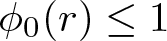 $\phi_{0}(r)\leq 1$ such that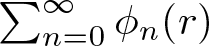 $\sum_{n=0}^{\infty} \phi_{n}(r)$ converges locally uniformly with respect to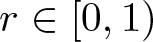 $r \in [0,1)$. For $1\leq p,q \lt \infty$, we denoteand define the Bohr radius associated with ϕ by
 \begin{equation*}R_{p,q,\phi}(f,\Omega,X)= \sup \left\{r \geq 0: \left\lVert x_{0}\right\rVert^p \phi_{0}(r) + \left(\sum_{n=1}^{\infty} \left\lVert x_{n}\right\rVert\phi_{n}(r)\right)^q \leq \phi_{0}(r)\right\}\end{equation*}In this article, we extensively study the Bohr radius
 \begin{equation*}R_{p,q,\phi}(\Omega,X)=\inf \left\{R_{p,q,\phi}(f,\Omega,X): \left\lVert f\right\rVert_{H^{\infty}(\Omega,X)} \leq 1\right\}.\end{equation*} $R_{p,q,\phi}(\Omega,X)$, when X is an arbitrary Banach space, and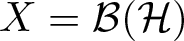 $X=\mathcal{B}(\mathcal{H})$ is the algebra of all bounded linear operators on a complex Hilbert space $\mathcal{H}$. Furthermore, we establish the Bohr inequality for the operator-valued Cesáro operator and Bernardi operator.

On the choosability of $H$-minor-free graphs
- Part of
-
- Journal:
- Combinatorics, Probability and Computing / Volume 33 / Issue 2 / March 2024
- Published online by Cambridge University Press:
- 03 November 2023, pp. 129-142
-
- Article
-
- You have access
- Open access
- HTML
- Export citation
-
Given a graph $H$, let us denote by $f_\chi (H)$ and $f_\ell (H)$, respectively, the maximum chromatic number and the maximum list chromatic number of $H$-minor-free graphs. Hadwiger’s famous colouring conjecture from 1943 states that $f_\chi (K_t)=t-1$ for every $t \ge 2$. A closely related problem that has received significant attention in the past concerns $f_\ell (K_t)$, for which it is known that $2t-o(t) \le f_\ell (K_t) \le O(t (\!\log \log t)^6)$. Thus, $f_\ell (K_t)$ is bounded away from the conjectured value $t-1$ for $f_\chi (K_t)$ by at least a constant factor. The so-called $H$-Hadwiger’s conjecture, proposed by Seymour, asks to prove that $f_\chi (H)={\textrm{v}}(H)-1$ for a given graph $H$ (which would be implied by Hadwiger’s conjecture).
In this paper, we prove several new lower bounds on $f_\ell (H)$, thus exploring the limits of a list colouring extension of $H$-Hadwiger’s conjecture. Our main results are:
For every $\varepsilon \gt 0$ and all sufficiently large graphs $H$ we have $f_\ell (H)\ge (1-\varepsilon )({\textrm{v}}(H)+\kappa (H))$, where $\kappa (H)$ denotes the vertex-connectivity of $H$.
$H$.For every $\varepsilon \gt 0$ there exists $C=C(\varepsilon )\gt 0$ such that asymptotically almost every $n$-vertex graph $H$ with $\left \lceil C n\log n\right \rceil$ edges satisfies $f_\ell (H)\ge (2-\varepsilon )n$.
The first result generalizes recent results on complete and complete bipartite graphs and shows that the list chromatic number of $H$-minor-free graphs is separated from the desired value of $({\textrm{v}}(H)-1)$ by a constant factor for all large graphs $H$ of linear connectivity. The second result tells us that for almost all graphs $H$ with superlogarithmic average degree $f_\ell (H)$ is separated from $({\textrm{v}}(H)-1)$ by a constant factor arbitrarily close to $2$. Conceptually these results indicate that the graphs $H$ for which $f_\ell (H)$ is close to the conjectured value $({\textrm{v}}(H)-1)$ for $f_\chi (H)$ are typically rather sparse.


Rigidity of Ext and Tor via flat–cotorsion theory
- Part of
-
- Journal:
- Proceedings of the Edinburgh Mathematical Society / Volume 66 / Issue 4 / November 2023
- Published online by Cambridge University Press:
- 03 November 2023, pp. 1142-1153
-
- Article
- Export citation
-
Let $\mathfrak{p}$ be a prime ideal in a commutative noetherian ring R and denote by $k(\mathfrak{p})$ the residue field of the local ring $R_\mathfrak{p}$. We prove that if an R-module M satisfies $\operatorname{Ext}_R^{n}(k(\mathfrak{p}),M)=0$ for some $n\geqslant\dim R$, then $\operatorname{Ext}_R^i(k(\mathfrak{p}),M)=0$ holds for all $i \geqslant n$. This improves a result of Christensen, Iyengar and Marley by lowering the bound on n. We also improve existing results on Tor-rigidity. This progress is driven by the existence of minimal semi-flat-cotorsion replacements in the derived category as recently proved by Nakamura and Thompson.


Far-field hydrodynamic interaction in a group of swimmers
-
- Journal:
- Journal of Fluid Mechanics / Volume 974 / 10 November 2023
- Published online by Cambridge University Press:
- 03 November 2023, A34
-
- Article
-
- You have access
- Open access
- HTML
- Export citation
Parametrized polyconvex hyperelasticity with physics-augmented neural networks
- Part of
-
- Journal:
- Data-Centric Engineering / Volume 4 / 2023
- Published online by Cambridge University Press:
- 03 November 2023, e25
-
- Article
-
- You have access
- Open access
- HTML
- Export citation

The role of rolling resistance in the rheology of wizarding quidditch ball suspensions
-
- Journal:
- Journal of Fluid Mechanics / Volume 974 / 10 November 2023
- Published online by Cambridge University Press:
- 03 November 2023, A36
-
- Article
-
- You have access
- Open access
- HTML
- Export citation
A mechanism for ejecting a horseshoe from a partially hyperbolic chain recurrence class
- Part of
-
- Journal:
- Ergodic Theory and Dynamical Systems / Volume 44 / Issue 8 / August 2024
- Published online by Cambridge University Press:
- 03 November 2023, pp. 2080-2142
- Print publication:
- August 2024
-
- Article
- Export citation
-
We give a $C^1$-perturbation technique for ejecting an a priori given finite set of periodic points preserving a given finite set of homo/heteroclinic intersections from a chain recurrence class of a periodic point. The technique is first stated under a simpler setting called a Markov iterated function system, a two-dimensional iterated function system in which the compositions are chosen in a Markovian way. Then we apply the result to the setting of three-dimensional partially hyperbolic diffeomorphisms.

Inertial migration of a neutrally buoyant spheroid in plane Poiseuille flow
-
- Journal:
- Journal of Fluid Mechanics / Volume 974 / 10 November 2023
- Published online by Cambridge University Press:
- 03 November 2023, A39
-
- Article
- Export citation
-
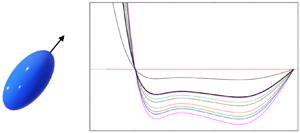
We study the cross-stream inertial migration of a torque-free neutrally buoyant spheroid, of an arbitrary aspect ratio $\kappa$, in wall-bounded plane Poiseuille flow for small particle Reynolds numbers ( $Re_p\ll 1$) and confinement ratios ( $\lambda \ll 1$), with the channel Reynolds number,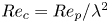 $Re_c = Re_p/\lambda ^2$, assumed to be arbitrary; here $\lambda =L/H$, where $L$ is the semi-major axis of the spheroid and $H$ denotes the separation between the channel walls. In the Stokes limit ( $Re_p =0)$, and for $\lambda \ll 1$, a spheroid rotates along any of an infinite number of Jeffery orbits parameterized by an orbit constant $C$, while translating with a time-dependent speed along a given ambient streamline. Weak inertial effects stabilize either the spinning ( $C=0$) or tumbling orbit ( $C=\infty$), or both, depending on $\kappa$. The asymptotic separation of the Jeffery rotation and orbital drift time scales, from that associated with cross-stream migration, implies that migration occurs due to a Jeffery-averaged lift velocity. Although the magnitude of this averaged lift velocity depends on $\kappa$ and $C$, the shape of the lift profiles are identical to those for a sphere, regardless of $Re_c$. In particular, the equilibrium positions for a spheroid remain identical to the classical Segre–Silberberg ones for a sphere, starting off at a distance of about $0.6(H/2)$ from the channel centreline for small $Re_c$, and migrating wallward with increasing $Re_c$. For spheroids with $\kappa \sim O(1)$, the Jeffery-averaged analysis is valid for $Re_p\ll 1$; for extreme aspect ratio spheroids, the regime of validity becomes more restrictive being given by $Re_p \kappa /\ln \kappa \ll 1$ and $Re_p/\kappa \ll 1$ for $\kappa \rightarrow \infty$ (slender fibres) and $\kappa \rightarrow 0$ (flat disks), respectively.


Geometrical representation of subshifts for primitive substitutions
- Part of
-
- Journal:
- Ergodic Theory and Dynamical Systems / Volume 44 / Issue 7 / July 2024
- Published online by Cambridge University Press:
- 03 November 2023, pp. 1885-1912
- Print publication:
- July 2024
-
- Article
- Export citation
Conditional analysis on extreme wall shear stress and heat flux events in compressible turbulent boundary layers
-
- Journal:
- Journal of Fluid Mechanics / Volume 974 / 10 November 2023
- Published online by Cambridge University Press:
- 03 November 2023, A38
-
- Article
- Export citation
-
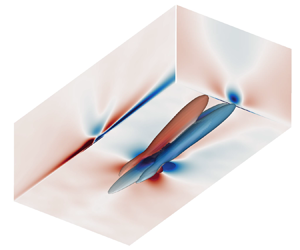
This study presents a comprehensive analysis on the extreme positive and negative events of wall shear stress and heat flux fluctuations in compressible turbulent boundary layers (TBLs) solved by direct numerical simulations. To examine the compressibility effects, we focus on the extreme events in two representative cases, i.e. a supersonic TBL of Mach number $M=2$ and a hypersonic TBL of $M=8$, by scrutinizing the coherent structures and their correlated dynamics based on conditional analysis. As characterized by the spatial distribution of wall shear stress and heat flux, the extreme events are indicated to be closely related to the structural organization of wall streaks, in addition to the occurrence of the alternating positive and negative structures (APNSs) in the hypersonic TBL. These two types of coherent structures are strikingly different, namely the nature of wall streaks and APNSs are shown to be related to the solenoidal and dilatational fluid motions, respectively. Quantitative analysis using a volumetric conditional average is performed to identify and extract the coherent structures that directly account for the extreme events. It is found that in the supersonic TBL, the essential ingredients of the conditional field are hairpin-like vortices, whose combinations can induce wall streaks, whereas in the hypersonic TBL, the essential ingredients become hairpin-like vortices as well as near-wall APNSs. To quantify the momentum and energy transport mechanisms underlying the extreme events, we proposed a novel decomposition method for extreme skin friction and heat flux, based on the integral identities of conditionally averaged governing equations. Taking advantage of this decomposition method, the dominant transport mechanisms of the hairpin-like vortices and APNSs are revealed. Specifically, the momentum and energy transports undertaken by the hairpin-like vortices are attributed to multiple comparable mechanisms, whereas those by the APNSs are convection dominated. In that, the dominant transport mechanisms in extreme events between the supersonic and hypersonic TBLs are indicated to be totally different.


Cohomology of a real toric variety and shellability of posets arising from a graph
- Part of
-
- Journal:
- Proceedings of the Edinburgh Mathematical Society / Volume 66 / Issue 4 / November 2023
- Published online by Cambridge University Press:
- 03 November 2023, pp. 1044-1084
-
- Article
- Export citation
-
Given a graph G without loops, the pseudograph associahedron PG is a smooth polytope, so there is a projective smooth toric variety XG corresponding to PG. Taking the real locus of XG, we have the projective smooth real toric variety $X^{\mathbb{R}}_G$. The integral cohomology groups of $X^{\mathbb{R}}_G$ can be computed by studying the topology of certain posets of even subgraphs of G; such a poset is neither pure nor shellable in general. We completely characterize the graphs whose posets of even subgraphs are always shellable. It follows that we get a family of projective smooth real toric varieties whose integral cohomology groups are torsion-free or have only 2-torsion.


Determinants of incomplete childhood hepatitis B vaccination in Sierra Leone, Liberia, and Guinea: Analysis of national surveys (2018–2020)
-
- Journal:
- Epidemiology & Infection / Volume 151 / 2023
- Published online by Cambridge University Press:
- 03 November 2023, e193
-
- Article
-
- You have access
- Open access
- HTML
- Export citation
Dynamics of multilayer Rayleigh–Taylor instability at moderately high Atwood numbers
-
- Journal:
- Journal of Fluid Mechanics / Volume 974 / 10 November 2023
- Published online by Cambridge University Press:
- 03 November 2023, A35
-
- Article
-
- You have access
- Open access
- HTML
- Export citation
-
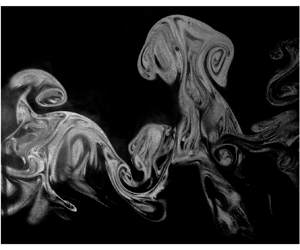
This paper investigates the multilayer Rayleigh–Taylor instability (RTI) using statistically stationary experiments conducted in a gas tunnel. Employing diagnostics such as particle image velocimetry (PIV) and planar laser induced fluorescence (PLIF), we make simultaneous velocity–density measurements to study how dynamics and mixing are linked in this variable density flow. Experiments are conducted in a newly built, blow-down three-layer gas tunnel facility. Mixing between three gas streams is studied, where the top and bottom streams are comprised of air, and the middle stream is an air–helium mixture. Shear is minimized between these streams by matching their inlet velocities. The four experimental conditions investigated here consist of two different density ratios (Atwood numbers 0.3 and 0.6), each investigated at two instability development times (or equivalently, two streamwise locations), and all experiments are with the same middle stream thickness of 3 cm. The growth of the middle layer is measured using laser-based planar Mie scattering visualization. The mixing width is found to grow linearly with time at late times. Various quantitative measures of molecular mixing indicate a very high degree of molecular mixing at late times in the multilayer RTI flow. The vertical turbulent mass flux $a_y$ is calculated. In addition to mostly negative values of $a_y$, typical of buoyancy-dominated flows due to negative correlation between velocity and density fluctuations, positive regions are also observed in profiles of $a_y$ due to entrainment and erosion at the lower edge of the mixing region. Global energy budgets are calculated for the multilayer RTI flow at late times and it is found that the majority of potential energy released has been dissipated due to viscous effects, and a large value of mixing efficiency ( $\sim$60 %) is observed.


Mean flow and turbulence in unsteady canopy layers
-
- Journal:
- Journal of Fluid Mechanics / Volume 974 / 10 November 2023
- Published online by Cambridge University Press:
- 03 November 2023, A33
-
- Article
-
- You have access
- Open access
- HTML
- Export citation
-
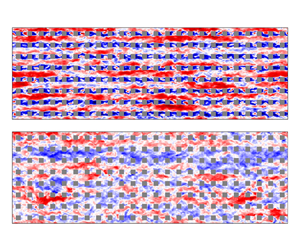
Non-stationarity is the rule in the atmospheric boundary layer (ABL). Under such conditions, the flow may experience departures from equilibrium with the underlying surface stress, misalignment of shear stresses and strain rates, and three-dimensionality in turbulence statistics. Existing ABL flow theories are primarily established for statistically stationary flow conditions and cannot predict such behaviours. Motivated by this knowledge gap, this study analyses the impact of time-varying pressure gradients on mean flow and turbulence over urban-like surfaces. A series of large-eddy simulations of pulsatile flow over cuboid arrays is performed, programmatically varying the oscillation amplitude $\alpha$ and forcing frequency $\omega$. The analysis focuses on both longtime-averaged and phase-dependent flow dynamics. Inspection of longtime-averaged velocity profiles reveals that the aerodynamic roughness length $z_0$ increases with $\alpha$ and $\omega$, whereas the displacement height $d$ appears to be insensitive to these parameters. In terms of oscillatory flow statistics, it is found that $\alpha$ primarily controls the oscillation amplitude of the streamwise velocity and Reynolds stresses, but has a negligible impact on their wall-normal structure. On the other hand, $\omega$ determines the size of the region affected by the unsteady forcing, which identifies the so-called Stokes layer thickness $\delta _s$. Within the Stokes layer, phase-averaged resolved Reynolds stress profiles feature substantial variations during the pulsatile cycle, and the turbulence is out of equilibrium with the mean flow. Two phenomenological models have been proposed that capture the influence of flow unsteadiness on $z_0$ and $\delta _s$, respectively.


Double Schubert polynomials do have saturated Newton polytopes
- Part of
-
- Journal:
- Forum of Mathematics, Sigma / Volume 11 / 2023
- Published online by Cambridge University Press:
- 03 November 2023, e100
-
- Article
-
- You have access
- Open access
- HTML
- Export citation
Embedding data science innovations in organizations: a new workflow approach
-
- Journal:
- Data-Centric Engineering / Volume 4 / 2023
- Published online by Cambridge University Press:
- 03 November 2023, e26
-
- Article
-
- You have access
- Open access
- HTML
- Export citation
Incomplete to complete multiphysics forecasting: a hybrid approach for learning unknown phenomena
-
- Journal:
- Data-Centric Engineering / Volume 4 / 2023
- Published online by Cambridge University Press:
- 03 November 2023, e27
-
- Article
-
- You have access
- Open access
- HTML
- Export citation
Material dialogues for first-order logic in constructive type theory: extended version
-
- Journal:
- Mathematical Structures in Computer Science / Volume 34 / Issue 7 / August 2024
- Published online by Cambridge University Press:
- 03 November 2023, pp. 689-709
-
- Article
-
- You have access
- Open access
- HTML
- Export citation
