Refine listing
Actions for selected content:
57 results in 46Jxx
Invariant subspaces in the bidisc and commutators
- Part of
-
- Journal:
- Journal of the Australian Mathematical Society. Series A. Pure Mathematics and Statistics / Volume 56 / Issue 2 / April 1994
- Published online by Cambridge University Press:
- 09 April 2009, pp. 232-242
-
- Article
-
- You have access
- Export citation
-
Let M be an invariant subspace of L2 (T2) on the bidisc. V1 and V2 denote the multiplication operators on M by coordinate functions z and ω, respectively. In this paper we study the relation between M and the commutator of V1 and
 , For example, M is studied when the commutator is self-adjoint or of finite rank.
 , For example, M is studied when the commutator is self-adjoint or of finite rank.
Relative amenability and the non-amenability of B(l1)
- Part of
-
- Journal:
- Journal of the Australian Mathematical Society / Volume 80 / Issue 3 / June 2006
- Published online by Cambridge University Press:
- 09 April 2009, pp. 317-333
-
- Article
-
- You have access
- Export citation
-
In this paper we begin with a short, direct proof that the Banach algebra B(l1) is not amenable. We continue by showing that various direct sums of matrix algebras are not amenable either, for example the direct sum of the finite dimensional algebras
 is no amenable for 1 ≤ p ≤ ∞, p ≠ 2. Our method of proof naturally involves free group algebras, (by which we mean certain subalgebras of B(X) for some space X with symmetric basis—not necessarily X = l2) and we introduce the notion of ‘relative amenability’ of these algebras.
 is no amenable for 1 ≤
 Extremal problems in Hp
- Part of
-
- Journal:
- Journal of the Australian Mathematical Society. Series A. Pure Mathematics and Statistics / Volume 52 / Issue 1 / February 1992
- Published online by Cambridge University Press:
- 09 April 2009, pp. 103-110
-
- Article
-
- You have access
- Export citation
-
Let 1≤p <∞ and 1/p+1/q = 1. If φ ∈ Lq, we denote by Tφ the functional defined on the Hardy space Hp by
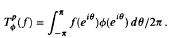 . A function f in Hp, which satisfies Tpφ(f) = ‖Tpφ‖ and ‖f‖p ≤ 1, is called an extremal function. Also, φ is called an extremal kernel when ‖φ‖q =‖Tpφ‖. In this paper, using the results in the case of p = 1, we study extremal kernel and extremal functions for p > 1.
Ergodicity and stability of orbits of unbounded semigroup representations
- Part of
-
- Journal:
- Journal of the Australian Mathematical Society / Volume 77 / Issue 2 / October 2004
- Published online by Cambridge University Press:
- 09 April 2009, pp. 209-232
-
- Article
-
- You have access
- Export citation
-
We develop a theory of ergodicity for unbounded functions ø: J → X, where J is a subsemigroup of a locally compact abelian group G and X is a Banach space. It is assumed that ø is continuous and dominated by a weight w defined on G. In particular, we establish total ergodicity for the orbits of an (unbounded) strongly continuous representation T: G → L(X) whose dual representation has no unitary point spectrum. Under additional conditions stability of the orbits follows. To study spectra of functions, we use Beurling algebras L1w(G) and obtain new characterizations of their maximal primary ideals, when w is non-quasianalytic, and of their minimal primary ideals, when w has polynomial growth. It follows that, relative to certain translation invariant function classes
 , the reduced Beurling spectrum of ø is empty if and only if ø ∈ . For the zero class, this is Wiener's tauberian theorem.
 , the reduced Beurling spectrum of ø is empty if and only if ø ∈
 The second dual of C0 (S, A)
- Part of
-
- Journal:
- Journal of the Australian Mathematical Society. Series A. Pure Mathematics and Statistics / Volume 56 / Issue 3 / June 1994
- Published online by Cambridge University Press:
- 09 April 2009, pp. 303-313
-
- Article
-
- You have access
- Export citation
-
The second dual of the vector-valued function space C0(S, A) is characterized in terms of generalized functions in the case where A* and A** have the Radon-Nikodým property. As an application we present a simple proof that C0 (S, A) is Arens regular if and only if A is Arens regular in this case. A representation theorem of the measure μh is given, where
 , h ∈ L∞ (|μ;|, A**) and μh is defined by the Arens product.
 ,
, Interpolation problem for l1 and a uniform algebra
- Part of
-
- Journal:
- Journal of the Australian Mathematical Society / Volume 72 / Issue 1 / February 2002
- Published online by Cambridge University Press:
- 09 April 2009, pp. 1-12
-
- Article
-
- You have access
- Export citation
Two commutative amenable non-symmetric Banach algebras
- Part of
-
- Journal:
- Journal of the Australian Mathematical Society. Series A. Pure Mathematics and Statistics / Volume 59 / Issue 2 / October 1995
- Published online by Cambridge University Press:
- 09 April 2009, pp. 225-231
-
- Article
-
- You have access
- Export citation
Uniform spaces, spanier quasitopologies, and a duality for locally convex algebras
- Part of
-
- Journal:
- Journal of the Australian Mathematical Society. Series A. Pure Mathematics and Statistics / Volume 29 / Issue 1 / February 1980
- Published online by Cambridge University Press:
- 09 April 2009, pp. 99-128
-
- Article
-
- You have access
- Export citation
Homomorphisms of the algebra of locally integrable functions on the half line
- Part of
-
- Journal:
- Journal of the Australian Mathematical Society / Volume 81 / Issue 2 / October 2006
- Published online by Cambridge University Press:
- 09 April 2009, pp. 253-278
-
- Article
-
- You have access
- Export citation
Ideals in the Wiener algebra W+
- Part of
-
- Journal:
- Journal of the Australian Mathematical Society. Series A. Pure Mathematics and Statistics / Volume 46 / Issue 2 / April 1989
- Published online by Cambridge University Press:
- 09 April 2009, pp. 220-228
-
- Article
-
- You have access
- Export citation
Harmonic analysis on the Fourier algebras A1, p(G)
- Part of
-
- Journal:
- Journal of the Australian Mathematical Society. Series A. Pure Mathematics and Statistics / Volume 30 / Issue 4 / April 1981
- Published online by Cambridge University Press:
- 09 April 2009, pp. 438-452
-
- Article
-
- You have access
- Export citation
Amenability and ideals in A(G)
- Part of
-
- Journal:
- Journal of the Australian Mathematical Society. Series A. Pure Mathematics and Statistics / Volume 53 / Issue 2 / October 1992
- Published online by Cambridge University Press:
- 09 April 2009, pp. 143-155
-
- Article
-
- You have access
- Export citation
Generalized hypergroups and orthogonal polynomials
- Part of
-
- Journal:
- Journal of the Australian Mathematical Society / Volume 82 / Issue 3 / June 2007
- Published online by Cambridge University Press:
- 09 April 2009, pp. 369-394
-
- Article
-
- You have access
- Export citation
Some Inequalities arising from a Banach algebra norm
- Part of
-
- Journal:
- Journal of the Australian Mathematical Society. Series A. Pure Mathematics and Statistics / Volume 34 / Issue 2 / April 1983
- Published online by Cambridge University Press:
- 09 April 2009, pp. 199-202
-
- Article
-
- You have access
- Export citation
On unilateral shift operators and C0-operators
- Part of
-
- Journal:
- Journal of the Australian Mathematical Society. Series A. Pure Mathematics and Statistics / Volume 53 / Issue 1 / August 1992
- Published online by Cambridge University Press:
- 09 April 2009, pp. 137-142
-
- Article
-
- You have access
- Export citation
-
Let S(n) be a unilateral shift operator on a Hilbert space of multiplicity n. In this paper, we prove a generalization of the theorem that if S(1) is unitarily equivalent to an operator matrix form
 relative to a decomposition ℳ ⊕ N, then E is in a certain class C0 which will be defined below.
 relative to a decomposition ℳ ⊕
 UNIFORM APPROXIMATION BY POLYNOMIAL, RATIONAL AND ANALYTIC FUNCTIONS
- Part of
-
- Journal:
- Bulletin of the Australian Mathematical Society / Volume 77 / Issue 3 / June 2008
- Published online by Cambridge University Press:
- 01 June 2008, pp. 387-399
- Print publication:
- June 2008
-
- Article
-
- You have access
- Export citation
-
Let K and X be compact plane sets such that
 . Let P(K) be the uniform closure of polynomials on K, let R(K) be the uniform closure of rational functions on K with no poles in K and let A(K) be the space of continuous functions on K which are analytic on int(K). Define P(X,K),R(X,K) and A(X,K) to be the set of functions in C(X) whose restriction to K belongs to P(K),R(K) and A(K), respectively. Let S0(A) denote the set of peak points for the Banach function algebra A on X. Let S and T be compact subsets of X. We extend the Hartogs–Rosenthal theorem by showing that if the symmetric difference SΔT has planar measure zero, then R(X,S)=R(X,T) . Then we show that the following properties are equivalent:
 (i) R(X,S)=R(X,T) ;
(ii)
 and
and  ;
;(iii) R(K)=C(K)for every compact set
 ;
;(iv)
 for every open set U in ℂ ;
(v) for every p∈X there exists an open disk Dp with centre p such that

(i) A(X,S)=R(X,T) ;
(ii)
 for every closed disk
  in ℂ ;
(iii) for every p∈X there exists an open disk Dp with centre p such that

 . Let
. Let  and
and  ;
; ;
; for every open set
 for every closed disk
  in ℂ ;
INVARIANT SUBSPACES IN THE BIDISC AND WANDERING SUBSPACES
- Part of
-
- Journal:
- Journal of the Australian Mathematical Society / Volume 84 / Issue 3 / June 2008
- Published online by Cambridge University Press:
- 01 June 2008, pp. 367-374
-
- Article
-
- You have access
- Export citation
-
Let M be a forward-shift-invariant subspace and N a backward-shift-invariant subspace in the Hardy space H2 on the bidisc. We assume that
 . Using the wandering subspace of M and N, we study the relations between M and N. Moreover we study M and N using several natural operators defined by shift operators on H2.
 . Using the wandering subspace of