Refine listing
Actions for selected content:
82 results in 42Cxx
NUMBER THEORY PROBLEMS RELATED TO THE SPECTRUM OF CANTOR-TYPE MEASURES WITH CONSECUTIVE DIGITS
- Part of
-
- Journal:
- Bulletin of the Australian Mathematical Society / Volume 103 / Issue 1 / February 2021
- Published online by Cambridge University Press:
- 10 June 2020, pp. 113-123
- Print publication:
- February 2021
-
- Article
- Export citation
-
For integers $p,b\geq 2$, let $D=\{0,1,\ldots ,b-1\}$ be a set of consecutive digits. It is known that the Cantor measure $\unicode[STIX]{x1D707}_{pb,D}$ generated by the iterated function system $\{(pb)^{-1}(x+d)\}_{x\in \mathbb{R},d\in D}$ is a spectral measure with spectrum where
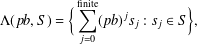 $$\begin{eqnarray}\unicode[STIX]{x1D6EC}(pb,S)=\bigg\{\mathop{\sum }_{j=0}^{\text{finite}}(pb)^{j}s_{j}:s_{j}\in S\bigg\},\end{eqnarray}$$ $S=pD$. We give conditions on $\unicode[STIX]{x1D70F}\in \mathbb{Z}$ under which the scaling set $\unicode[STIX]{x1D70F}\unicode[STIX]{x1D6EC}(pb,S)$ is also a spectrum of $\unicode[STIX]{x1D707}_{pb,D}$. These investigations link number theory and spectral measures.


Translates of Functions on the Heisenberg Group and the HRT Conjecture
- Part of
-
- Journal:
- Canadian Mathematical Bulletin / Volume 63 / Issue 4 / December 2020
- Published online by Cambridge University Press:
- 03 February 2020, pp. 871-881
- Print publication:
- December 2020
-
- Article
-
- You have access
- Export citation
OPTIMAL LINE PACKINGS FROM FINITE GROUP ACTIONS
- Part of
-
- Journal:
- Forum of Mathematics, Sigma / Volume 8 / 2020
- Published online by Cambridge University Press:
- 20 January 2020, e6
-
- Article
-
- You have access
- Open access
- Export citation
Spectrality of a Class of Moran Measures
- Part of
-
- Journal:
- Canadian Mathematical Bulletin / Volume 63 / Issue 2 / June 2020
- Published online by Cambridge University Press:
- 17 January 2020, pp. 366-381
- Print publication:
- June 2020
-
- Article
-
- You have access
- Export citation
-
Let $\{M_{n}\}_{n=1}^{\infty }$ be a sequence of expanding matrices with $M_{n}=\operatorname{diag}(p_{n},q_{n})$, and let $\{{\mathcal{D}}_{n}\}_{n=1}^{\infty }$ be a sequence of digit sets with ${\mathcal{D}}_{n}=\{(0,0)^{t},(a_{n},0)^{t},(0,b_{n})^{t},\pm (a_{n},b_{n})^{t}\}$, where $p_{n}$, $q_{n}$, $a_{n}$ and $b_{n}$ are positive integers for all $n\geqslant 1$. If $\sup _{n\geqslant 1}\{\frac{a_{n}}{p_{n}},\frac{b_{n}}{q_{n}}\}<\infty$, then the infinite convolution $\unicode[STIX]{x1D707}_{\{M_{n}\},\{{\mathcal{D}}_{n}\}}=\unicode[STIX]{x1D6FF}_{M_{1}^{-1}{\mathcal{D}}_{1}}\ast \unicode[STIX]{x1D6FF}_{(M_{1}M_{2})^{-1}{\mathcal{D}}_{2}}\ast \cdots \,$ is a Borel probability measure (Cantor–Dust–Moran measure). In this paper, we investigate whenever there exists a discrete set $\unicode[STIX]{x1D6EC}$ such that $\{e^{2\unicode[STIX]{x1D70B}i\langle \unicode[STIX]{x1D706},x\rangle }:\unicode[STIX]{x1D706}\in \unicode[STIX]{x1D6EC}\}$ is an orthonormal basis for $L^{2}(\unicode[STIX]{x1D707}_{\{M_{n}\},\{{\mathcal{D}}_{n}\}})$.


ODD–EVEN DECOMPOSITION OF FUNCTIONS
- Part of
-
- Journal:
- Bulletin of the Australian Mathematical Society / Volume 102 / Issue 1 / August 2020
- Published online by Cambridge University Press:
- 08 January 2020, pp. 104-108
- Print publication:
- August 2020
-
- Article
-
- You have access
- Export citation
On Parseval Wavelet Frames via Multiresolution Analyses in $H_{G}^{2}$
- Part of
-
- Journal:
- Canadian Mathematical Bulletin / Volume 63 / Issue 1 / March 2020
- Published online by Cambridge University Press:
- 06 December 2019, pp. 157-172
- Print publication:
- March 2020
-
- Article
-
- You have access
- Export citation

CALDERÓN’S INVERSE PROBLEM WITH A FINITE NUMBER OF MEASUREMENTS
- Part of
-
- Journal:
- Forum of Mathematics, Sigma / Volume 7 / 2019
- Published online by Cambridge University Press:
- 08 October 2019, e35
-
- Article
-
- You have access
- Open access
- Export citation
-
We prove that an $L^{\infty }$ potential in the Schrödinger equation in three and higher dimensions can be uniquely determined from a finite number of boundary measurements, provided it belongs to a known finite dimensional subspace ${\mathcal{W}}$. As a corollary, we obtain a similar result for Calderón’s inverse conductivity problem. Lipschitz stability estimates and a globally convergent nonlinear reconstruction algorithm for both inverse problems are also presented. These are the first results on global uniqueness, stability and reconstruction for nonlinear inverse boundary value problems with finitely many measurements. We also discuss a few relevant examples of finite dimensional subspaces ${\mathcal{W}}$, including bandlimited and piecewise constant potentials, and explicitly compute the number of required measurements as a function of $\dim {\mathcal{W}}$.


Non-spectral Problem for Some Self-similar Measures
- Part of
-
- Journal:
- Canadian Mathematical Bulletin / Volume 63 / Issue 2 / June 2020
- Published online by Cambridge University Press:
- 28 August 2019, pp. 318-327
- Print publication:
- June 2020
-
- Article
-
- You have access
- Export citation
-
Suppose that $0<|\unicode[STIX]{x1D70C}|<1$ and $m\geqslant 2$ is an integer. Let $\unicode[STIX]{x1D707}_{\unicode[STIX]{x1D70C},m}$ be the self-similar measure defined by $\unicode[STIX]{x1D707}_{\unicode[STIX]{x1D70C},m}(\cdot )=\frac{1}{m}\sum _{j=0}^{m-1}\unicode[STIX]{x1D707}_{\unicode[STIX]{x1D70C},m}(\unicode[STIX]{x1D70C}^{-1}(\cdot )-j)$. Assume that $\unicode[STIX]{x1D70C}=\pm (q/p)^{1/r}$ for some $p,q,r\in \mathbb{N}^{+}$ with $(p,q)=1$ and $(p,m)=1$. We prove that if $(q,m)=1$, then there are at most $m$ mutually orthogonal exponential functions in $L^{2}(\unicode[STIX]{x1D707}_{\unicode[STIX]{x1D70C},m})$ and $m$ is the best possible. If $(q,m)>1$, then there are any number of orthogonal exponential functions in $L^{2}(\unicode[STIX]{x1D707}_{\unicode[STIX]{x1D70C},m})$.


A Measurable Selector in Kadison’s Carpenter’s Theorem
- Part of
-
- Journal:
- Canadian Journal of Mathematics / Volume 72 / Issue 6 / December 2020
- Published online by Cambridge University Press:
- 16 July 2019, pp. 1505-1528
- Print publication:
- December 2020
-
- Article
-
- You have access
- Export citation
-
We show the existence of a measurable selector in Carpenter’s Theorem due to Kadison. This solves a problem posed by Jasper and the first author in an earlier work. As an application we obtain a characterization of all possible spectral functions of shift-invariant subspaces of $L^{2}(\mathbb{R}^{d})$ and Carpenter’s Theorem for type $\text{I}_{\infty }$ von Neumann algebras.


On the Gibbs–Wilbraham Phenomenon for Sampling and Interpolatory Series
- Part of
-
- Journal:
- Proceedings of the Edinburgh Mathematical Society / Volume 62 / Issue 4 / November 2019
- Published online by Cambridge University Press:
- 12 July 2019, pp. 1163-1171
-
- Article
- Export citation
Higher Summability and Discrete Weighted Muckenhoupt and Gehring Type Inequalities
- Part of
-
- Journal:
- Proceedings of the Edinburgh Mathematical Society / Volume 62 / Issue 4 / November 2019
- Published online by Cambridge University Press:
- 11 March 2019, pp. 949-973
-
- Article
- Export citation
-
In this paper, we prove some reverse discrete inequalities with weights of Muckenhoupt and Gehring types and use them to prove some higher summability theorems on a higher weighted space $l_{w}^{p}({\open N})$ form summability on the weighted space $l_{w}^{q}({\open N})$ when p>q. The proofs are obtained by employing new discrete weighted Hardy's type inequalities and their converses for non-increasing sequences, which, for completeness, we prove in our special setting. To the best of the authors' knowledge, these higher summability results have not been considered before. Some numerical results will be given for illustration.


Lipschitz-free Spaces on Finite Metric Spaces
- Part of
-
- Journal:
- Canadian Journal of Mathematics / Volume 72 / Issue 3 / June 2020
- Published online by Cambridge University Press:
- 13 February 2019, pp. 774-804
- Print publication:
- June 2020
-
- Article
-
- You have access
- Export citation
-
Main results of the paper are as follows:
(1) For any finite metric space $M$ the Lipschitz-free space on $M$ contains a large well-complemented subspace that is close to $\ell _{1}^{n}$.
(2) Lipschitz-free spaces on large classes of recursively defined sequences of graphs are not uniformly isomorphic to $\ell _{1}^{n}$ of the corresponding dimensions. These classes contain well-known families of diamond graphs and Laakso graphs.
Interesting features of our approach are: (a) We consider averages over groups of cycle-preserving bijections of edge sets of graphs that are not necessarily graph automorphisms. (b) In the case of such recursive families of graphs as Laakso graphs, we use the well-known approach of Grünbaum (1960) and Rudin (1962) for estimating projection constants in the case where invariant projections are not unique.


Three Problems on Exponential Bases
- Part of
-
- Journal:
- Canadian Mathematical Bulletin / Volume 62 / Issue 1 / March 2019
- Published online by Cambridge University Press:
- 07 January 2019, pp. 55-70
- Print publication:
- March 2019
-
- Article
-
- You have access
- Export citation
-
We consider three special and significant cases of the following problem. Let $D\subset \mathbb{R}^{d}$ be a (possibly unbounded) set of finite Lebesgue measure. Let $E(\mathbb{Z}^{d})=\{e^{2\unicode[STIX]{x1D70B}ix\cdot n}\}\text{}_{n\in \mathbb{Z}^{d}}$ be the standard exponential basis on the unit cube of $\mathbb{R}^{d}$. Find conditions on $D$ for which $E(\mathbb{Z}^{d})$ is a frame, a Riesz sequence, or a Riesz basis for $L^{2}(D)$.


ANALYSIS IN THE MULTI-DIMENSIONAL BALL
- Part of
-
- Journal:
- Mathematika / Volume 65 / Issue 2 / 2019
- Published online by Cambridge University Press:
- 31 October 2018, pp. 190-212
- Print publication:
- 2019
-
- Article
- Export citation
-
We study the heat semigroup maximal operator associated with a well-known orthonormal system in the $d$-dimensional ball. The corresponding heat kernel is shown to satisfy Gaussian bounds. As a consequence, we can prove weighted $L^{p}$ estimates, as well as some weighted inequalities in mixed norm spaces, for this maximal operator.


Stochastic LU factorizations, Darboux transformations and urn models
- Part of
-
- Journal:
- Journal of Applied Probability / Volume 55 / Issue 3 / September 2018
- Published online by Cambridge University Press:
- 16 November 2018, pp. 862-886
- Print publication:
- September 2018
-
- Article
- Export citation
A SHORT NOTE ON THE FRAME SET OF ODD FUNCTIONS
- Part of
-
- Journal:
- Bulletin of the Australian Mathematical Society / Volume 98 / Issue 3 / December 2018
- Published online by Cambridge University Press:
- 15 August 2018, pp. 481-493
- Print publication:
- December 2018
-
- Article
-
- You have access
- Export citation
-
We give a simple argument which shows that Gabor systems consisting of oddfunctions of $d$ variables and symplectic lattices of density $2^{d}$ cannot constitute a Gabor frame. In the one-dimensional,separable case, this follows from a more general result of Lyubarskii andNes [‘Gabor frames with rational density’, Appl. Comput. Harmon. Anal.34(3) (2013), 488–494]. We use a differentapproach exploiting the algebraic relation between the ambiguity functionand the Wigner distribution as well as their relation given by the(symplectic) Fourier transform. Also, we do not need the assumption that thelattice is separable and, hence, new restrictions are added to the fullframe set of odd functions.


Hardy-Type Inequalities for Fractional Powers of the Dunkl–Hermite Operator
- Part of
-
- Journal:
- Proceedings of the Edinburgh Mathematical Society / Volume 61 / Issue 2 / May 2018
- Published online by Cambridge University Press:
- 02 April 2018, pp. 513-544
-
- Article
- Export citation
FRAME-LESS HILBERT C*-MODULES
- Part of
-
- Journal:
- Glasgow Mathematical Journal / Volume 61 / Issue 1 / January 2019
- Published online by Cambridge University Press:
- 07 February 2018, pp. 25-31
- Print publication:
- January 2019
-
- Article
-
- You have access
- Export citation
-
We show that if A is a compact C*-algebra without identity that has a faithful *-representation in the C*-algebra of all compact operators on a separable Hilbert space and its multiplier algebra admits a minimal central projection p such that pA is infinite-dimensional, then there exists a Hilbert A1-module admitting no frames, where A1 is the unitization of A. In particular, there exists a frame-less Hilbert C*-module over the C*-algebra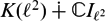 $K(\ell^2) \dotplus \mathbb{C}I_{\ell^2}$.
THE CRAMÉR–WOLD THEOREM ON QUADRATIC SURFACES AND HEISENBERG UNIQUENESS PAIRS
- Part of
-
- Journal:
- Journal of the Institute of Mathematics of Jussieu / Volume 19 / Issue 1 / January 2020
- Published online by Cambridge University Press:
- 07 November 2017, pp. 117-135
- Print publication:
- January 2020
-
- Article
- Export citation
-
Two measurable sets $S,\unicode[STIX]{x1D6EC}\subseteq \mathbb{R}^{d}$ form a Heisenberg uniqueness pair, if every bounded measure $\unicode[STIX]{x1D707}$ with support in $S$ whose Fourier transform vanishes on $\unicode[STIX]{x1D6EC}$ must be zero. We show that a quadratic hypersurface and the union of two hyperplanes in general position form a Heisenberg uniqueness pair in $\mathbb{R}^{d}$. As a corollary we obtain a new, surprising version of the classical Cramér–Wold theorem: a bounded measure supported on a quadratic hypersurface is uniquely determined by its projections onto two generic hyperplanes (whereas an arbitrary measure requires the knowledge of a dense set of projections). We also give an application to the unique continuation of eigenfunctions of second-order PDEs with constant coefficients.


Sparse Recovery via ℓq -Minimization for Polynomial Chaos Expansions
- Part of
-
- Journal:
- Numerical Mathematics: Theory, Methods and Applications / Volume 10 / Issue 4 / November 2017
- Published online by Cambridge University Press:
- 12 September 2017, pp. 775-797
- Print publication:
- November 2017
-
- Article
- Export citation
