Refine search
Actions for selected content:
238502 results in Physics and Astronomy
Thermosolutal instabilities in a moderately dense nanoparticle suspension
-
- Journal:
- Journal of Fluid Mechanics / Volume 1011 / 25 May 2025
- Published online by Cambridge University Press:
- 23 May 2025, A52
-
- Article
-
- You have access
- Open access
- HTML
- Export citation
A search for Planet Nine with IRAS and AKARI data
-
- Journal:
- Publications of the Astronomical Society of Australia / Volume 42 / 2025
- Published online by Cambridge University Press:
- 23 May 2025, e064
-
- Article
-
- You have access
- Open access
- HTML
- Export citation
-
The outer solar system is theoretically predicted to harbour an undiscovered planet, often referred to as Planet Nine. Simulations suggest that its gravitational influence could explain the unusual clustering of minor bodies in the Kuiper Belt. However, no observational evidence for Planet Nine has been found so far, as its predicted orbit lies far beyond Neptune, where it reflects only a faint amount of Sunlight. This work aims to find Planet Nine candidates by taking advantage of two far-infrared all-sky surveys, which are IRAS and AKARI. The epochs of these two surveys were separated by 23 years, which is large enough to detect Planet Nine’s $\sim3'$/year orbital motion. We use a dedicated AKARI Far-Infrared point source list for the purpose of our Planet Nine search — AKARI-FIS Monthly Unconfirmed Source List (AKARI-MUSL), which includes sources detected repeatedly only in hours timescale, but not after months. AKARI-MUSL is more advantageous than the AKARI Bright Source Catalogue (AKARI-BSC) for detecting moving and faint objects like Planet Nine with a twice-deeper flux detection limit. We search for objects that moved slowly between IRAS and AKARI detections given in the catalogues. First, we estimated the expected flux and orbital motion of Planet Nine by assuming its mass, distance, and effective temperature to ensure it can be detected by IRAS and AKARI, then applied the positional and flux selection criteria to narrow down the number of sources from the catalogues. Next, we produced all possible candidate pairs including one IRAS source and one AKARI source whose angular separations were limited between 42′ and $69.6'$, corresponding to the heliocentric distance range of 500 – 700 AU and the mass range of 7 – 17M $_{\oplus}$. There are 13 candidate pairs obtained after the selection criteria. After image inspection, we found one good candidate, of which the IRAS source is absent from the same coordinate in the AKARI image after 23 years and vice versa. However, AKARI and IRAS detections are not enough to determine the full orbit of this candidate. This issue leads to the need for follow-up observations, which will determine the Keplerian motion of our Planet Nine candidate.


Galaxy and Mass Assembly: A new approach to quantifying dust in galaxies
-
- Journal:
- Publications of the Astronomical Society of Australia / Volume 42 / 2025
- Published online by Cambridge University Press:
- 23 May 2025, e067
-
- Article
-
- You have access
- Open access
- HTML
- Export citation
-
We introduce a new approach to quantifying dust in galaxies by combining information from the Balmer decrement (BD) and the dust mass ( $M_d$). While there is no explicit correlation between these two properties, they jointly probe different aspects of the dust present in galaxies. We explore two new parameters that link BD with $M_d$ by using star formation rate (SFR) sensitive luminosities at several wavelengths (ultraviolet, H $\alpha$, and far-infrared). This analysis shows that combining the BD and $M_d$ in these ways provides new metrics that are sensitive to the degree of optically thick dust affecting the short wavelength emission. We show how these new ‘dust geometry’ parameters vary as a function of galaxy mass, SFR, and specific SFR. We demonstrate that they are sensitive probes of the dust geometry in galaxies, and that they support the ‘maximal foreground screen’ model for dust in starburst galaxies.


The p-adic limits of class numbers in ${\mathbb{Z}}_p$-towers
- Part of
-
- Journal:
- Mathematical Proceedings of the Cambridge Philosophical Society / Volume 179 / Issue 2 / September 2025
- Published online by Cambridge University Press:
- 23 May 2025, pp. 299-329
- Print publication:
- September 2025
-
- Article
- Export citation
-
This paper discusses variants of Weber’s class number problem in the spirit of arithmetic topology to connect the results of Sinnott–Kisilevsky and Kionke. Let p be a prime number. We first prove the p-adic convergence of class numbers in a ${\mathbb{Z}_{p}}$-extension of a global field and a similar result in a ${\mathbb{Z}_{p}}$-cover of a compact 3-manifold. Secondly, we establish an explicit formula for the p-adic limit of the p-power-th cyclic resultants of a polynomial using roots of unity of orders prime to p, the p-adic logarithm, and the Iwasawa invariants. Finally, we give thorough investigations of torus knots, twist knots, and elliptic curves; we complete the list of the cases with p-adic limits being in ${\mathbb{Z}}$ and find the cases such that the base p-class numbers are small and $\nu$’s are arbitrarily large.


3 - Geometric Rigidity Theory
- from Part I - Maxwell and Structural Mechanics
-
-
- Book:
- The Geometry of Equilibrium
- Published online:
- 03 May 2025
- Print publication:
- 22 May 2025, pp 29-44
-
- Chapter
- Export citation
16 - On the Equilibrium of Stress in a Solid Body
- from Part II - Concepts from Maxwell’s Articles on Structural Mechanics
-
-
- Book:
- The Geometry of Equilibrium
- Published online:
- 03 May 2025
- Print publication:
- 22 May 2025, pp 199-208
-
- Chapter
- Export citation
6 - A Brief Introduction to Mid–19th Century Projective Geometry and Topology
- from Part I - Maxwell and Structural Mechanics
-
-
- Book:
- The Geometry of Equilibrium
- Published online:
- 03 May 2025
- Print publication:
- 22 May 2025, pp 61-72
-
- Chapter
- Export citation
Frontmatter
-
- Book:
- The Geometry of Equilibrium
- Published online:
- 03 May 2025
- Print publication:
- 22 May 2025, pp i-iv
-
- Chapter
- Export citation
Bibliography
-
- Book:
- The International Atlas of Mars Exploration
- Published online:
- 13 June 2025
- Print publication:
- 22 May 2025, pp 596-610
-
- Chapter
- Export citation
Part I - Maxwell and Structural Mechanics
-
- Book:
- The Geometry of Equilibrium
- Published online:
- 03 May 2025
- Print publication:
- 22 May 2025, pp 1-2
-
- Chapter
- Export citation
4 - Maxwell’s Relevance to Modern Research in Materials
- from Part I - Maxwell and Structural Mechanics
-
-
- Book:
- The Geometry of Equilibrium
- Published online:
- 03 May 2025
- Print publication:
- 22 May 2025, pp 45-54
-
- Chapter
- Export citation
7 - Plane Reciprocal Diagrams
- from Part II - Concepts from Maxwell’s Articles on Structural Mechanics
-
-
- Book:
- The Geometry of Equilibrium
- Published online:
- 03 May 2025
- Print publication:
- 22 May 2025, pp 75-92
-
- Chapter
- Export citation
Mars mission data
-
- Book:
- The International Atlas of Mars Exploration
- Published online:
- 13 June 2025
- Print publication:
- 22 May 2025, pp 591-595
-
- Chapter
- Export citation
Index
-
- Book:
- The Geometry of Equilibrium
- Published online:
- 03 May 2025
- Print publication:
- 22 May 2025, pp 303-304
-
- Chapter
- Export citation
Contents
-
- Book:
- The International Atlas of Mars Exploration
- Published online:
- 13 June 2025
- Print publication:
- 22 May 2025, pp vii-vii
-
- Chapter
- Export citation
1870a: On Reciprocal Figures, Frames, and Diagrams of Forces
- from Part III - Annotated Original Articles by Maxwell on Structural Mechanics
-
- Book:
- The Geometry of Equilibrium
- Published online:
- 03 May 2025
- Print publication:
- 22 May 2025, pp 239-282
-
- Chapter
- Export citation
9 - The Unit Load Method and the Maxwell Reciprocal Theorem
- from Part II - Concepts from Maxwell’s Articles on Structural Mechanics
-
-
- Book:
- The Geometry of Equilibrium
- Published online:
- 03 May 2025
- Print publication:
- 22 May 2025, pp 107-114
-
- Chapter
- Export citation
A modelling framework for jet penetration into soft gels
-
- Journal:
- Journal of Fluid Mechanics / Volume 1011 / 25 May 2025
- Published online by Cambridge University Press:
- 22 May 2025, R5
-
- Article
-
- You have access
- Open access
- HTML
- Export citation
-
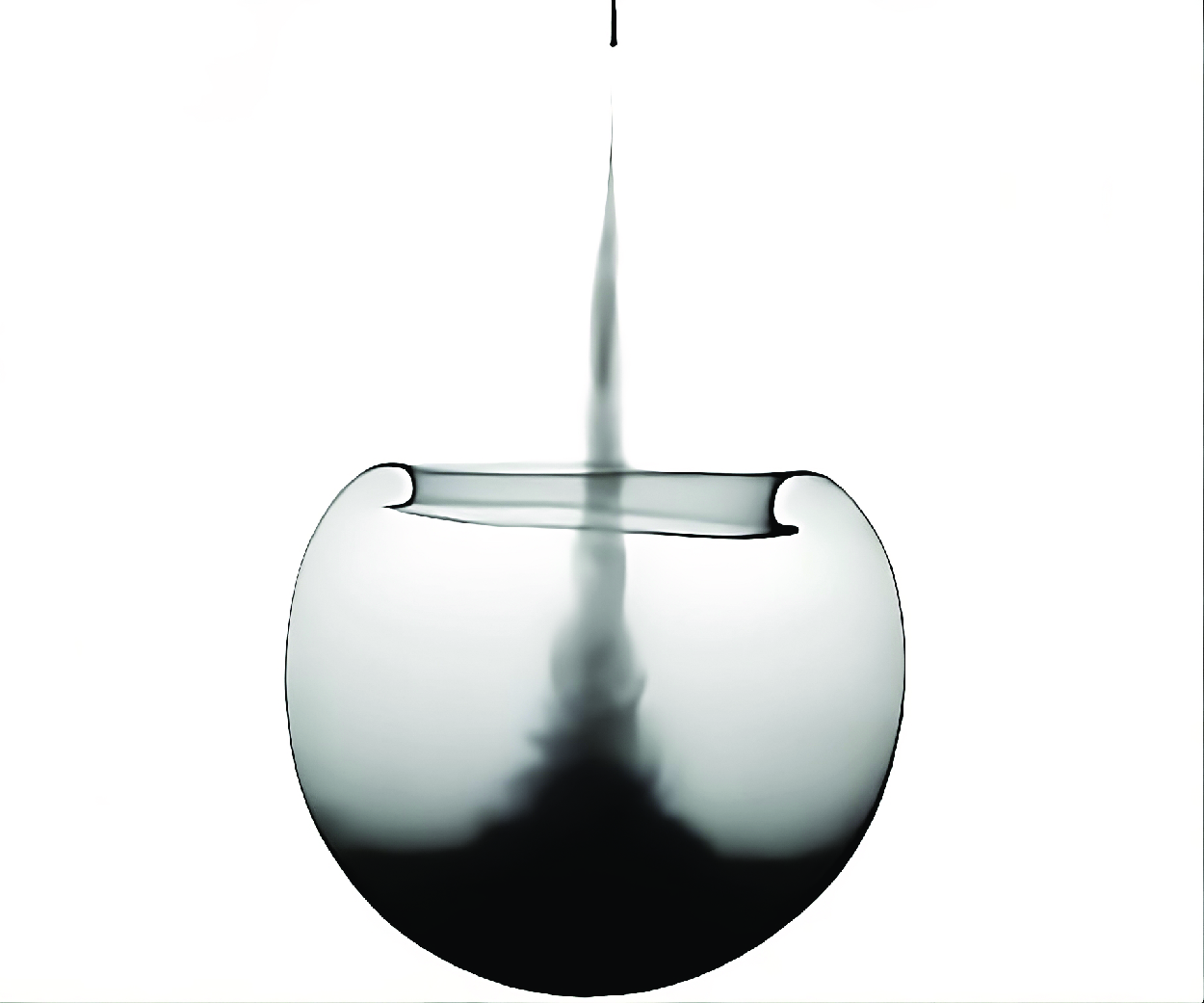
Jet penetration into soft gels is essential for optimising fluid delivery in medical therapies, biomedical engineering, and soft robotics. In this work, we visualise the jet flow of a Newtonian fluid into a soft viscoplastic gel using camera imaging and time-resolved tomographic particle image velocimetry (PIV) systems. The flow is primarily governed by the Reynolds number ( $Re = 350-5000$) and the effective viscosity ratio ( $m$ up to 22). We observe three flow regimes – mixing, jellyfish, and fingering – with transitions between them quantified in the $Re-m$ plane. An experimentally informed, systematic, practical, semi-analytical modelling framework is developed to estimate jet penetration depth over time, incorporating PIV results and an approximate functional decomposition approach to describe the velocity distribution and Reynolds stress contributions. The model provides reasonable estimations across all three regimes.


Contributors
-
- Book:
- The Geometry of Equilibrium
- Published online:
- 03 May 2025
- Print publication:
- 22 May 2025, pp x-x
-
- Chapter
- Export citation
Editorial Note
-
- Book:
- The Geometry of Equilibrium
- Published online:
- 03 May 2025
- Print publication:
- 22 May 2025, pp xiii-xviii
-
- Chapter
- Export citation
