Refine search
Actions for selected content:
238502 results in Physics and Astronomy
8 - Laplace and Poisson Equations
-
- Book:
- Notes, Problems and Solutions in Differential Equations
- Published online:
- 15 April 2025
- Print publication:
- 05 June 2025, pp 247-284
-
- Chapter
- Export citation
3 - Strong Field Interactions with Free Electrons
-
- Book:
- Strong Field Physics
- Published online:
- 05 July 2025
- Print publication:
- 05 June 2025, pp 70-139
-
- Chapter
- Export citation
6 - First-Order Partial Differential Equations
-
- Book:
- Notes, Problems and Solutions in Differential Equations
- Published online:
- 15 April 2025
- Print publication:
- 05 June 2025, pp 185-234
-
- Chapter
- Export citation
Index
-
- Book:
- Notes, Problems and Solutions in Differential Equations
- Published online:
- 15 April 2025
- Print publication:
- 05 June 2025, pp 357-359
-
- Chapter
- Export citation
11 - Wave Equation in Higher Dimensions
-
- Book:
- Notes, Problems and Solutions in Differential Equations
- Published online:
- 15 April 2025
- Print publication:
- 05 June 2025, pp 329-352
-
- Chapter
- Export citation
4 - Strong Field Interactions with Single Atoms
-
- Book:
- Strong Field Physics
- Published online:
- 05 July 2025
- Print publication:
- 05 June 2025, pp 140-261
-
- Chapter
- Export citation
Contents
-
- Book:
- Strong Field Physics
- Published online:
- 05 July 2025
- Print publication:
- 05 June 2025, pp v-viii
-
- Chapter
- Export citation
Acknowledgements
-
- Book:
- Notes, Problems and Solutions in Differential Equations
- Published online:
- 15 April 2025
- Print publication:
- 05 June 2025, pp xv-xvi
-
- Chapter
- Export citation
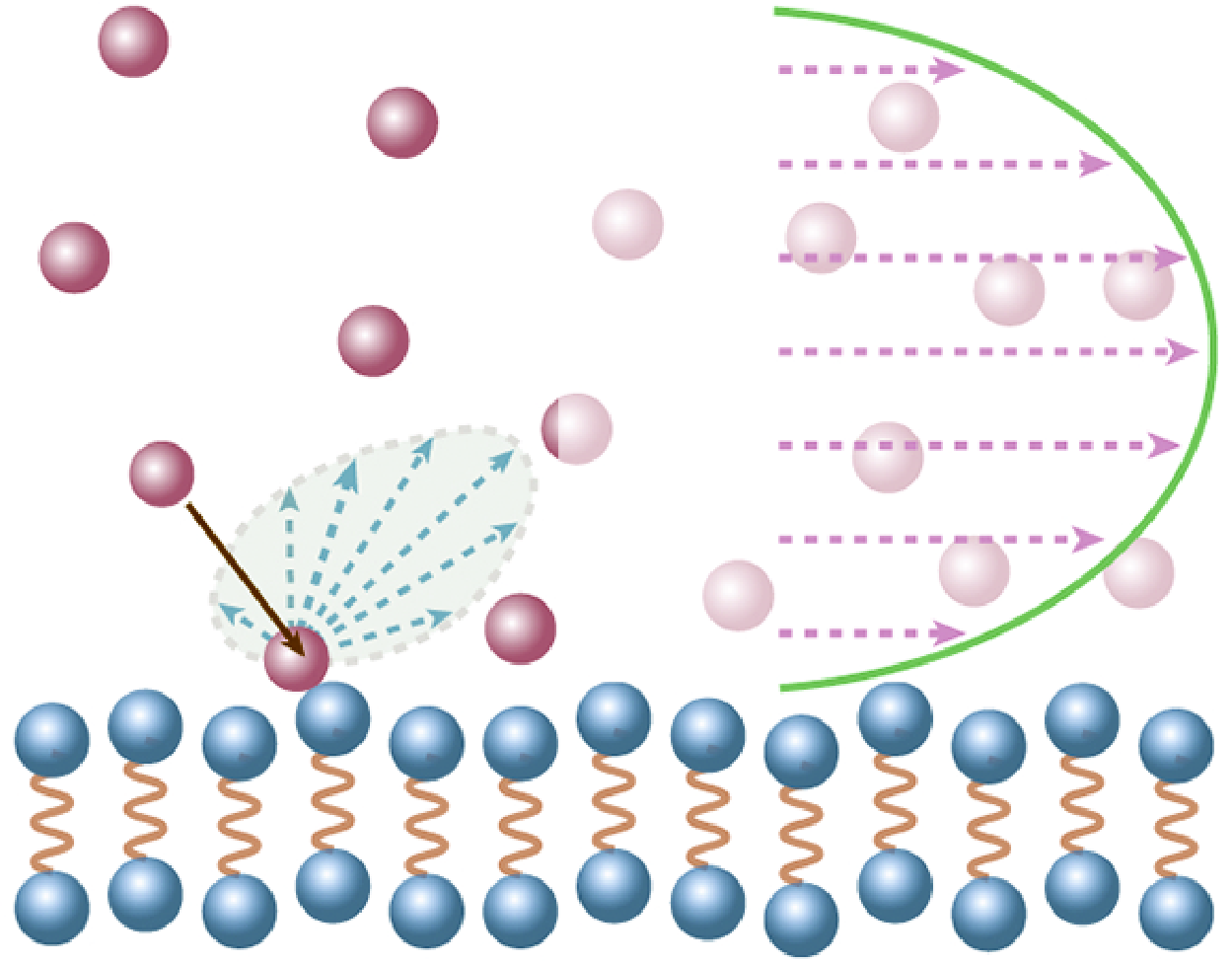
Molecular kinetic modelling of nanoscale confined flows
-
- Journal:
- Journal of Fluid Mechanics / Volume 1012 / 10 June 2025
- Published online by Cambridge University Press:
- 05 June 2025, A20
-
- Article
- Export citation

Large-eddy simulation for decaying magnetohydrodynamic turbulence at low magnetic Reynolds number
-
- Journal:
- Journal of Fluid Mechanics / Volume 1012 / 10 June 2025
- Published online by Cambridge University Press:
- 05 June 2025, A19
-
- Article
- Export citation
-
Large-eddy simulations have been conducted to investigate the decay law of homogeneous turbulence influenced by a magnetic field within a cubic domain, employing periodic boundary conditions. The initial integral Reynolds number is approximately 1000, while the initial interaction number $N$ ranges from 0.1–100. The results reveal that the Joule cone angle $\theta$, half of the Joule cone, decays as $\cos \theta \sim t^{-1/2}$ when $N \gg 1$. In the nonlinear stage, small-scale vortices gradually recover and restore three-dimensionality. Moreover, the corresponding critical state at small scales, marking the transition from quasi-two-dimensional structure to the onset of three-dimensionality, has been quantitatively defined. During the linear stage, based on the true magnetic damping number ( $\tau _t = \rho / (\sigma {\boldsymbol{B}}^2 \cos ^2 \psi )$, where $\sigma$, $\boldsymbol{B}$ and $\psi$ denote the electrical conductivity, magnetic field and the angle between the wavevector and $\boldsymbol{B}$ in Fourier space, respectively), Moffatt’s decay law, $K \sim t^{-1/2}$, manifests at distinct times and zones in the Fourier space, with $K$ signifying turbulent kinetic energy. In the nonlinear stage, for $N \gg 1$, a $-3$ slope in the energy power spectrum is prominently observed over an extended period. The near-equivalence of the characteristic time scales of inertial and Lorentz forces in the inertial subrange suggests a quasiequilibrium state between energy transfer and Joule dissipation in Fourier space, thereby corroborating the hypothesis proposed by Alemany et al. 1979 Journal de Mecanique 18(2): 277–313. Additionally, it is observed that pressure mediates energy transfer from horizontal kinetic energy ( $K_{\parallel }$) to vertical kinetic energy ( $K_{\bot }$), accelerating the decay of $K_{\parallel }$. Notably, concurrent inverse and direct energy transfers emerge during the decay process. Our analysis reveals that the ratio $R$ of the maximum inverse to maximum direct energy flux correlates with the dimensionality of the turbulence, following the scaling law $R\sim (\cos \theta )^{-2.2}$.


Appendix - List of Symbols
-
- Book:
- Strong Field Physics
- Published online:
- 05 July 2025
- Print publication:
- 05 June 2025, pp 788-802
-
- Chapter
- Export citation
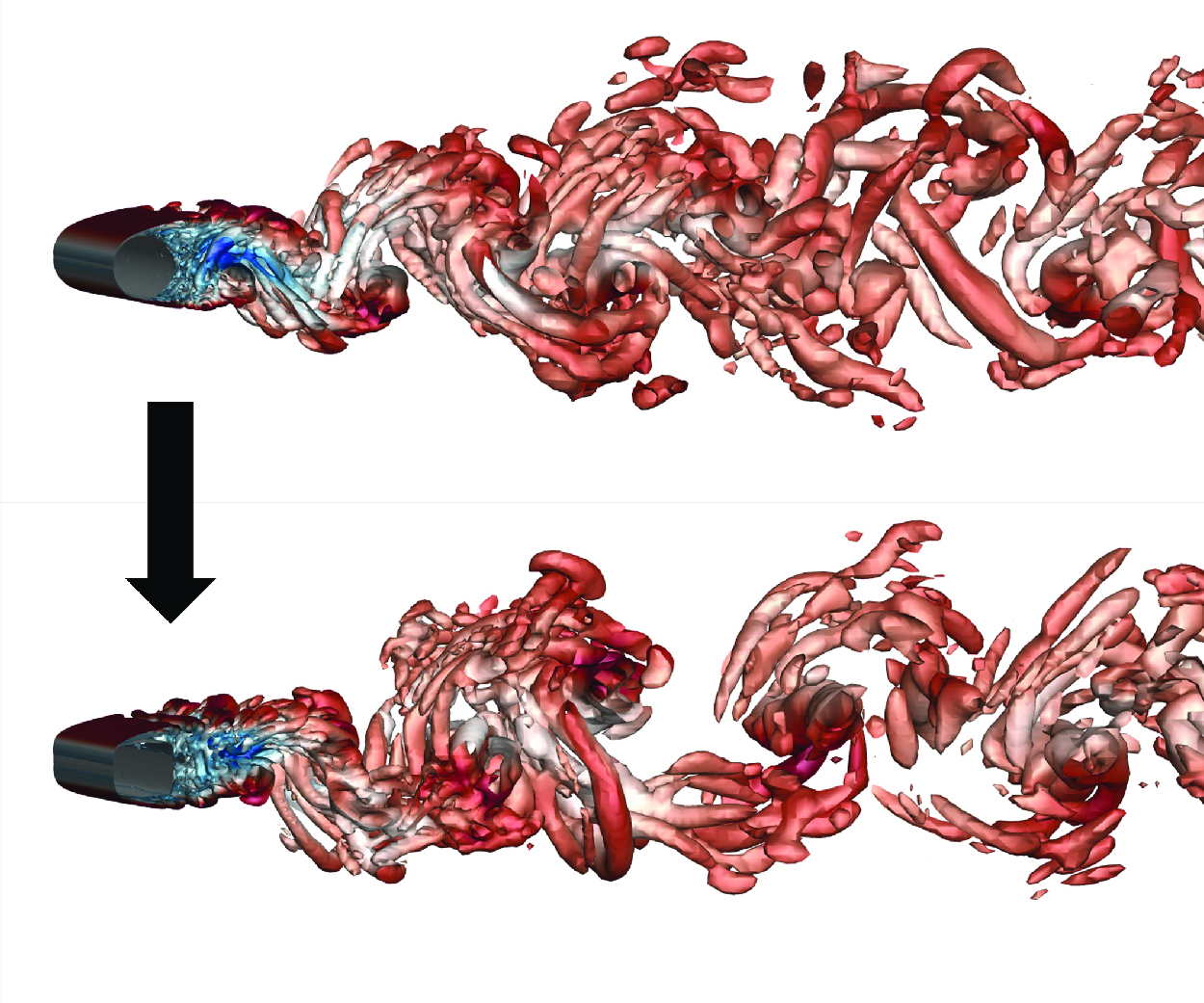
Resolvent-based shape optimisation for a two-dimensional cylinder at low Reynolds numbers
-
- Journal:
- Journal of Fluid Mechanics / Volume 1012 / 10 June 2025
- Published online by Cambridge University Press:
- 05 June 2025, A10
-
- Article
- Export citation
-
Flow over bluff bodies encounters instability at supercritical Reynolds numbers, exhibiting the periodic vortex shedding that leads to structural vibrations and acoustic noise. In this paper, a new aerodynamic shape optimisation strategy based on resolvent analysis is proposed to passively control the vortex shedding over two-dimensional cylinders. Firstly, we show that when the flow satisfies the rank-1 approximation, minimizing the maximal resolvent gain enhances flow stability. Secondly, we formulate the geometry-constrained resolvent-based optimisation problem that can be solved by the nonlinear conjugate gradient algorithm. Compared with conventional stability-based optimisation, the proposed approach is more effective as it avoids the cumbersome eigendecomposition of the high-dimensional Jacobian matrix. The efficacy of the proposed resolvent-based optimisation is validated through improving the stability of the one-dimensional Ginzburg–Landau equation. Thirdly, this approach is applied to suppress the vortex shedding of bluff bodies, initialised by a circular cylinder. Although the optimisation is performed at a subcritical state $Re = 40$, reduced vortex shedding and drag forces can be achieved at supercritical Reynolds numbers, while the critical Reynolds number is extended from $47$ to $60$. Dynamic mode decomposition is then performed to reveal that the optimised system becomes more stable and satisfies the rank-1 approximation. Finally, we demonstrate that the combined effects of the flattened surface and the Coanda effect delay flow separation, keeping the separation point nearly unchanged at supercritical Reynolds numbers (e.g. between 80 and 140) for the optimised geometry. This results in a substantial reduction in the strength of vortex shedding, which in turn leads to decreased drag forces. The optimised shape still achieves drag reduction in turbulent flows at a relatively high Reynolds number.


List of Illustrations
-
- Book:
- Notes, Problems and Solutions in Differential Equations
- Published online:
- 15 April 2025
- Print publication:
- 05 June 2025, pp xxi-xxii
-
- Chapter
- Export citation

Mass and momentum transfer at fluid–porous interfaces: jump boundary conditions for non-parallel flows
-
- Journal:
- Journal of Fluid Mechanics / Volume 1012 / 10 June 2025
- Published online by Cambridge University Press:
- 04 June 2025, A16
-
- Article
- Export citation
-
We derive boundary conditions for two-dimensional parallel and non-parallel flows at the interface of a homogeneous and isotropic porous medium and an overlying fluid layer by solving a macroscopic closure problem based on the asymptotic solution to the generalised transport equations (GTE) in the interfacial region. We obtained jump boundary conditions at the effective sharp surface dividing the homogeneous fluid and porous layers for either the Darcy or the Darcy–Brinkman equations. We discuss the choice of the location of the dividing surface and propose choices which reduce the distance with the GTE solutions. We propose an ad hoc expression of the permeability distribution within the interfacial region which enables us to preserve the invariance of the fluid-side-averaged velocity profile with respect to the radius $r_0$ of the averaging volume. Solutions to the GTE, equipped with the proposed permeability distribution, compare favourably with the averaged solutions to the pore-scale simulations when the interfacial thickness $\delta$ is adjusted to $r_0$. Numerical tests for parallel and non-parallel flows using the obtained jump boundary conditions or the generalised transport equations show quantitative agreement with the GTE solutions, with experiments and pore-scale simulations. The proposed model of mass and momentum transport is predictive, requiring solely information on the bulk porosity and permeability and the location of the solid matrix of the porous medium. Our results suggest that the Brinkman corrections may be avoided if the ratio $a=\delta /\delta _B$ of the thickness $\delta$ of the interfacial region to the Brinkman penetration depth $\delta _B$ is large enough, as the Brinkman sub-layer is entirely contained within the interfacial region in that case. Our formulation has been extended to anisotropic porous media and can be easily dealt with for three-dimensional configurations.


A new radio continuum study of the large magellanic cloud supernova remnant MC SNR J0519–6902
-
- Journal:
- Publications of the Astronomical Society of Australia / Volume 42 / 2025
- Published online by Cambridge University Press:
- 04 June 2025, e069
-
- Article
-
- You have access
- Open access
- HTML
- Export citation
-
We present a new radio continuum study of the Large Magellanic Cloud supernova remnant (SNR) MC SNR J0519–6902. With a diameter of $\sim$8 pc, this SNR shows a radio ring-like morphology with three bright regions towards the north, east, and south. Its linear polarisation is prominent with average values of $5\pm1$% and $6\pm1$% at 5 500 and 9 000 MHz, and we find a spectral index of ${-0.62\pm0.02}$, typical of a young SNR. The average rotation measure is estimated at ${-124\pm83}$ rad m $^{-2}$ and the magnetic field strength at ${\sim11}\,\mu$G. We also estimate an equipartition magnetic field of ${72\pm 5}\,\mu$G and minimum explosion energy of E $_\textrm{ min}$ = 2.6 $\times10^{48}$ erg. Finally, we identified an H i cloud that may be associated with MC SNR J0519–6902, located in the southeastern part of the remnant, along with a potential wind-bubble cavity.


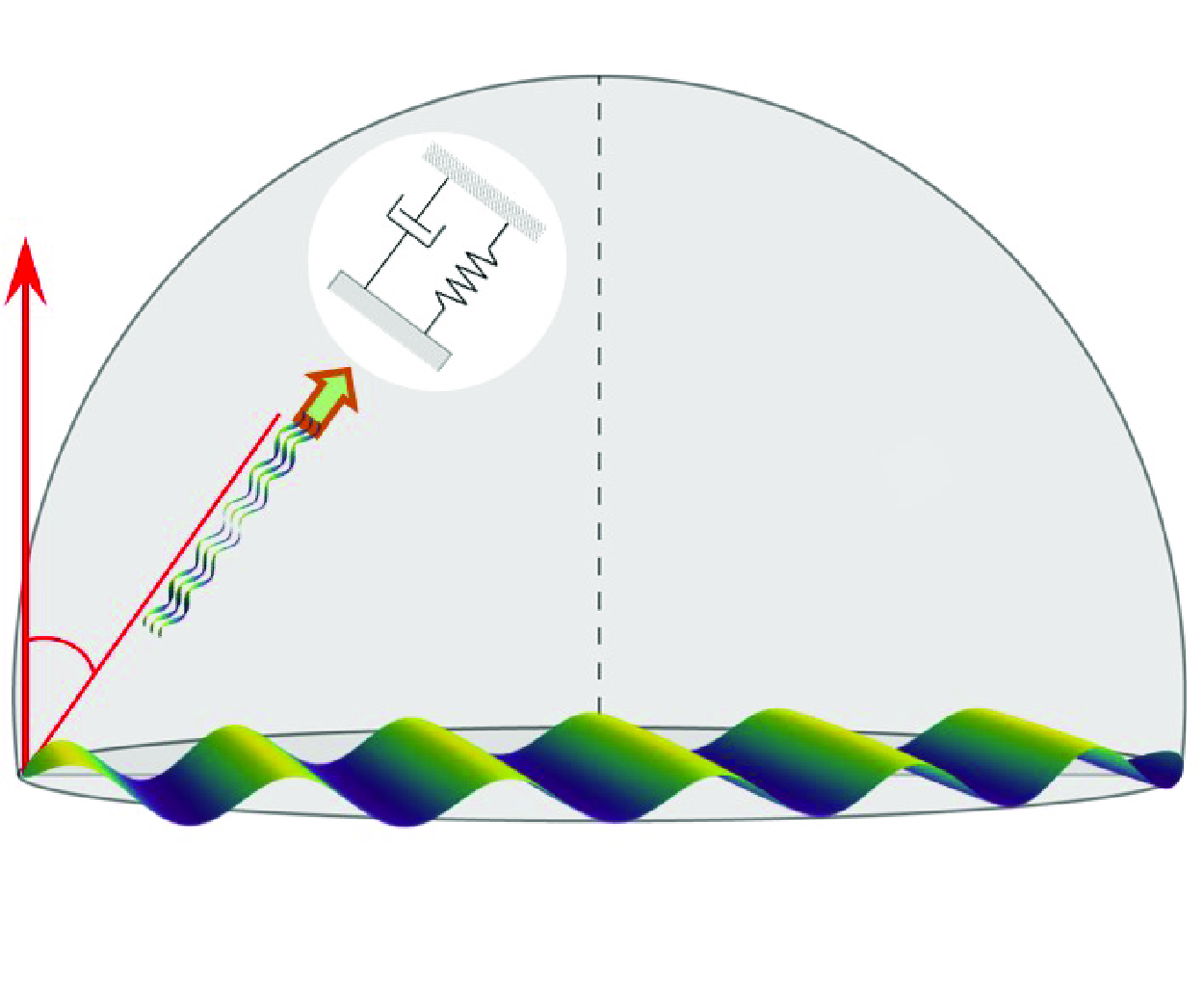
Acoustothermal effect: mechanism and quantification of the heat source
-
- Journal:
- Journal of Fluid Mechanics / Volume 1012 / 10 June 2025
- Published online by Cambridge University Press:
- 04 June 2025, A11
-
- Article
-
- You have access
- Open access
- HTML
- Export citation
Revisiting two-dimensional viscoelastic Kolmogorov flow: a centre-mode-driven transition – CORRIGENDUM
-
- Journal:
- Journal of Fluid Mechanics / Volume 1012 / 10 June 2025
- Published online by Cambridge University Press:
- 04 June 2025, E1
-
- Article
-
- You have access
- Open access
- HTML
- Export citation
Unravelling the role of merger histories in the population of in situ stars: Linking IllustrisTNG cosmological simulation to H3 survey
-
- Journal:
- Publications of the Astronomical Society of Australia / Volume 42 / 2025
- Published online by Cambridge University Press:
- 04 June 2025, e082
-
- Article
-
- You have access
- Open access
- HTML
- Export citation
A comparison of dust content and properties in GAMA/G10-COSMOS/3D-HST and Simba cosmological simulations
-
- Journal:
- Publications of the Astronomical Society of Australia / Volume 42 / 2025
- Published online by Cambridge University Press:
- 04 June 2025, e070
-
- Article
-
- You have access
- Open access
- HTML
- Export citation
-
The abundance of dust within galaxies directly influences their evolution. Contemporary models attempt to match this abundance by simulating the processes of dust creation, growth, and destruction. While these models are accurate, they require refinement, especially at earlier epochs. This study aims to compare simulated and observed datasets and identify discrepancies between the two, providing a basis for future improvements. We utilise simulation data from the Simba cosmological simulation suite and observed data from the Galaxy and Mass Assembly (GAMA), a subset of the Cosmic Evolution Survey (G10-COSMOS), and the Hubble Space Telescope (3D-HST). We selected galaxies in the observed and simulated data in a stellar mass range of ( $10^{8.59} \lt \text{M}_\odot \lt 10^{11.5}$) and at redshift bins centering around $z = 0.0$, $z = 0.1$, $z = 0.5$, $z = 1.0$, and $z = 1.5$ in a homogeneous dust mass range ( $10^{6} \lt \text{M}_D [\text{ M}_\odot] \lt 10^{9}$). Our results show notable deviations between Simba and observed data for dust-poor and rich galaxies, with strong indications that differences in galaxy populations and Simba limitations are the underlying cause rather than the dust physics implemented in Simba itself.


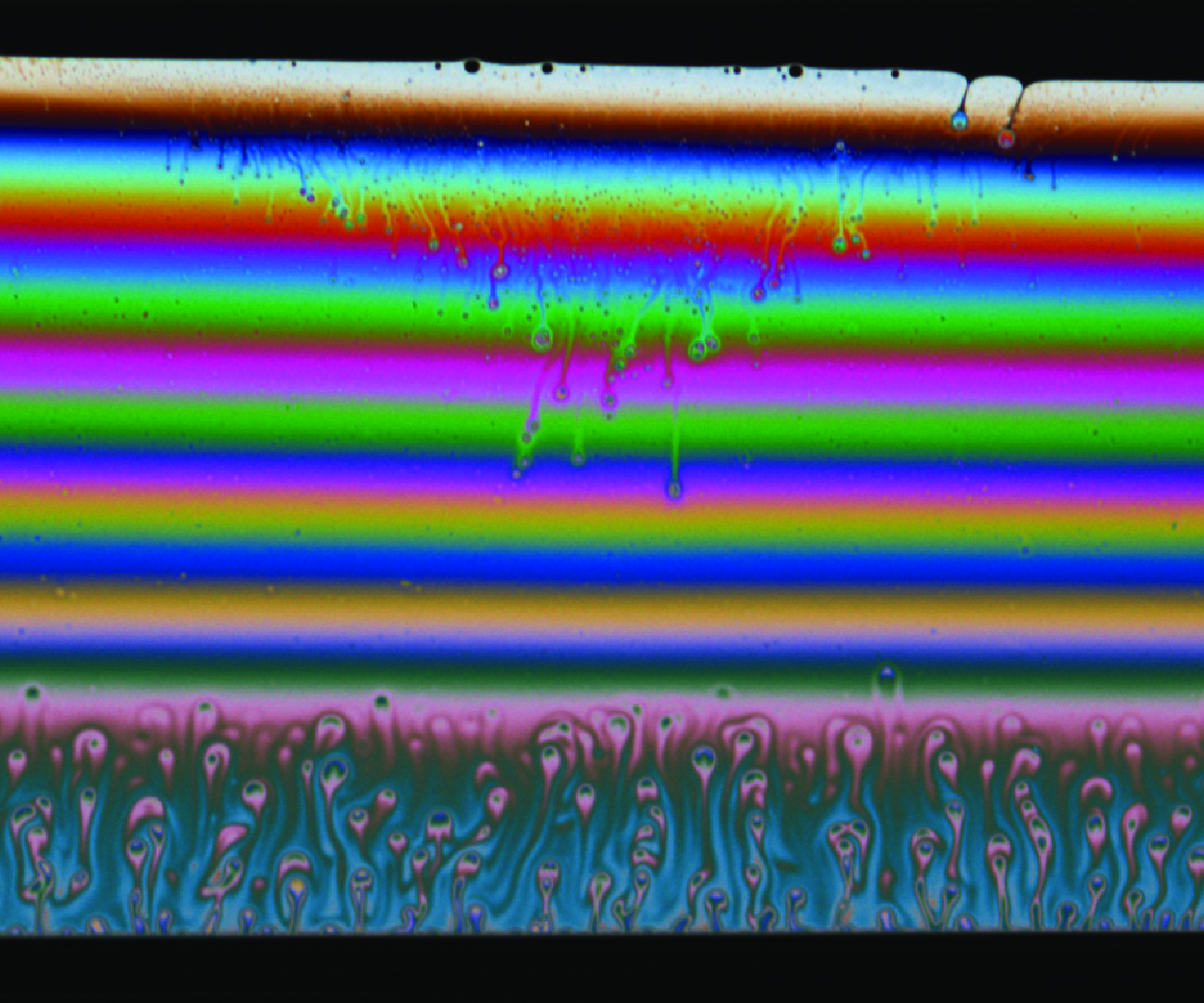
Drainage and lifetime of thin liquid films: the role of salinity and convective evaporation
-
- Journal:
- Journal of Fluid Mechanics / Volume 1012 / 10 June 2025
- Published online by Cambridge University Press:
- 04 June 2025, A18
-
- Article
-
- You have access
- Open access
- HTML
- Export citation
