Contents
Research Article
Idempotent-generated semigroups and pseudovarieties
- Part of:
-
- Published online by Cambridge University Press:
- 20 June 2011, pp. 545-568
-
- Article
-
- You have access
- Export citation
On an automorphism of Hilb[2] of certain K3 surfaces
- Part of:
-
- Published online by Cambridge University Press:
- 19 January 2011, pp. 1-7
-
- Article
-
- You have access
- Export citation
Generalizations of Clausen's Formula and algebraic transformations of Calabi–Yau differential equations
- Part of:
-
- Published online by Cambridge University Press:
- 30 March 2011, pp. 273-295
-
- Article
-
- You have access
- Export citation
The ρ-variation of the heat semigroup in the Hermitian setting: behaviour in L∞
- Part of:
-
- Published online by Cambridge University Press:
- 14 June 2011, pp. 569-585
-
- Article
-
- You have access
- Export citation
-
Let
 , ρ > 2, be the ρ-variation of the heat semigroup associated to the harmonic oscillator H = ½(−Δ + |x|2). We show that if f ∈ L∞ (ℝ), the (f)(x) < ∞, a.e. x ∈ ℝ. However, we find a function G ∈ L∞ (ℝ), such that (G)(x) ∉ L∞ (ℝ). We also analyse the local behaviour in L∞ of the operator . We find that its growth is smaller than that of a standard singular integral operator. As a by-product of our work we obtain an L∞ (ℝ) function F, such that the square function
a.e. x ∈ ℝ, where
 is the classical Poisson kernal in ℝ.
 , ρ > 2, be the ρ-variation of the heat semigroup associated to the harmonic oscillator H = ½(−Δ + |x|
 is the classical Poisson kernal in ℝ.
Yet another Poincaré Polyhedron Theorem
- Part of:
-
- Published online by Cambridge University Press:
- 07 April 2011, pp. 297-308
-
- Article
-
- You have access
- Export citation
Infinitely many solutions for a class of systems of differential inclusions
- Part of:
-
- Published online by Cambridge University Press:
- 19 January 2011, pp. 9-23
-
- Article
-
- You have access
- Export citation
Bounds for the multiplicities of the roots of a complex polynomial
- Part of:
-
- Published online by Cambridge University Press:
- 08 April 2011, pp. 587-598
-
- Article
-
- You have access
- Export citation
On the gaps between values of binary quadratic forms
- Part of:
-
- Published online by Cambridge University Press:
- 01 November 2010, pp. 25-32
-
- Article
-
- You have access
- Export citation
On conditional permutability and saturated formations
- Part of:
-
- Published online by Cambridge University Press:
- 30 March 2011, pp. 309-319
-
- Article
-
- You have access
- Export citation
Dehn surgeries on some classical links
- Part of:
-
- Published online by Cambridge University Press:
- 19 January 2011, pp. 33-45
-
- Article
-
- You have access
- Export citation
Homological properties of certain Banach modules over group algebras
- Part of:
-
- Published online by Cambridge University Press:
- 07 April 2011, pp. 321-328
-
- Article
-
- You have access
- Export citation
-
Homological properties of several Banach left L1(G)-modules have been studied by Dales and Polyakov and recently by Ramsden. In this paper, we characterize some homological properties of
 and
and  as Banach left L1(G)-modules, such as flatness, injectivity and projectivity.
 and
and  as Banach left L
On simultaneous rational approximation to a p-adic number and its integral powers
- Part of:
-
- Published online by Cambridge University Press:
- 17 August 2011, pp. 599-612
-
- Article
-
- You have access
- Export citation
Curves of infinite length in labyrinth fractals
- Part of:
-
- Published online by Cambridge University Press:
- 30 March 2011, pp. 329-344
-
- Article
-
- You have access
- Export citation
Notes on contact Ricci solitons
- Part of:
-
- Published online by Cambridge University Press:
- 28 October 2010, pp. 47-53
-
- Article
-
- You have access
- Export citation
The braided monoidal structures on the category of vector spaces graded by the Klein group
- Part of:
-
- Published online by Cambridge University Press:
- 14 June 2011, pp. 613-641
-
- Article
-
- You have access
- Export citation
Corrigendum: C*-envelopes of tensor algebras for multivariable dynamics
- Part of:
-
- Published online by Cambridge University Press:
- 20 May 2011, pp. 643-644
-
- Article
-
- You have access
- Export citation
Repunit Lehmer numbers
- Part of:
-
- Published online by Cambridge University Press:
- 28 October 2010, pp. 55-65
-
- Article
-
- You have access
- Export citation
Higher-order singular multi-point boundary-value problems on time scales
- Part of:
-
- Published online by Cambridge University Press:
- 30 March 2011, pp. 345-361
-
- Article
-
- You have access
- Export citation
-
We study classes of higher-order singular boundary-value problems on a time scale
 with a positive parameter λ in the differential equations. A homeomorphism and homomorphism ø are involved both in the differential equation and in the boundary conditions. Criteria are obtained for the existence and uniqueness of positive solutions. The dependence of positive solutions on the parameter λ is studied. Applications of our results to special problems are also discussed. Our analysis mainly relies on the mixed monotone operator theory. The results here are new, even in the cases of second-order differential and difference equations.
 with a positive parameter λ in the differential equations. A homeomorphism and homomorphism ø are involved both in the differential equation and in the boundary conditions. Criteria are obtained for the existence and uniqueness of positive solutions. The dependence of positive solutions on the parameter λ is studied. Applications of our results to special problems are also discussed. Our analysis mainly relies on the mixed monotone operator theory. The results here are new, even in the cases of second-order differential and difference equations.
Admissible solutions for Dirac equations with singular and non-monotone nonlinearity
- Part of:
-
- Published online by Cambridge University Press:
- 25 February 2011, pp. 363-371
-
- Article
-
- You have access
- Export citation
-
By making use of Merle's general shooting method we investigate Dirac equations of the form
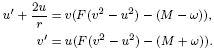
Here it is possible that F(0) = −∞ and that F(s) defined on (0,+∞) is not monotonously nondecreasing. Our results cover some known ones as a special case.
Spaces of commuting elements in SU(2)
- Part of:
-
- Published online by Cambridge University Press:
- 19 January 2011, pp. 67-75
-
- Article
-
- You have access
- Export citation