Refine listing
Actions for selected content:
2118398 results in Journals
Joshua Reno, Home signs: An ethnography of life beyond and beside language. Chicago: University of Chicago Press, 2024. Pp. 242. Pb. $27.50.
-
- Journal:
- Language in Society / Volume 55 / Issue 3 / June 2026
- Published online by Cambridge University Press:
- 18 June 2026, pp. 575-576
-
- Article
- Export citation
Yaron Matras, Speech and the city: Multilingualism, decoloniality and the civic university. Cambridge: Cambridge University Press, 2024. Pp. 188. Hb. £95.
-
- Journal:
- Language in Society / Volume 55 / Issue 3 / June 2026
- Published online by Cambridge University Press:
- 18 June 2026, pp. 572-573
-
- Article
- Export citation
A theory-first approach toward using generative AI for humanities research
- Part of
-
- Journal:
- Computational Humanities Research / Volume 2 / 2026
- Published online by Cambridge University Press:
- 18 June 2026, e18
-
- Article
-
- You have access
- Open access
- HTML
- Export citation
Aggregating heavy-tailed random vectors: from finite sums to lévy processes
- Part of
-
- Journal:
- Advances in Applied Probability , First View
- Published online by Cambridge University Press:
- 18 June 2026, pp. 1-44
-
- Article
-
- You have access
- Open access
- HTML
- Export citation
-
The tail behavior of aggregates of heavy-tailed random vectors is known to be determined by the so-called principle of ‘one large jump’, be it for finite sums, random sums, or Lévy processes. We establish that, in fact, a more general principle is at play. Assuming that the random vectors are multivariate regularly varying on various subcones of the positive orthant $[0,\infty)^d$, first we show that their aggregates are also multivariate regularly varying on these subcones. This allows us to approximate certain tail probabilities rendered asymptotically negligible under classical regular variation. Second, we discover that depending on the structure of a particular tail event, the tail behavior of the aggregates may be characterized by more than a single large jump. Finally, we illustrate a similar phenomenon for regularly varying multivariate Lévy processes, establishing as well a relationship between regular variation of a multivariate Lévy process and multivariate regular variation of its Lévy measure on different subcones. The applicability of these results in financial and insurance risk management is discussed.

Reviewer Comment on Martineau et al. “Barriers to Clinical Care in Frontotemporal Dementia and Related Disorders: A Cross-Sectional Survey of Patients and Caregivers’ Journey in the Canadian Healthcare System”
-
- Journal:
- Canadian Journal of Neurological Sciences , First View
- Published online by Cambridge University Press:
- 18 June 2026, pp. 1-2
-
- Article
-
- You have access
- HTML
- Export citation
Experimental infection of wild Mastomys natalensis with the parasitic nematode Trichuris mastomysi
-
- Journal:
- Journal of Helminthology / Volume 100 / 2026
- Published online by Cambridge University Press:
- 18 June 2026, e65
-
- Article
-
- You have access
- Open access
- HTML
- Export citation
Introducing the trajectories of democratic innovations
-
- Journal:
- European Political Science ,
- Published online by Cambridge University Press:
- 18 June 2026, pp. 1-7
-
- Article
-
- You have access
- Open access
- HTML
- Export citation
BJP volume 229 issue 1 Cover and Back matter
-
- Journal:
- The British Journal of Psychiatry / Volume 229 / Issue 1 / July 2026
- Published online by Cambridge University Press:
- 18 June 2026, pp. b1-b2
- Print publication:
- July 2026
-
- Article
-
- You have access
- Export citation
Scope, goals and relationship-building: Tackling the challenges in integrating ethics into AI research
- Part of
-
- Journal:
- Cambridge Forum on AI: Culture and Society / Volume 2 / 2026
- Published online by Cambridge University Press:
- 18 June 2026, e18
-
- Article
-
- You have access
- Open access
- HTML
- Export citation
BJA volume 32 issue 4 Cover and Front matter
-
- Journal:
- BJPsych Advances / Volume 32 / Issue 4 / July 2026
- Published online by Cambridge University Press:
- 18 June 2026, pp. f1-f2
- Print publication:
- July 2026
-
- Article
-
- You have access
- Export citation
Jean d’Aspremont , The Epistemology of the Secret: International Law as Revelation, Cambridge University Press, 2025.
-
- Journal:
- Leiden Journal of International Law , First View
- Published online by Cambridge University Press:
- 18 June 2026, pp. 1-4
-
- Article
-
- You have access
- Open access
- HTML
- Export citation
Falco Pfalzgraf (ed.), Public attitudes towards gender-inclusive language: A multilingual perspective. Berlin: De Gruyter Mouton, 2024. Pp. 417. Hb. €120.
-
- Journal:
- Language in Society / Volume 55 / Issue 3 / June 2026
- Published online by Cambridge University Press:
- 18 June 2026, pp. 577-578
-
- Article
- Export citation
Patronage Networks and the Afterlives of James Cook, c. 1770–1820
-
- Journal:
- The Historical Journal , First View
- Published online by Cambridge University Press:
- 18 June 2026, pp. 1-20
-
- Article
-
- You have access
- Open access
- HTML
- Export citation
Academic Freedom in Times of War: Case of the Sudan
-
- Journal:
- Review of Middle East Studies , First View
- Published online by Cambridge University Press:
- 17 June 2026, pp. 1-9
-
- Article
-
- You have access
- Open access
- HTML
- Export citation
Enhanced UAV-type recognition method using improved EMD and RF fingerprint
-
- Journal:
- The Aeronautical Journal / Volume 130 / Issue 1350 / August 2026
- Published online by Cambridge University Press:
- 17 June 2026, pp. 2580-2599
-
- Article
- Export citation
Empirical models for light aircraft weight estimation in conceptual design and parametric studies
-
- Journal:
- The Aeronautical Journal , First View
- Published online by Cambridge University Press:
- 17 June 2026, pp. 1-19
-
- Article
-
- You have access
- Open access
- HTML
- Export citation
Assessing Antarctic Marine Bioprospecting Governance in the Light of the Biodiversity Beyond National Jurisdiction Agreement: Competence, Comprehensiveness, and Coherence
-
- Journal:
- Transnational Environmental Law , First View
- Published online by Cambridge University Press:
- 17 June 2026, pp. 1-38
-
- Article
-
- You have access
- Open access
- HTML
- Export citation
ADDITIVITY AXIOM FOR THE TORSION FORMS AND HIGHER CHEEGER-MÜLLER/BISMUT-ZHANG THEOREM
- Part of
-
- Journal:
- Journal of the Institute of Mathematics of Jussieu / Volume 25 / Issue 4 / July 2026
- Published online by Cambridge University Press:
- 17 June 2026, pp. 1833-1920
- Print publication:
- July 2026
-
- Article
-
- You have access
- HTML
- Export citation
National Opera in the Periphery: Economy, Aesthetics and the Paradox of Modernity in R.M. Azkue’s Basque Operas
-
- Journal:
- Cambridge Opera Journal , First View
- Published online by Cambridge University Press:
- 17 June 2026, pp. 1-22
-
- Article
-
- You have access
- Open access
- HTML
- Export citation
Algebraic independence of values of Weierstrass elliptic and zeta functions
- Part of
-
- Journal:
- Proceedings of the Edinburgh Mathematical Society , First View
- Published online by Cambridge University Press:
- 17 June 2026, pp. 1-33
-
- Article
-
- You have access
- Open access
- HTML
- Export citation
-
Let $\Omega$ be a lattice in $\mathbb C$ with invariants $g_2,g_3$ and let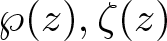 $\wp(z), \zeta(z)$ be the associated Weierstrass elliptic and zeta functions, respectively. In this paper, we prove that if $\omega$ is any non-zero period of $\wp(z)$ and $u_1,u_2$ complex numbers such that $u_1,u_2, \omega$ are $\mathbb{Q}$-linearly independent with $({\mathbb{Z}} u_1+{\mathbb{Z}} u_2)\cap\Omega=(0),$ then at least two of the numbersare algebraically independent over
 \begin{equation*}g_2,g_3,\omega, \eta,u_1,u_2,\wp(u_i),\zeta(u_i)~~(1\leq i\leq 2)\end{equation*} $\mathbb{Q},$ where $\eta$ is the quasi-period of $\zeta(z)$ associated with $\omega.$


