Refine listing
Actions for selected content:
1366353 results in Open Access
An infant case of autosomal recessive polycystic kidney disease-associated dilated cardiomyopathy-like hypertensive cardiomyopathy diagnosed because of urinary tract infection
-
- Journal:
- Cardiology in the Young / Volume 34 / Issue 8 / August 2024
- Published online by Cambridge University Press:
- 13 September 2024, pp. 1835-1837
-
- Article
- Export citation
Cardiac effects of COVID-19 infection in children
-
- Journal:
- Cardiology in the Young / Volume 34 / Issue 10 / October 2024
- Published online by Cambridge University Press:
- 13 September 2024, pp. 2146-2155
-
- Article
-
- You have access
- Open access
- HTML
- Export citation
‘When intuitions (don't) fail’: combining syntax and sociolinguistics in the analysis of Scots
-
- Journal:
- English Language & Linguistics / Volume 29 / Issue 1 / March 2025
- Published online by Cambridge University Press:
- 13 September 2024, pp. 1-34
-
- Article
-
- You have access
- Open access
- HTML
- Export citation
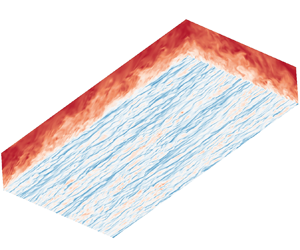
A combined active control method of restricted nonlinear model and machine learning technology for drag reduction in turbulent channel flow
-
- Journal:
- Journal of Fluid Mechanics / Volume 993 / 25 August 2024
- Published online by Cambridge University Press:
- 13 September 2024, A4
-
- Article
- Export citation
-
The practical implementation of machine learning in flow control is limited due to its significant training expenses. In the present study the convolutional neural network (CNN) trained with the data of the restricted nonlinear (RNL) model is used to predict the normal velocity on a detection plane at $y^+=10$ in a turbulent channel flow, and the predicted velocity is used as wall blowing and suction for drag reduction. An active control test is carried out by using the well-trained CNN in direct numerical simulation (DNS). Substantial drag reduction rates up to 19 % and 16 % are obtained based on the spanwise and streamwise wall shear stresses, respectively. Furthermore, we explore the online control of wall turbulence by combining the RNL model with reinforcement learning (RL). The RL is constructed to determine the optimal wall blowing and suction based on its observation of the wall shear stresses without using the label data on the detection plane for training. The controlling and training processes are conducted synchronously in a RNL flow field. The control strategy discovered by RL has similar drag reduction rates with those obtained previously by the established method. Also, the training cost decreases by over thirty times at $Re_{\tau }=950$ compared with the DNS-RL model. The present results provide a perspective that combining the RNL model with machine learning control for drag reduction in wall turbulence can be effective and computationally economical. Also, this approach can be easily extended to flows at higher Reynolds numbers.


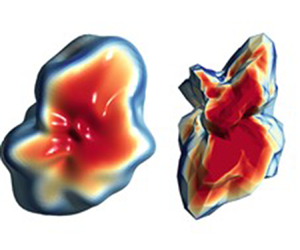
Drag coefficient for irregularly shaped grains: rotational dependence at various Reynolds numbers
-
- Journal:
- Journal of Fluid Mechanics / Volume 994 / 10 September 2024
- Published online by Cambridge University Press:
- 13 September 2024, A1
-
- Article
-
- You have access
- Open access
- HTML
- Export citation
-
The nature and behaviour of the drag coefficient $C_D$ of irregularly shaped grains within a wide range of Reynolds numbers $Re$ is discussed. The morphology of the grains is controlled by their fractal description, and they differ in shape. Using computational fluid dynamics tools, the characteristics of the boundary layer at high $Re$ has been determined by applying the Reynolds-averaged Navier–Stokes turbulence model. Both grid resolution and mesh size dependence are validated with well-reported previous experimental results applied in flow around isolated smooth spheres. The drag coefficient for irregularly shaped grains is shown to be higher than that for spherical shapes, also showing a strong drop in its value at high $Re$. This drag crisis is reported at lower $Re$ compared to the smooth sphere, but higher critical $C_D$, demonstrating that the morphology of the particle accelerates this crisis. Furthermore, the dependence of $C_D$ on $Re$ in this type of geometry can be represented qualitatively by four defined zones: subcritical, critical, supercritical and transcritical. The orientational dependence for both particles with respect to the fluid flow is analysed, where our findings show an interesting oscillatory behaviour of $C_D$ as a function of the angle of incidence, fitting the results to a sine-squared interpolation, predicted for particles within the Stokes laminar regime ( $Re\ll 1$) and for elongated/flattened spheroids up to $Re=2000$. A statistical analysis shows that this system satisfies a Weibullian behaviour of the drag coefficient when random azimuthal and polar rotation angles are considered.


Characterization of MoS2 films via simultaneous grazing incidence X-ray diffraction and grazing incidence X-ray fluorescence (GIXRD/GIXRF)
-
- Journal:
- Powder Diffraction / Volume 39 / Issue 2 / June 2024
- Published online by Cambridge University Press:
- 13 September 2024, pp. 60-68
-
- Article
-
- You have access
- Open access
- HTML
- Export citation
J. BROWN, “PHILLIPS’S CURVE,” AND ECONOMIC NETWORKS IN THE 1950S – EXPRESSION OF CONCERN
-
- Journal:
- Journal of the History of Economic Thought , First View
- Published online by Cambridge University Press:
- 13 September 2024, p. 1
-
- Article
-
- You have access
- HTML
- Export citation
Treating with minerals in the Middle Ages: the rare substance mūmiyāʾ (pitch-asphalt) and its medicinal uses in Byzantium
-
- Journal:
- Medical History / Volume 68 / Issue 3 / July 2024
- Published online by Cambridge University Press:
- 13 September 2024, pp. 223-236
-
- Article
-
- You have access
- Open access
- HTML
- Export citation
ASYMPTOTIC BEHAVIOUR OF THE LEAST ENERGY SOLUTIONS TO FRACTIONAL NEUMANN PROBLEMS
- Part of
-
- Journal:
- Journal of the Australian Mathematical Society / Volume 118 / Issue 2 / April 2025
- Published online by Cambridge University Press:
- 13 September 2024, pp. 178-209
-
- Article
- Export citation
-
We study the asymptotic behaviour of the least energy solutions to the following class of nonlocal Neumann problems:
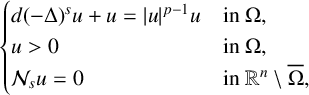 $$ \begin{align*} \begin{cases} { d(-\Delta)^{s}u+ u= \vert u\vert^{p-1}u } & \text{in } \Omega, \\ {u>0} & \text{in } \Omega, \\ { \mathcal{N}_{s}u=0 } & \text{in } \mathbb{R}^{n}\setminus \overline{\Omega}, \end{cases} \end{align*} $$
where $\Omega \subset \mathbb {R}^{n}$ is a bounded domain of class $C^{1,1}$, $1<p<({n+s})/({n-s}),\,n>\max \{1, 2s \}, 0<s<1, d>0$ and $\mathcal {N}_{s}u$ is the nonlocal Neumann derivative. We show that for small $d,$ the least energy solutions $u_d$ of the above problem achieve an $L^{\infty }$-bound independent of $d.$ Using this together with suitable $L^{r}$-estimates on $u_d,$ we show that the least energy solution $u_d$ achieves a maximum on the boundary of $\Omega $ for d sufficiently small.



Double diffusive convection in the diffusive regime with a uniform background shear
-
- Journal:
- Journal of Fluid Mechanics / Volume 993 / 25 August 2024
- Published online by Cambridge University Press:
- 13 September 2024, A14
-
- Article
- Export citation
Why Not Phase Out Animal Experimentation? Considering Objections from Freedom of Inquiry and Cross-Border Displacement
-
- Journal:
- Cambridge Quarterly of Healthcare Ethics / Volume 34 / Issue 2 / April 2025
- Published online by Cambridge University Press:
- 13 September 2024, pp. 264-279
-
- Article
-
- You have access
- Open access
- HTML
- Export citation
Medication management and electrocardiogram screening in children with attention deficit hyperactivity disorder
-
- Journal:
- Cardiology in the Young / Volume 34 / Issue 10 / October 2024
- Published online by Cambridge University Press:
- 13 September 2024, pp. 2080-2085
-
- Article
- Export citation
Surgical management of congenital mitral stenosis in a patient with Kabuki syndrome
-
- Journal:
- Cardiology in the Young / Volume 34 / Issue 8 / August 2024
- Published online by Cambridge University Press:
- 13 September 2024, pp. 1832-1834
-
- Article
-
- You have access
- Open access
- HTML
- Export citation
Thinking freedom relationally: Life projects and care as an ethical orientation for International Studies
-
- Journal:
- Review of International Studies / Volume 51 / Issue 3 / May 2025
- Published online by Cambridge University Press:
- 13 September 2024, pp. 488-503
- Print publication:
- May 2025
-
- Article
-
- You have access
- Open access
- HTML
- Export citation
Isolating the Effect of Social Risk on MNEs’ CSR Reporting: A New Approach Based on China's Belt & Road Initiative
-
- Journal:
- Management and Organization Review / Volume 20 / Issue 3 / June 2024
- Published online by Cambridge University Press:
- 13 September 2024, pp. 425-465
-
- Article
- Export citation
The first recorded outbreak of epidemic dropsy, 1877–80: Climate, empire, and colonial medical science between India, Bengal, and Mauritius
-
- Journal:
- Medical History / Volume 68 / Issue 4 / October 2024
- Published online by Cambridge University Press:
- 13 September 2024, pp. 436-456
-
- Article
-
- You have access
- Open access
- HTML
- Export citation
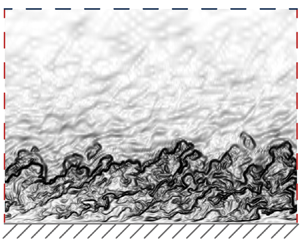
The intrinsic scaling relation between pressure fluctuations and Mach number in compressible turbulent boundary layers
-
- Journal:
- Journal of Fluid Mechanics / Volume 993 / 25 August 2024
- Published online by Cambridge University Press:
- 13 September 2024, A2
-
- Article
- Export citation
-
The scaling relations mapping the turbulence statistics in compressible turbulent boundary layers (TBLs) onto their incompressible counterparts are of fundamental significance for turbulence modelling, such as the Morkovin scaling for velocity fields, while for pressure fluctuation fields, a corresponding scaling relation is currently absent. In this work, the underlying scaling relations of pressure fluctuations about Mach number ( $M$) contained in their generation mechanisms are explored by analysing a series of direct numerical simulation data of compressible TBLs over a wide Mach number range $(0.5\leq M \leq 8.0)$. Based on the governing equation of pressure fluctuations, they are decomposed into components according to the properties of source terms. It is notable that the intensity of the compressible component, predominantly originating from the acoustic mode, obeys a monotonic distribution about the Mach number and wall distance; further, the intensity of the rest of the pressure components, which are mainly generated by the vorticity mode, demonstrates a uniform distribution consistent with its incompressible counterpart. Moreover, the coupling between the two components is negligibly weak. Based on the scaling relations, semiempirical models for the fluctuation intensity of both pressure and its components are constructed. Hence, a mapping relation is obtained that the profiles of pressure fluctuation intensities in compressible TBLs can be mapped onto their incompressible counterparts by removing the contribution from the acoustic mode, which can be provided by the model. The intrinsic scaling relation can provide some basic insight for pressure fluctuation modelling.

Cardiac biomarkers in COVID-19: what did we learn?
-
- Journal:
- Cardiology in the Young / Volume 34 / Issue 8 / August 2024
- Published online by Cambridge University Press:
- 13 September 2024, pp. 1636-1644
-
- Article
- Export citation
KRONECKER COEFFICIENTS FOR (DUAL) SYMMETRIC INVERSE SEMIGROUPS
- Part of
-
- Journal:
- Journal of the Australian Mathematical Society / Volume 118 / Issue 1 / February 2025
- Published online by Cambridge University Press:
- 13 September 2024, pp. 65-90
-
- Article
- Export citation
