Refine listing
Actions for selected content:
153921 results in Open Access
Government ideology and support for redistribution among the wealthy
-
- Journal:
- Political Science Research and Methods , First View
- Published online by Cambridge University Press:
- 17 July 2025, pp. 1-17
-
- Article
-
- You have access
- Open access
- HTML
- Export citation
On the rescuing of some-indefinites
-
- Journal:
- Journal of Linguistics / Volume 62 / Issue 2 / April 2026
- Published online by Cambridge University Press:
- 17 July 2025, pp. 329-356
- Print publication:
- April 2026
-
- Article
-
- You have access
- Open access
- HTML
- Export citation
9 - The Italian Wealth Distribution
-
- Book:
- Wealth, Office and Rank in Roman Italy
- Published online:
- 23 July 2025
- Print publication:
- 17 July 2025, pp 156-176
-
- Chapter
-
- You have access
- Open access
- Export citation
Hydromulches offer yield protection comparable to plastic mulch in organic strawberry production
-
- Journal:
- Weed Technology / Volume 39 / 2025
- Published online by Cambridge University Press:
- 17 July 2025, e75
-
- Article
-
- You have access
- Open access
- HTML
- Export citation
Has mental health changed in children and adolescents registered with a dedicated support service responding to the Manchester Arena attack: 3-year follow-up
-
- Journal:
- The British Journal of Psychiatry / Volume 228 / Issue 3 / March 2026
- Published online by Cambridge University Press:
- 17 July 2025, pp. 244-251
- Print publication:
- March 2026
-
- Article
-
- You have access
- Open access
- HTML
- Export citation
Argentopearceite, Ag16As2S11, a new silver mineral from the Mikulov and Moldava deposits, Czech Republic
-
- Journal:
- Mineralogical Magazine / Volume 90 / Issue 1 / February 2026
- Published online by Cambridge University Press:
- 17 July 2025, pp. 21-32
-
- Article
-
- You have access
- Open access
- HTML
- Export citation
Exploring the perspectives of urban and regional living Aboriginal and Torres Strait Islander Peoples regarding bush foods, nutrition and health: insights for culturally informed health policy in Australia
-
- Journal:
- Public Health Nutrition / Volume 28 / Issue 1 / 2025
- Published online by Cambridge University Press:
- 17 July 2025, e124
-
- Article
-
- You have access
- Open access
- HTML
- Export citation
A Functional Analysis of Self-Deception
-
- Journal:
- Journal of the American Philosophical Association / Volume 11 / Issue 4 / December 2025
- Published online by Cambridge University Press:
- 17 July 2025, pp. 730-749
-
- Article
-
- You have access
- Open access
- HTML
- Export citation
Successful transcatheter device occlusion of a silent patent ductus arteriosus after treatment for infective endarteritis
-
- Journal:
- Cardiology in the Young / Volume 35 / Issue 6 / June 2025
- Published online by Cambridge University Press:
- 17 July 2025, pp. 1202-1204
-
- Article
-
- You have access
- Open access
- HTML
- Export citation
Construction of a register-based severity index for anorexia nervosa in Denmark: Association with overall and cause-specific mortality
- Part of
-
- Journal:
- European Psychiatry / Volume 68 / Issue 1 / 2025
- Published online by Cambridge University Press:
- 17 July 2025, e104
-
- Article
-
- You have access
- Open access
- HTML
- Export citation
Handling of model uncertainties for underdetermined gas path analysis
-
- Journal:
- The Aeronautical Journal / Volume 129 / Issue 1338 / August 2025
- Published online by Cambridge University Press:
- 17 July 2025, pp. 2263-2282
-
- Article
-
- You have access
- Open access
- HTML
- Export citation
-
In model-based diagnostics, a simulation model is used to simulate the same operating conditions as the system to be diagnosed to detect and identify anomalies. For this type of analysis, the diagnostic results may be affected by multiple sources of uncertainty. The most common uncertainty to consider is measurement noise. Other sources of uncertainties may originate from the simulation model, instrumentation setup and numerical issues, such as tolerances. While these are often overlooked, they may affect the result to various extent.
In this paper, a multi-point model-based gas path analysis method is proposed and evaluated in the presence of both measurement noise and model uncertainties. The multi-point algorithm addresses the issue of the diagnostic system being underdetermined, having more health parameters than measurements available for diagnostics. It obtains a unique solution through an optimization, where the deviation in health parameter estimation for the operating conditions going into the analysis is minimised. Model uncertainties are introduced in the system by intentionally skewing the characteristics of the rotating components. The objective function is then reconfigured with a, for the gas turbine diagnostic field, novel method taking model uncertainties of the component maps into account. Through this it is possible to reduce the effect of model uncertainties on the diagnostic result. The study shows that through this approach, the uncertainties in diagnostic results are reduced by $3.7{\rm{\% }}$ for the evaluated operating conditions.

Aspherical complex surfaces, the Singer conjecture, and Gromov–Lück inequality $\chi \ge |\sigma |$
- Part of
-
- Journal:
- Mathematical Proceedings of the Cambridge Philosophical Society / Volume 179 / Issue 3 / November 2025
- Published online by Cambridge University Press:
- 17 July 2025, pp. 541-555
- Print publication:
- November 2025
-
- Article
-
- You have access
- Open access
- HTML
- Export citation
-
We discuss the Singer conjecture and Gromov–Lück inequality $\chi\geq |\sigma|$ for aspherical complex surfaces. We give a proof of the Singer conjecture for aspherical complex surfaces with residually finite fundamental group that does not rely on Gromov’s Kähler groups theory. Without the residually finiteness assumption, we observe that this conjecture can be proven for all aspherical complex surfaces except possibly those in Class $\mathrm{VII}_0^+$ (a positive answer to the global spherical shell conjecture would rule out the existence of aspherical surfaces in this class). We also sharpen the Gromov-Lück inequality for aspherical complex surfaces that are not in Class $\mathrm{VII}_0^+$. This is achieved by connecting the circle of ideas of the Singer conjecture with the study of Reid’s conjecture.


Dedication
-
- Book:
- Handbook of Compassion in Healthcare
- Published online:
- 27 June 2025
- Print publication:
- 17 July 2025, pp vi-vi
-
- Chapter
-
- You have access
- Open access
- HTML
- Export citation
Map of Roman Italy
-
- Book:
- Wealth, Office and Rank in Roman Italy
- Published online:
- 23 July 2025
- Print publication:
- 17 July 2025, pp xiii-xiii
-
- Chapter
-
- You have access
- Open access
- Export citation
Part II - Practising Compassion
-
- Book:
- Handbook of Compassion in Healthcare
- Published online:
- 27 June 2025
- Print publication:
- 17 July 2025, pp 83-116
-
- Chapter
-
- You have access
- Open access
- HTML
- Export citation
Part I - Compassion in Healthcare
-
- Book:
- Handbook of Compassion in Healthcare
- Published online:
- 27 June 2025
- Print publication:
- 17 July 2025, pp 11-82
-
- Chapter
-
- You have access
- Open access
- HTML
- Export citation
Appendix B - Dataset: Alimenta Pledges
-
- Book:
- Wealth, Office and Rank in Roman Italy
- Published online:
- 23 July 2025
- Print publication:
- 17 July 2025, pp 228-241
-
- Chapter
-
- You have access
- Open access
- Export citation
Conclusions
- from Part II - Practising Compassion
-
- Book:
- Handbook of Compassion in Healthcare
- Published online:
- 27 June 2025
- Print publication:
- 17 July 2025, pp 114-116
-
- Chapter
-
- You have access
- Open access
- HTML
- Export citation
From betel nuts to Cobenfy: how an ancient recreational drug gave rise to a new class of schizophrenia medications
-
- Journal:
- CNS Spectrums / Volume 30 / Issue 1 / 2025
- Published online by Cambridge University Press:
- 17 July 2025, e55
-
- Article
-
- You have access
- Open access
- HTML
- Export citation
Thermoviscous localisation of volcanic eruptions is enhanced by variations in fissure width
-
- Journal:
- Journal of Fluid Mechanics / Volume 1015 / 25 July 2025
- Published online by Cambridge University Press:
- 17 July 2025, A18
-
- Article
-
- You have access
- Open access
- HTML
- Export citation
-
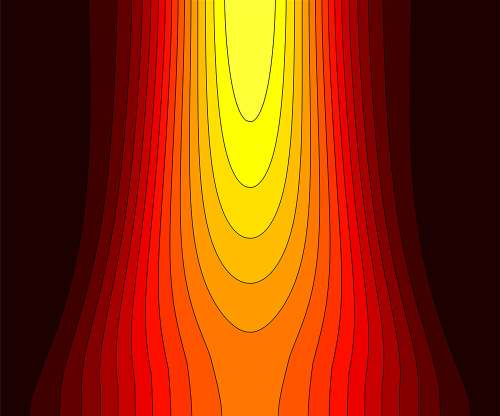
Volcanic fissure eruptions typically start with the opening of a linear fissure that erupts along its entire length, following which, activity localises to one or more isolated vents within a few hours or days. Localisation is important because it influences the spatiotemporal evolution of the hazard posed by the eruption. Previous work has proposed that localisation can arise through a thermoviscous fingering instability driven by the strongly temperature dependent viscosity of the rising magma. Here, we explore how thermoviscous localisation is influenced by the irregular geometry of natural volcanic fissures. We model the pressure-driven flow of a viscous fluid with temperature-dependent viscosity through a narrow fissure with either sinusoidal or randomised deviations from a uniform width. We identify steady states, determine their stability and quantify the degree of flow enhancement associated with localised flow. We find that, even for relatively modest variations of the fissure width ( ${\lt } 10$ %), the non-planar geometry supports strongly localised steady states, in which the wider parts of the fissure host faster, hotter flow, and the narrower parts of the fissure host slower, cooler flow. This geometrically driven localisation differs from the spontaneous thermoviscous fingering observed in planar geometries and can strongly impact the localisation process. We delineate the regions of parameter space under which geometrically driven localisation is significant, showing that it is a viable mechanism for the observed localisation under conditions typical of basaltic eruptions, and that it has the potential to dominate the effects of spontaneous thermoviscous fingering in these cases.

