Refine listing
Actions for selected content:
142763 results in Open Access
A comprehensive investigation of environmental influences on galaxies in group environments
-
- Journal:
- Publications of the Astronomical Society of Australia / Volume 41 / 2024
- Published online by Cambridge University Press:
- 24 October 2024, e096
-
- Article
-
- You have access
- Open access
- HTML
- Export citation
-
Environment has long been known to have an impact on the evolution of galaxies, but disentangling its impact from mass evolution requires the careful analysis of statistically significant samples. By implementing cutting-edge visualisation methods to test and validate group-finding algorithms, we utilise a mass-complete sample of galaxies to $z \lt 0.1$ comprised of spectroscopic redshifts from prominent surveys such as the 2-degree Field Galaxy Redshift Survey and the Galaxy and Mass Assembly Survey. Utilising our group finding methods, we find 1 413 galaxy groups made up of 8 990 galaxies corresponding to 36% of galaxies associated with group environments. We also search for close pairs, with separations of $r_\mathrm{sep} \lt 50$ $\text{h}^{-1}\text{kpc}$ and $v_\mathrm{sep} \lt 500 \: \text{km s}^{-1}$ within our sample and further classified them into major ( $M_{sec}/M_{prim} \leq$ 0.25) and minor ( $M_{sec}/M_{prim} \gt $ 0.25) pairs. To examine the impact of environmental factors, we employ bespoke WISE photometry, which facilitates accurate measurements of stellar mass and star formation rates and hence the best possible description of the variation of galaxy properties as a function of the local environment. Our analysis, employing a derived star-forming main sequence relation, reveals that star-formation (SF) within galaxies are pre-processed as a function of group membership. This is evident from the evolution of the star-forming and quenched population of galaxies. We see an increase in the fraction of quiescent galaxies relative to the field as group membership increases, and this excess of quenched galaxies relative to the field is later quantified through the use of the environmental quenching efficiency ( $\varepsilon_{env}$) metric. Within the star-forming population, we observe SF pre-processing with the relative difference in specific star formation rates ( $\Delta sSFR$), where we see a net decrease in SF as group membership increases, particularly at larger stellar masses. We again quantify this change within the SF population with our star formation deficiency ( $\varepsilon_{SFD}$) metric. Our sample of close pairs at low stellar masses exhibit enhanced star formation efficiencies compared to the field, and at larger stellar mass ranges show large deficiencies. Separating the close pairs into major/minors and primary/secondaries reveals SF enhancements projected separation decreases within the minor pairs, this effect is even more pronounced within minor primaries. This research emphasises the importance of carefully studying the properties of galaxies within group environments to better understand the pre-processing of SF within galaxies. Our results show that the small-scale environments of galaxies influence star-forming properties even when stellar masses are kept constant. This demonstrates that galaxies do not evolve in isolation over cosmic time but are shaped by a complex interaction between their internal dynamics and external influences.


Letter to the editor: willingness v. ability to pay for a universal cost-shared school food programme in Canada
-
- Journal:
- Public Health Nutrition / Volume 27 / Issue 1 / 2024
- Published online by Cambridge University Press:
- 24 October 2024, e219
-
- Article
-
- You have access
- Open access
- HTML
- Export citation

“Helping myself empowered me to help young people better”: A stepped care model, with non-specialist workers (NSWs) addressing mental health of young people in urban vulnerable communities across the Mumbai metropolitan region in India
-
- Journal:
- Cambridge Prisms: Global Mental Health / Volume 11 / 2024
- Published online by Cambridge University Press:
- 24 October 2024, e95
-
- Article
-
- You have access
- Open access
- HTML
- Export citation
Do the Bretton Woods Institutions promote economic transparency?
-
- Journal:
- Political Science Research and Methods / Volume 13 / Issue 2 / April 2025
- Published online by Cambridge University Press:
- 24 October 2024, pp. 354-372
-
- Article
-
- You have access
- Open access
- HTML
- Export citation
The impact of viral respiratory infection on surgical outcome of cavopulmonary shunt
-
- Journal:
- Cardiology in the Young / Volume 35 / Issue 1 / January 2025
- Published online by Cambridge University Press:
- 24 October 2024, pp. 72-74
-
- Article
-
- You have access
- Open access
- HTML
- Export citation

Broadband near-perfect capture of water wave energy by an array of heaving buoy wave energy converters
-
- Journal:
- Journal of Fluid Mechanics / Volume 998 / 10 November 2024
- Published online by Cambridge University Press:
- 24 October 2024, A5
-
- Article
-
- You have access
- Open access
- HTML
- Export citation
-
Arrays of heaving buoy type wave energy converters (WECs) are a promising contender to harness the renewable power of ocean waves on a commercial scale but require strategies to achieve efficient capture of wave energy over broad frequency bands for economic viability. A WEC-array design is proposed for absorption over a target frequency range in the two-dimensional water wave context by spatially grading the resonant properties of WECs via linear spring–damper power take-off mechanisms. The design is based on theories for rainbow reflection and rainbow absorption, which incorporate analyses based on Bloch wave modes and pole–zero pairs in complex frequency space. In contrast to previous applications of these theories, the influence of a higher-order passband and associated pole–zero pairs are shown to influence absorption at the high-frequency end of the target interval. The theories are used to inform initialisations for optimisation algorithms, and an optimised array of only five WECs is shown to give near-perfect absorption ( $\geq$99 %) over the target interval. Broadband absorption is demonstrated when surge and pitch motions are released, for irregular sea states, and for incident wave packets in the time domain, where the time-domain responses are decomposed into Bloch modes to connect with the underlying theory.

State servants, cash, and credit market modernizations in early modern Stockholm
-
- Journal:
- Social Science History / Volume 49 / Issue 1 / Spring 2025
- Published online by Cambridge University Press:
- 24 October 2024, pp. 52-74
- Print publication:
- Spring 2025
-
- Article
-
- You have access
- Open access
- HTML
- Export citation
Gaps and opportunities for measuring equity with the Translational Science Benefits Model: Recommendations from the Center for American Indian and Alaska Native Diabetes Translation Research
-
- Journal:
- Journal of Clinical and Translational Science / Volume 8 / Issue 1 / 2024
- Published online by Cambridge University Press:
- 24 October 2024, e206
-
- Article
-
- You have access
- Open access
- HTML
- Export citation
Geology and 40Ar/39Ar age of the Khopoli olivine gabbro intrusion, Konkan Plain, western Deccan Traps
-
- Journal:
- Geological Magazine / Volume 161 / 2024
- Published online by Cambridge University Press:
- 24 October 2024, e12
-
- Article
-
- You have access
- Open access
- HTML
- Export citation
From Piracy to Mechanization: The Atlantic Logwood Trade, 1550–1775
-
- Journal:
- Itinerario / Volume 49 / Issue 1 / April 2025
- Published online by Cambridge University Press:
- 24 October 2024, pp. 43-63
-
- Article
-
- You have access
- Open access
- HTML
- Export citation

Mental health vulnerability in multicultural families: Risk factors among homogenous country
-
- Journal:
- Cambridge Prisms: Global Mental Health / Volume 11 / 2024
- Published online by Cambridge University Press:
- 24 October 2024, e101
-
- Article
-
- You have access
- Open access
- HTML
- Export citation
Urothelial genotoxicity of environmental chemicals detected in the urine of healthy dogs and their owners
-
- Journal:
- Journal of Clinical and Translational Science / Volume 8 / Issue 1 / 2024
- Published online by Cambridge University Press:
- 24 October 2024, e172
-
- Article
-
- You have access
- Open access
- HTML
- Export citation
Nationalism and Economic Modernization of China: The Chinese Masses’ Reorientation to “the Spirit of Capitalism”
-
- Journal:
- Nationalities Papers / Volume 53 / Issue 4 / July 2025
- Published online by Cambridge University Press:
- 24 October 2024, pp. 897-916
-
- Article
-
- You have access
- Open access
- HTML
- Export citation

Inertial effects on free surface pumping with an undulating surface
-
- Journal:
- Journal of Fluid Mechanics / Volume 998 / 10 November 2024
- Published online by Cambridge University Press:
- 24 October 2024, A6
-
- Article
-
- You have access
- Open access
- HTML
- Export citation
-
Free surface flows driven by boundary undulations are observed in many biological phenomena, including the feeding and locomotion of water snails. To simulate the feeding strategy of apple snails, we develop a centimetric robotic undulator that drives a thin viscous film of liquid with the wave speed $V_w$. Our experimental results demonstrate that the behaviour of the net fluid flux $Q$ strongly depends on the Reynolds number $Re$. Specifically, in the limit of vanishing $Re$, we observe that $Q$ varies non-monotonically with $V_w$, which has been successfully rationalised by Pandey et al. (Nat. Commun., vol. 14, no. 1, 2023, p. 7735) with the lubrication model. By contrast, in the regime of finite inertia ( ${Re} \sim O(1)$), the fluid flux continues to increase with $V_w$ and completely deviates from the prediction of lubrication theory. To explain the inertia-enhanced pumping rate, we build a thin-film, two-dimensional model via the asymptotic expansion in which we linearise the effects of inertia. Our model results match the experimental data with no fitting parameters and also show the connection to the corresponding free surface shapes $h_2$. Going beyond the experimental data, we derive analytical expressions of $Q$ and $h_2$, which allow us to decouple the effects of inertia, gravity, viscosity and surface tension on free surface pumping over a wide range of parameter space.


Attachment-informed mental healthcare systems as ‘organisational caregivers’: ideas for the future
-
- Journal:
- BJPsych Bulletin / Volume 49 / Issue 4 / August 2025
- Published online by Cambridge University Press:
- 24 October 2024, pp. 259-264
- Print publication:
- August 2025
-
- Article
-
- You have access
- Open access
- HTML
- Export citation
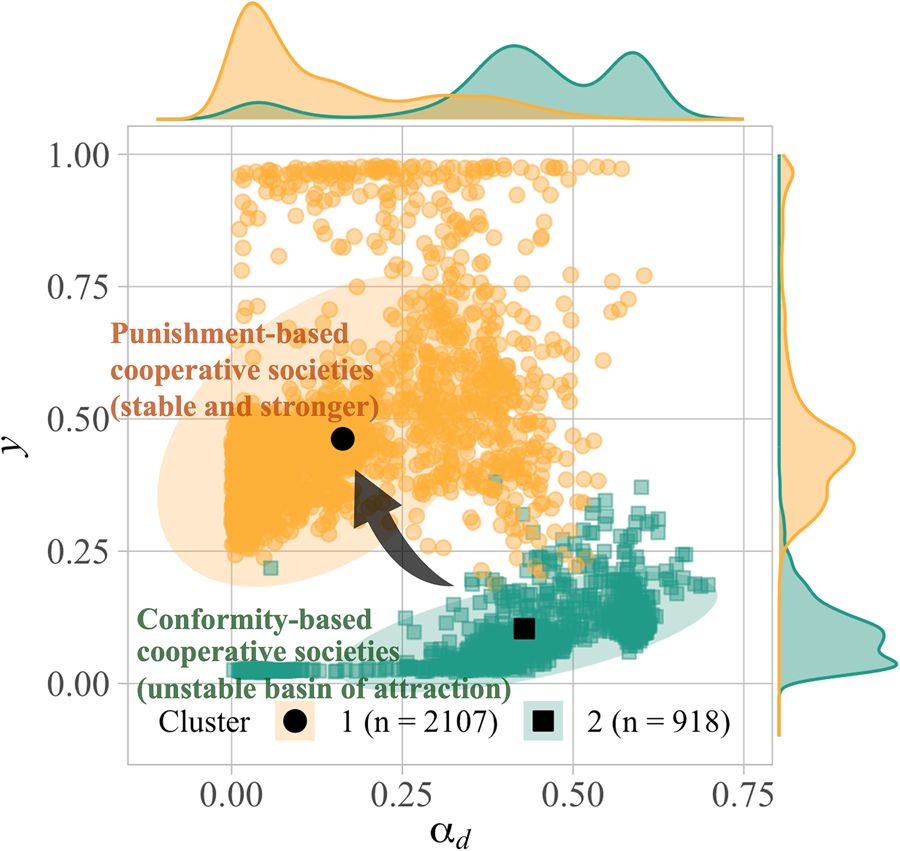
Coevolution of norm psychology and cooperation through exapted conformity
-
- Journal:
- Evolutionary Human Sciences / Volume 6 / 2024
- Published online by Cambridge University Press:
- 24 October 2024, e35
-
- Article
-
- You have access
- Open access
- HTML
- Export citation
Improving University Mental Health By Jane Morris. Cambridge University Press. 2024. £27.44 (pb). 350 pp. ISBN 978-1911623830
-
- Journal:
- BJPsych Bulletin / Volume 48 / Issue 6 / December 2024
- Published online by Cambridge University Press:
- 24 October 2024, p. 390
- Print publication:
- December 2024
-
- Article
-
- You have access
- Open access
- HTML
- Export citation
Feature, specification and evidence framework for communicating design rationale
-
- Journal:
- Design Science / Volume 10 / 2024
- Published online by Cambridge University Press:
- 24 October 2024, e20
-
- Article
-
- You have access
- Open access
- HTML
- Export citation
A Conversation with Waldemar A. Carlo, MD, Co-Division Director of Neonatology, Edwin M. Dixon Chair in Neonatology Professor of Pediatrics, University of Alabama at Birmingham
-
- Journal:
- Journal of Clinical and Translational Science / Volume 8 / Issue 1 / 2024
- Published online by Cambridge University Press:
- 24 October 2024, e173
-
- Article
-
- You have access
- Open access
- HTML
- Export citation
The Curated ATCA Census of High-Mass Clumps (CACHMC) Legacy Survey
-
- Journal:
- Publications of the Astronomical Society of Australia / Volume 41 / 2024
- Published online by Cambridge University Press:
- 24 October 2024, e079
-
- Article
-
- You have access
- Open access
- HTML
- Export citation
-
In order to study the structure and temperature distribution within high-mass star-forming clumps, we employed the Australia Telescope Compact Array to image the $\mathrm{NH}_3$ (J,K) = (1,1) through (6,6) and the (2,1) inversion transitions, the $\mathrm{H}_2\mathrm{O}$ $6_{16}$- $5_{23}$ maser line at 22.23508 GHz, several $\mathrm{CH}_3\mathrm{OH}$ lines and hydrogen and helium recombination lines. In addition, 22- and 24-GHz radio continuum emission was also imaged.
The $\mathrm{NH}_3$ lines probe the optical depth and gas temperature of compact structures within the clumps. The $\mathrm{H}_2\mathrm{O}$ maser pinpoints the location of shocked gas associated with star formation. The recombination lines and the continuum emission trace the ionised gas associated with hot OB stars. The paper describes the data and presents sample images and spectra towards select clumps. The technique for estimating gas temperature from $\mathrm{NH}_3$ line ratios is described. The data show widespread hyperfine intensity anomalies in the $\mathrm{NH}_3$ (1,1) images, an indicator of non-LTE $\mathrm{NH}_3$ excitation. We also identify several new $\mathrm{NH}_3$ (3,3) masers associated with shocked gas. Towards AGAL328.809+00.632, the $\mathrm{H}_2\mathrm{O}$ $6_{16}$- $5_{23}$ line, normally seen as a maser, is instead seen as a thermally excited absorption feature against a strong background continuum. The data products are described in detail.


