To save content items to your account,
please confirm that you agree to abide by our usage policies.
If this is the first time you use this feature, you will be asked to authorise Cambridge Core to connect with your account.
Find out more about saving content to .
To save content items to your Kindle, first ensure no-reply@cambridge.org
is added to your Approved Personal Document E-mail List under your Personal Document Settings
on the Manage Your Content and Devices page of your Amazon account. Then enter the ‘name’ part
of your Kindle email address below.
Find out more about saving to your Kindle.
Note you can select to save to either the @free.kindle.com or @kindle.com variations.
‘@free.kindle.com’ emails are free but can only be saved to your device when it is connected to wi-fi.
‘@kindle.com’ emails can be delivered even when you are not connected to wi-fi, but note that service fees apply.
The variability in ground manoeuvre occurrences for aircraft landing gear is intrinsically linked to the airport geometries served by aircraft in-service and consequently, the cyclic loads that landing gear carry are driven by the route network and characteristics of aircraft operators. Currently, assumptions must be made when deriving fatigue load spectra for aircraft landing gear, which may fail to capture the operator characteristics, potentially leading to design conservatism. This paper presents the enhanced characterisation of ground turning manoeuvres within the Automatic Dependent Surveillance-Broadcast (ADS-B) trajectories for six narrow-body aircraft across a full-service carrier (FSC) and a low-cost carrier (LCC) fleet. The methodology presented within this paper employs ADS-B latitude and longitude information to overcome limitations of previous approaches, increasing the rate of correct manoeuvre identification within ADS-B trajectories to 77% of flights from the 50% rate achieved previously. When characterising the ground manoeuvres across 3,000 flights, significant differences in manoeuvre occurrences were observed between individual aircraft within the LCC fleet and between the FSC and LCC fleets. The occurrence of tight and pivot turns were shown to vary across the six aircraft with six and eight fatigue-critical turns being performed by the FSC and LCC fleet for every 10 flights performed. In addition, it was observed that the direction of fatigue critical turns is biased in specific directions, suggesting that individual main landing gear assemblies will accumulate fatigue damage at an increased rate, leading to greater justification for operator-specific spectra and structural health monitoring of aircraft landing gear.
How does the general public perceive immigrants, whom do they think of when thinking about “immigrants,” and to what extent are these perceptions related to the actual composition of immigrant populations? We use three representative online surveys in the United States, South Africa, and Switzerland (total N = 2,778) to extend existing work on the perception of immigrants in terms of geographic coverage and individual characteristics. We also relate these responses to official statistics on immigration and integration patterns. In all three countries, there are significant discrepancies between perceptions of immigrants and their real proportion in the population and characteristics. Although we observe clear country differences, there is a striking pattern of people associating “immigrants” with “asylum seekers” in all three countries. We consider two possible explanations for the differences between perceptions and facts: the representativeness heuristic and the affect heuristic. In contrast to previous research, we find only partial support for the representativeness heuristic, whereas the results are consistent with the affect heuristic. We conclude that images of “immigrants” are largely shaped by pre-existing attitudes.
This article considers both presidential approval and party brand differentials, as measured by the generic ballot, to forecast the 2024 US presidential and congressional elections. Although both variables are leveraged to forecast collective partisan election outcomes, we consider the variables together as distinct determinants of partisan fortunes at both the executive and legislative levels. First, using a novel time series of mass national opinion since 1937, we show that presidential approval and generic brands are distinct conceptual and empirical measures of mass public assessments of collective institutions. Second, in a series of fully specified models validated with out-of-sample predictions, we show that presidential approval is the main predictor of presidential elections, yet, perhaps surprisingly, the vast bulk of the incumbent party’s performance in congressional elections is explained by partisan brands. Lastly, we forecast the 2024 U.S. national elections and find that Republicans are well positioned to win back the White House this November. By contrast, our model forecasts control of both chambers of the US Congress to be essentially a tied contest.
This article investigates the effect of priming the existence of corrupt connections to the bureaucracy and of trusted references on the demand for intermediary services. We performed an experimental survey with undergraduate students in Caracas, Venezuela. Participants are presented with a hypothetical situation in which they need to obtain the apostille of their professional degrees in order to migrate and are considering whether to hire an intermediary (“gestor”) or not. The survey randomly reveals the existence of an illicit connection between the gestor and the bureaucracy and whether a trusted individual referred the intermediary. Our findings are not consistent with the “market maker” hypothesis that revealing the existence of illicit connections increases demand. Consistent with the view that trust is a key element in inherently opaque transactions, we find that the demand for intermediaries is price inelastic when gestores are referred by trusted individuals.
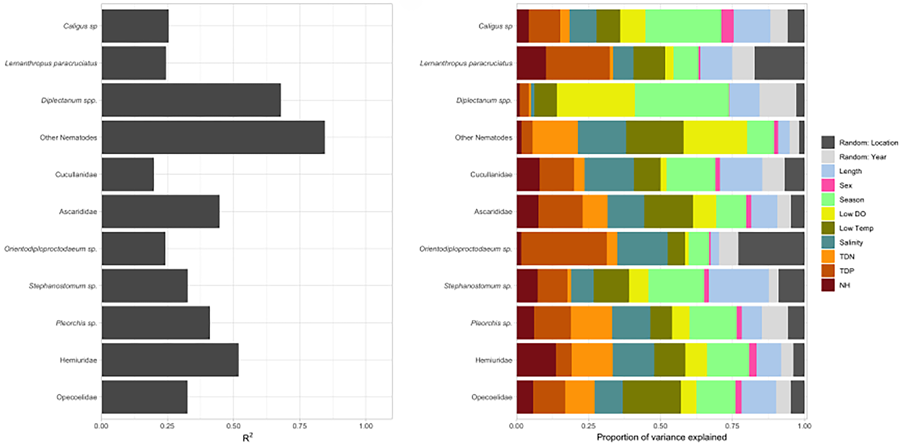
The functioning and richness of marine systems (and biological interactions such as parasitism) are continuously influenced by a changing environment. Using hierarchical modelling of species communities (HMSC), the presence and abundance of multiple parasite species of the black-spotted croaker, Protonibea diacanthus (Sciaenidae), was modelled against environmental measures reflecting seasonal change. Protonibea diacanthus were collected in three seasons across 2019–2021 from four locations within the waters of the Northern Territory, Australia. The length of P. diacanthus proved to have a strong positive effect on the abundance of parasite taxa and overall parasitic assemblage of the sciaenid host. This finding introduces potential implications for parasitism in the future as fish body size responds to fishing pressure and climate changes. Of the various environmental factors measured during the tropical seasons of northern Australia, water temperature and salinity changes were shown as potential causal factors for the variance in parasite presence and abundance, with changes most influential on external parasitic organisms. As environmental factors like ocean temperature and salinity directly affect parasite–host relationships, this study suggests that parasite assemblages and the ecological functions that they perform are likely to change considerably over the coming decades in response to climate change and its proceeding effects.
Our 2020 analysis correctly forecasted Joe Biden’s victory and the outcome of every state except Georgia. That forecast relied on economic data from 125 days prior to Election Day and presidential approval data from 104 days (or more) before the election. Since 2000, our model would have correctly forecasted the winner in 95% of all states. We updated our State Presidential Approval/State Economy Model for 2024. This article summarizes the model and its historical accuracy as well as new data updates. We then generate forecasts for the overall two-party popular vote, each state’s outcome, and the Electoral College winner for the 2024 US presidential election. One hundred days prior to Election Day, our model forecasts a split two-party popular vote (50.3% for Trump, 49.7% for Harris) but a notable Trump advantage in the Electoral College, with slightly less than a three-in-four chance that Trump wins the election. This Republican advantage 100 days prior to Election Day sheds light on Biden’s abrupt decision to drop out of the race and suggests that if Harris wins, she will have overcome extremely challenging fundamentals, and/or that Donald Trump and the Republican Party will have squandered a sizeable Electoral College advantage.
This paper analyzes the Jin Yong novel The Deer and the Cauldron through the lens of Etienne Balibar's theory of super-nationalism and supranationalism. The novel employs a pan-Asian racial ideology to expand national identity from Han Chinese to other ethnic groups (supranationalism) by introducing a racial Other, white Europeans, to unify warring groups. Simultaneously, Han culture is consistently uplifted as superior (super-nationalism). A critical sequence features the Kangxi Emperor asserting his legitimacy as the ruler of China to the protagonist Wei Xiaobao by claiming the Mandate of Heaven has passed from the Ming to the Qing dynasty. However, Han Chinese gallants and intellectuals constantly challenge his legitimacy because, as a Manchu, he is considered foreign. To resolve this issue, Wei Xiaobao begins constructing a racial national framework that includes Manchus. This paper further argues that Wei Xiaobao's moral relativism, unusual for a protagonist in martial arts fiction, enables the flexibility to redefine Chinese identity on racial grounds instead of moral or cultural. The Deer and the Cauldron illustrates the transition from the Mandate of Heaven to modern nation-state ideology in China, in the form of an irreverent martial arts fiction novel, crafted by the genre's greatest master.
Severe mental illness (SMI), which includes schizophrenia, schizoaffective disorder and bipolar disorder, has profound health impacts, even in the elderly.
Aims
To evaluate relative risk of hospital admission and length of hospital stay for physical illness in elders with SMI.
Method
To construct a population-based retrospective cohort observed from April 2007 to March 2016, data from a case registry with full but de-identified electronic health records were retrieved for patients of the South London and Maudsley NHS Foundation Trust, the single secondary mental healthcare service provider in south-east London. We compared participants with SMI aged >60 years old with the general population of the same age and residing in the same areas through data linkage by age-, sex- and fiscal-year-standardised admission ratios (SARs) for primary diagnoses at hospital discharge. Furthermore, we compared the duration of hospital stay with an age-, sex- and cause-of-admission-matched random group by linear regression for major causes of admission.
Results
In total, records for 4175 older people with SMI were obtained, relating to 10 342 admission episodes, showing an overall SAR for all physical illnesses of 5.15 (95% CI: 5.05, 5.25). Among the top causes of admission, SARs ranged from 3.87 for circulatory system disorders (ICD-10 codes: I00–I99) to 6.99 for genitourinary system or urinary conditions (N00–N39). Specifically, the diagnostic group of ‘symptoms, signs and findings, not elsewhere classified’ (R00–R99) had an elevated SAR of 6.56 (95% CI: 6.22, 6.90). Elders with SMI also had significantly longer hospital stays than their counterparts in the general population, especially for digestive system illnesses (K00–K93), after adjusting for confounding.
Conclusions
Poorer overall physical health and specific patterns were identified in elders with SMI.
Donald Trump’s bid for the 2024 Republican presidential nomination is unique in that no former president since Theodore Roosevelt in 1912 has sought the nomination of their political party, nor has a candidate sought the nomination while facing multiple criminal indictments. With data from previous nomination cycles, we use presidential nominations from 1980 to 2020 to create a forecast for the 2024 Republican primaries. The variables in the equations consist of data from the pre-primary period (e.g., money raised, cash reserves, elite endorsements, and polling results) and a second model with results of the Iowa caucuses and the New Hampshire primary to forecast the remaining primary vote. The models accurately predict Trump’s victory despite the unique nature of his candidacy.
With the upsurge of anti-globalizing ideologies and politics, the increasing institutionalization of xenophobia within the legal system has emerged as a pressing concern. Existing law and social science research has underexplored xenophobic bias in the US legal system. This article conceptualizes xenophobic bias as consisting of racism and nationalism. It investigates whether mock jurors reach different verdicts on defendant companies from foreign countries of origin (Japan, France, and China) compared to domestic (US) companies. Using a test simulating a patent lawsuit, the research finds no evidence of general xenophobic bias in juror liability verdict decisions, yet there is a specific bias against the Chinese company when granting damage awards. The similarity-leniency effect that has been established in the previous literature is corroborated in this article. Additionally, political views moderate the effects of the company’s country of origin on juror decisions. This research offers a more nuanced conceptual framework of xenophobic bias in juror decision-making for future law and social science research and informs judicial policies seeking to improve jury instructions and jury selection to reduce xenophobic bias.
The COVID-19 pandemic amplified known challenges associated with the conduct of inpatient clinical trials, while also introducing new ones that needed to be addressed.
Methods:
Stakeholders based in the United States who participated in the conduct of inpatient therapeutic trials for the treatment of COVID-19 as part of the Accelerating COVID-19 Therapeutic Interventions and Vaccines program identified challenges experienced in the conduct of these trials through a series of meeting to discuss and identify common themes. In addition, innovations developed to address these challenges and other potential solutions that may be utilized in future pandemics were highlighted.
Results:
Six thematic challenges including infection control considerations, the interplay between provision of clinical care and research, competing clinical trials, arduous consenting procedures, onerous procedural requirements, and participant recruitment including achieving representation of diverse populations were identified and are discussed here.
Conclusions:
Consideration of the lessons learned and recommendation outlined here may allow for more efficient conduct of inpatient clinical trials in future pandemics.
The initial predictions presented in this article confirm that presidential candidate vote-share estimates based on AI polling are broadly exchangeable with those of other polling organizations. We present our first two biweekly vote-share estimates for the 2024 US presidential election and benchmark them against those being generated by other polling organizations. Our post–Democratic National Convention top-line estimates for Trump (47%) and Harris (46%) closely track measurements generated by other polls during the month of August. The subsequent early September (post-debate) PoSSUM vote-share estimates for Trump (47%) and Harris (48%) again closely track with other national polling being conducted in the United States. An ultimate test for the PoSSUM polling method will be the final preelection vote-share results that we publish before Election Day on November 5, 2024.
Theory and research indicated that executive functioning (EF) correlated with, preceded, and stemmed from worry in generalized anxiety disorder (GAD). The present secondary analysis (Zainal & Newman, 2023b) thus determined whether EF domains mediated the effect of a 14-day (5 prompts/day) mindfulness ecological momentary intervention (MEMI) against a self-monitoring control (SM) for GAD.
Method
Participants (N = 110) diagnosed with GAD completed self-reported (Attentional Control Scale, GAD Questionnaire, Perseverative Cognitions Questionnaire) and performance-based tests (Letter-Number Sequencing, Stroop, Trail Making Test-B, Verbal Fluency) at baseline, post-treatment, and one-month follow-up (1MFU). Causal mediation analyses determined if pre-post changes in EF domains preceded and mediated the effect of MEMI against SM on pre-1MFU changes in GAD severity and trait repetitive negative thinking (RNT).
Results
MEMI was more efficacious than SM in improving pre–post inhibition (β = −2.075, 95% [−3.388, −0.762], p = .002), working memory (β = 0.512, 95% [0.012, 1.011], p = .045), and set-shifting (β = −2.916, 95% [−5.142, −0.691], p = .010) but not verbal fluency and attentional control. Within groups, MEMI but not SM produced improvements in all examined pre–post EF outcomes except attentional control. Only pre–post improvements in inhibition mediated the effect of MEMI against SM on pre-1MFU reductions in GAD severity (β = −0.605, 95% [−1.357, −0.044], p = .030; proportion mediated = 7.1%) and trait RNT (β = −0.024, 95% [−0.054, −0.001], p = .040; proportion mediated = 7.4%). These patterns remained after conducting sensitivity analyses with non-linear mediator-outcome relations.
Conclusions
Optimizing MEMI for GAD might entail specifically boosting inhibition plausibly by augmenting it with dialectical behavioral therapy, encouraging high-intensity physical exercises, and targeting negative emotional contrast avoidance.
Hedonic analysis of Wisconsin Beef Improvement Association Bull Sale and Development Program data revealed buyer preferences for calving ease, growth, production weight, and carcass merit traits. Attributes like calving ease direct Expected Progeny Differences (EPD), average daily gain, birth to yearling gain EPD, and rib-eye area consistently ranked higher and significantly influenced the bull’s sale price. Further analysis using a 2-Class Finite Mixture Model indicated distinct groups of buyers in the region who prioritized measured bull attributes and others who did not, confirming heterogeneity in buyer preferences.
Migrating reefs, unprecedented species assemblages, neophytes, toxicities, pollutants, aquatic ruins – The future of coral reefs in the Anthropocene is likely to look different from anything we have experienced so far. While the classic conservation debate on coral reef restoration still treats these ecosystems as “sick patients,” a radically different view of convivial conservation is beginning to challenge exclusive human control over these endangered habitats. Putting aside notions of natural “purity” and adopting a much more humble and highly interconnected perspective on marine habitats, we can begin to see reefs as transformative, sympoïetic and blasted seascapes for a convivial future. The discipline of biodesign has been primarily focussed on researching ecological relationships with regard to new materials and products. The emerging interest in shaping the multi-layered ecological relationships of habitats for other-than-human lives, however, is steering design practice towards terraforming or, in the case of marine environments, “aquaforming.” This paper argues for taking convivial conservation practices in marine environments as a starting point for the development of a new design methodology that focuses on the design of living systems in open environments: a proposed methodology called Sympoïetic Design.
This article focuses on measuring the impact of artificial intelligence (AI) on the peace and security agenda, taking stock of recent initiatives and progress in this area. While there is a keen awareness of the fact that AI can be weaponized to become a tool of power politics and military competition, there is comparatively less systematic attention paid to what technology can do for peace. While it is important to address risk mitigation, equal space should be given to thinking about how to harness the peace potential of AI on a large scale. This study follows a series of publications that aim to assess the impact of technological innovation on peace, also referred to as PeaceTech, Global PeaceTech, peace innovation, or digital peacebuilding. The first section provides an overview of the debate on the impact of AI on peace and conflict. The second section examines conceptual frameworks and measures of the impact of AI on peace and conflict. The third section looks at the risks to peace and conflict posed by the use of AI and possible governance measures to mitigate them. The fourth section provides examples of AI-enabled initiatives that are having a positive impact on peace, providing a compass for public and private investment. The conclusion offers policy recommendations to advance the AI for peace agenda.
Low birth weight (LBW) is an important public health indicator that is associated with various negative health outcomes in infants. To effectively implement interventions that would improve health outcomes in children, it is important to understand both the historical trends and current levels of LBW rates. In this study, trends and regional differences in LBW rates in Saskatchewan from 2002/2003 to 2021/2022 were assessed. A joinpoint regression analysis was conducted using historical LBW rates, obtained from the Canadian Institute for Health Information database. Data were analysed using average percent change and average annual percent change. Spatial patterns and trends were identified using a choropleth map. From a provincial and national rate of 5.2% in 2002/2003, the LBW rate in Saskatchewan increased to 6.5% in 2021/2022, approaching the national rate of 6.8%. Over the 20-year period, average annual changes for Canada were 1.4% and 1.0% for Saskatchewan. There was a turning point in the study: 2004/2005 for Canada and 2011/2012 for Saskatchewan. Initially, Saskatchewan had stable LBW rates, increasing yearly by 0.1%, while the national rate was 5.7%. However, in recent years, Saskatchewan’s rate increased to 1.8% annually, surpassing the national rate of 0.9%. Geographical differences were also observed within Saskatchewan, with the Far North region having the highest LBW rate (9.2%), and the Central West region having the lowest rate (4.3%) in 2021/2022. The Central East, Regina Qu’Appelle, and southern Saskatchewan saw significant upwards trends in LBW rates between 2015/2016 and 2021/2022. There is an increasing trend in LBW rates in Canada and Saskatchewan, as well as geographical disparities within the province. The geographical disparities in LBW rates underscore the need for tailored interventions in high-risk regions in the province.
Despite governors’ crucial roles in shaping important policies, including abortion, education, and infrastructure, forecasters have paid little attention to gubernatorial elections. We posit that institutional idiosyncrasies and lack of public opinion data have exacerbated the classic problem facing all election forecasts: there are too many predictors and too few cases, leading to overfitting. To address these problems, we combine new governor and state-level presidential approval data with a machine-learning approach, LASSO, for variable selection. LASSO examines numerous variables but retains only those that substantively improve model performance. Results demonstrate the efficacy of gubernatorial and presidential approval ratings measured two quarters preelection in predicting both incumbent-party vote share and election winners in out-of-sample predictions. For 2022, our approach outperformed the Cook Political Report’s Partisan Voting Index and compared well with 538’s Election Day prediction. For 2024, our LASSO-Popularity model predictions indicate that it will likely be a difficult year for Democrats in gubernatorial contests.