To save content items to your account,
please confirm that you agree to abide by our usage policies.
If this is the first time you use this feature, you will be asked to authorise Cambridge Core to connect with your account.
Find out more about saving content to .
To save content items to your Kindle, first ensure no-reply@cambridge.org
is added to your Approved Personal Document E-mail List under your Personal Document Settings
on the Manage Your Content and Devices page of your Amazon account. Then enter the ‘name’ part
of your Kindle email address below.
Find out more about saving to your Kindle.
Note you can select to save to either the @free.kindle.com or @kindle.com variations.
‘@free.kindle.com’ emails are free but can only be saved to your device when it is connected to wi-fi.
‘@kindle.com’ emails can be delivered even when you are not connected to wi-fi, but note that service fees apply.
The outcome of the 2016 election made it abundantly clear that victory in US presidential contests depends on the Electoral College much more than on direct universal suffrage. This fact points to the importance of using state-level models to arrive at adequate predictions of winners and losers in US presidential elections. In fact, the use of a model disaggregated to the state level and focusing on three types of measures—namely, changes in the unemployment rate, presidential popularity, and indicators of long-term patterns in the regional strength of the Democratic and Republican parties—has in the past enabled us to produce fairly accurate forecasts of the number of Electoral College votes for the presidential candidates of the two major American parties. In this article, we bring various modifications to this model to improve its overall accuracy. With Joe Biden out of the race, this revised model predicts that Donald Trump will succeed in winning back the presidency with 341 electoral votes against 197 for Kamala Harris.
To describe clinical syndromes, opportunities for antimicrobial optimization, and acceptance of recommendations made by an immunocompromised antimicrobial stewardship program performing in-person prospective audit and feedback (IPPAF) on inpatient oncology services.
Design:
Retrospective cohort study.
Setting:
Three inpatient oncology services including patients with solid tumor malignancies in an academic cancer center.
Patients:
Hospitalized adults with oncologic malignancies receive antimicrobials for any indication.
Methods:
We reviewed all patients receiving antimicrobials on inpatient oncology services who were included in IPPAF and prospectively documented clinical syndromes represented, most common recommendations, and acceptance rate. We also examined the standardized antimicrobial administration ratio (SAAR) for oncology units over the study period.
Results:
Over 34 weeks, we performed 154 interventions for 138 patients. Metastatic malignancy was common (52%) and 90-day mortality was high (43%). Diagnostic uncertainty was common (33/154, 21%), as were cases of intra-abdominal pathology (30/154, 19%), pneumonia (25/154, 16%), and urinary tract infection (12/154, 8%). The most common recommendations were changes in duration (63/154, 41%) and stopping antimicrobials for syndromes determined to be noninfectious (29/154, 19%). Acceptance of interventions was high (77% overall) and several SAARs on the primary oncology unit significantly decreased after starting IPPAF.
Conclusions:
We identified numerous opportunities for antimicrobial optimization among solid tumor malignancy patients. Most clinical syndromes were ones also encountered frequently in non-oncology populations, but several were unique and represented opportunities for targeted education.
In a prospective, remote natural history study of 277 individuals with (60) and genetically at risk for (217) Parkinson’s disease (PD), we examined interest in the return of individual research results (IRRs) and compared characteristics of those who opted for versus against the return of IRRs. Most (n = 180, 65%) requested sharing of IRRs with either a primary care provider, neurologist, or themselves. Among individuals without PD, those who requested sharing of IRRs with a clinician reported more motor symptoms than those who did not request any sharing (mean (SD) 2.2 (4.0) versus 0.7 (1.5)). Participant interest in the return of IRRs is strong.
Advance consent could address many of the limitations traditional consenting methods pose to participation in acute stroke trials. We conducted a series of five focus groups with people with lived experience of stroke. Using an inductive thematic approach, two themes were developed: factors in favour of, and against, advance consent. Participants supported the idea of advance consent and highlighted trust, transparent communication and sufficient time as major factors that would positively affect their decision to provide advance consent. The results will be used to finalise a model of advance consent suitable for testing the feasibility in stroke prevention clinics.
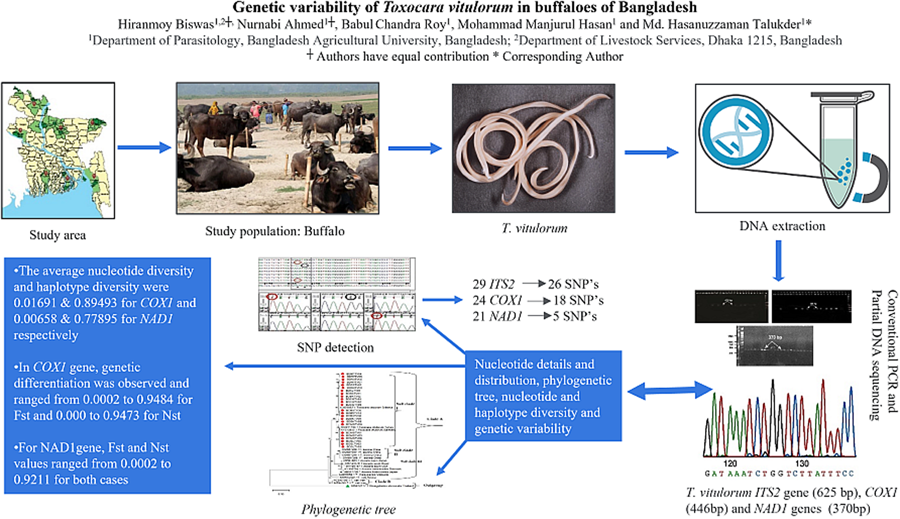
Toxocara vitulorum is one of the deadliest parasite of buffalo calves in Bangladesh. This study was conducted to explore genetic variability within and among the T. vitulorum populations in buffalo calves of Bangladesh. Genomic DNA was extracted, ITS2, COX1 and NAD1 gene were amplified and sequenced. Distinct 29 ITS2, 21 unique NAD1 and 24 COX1 genotypes were detected among the T. vitulorum of different geographic regions. These three gene genotypes similarities ranged from 97 to 99%, when these were compared to best hit scoring T. vitulorum sequences retrieved from GenBank. A total of 12 and 6 unique haplotypes were detected for COX1 and NAD1 gene sequences. The average nucleotide and haplotype diversity for COX1 and NAD1 were 0.0931 & 0.89493 and 0.00658 & 0.77895 respectively and the recorded values were more dispersed than previously published values. The pairwise Nst values ranged from −0.050 to 0.602 and Fst from −0.050 to 0.600 between all the T. vitulorum genotypes indicated huge genetic differentiation which were reportedly higher than other published reports Fst values. This is the first report of T. vitulorum on the basis of COX1 gene in Bangladesh. The study findings will be helpful for further extensive epidemiological studies regarding anthelmintic resistance, control and prevention of T. vitulorum infection in buffalo calves.
Rice cultivation in Italy is usually performed by direct seeding in flooded or in dry fields. Mechanical rice transplanting is a technique that can help control weeds and improve rice competition. To test the feasibility of the technique for different rice varieties in Italy, a study was conducted in the Lombardy region (northwest Italy), from 2016 to 2018. The study also evaluated the efficacy of hoeing in transplanted rice fields. The experiment consisted of two studies, a ‘field plot experiment’ (conducted from 2017 to 2018) and an ‘on-farm transplanting trial’ (conducted from 2016 to 2018). The ‘field plot experiment’ was carried out using a split plot design to determine the optimal transplanting distances within the row (12 or 17 cm) and the most suitable rice varieties for transplanting. Hoeing was performed once in 2017 and twice in 2018. Weed infestation was assessed by counting the number of weeds within a randomly placed square frame in the interrow areas, both before and after hoeing. Rice plant density, panicle density, yield, and yield components were also assessed. The ‘on-farm transplanting trial’ tested transplanting in several farms over the years. Different rice varieties were transplanted using the same machines, and hoeing was performed according to a predetermined schedule. Transplanter performance was assessed as well as rice yield data in all fields, while four fields were selected each year to assess hoeing efficacy against weeds. ANOVAs were used to test the differences in weed control and rice parameters among varieties and transplanting distances. The ‘field plot experiment’ showed that the transplanting distance did not affect weeds or rice variety. Transplanting at 12 cm within the row resulted in a higher plant density compared to 17 cm, however tillering compensated for the difference in the number of panicles. Carnaroli consistently recorded the lowest yield, less than 2 t ha−1, while Selenio, Spillo, and Laser seemed to be better suited for transplanting achieving the highest yield in 2018 (about 7 ha−1). In the ‘on-farm transplanting experiment’ hoeing was effective in controlling weeds, although the machineries used were not always able to function properly in saturated soil. Most of the transplanted field yielded approximately 3 to 5 t ha−1. Varieties with round grain exhibited the greatest yield variability among fields. The study suggests that to achieve a high yield in organic rice, the transplanting technique should be combined with an effective interrow tillage to control weeds.
In this article, we build a model to predict the state-level results of the 2024 election. We do so by using both polling from similar points in past election cycles and the results of the previous election. Notably, we update our model over time, and the coefficients of the two variables change as a result: the model puts more weight on polling as the election gets closer. As of September 1, 2024, we find that Kamala Harris is a narrow favorite to win the 2024 election, with a 57% chance of doing so. Currently, the model predicts she will win 289 electoral votes to Trump’s 249. However, there remains significant uncertainty, and the model will continue to be updated as the election nears.
In recent decades, there has been a global growth of the use of contract labour in the mining industry, primarily driven by cost/flexibility considerations. At the same time, contracting has been associated with poorer occupational health and safety (OHS) outcomes across a range of industries. Drawing on published research, theses, and government reports, this paper critically reviews the available evidence on the OHS effects of contract labour in mining and the likely implications of further growth in this trend. This evidence confirms that the use of contract labour is associated with worse OHS outcomes, and that the Ten Pathways and Pressure, Disorganisation, and Regulatory failure (PDR) models are both valuable in explaining this. The latter point is confirmed by a more detailed examination of four serious mine incidents in NSW and Queensland. The paper identifies some gaps and areas for further research as well as the actions that mining companies, regulators, and unions could take to improve contractor safety. Notwithstanding the latter, the paper argues that the most effective way of improving contractor safety in mines is reducing the use of contractors overall and concentrating their activities in areas such as major shutdowns/repairs, where contractors have specialised expertise to undertake non-routine tasks. Despite oft-repeated phrases such as zero-harm and management systems, the corporate shift to using contractors is primarily driven by cost-cutting and highlights how OHS is compromised by such priorities.
Drawing on the case of American Muslim voter engagement in the 2024 election season, this article argues that election-forecasting models – particularly state-based models – should integrate minority populations into their analysis as crucial variables. This is of particular significance in swing states. By including minority-voter engagement and related variables relevant to them such as pressing policy concerns (e.g., anti-war sentiment and racial attitudes), forecasters can better understand and predict electoral outcomes and address the gaps identified in traditional forecasting approaches. The recommendations presented in this article help election forecasters prepare for unexpected changes, such as the American Muslim shift of support away from President Biden in the 2024 primary election season.
External advisory committees (EACs) are critical peer-review meetings that drive improvement at Clinical and Translational Science Award Program Hubs. Despite their ubiquity, evaluations of EAC optimization and effective implementation remain scarce. We present a two-tiered approach to optimizing EAC meetings through (1) in-depth, topically focused “pre-review” meetings comprised of external topic experts and at least one standing “full-board” EAC member, followed by (2) a traditional “full-board” EAC meeting. This approach allowed pre-review discussion of program-focused topics and specific recommendations, later delivered to the full-board for review and direction. To evaluate this approach, we interviewed 18 people who planned, administered, or attended pre-review and/or full-board meetings, including internal Hub staff, external topic experts, and standing EAC members. Thematic analysis was used to explore planning, implementation, and value of our two-tiered approach versus the traditional single full-board approach. Interviewees preferred the two-tiered approach, noting benefits including additional time to reflect, shared identification of strengths and challenges, and discussion of solutions to share later with the full-board. Those who attended pre-review meetings described building “transformational,” rather than “transactional,” relationships with invitees through more discussion and inter-hub sharing. That increased sharing invited more exploration, discussion, and planning of next steps toward innovation.
Controlling the landing position of a spinning ball is difficult when using a table tennis robot. A complete physical model requires the factoring in of aerodynamic elements and object collisions, and inaccurate environmental coefficients would increase the landing position error. This study proposed a landing position control method based on a cascade neural network (CNN) that consists of forward and recurrent neural networks (RNNs). The forward NNs are used to estimate the velocity of the outgoing ball according to the velocity and acceleration of the incoming ball captured by cameras and the desired velocity of the outgoing ball. The RNN is employed to reverse-predict ball displacement based on the state of the incoming ball, desired landing point, and ball flight duration. The experiments verified that the method proposed in this study achieved control of differently spinning balls more effectively than the locally weighted regression (LWR)-based model did. The success rate of the CNN at two of six desired landing points was 25.9% and 32.9% higher, respectively, compared with use of the LWR-based model.
Suicide and suicidal behaviour strongly contribute to overall male youth mortality. An understanding of worldwide data contextualises suicide and suicidal behaviour in young men within any given country.
Method:
Members and colleagues of the World Federation of Societies of Biological Psychiatry’s Task Force on Men’s Mental Health review the relevant data from several regions of the world. The review identifies notable findings across regions of relevance to researchers, policymakers, and clinicians.
Results:
Male suicide and suicidal behaviour in adolescence and emerging adulthood within North America, Latin America and the Caribbean, Europe, the Mediterranean and the Middle East, Continental Africa, South Asia, East Asia, China, and Oceania share similarities as well as significant points of divergence.
Conclusions:
International data provide an opportunity to obtain a superior understanding of suicide and suicidal behaviour amongst young men.
The sheer number of research outputs published every year makes systematic reviewing increasingly time- and resource-intensive. This paper explores the use of machine learning techniques to help navigate the systematic review process. Machine learning has previously been used to reliably “screen” articles for review – that is, identify relevant articles based on reviewers’ inclusion criteria. The application of machine learning techniques to subsequent stages of a review, however, such as data extraction and evidence mapping, is in its infancy. We, therefore, set out to develop a series of tools that would assist in the profiling and analysis of 1952 publications on the theme of “outcomes-based contracting.” Tools were developed for the following tasks: assigning publications into “policy area” categories; identifying and extracting key information for evidence mapping, such as organizations, laws, and geographical information; connecting the evidence base to an existing dataset on the same topic; and identifying subgroups of articles that may share thematic content. An interactive tool using these techniques and a public dataset with their outputs have been released. Our results demonstrate the utility of machine learning techniques to enhance evidence accessibility and analysis within the systematic review processes. These efforts show promise in potentially yielding substantial efficiencies for future systematic reviewing and for broadening their analytical scope. Beyond this, our work suggests that there may be implications for the ease with which policymakers and practitioners can access evidence. While machine learning techniques seem poised to play a significant role in bridging the gap between research and policy by offering innovative ways of gathering, accessing, and analyzing data from systematic reviews, we also highlight their current limitations and the need to exercise caution in their application, particularly given the potential for errors and biases.
This study aimed to investigate the factors contributing to the gap in the use of hygienic materials during menstruation to collect blood among adolescent women between Aspirational and the remaining districts of India. The study sample consisted of 114805 adolescent women (20835 women from 112 Aspirational districts and 93970 women from 595 remaining districts) from the National Family Health Survey-5. Fairlie decomposition was used to identify and measure the factors contributing to the gap in the use of hygienic materials between Aspirational and the remaining districts of India. This study determined that the use of hygienic materials during menstruation varied significantly between Aspirational and the remaining districts. While only 37% of adolescent women used hygienic materials in Aspirational districts, almost 52% did so in the remaining districts. Seventy-five per cent of Aspirational districts (84 of 112 districts) reported less than 50% use of hygienic materials, which is lower than the national average and the average of the remaining districts. It was revealed that nearly 90% of the total explained gap between the two groups was accounted for by household wealth, place of residence, exposure to mass media, and education level. Wealth was the main contributor to the gap, explaining about 46% of the difference in hygienic materials use between Aspirational and the remaining districts, followed by the place of residence (18%), exposure to mass media (15%), and education level (11%). Findings suggest that targeted interventions to improve access to hygienic materials among adolescent women in Aspirational districts, particularly those in the northern states of Uttar Pradesh, Bihar, and Chhattisgarh, are necessary. Policy efforts should focus on women from poor households, improving access to education, and expanding mass media exposure in Aspirational districts to reduce the gap in menstrual hygiene practices among adolescent women in India.
Coping with a patient’s death is one of the most challenging events faced by healthcare professionals in clinical practice. A broad understanding of the coping strategies used by healthcare professionals is fundamental to the development of effective interventions and the provision of good bereavement care. This review aims to systematically synthesize the coping experience of healthcare professionals in the course of their work when they are confronted with patient deaths.
Methods
PubMed, Embase, ScienceDirect, CINAHL, PsycINFO, Web of Science, Cochrane Library, Scopus, and Wiley online library were searched in April 2023 with no restriction on publication date. A 3-stage thematic synthesis method was applied for data integration and analysis.
Results
Thirty studies involving 545 participants met the inclusion criteria and scored a high level on quality assessment ranging from 9.0 to 10.0. Six themes were identified: emotional coping, cognitive coping, behavioral coping, relational coping, spiritual coping, and occupational coping.
Significance of the results
Overall, the coping strategies used by healthcare professionals in response to bereavement were found to be unique and multidimensional. Understanding how healthcare practitioners use emotional, cognitive, behavioral, relational, spiritual, and professional strategies to cope with bereavement will prove extremely beneficial in helping them to manage their grief, and can furthermore promote their professional growth and ensure the provision of excellent bereavement care for patients.
Lon Fuller’s fictional Purple Shirt regime, Victor Orbán’s illiberal democracy in today’s Hungary and the Kaczynski brothers’ recently ended unconstitutional republic of Poland are three examples of a ‘broken democratic polity’ in which many aspects of the rule of law and constitutional democracy have been compromised and cannot be fixed without a qualified majority, even if democratic forces come to power. In this article, I address the question of whether illegal state action of a democratic government is an appropriate means of restoring legitimacy to what I call a ‘broken’ polity. Put differently: Is it morally defensible for a new democratically elected government to override and replace the rules of illiberal constitutional reform in violation of formal legality? If so, under what conditions? I argue that a positive answer to this question is justified if we adopt a neo-republican approach to politics and legitimacy.
Haemodynamic instability is common after surgical repair of CHDs in infants and children. Monitoring cardiac output in addition to traditional circulation parameters could improve the postoperative care of these patients. Echocardiography and transpulmonary thermodilution are the two most common methods for measuring cardiac output in infants.
Objectives:
To compare the results of cardiac output measurements using echocardiography and a transpulmonary thermodilution setup after paediatric cardiac surgery.
Methods:
Forty children, scheduled for elective repair of a ventricular septal defect or of an atrio-ventricular septal defect using cardiopulmonary bypass, were enrolled in this prospective, observational study. Cardiac output was simultaneously measured using echocardiography and a commercially available transpulmonary thermodilution method (PiCCO™) at 18 h after the end of surgery.
Results:
At 18 h after surgery, PiCCO™ gave a mean of 3.0% higher cardiac output than echocardiography. This difference was not statistically significant. 95% of the observations fell within –50.0 to 82.6%.
Conclusion:
The methods were found to have a good agreement on average, with no statistically significant difference between them. However, the spread of the results was large. It is questionable whether the methods can be used interchangeably in clinical practice.
‘Inhalants’ have been associated with poorer mental health in adolescence, but little is known of associations with specific types of inhalants.
Aims
We aimed to investigate associations of using volatile substances, nitrous oxide and alkyl nitrates with mental health problems in adolescence.
Method
We conducted a cross-sectional analysis using data from 13- to 14-year-old adolescents across England and Wales collected between September 2019 and March 2020. Multilevel logistic regression examined associations between lifetime use of volatile substances, nitrous oxide and alkyl nitrates with self-reported symptoms of probable depression, anxiety, conduct disorder and auditory hallucinations.
Results
Of the 6672 adolescents in the study, 5.1% reported use of nitrous oxide, 4.9% volatile solvents and 0.1% alkyl nitrates. After accounting for multiple testing, adolescents who had used volatile solvents were significantly more likely to report probable depressive (odds ratio = 4.59, 95% CI 3.58, 5.88), anxiety (odds ratio = 3.47, 95% CI 2.72, 4.43) or conduct disorder (odds ratio = 7.52, 95% CI 5.80, 9.76) and auditory hallucinations (odds ratio = 5.35, 95% CI 4.00, 7.17) than those who had not. Nitrous oxide use was significantly associated with probable depression and conduct disorder but not anxiety disorder or auditory hallucinations. Alkyl nitrate use was rare and not associated with mental health outcomes. Adjustment for use of other inhalants, tobacco and alcohol resulted in marked attenuation but socioeconomic disadvantage had little effect.
Conclusion
To our knowledge, this study provides the first general population evidence that volatile solvents and nitrous oxide are associated with probable mental health disorders in adolescence. These findings require replication, ideally with prospective designs.
Thrombocytopenia is a common symptom and one of the warning signs of dengue virus (DENV) infection. Platelet depletion is critical as it may lead to other severe dengue symptoms. Understanding the molecular events of this condition during dengue infection is challenging because of the multifaceted factors involved in DENV infection and the dynamics of the disease progression. Platelet levels depend on the balance between platelet production and platelet consumption or clearance. Megakaryopoiesis and thrombopoiesis, two interdependent processes in platelet production, are hampered during dengue infection. Conversely, platelet elimination via platelet activation, apoptosis and clearance processes are elevated. Together, these anomalies contribute to thrombocytopenia in dengue patients. Targeting the molecular events of dengue-mediated thrombocytopenia shows great potential but still requires further investigation. Nonetheless, the application of new knowledge in this field, such as immature platelet fraction analysis, may facilitate physicians in monitoring the progression of the disease.
We explored the prevalence of autism and attention-deficit hyperactivity disorder in first-episode psychosis. Through service evaluation involving 509 individuals, detailed analyses were conducted on neurodevelopmental traits and patterns of service utilisation.
Results
Prevalence of neurodivergence in first-episode psychosis was 37.7%. Neurodivergent individuals used urgent mental health services more frequently (Mann–Whitney U = 25925, Z = −2.832, P = 0.005) and had longer hospital stays (Mann–Whitney U = 22816, Z = −4.886, P ≤ 0.001) than non-neurodivergent people. Neurodivergent people spend more than twice as long in mental health hospitals at a time than the non-neurodivergent people (Mann–Whitney U = 22 909.5, Z = −4.826, P ≤ 0.001). Mediation analysis underscored indirect impact of neurodivergence on hospital stay durations through age at onset of psychosis and use of emergency services.
Clinical implications
Prevalence of neurodevelopmental conditions in first-episode psychosis is underestimated. Neurodivergent individuals show increased utilisation of mental health services and experience psychosis earlier. Early assessment is crucial for optimising psychosis management and improving mental health outcomes.