Refine search
Actions for selected content:
515 results
Local limit theorems for energy fluxes of infinitely divisible random fields
- Part of
-
- Journal:
- Journal of Applied Probability , First View
- Published online by Cambridge University Press:
- 04 May 2026, pp. 1-31
-
- Article
-
- You have access
- Open access
- HTML
- Export citation
Strong uniform convergence of Laplacians of random geometric and directed kNN graphs on compact manifolds
- Part of
-
- Journal:
- Advances in Applied Probability , First View
- Published online by Cambridge University Press:
- 24 April 2026, pp. 1-36
-
- Article
-
- You have access
- Open access
- HTML
- Export citation
-
Consider n points independently sampled from a density p of class $\mathcal{C}^2$ on a smooth compact d-dimensional submanifold $\mathcal{M}$ of $\mathbb{R}^m$, and consider the random walk visiting these points according to a transition kernel K. We study the almost sure uniform convergence of the generator of this process to the diffusive Laplace–Beltrami operator when n tends to infinity, from which we establish the convergence of the random walk to a diffusion process on the manifold. In contrast to known results, our result does not require the kernel K to be continuous, which covers the cases of walks exploring k-nearest neighbor (kNN) and geometric graphs, and convergence rates are given. The distance between the random walk generator and the limiting operator is separated into several terms: a statistical term, related to the law of large numbers, is treated with concentration tools and an approximation term that we control with tools from differential geometry. The case of kNN Laplacians is detailed. The convergence of the stochastic processes having these operators as generators is also studied, by establishing additional tightness results of their distributions on the space of càdlàg functions.


FRACTAL UNCERTAINTY PRINCIPLE FOR RANDOM CANTOR SETS
- Part of
-
- Journal:
- Journal of the Australian Mathematical Society , First View
- Published online by Cambridge University Press:
- 13 April 2026, pp. 1-22
-
- Article
- Export citation
-
We continue our investigation of the fractal uncertainty principle (FUP) for random fractal sets. In the prequel Eswarathasan and Han [‘Fractal uncertainty principle for discrete Cantor sets with random alphabet’, Math. Res. Lett. 30(6) (2023), 1657–1679], we considered the Cantor sets in the discrete setting with alphabets randomly chosen from a base of digits so the dimension $\delta \in (0,\frac 23)$. We proved that, with overwhelming probability, the FUP with an exponent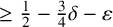 $\ge \frac 12-\frac 34\delta -\varepsilon $ holds for these discrete Cantor sets with random alphabets. In this paper, we construct random Cantor sets with dimension $\delta \in (0,\frac 23)$ in $\mathbb {R}$ via a different random procedure from the previous one used in Eswarathasan and Han [‘Fractal uncertainty principle for discrete Cantor sets with random alphabet’, Math. Res. Lett. 30(6) (2023), 1657–1679]. We prove that, with overwhelming probability, the FUP with an exponent $\ge \frac 12-\frac 34\delta -\varepsilon $ holds. The proof follows from establishing a Fourier decay estimate of the corresponding random Cantor measures, which is in turn based on a concentration of measure phenomenon in an appropriate probability space for the random Cantor sets.


Asymptotic normality for triangle counting in the sparse $\beta$-model
- Part of
-
- Journal:
- Journal of Applied Probability , First View
- Published online by Cambridge University Press:
- 07 April 2026, pp. 1-16
-
- Article
-
- You have access
- Open access
- HTML
- Export citation
-
We study the number of triangles $T_n$ in the sparse $\beta$-model on n vertices, a random graph model that captures degree heterogeneity in real-world networks. Using the norms of the heterogeneity parameter vector, we first determine the asymptotic mean and variance of $T_n$. Next, by applying the Malliavin–Stein method, we derive a non-asymptotic upper bound on the Kolmogorov distance between the normalized $T_n$ and the standard normal distribution. Under an additional assumption on degree heterogeneity, we further prove the asymptotic normality for $T_n$ as $n\to\infty$.


Weak convergence of the integral of semi-Markov processes
- Part of
-
- Journal:
- Journal of Applied Probability , First View
- Published online by Cambridge University Press:
- 06 April 2026, pp. 1-29
-
- Article
-
- You have access
- Open access
- HTML
- Export citation
-
We study the asymptotic properties, in the weak sense, of regenerative processes and Markov renewal processes. For the latter, we derive both renewal-type results, also concerning the related counting process, and ergodic-type results, including the so-called $\varphi$-mixing property. This theoretical framework permits us to study the weak limit of the integral of a semi-Markov process, which can be interpreted as the position of a particle moving with finite velocities, taken for a random time according to the Markov renewal process underlying the semi-Markov one. Under mild conditions, we obtain the weak convergence to scaled Brownian motion. As a particular case, this result establishes the weak convergence of the classical generalized telegraph process.

Monochromatic subgraphs in randomly colored dense multiplex networks
- Part of
-
- Journal:
- Advances in Applied Probability , First View
- Published online by Cambridge University Press:
- 05 March 2026, pp. 1-36
-
- Article
- Export citation
-
Given a sequence of graphs $G_n$ and a fixed graph H, denote by $T(H, G_n)$ the number of monochromatic copies of the graph H in a uniformly random c-coloring of the vertices of $G_n$. In this paper we study the joint distribution of a finite collection of monochromatic graph counts in networks with multiple layers (multiplex networks). Specifically, given a finite collection of graphs $H_1, H_2, \ldots, H_d$ we derive the joint distribution of $(T(H_1, G_n^{(1)}), T(H_2, G_n^{(2)}), \ldots, T(H_d, G_n^{(d)}))$, where $\mathbf{G}_n = (G_n^{(1)}, G_n^{(2)}, \ldots, G_n^{(d)})$ is a collection of dense graphs on the same vertex set converging in the multiplex cut-metric. The limiting distribution is the sum of two independent components: a multivariate Gaussian and a sum of independent bivariate stochastic integrals. This extends previous results on the marginal convergence of monochromatic subgraphs in a sequence of graphs to the joint convergence of a finite collection of monochromatic subgraphs in a sequence of multiplex networks. Several applications and examples are discussed.


Some stability results of optimal investment in an Itô–Markov additive market
- Part of
-
- Journal:
- Journal of Applied Probability , First View
- Published online by Cambridge University Press:
- 23 January 2026, pp. 1-17
-
- Article
- Export citation
Multitype branching processes with immigration generated by point processes
- Part of
-
- Journal:
- Journal of Applied Probability , First View
- Published online by Cambridge University Press:
- 12 January 2026, pp. 1-21
-
- Article
- Export citation
Scaling limits of SIR epidemics with vertex-dependent transition rates on complete graphs
- Part of
-
- Journal:
- Advances in Applied Probability , First View
- Published online by Cambridge University Press:
- 18 December 2025, pp. 1-45
-
- Article
- Export citation
-
In this paper we are concerned with susceptible–infected–removed (SIR) epidemics with vertex-dependent recovery and infection rates on complete graphs. We show that the hydrodynamic limit of our model is driven by a nonlinear function-valued ordinary differential equation consistent with a mean-field analysis. We further show that the fluctuation of our process is driven by a generalized Ornstein–Uhlenbeck process. A key step in the proofs of the main results is to show that states of different vertices are approximately independent as the population $N\rightarrow+\infty$.

Central limit theorems for additive functionals of patricia tries
- Part of
-
- Journal:
- Journal of Applied Probability / Volume 63 / Issue 1 / March 2026
- Published online by Cambridge University Press:
- 09 December 2025, pp. 334-347
- Print publication:
- March 2026
-
- Article
- Export citation
-
General additive functionals of patricia tries are studied asymptotically in a probabilistic model with independent, identically distributed letters from a finite alphabet. Asymptotic normality is shown after normalization together with asymptotic expansions of the moments. There are two regimes depending on the algebraic structure of the letter probabilities, with and without oscillations in the expansion of moments. As applications firstly the proportion of fringe trees of patricia tries with k keys is studied, which is oscillating around $(1-\rho(k))/(2H)k(k-1)$, where H denotes the source entropy and $\rho(k)$ is exponentially decreasing. The oscillations are identified explicitly. Secondly, the independence number of patricia tries and of tries is considered. The general results for additive functions also apply, where a leading constant is numerically approximated. The results extend work of Janson on tries by relating additive functionals on patricia tries to additive functionals on tries.

Scaling limits for supercritical nearly unstable Hawkes processes
- Part of
-
- Journal:
- Journal of Applied Probability , First View
- Published online by Cambridge University Press:
- 19 November 2025, pp. 1-16
-
- Article
-
- You have access
- Open access
- HTML
- Export citation
-
We investigate the asymptotic behavior of nearly unstable Hawkes processes whose regression kernel has $L^1$ norm strictly greater than 1 and close to 1 as time goes to infinity. We find that the scaling size determines the scaling behavior of the processes as in Jaisson and Rosenbaum (2015). Specifically, after a suitable rescale of $({a_T-1})/{T{\textrm{e}}^{b_TTx}}$, the limit of the sequence of Hawkes processes is deterministic. Also, with another appropriate rescaling of $1/T^2$, the sequence converges in law to an integrated Cox–Ingersoll–Ross-like process. This theoretical result may apply to model the recent COVID-19 outbreak in epidemiology and phenomena in social networks.


Localized geometry detection in scale-free random graphs
- Part of
-
- Journal:
- Journal of Applied Probability , First View
- Published online by Cambridge University Press:
- 04 November 2025, pp. 1-17
-
- Article
-
- You have access
- Open access
- HTML
- Export citation
-
We consider the problem of detecting whether a power-law inhomogeneous random graph contains a geometric community, and we frame this as a hypothesis-testing problem. More precisely, we assume that we are given a sample from an unknown distribution on the space of graphs on n vertices. Under the null hypothesis, the sample originates from the inhomogeneous random graph with a heavy-tailed degree sequence. Under the alternative hypothesis, $k=o(n)$ vertices are given spatial locations and connect following the geometric inhomogeneous random graph connection rule. The remaining $n-k$ vertices follow the inhomogeneous random graph connection rule. We propose a simple and efficient test based on counting normalized triangles to differentiate between the two hypotheses. We prove that our test correctly detects the presence of the community with high probability as $n\to\infty$, and identifies large-degree vertices of the community with high probability.


Poisson approximation for cycles in the generalised random graph
- Part of
-
- Journal:
- Journal of Applied Probability / Volume 63 / Issue 1 / March 2026
- Published online by Cambridge University Press:
- 03 November 2025, pp. 433-457
- Print publication:
- March 2026
-
- Article
- Export citation
-
The generalised random graph contains n vertices with positive i.i.d. weights. The probability of adding an edge between two vertices is increasing in their weights. We require the weight distribution to have finite second moments, and study the point process $\mathcal{C}_n$ on $\{3,4,\ldots\}$, which counts how many cycles of the respective length are present in the graph. We establish convergence of $\mathcal{C}_n$ to a Poisson point process. Under the stronger assumption of the weights having finite fourth moments we provide the following results. When $\mathcal{C}_n$ is evaluated on a bounded set A, we provide a rate of convergence. If the graph is additionally subcritical, we extend this to unbounded sets A at the cost of a slower rate of convergence. From this we deduce the limiting distribution of the length of the shortest and longest cycles when the graph is subcritical, including rates of convergence. All mentioned results also apply to the Chung–Lu model and the Norros–Reittu model.


THE NUMBER OF PARTS IN A RANDOM t-REGULAR PARTITION
- Part of
-
- Journal:
- Bulletin of the Australian Mathematical Society / Volume 113 / Issue 2 / April 2026
- Published online by Cambridge University Press:
- 16 October 2025, pp. 265-279
- Print publication:
- April 2026
-
- Article
-
- You have access
- Open access
- HTML
- Export citation
-
For any integer $t \geq 2$, we prove a local limit theorem (LLT) with an explicit convergence rate for the number of parts in a uniformly chosen t-regular partition. When $t = 2$, this recovers the LLT for partitions into distinct parts, as previously established in the work of Szekeres [‘Asymptotic distributions of the number and size of parts in unequal partitions’, Bull. Aust. Math. Soc. 36 (1987), 89–97].


Large and moderate deviations for Gaussian neural networks
- Part of
-
- Journal:
- Journal of Applied Probability / Volume 63 / Issue 1 / March 2026
- Published online by Cambridge University Press:
- 01 October 2025, pp. 96-115
- Print publication:
- March 2026
-
- Article
- Export citation
Limit theorems for the number of crossings and stress in projections of a random geometric graph
- Part of
-
- Journal:
- Journal of Applied Probability / Volume 63 / Issue 1 / March 2026
- Published online by Cambridge University Press:
- 01 October 2025, pp. 258-281
- Print publication:
- March 2026
-
- Article
-
- You have access
- Open access
- HTML
- Export citation
-
We consider the number of edge crossings in a random graph drawing generated by projecting a random geometric graph on some compact convex set $W\subset \mathbb{R}^d$, $d\geq 3$, onto a plane. The positions of these crossings form the support of a point process. We show that if the expected number of crossings converges to a positive but finite value, this point process converges to a Poisson point process in the Kantorovich–Rubinstein distance. We further show a multivariate central limit theorem between the number of crossings and a second variable called the stress that holds when the expected vertex degree in the random geometric graph converges to a positive finite value.


Quasi-stationary distributions for subcritical branching Markov chains
- Part of
-
- Journal:
- Advances in Applied Probability / Volume 58 / Issue 1 / March 2026
- Published online by Cambridge University Press:
- 10 September 2025, pp. 425-471
- Print publication:
- March 2026
-
- Article
- Export citation
-
Consider a subcritical branching Markov chain. Let $Z_n$ denote the counting measure of particles of generation n. Under some conditions, we give a probabilistic proof for the existence of the Yaglom limit of $(Z_n)_{n\in\mathbb{N}}$ by the moment method, based on the spinal decomposition and the many-to-few formula. As a result, we give explicit integral representations of all quasi-stationary distributions of $(Z_n)_{n\in\mathbb{N}}$, whose proofs are direct and probabilistic, and do not rely on Martin boundary theory.


Asymptotic mixed normality of maximum-likelihood estimator for Ewens–Pitman partition
- Part of
-
- Journal:
- Advances in Applied Probability / Volume 58 / Issue 1 / March 2026
- Published online by Cambridge University Press:
- 09 September 2025, pp. 214-234
- Print publication:
- March 2026
-
- Article
-
- You have access
- Open access
- HTML
- Export citation
-
This paper investigates the asymptotic properties of parameter estimation for the Ewens–Pitman partition with parameters $0\lt\alpha\lt1$ and $\theta\gt-\alpha$. Specifically, we show that the maximum-likelihood estimator (MLE) of $\alpha$ is $n^{\alpha/2}$-consistent and converges to a variance mixture of normal distributions, where the variance is governed by the Mittag-Leffler distribution. Moreover, we show that a proper normalization involving a random statistic eliminates the randomness in the variance. Building on this result, we construct an approximate confidence interval for $\alpha$. Our proof relies on a stable martingale central limit theorem, which is of independent interest.


Limit theorems for a class of unbounded observables with an application to ‘Sampling the Lindelöf hypothesis’
- Part of
-
- Journal:
- Ergodic Theory and Dynamical Systems / Volume 46 / Issue 1 / January 2026
- Published online by Cambridge University Press:
- 12 August 2025, pp. 34-92
- Print publication:
- January 2026
-
- Article
-
- You have access
- Open access
- HTML
- Export citation
-
We prove the central limit theorem (CLT), the first-order Edgeworth expansion and a mixing local central limit theorem (MLCLT) for Birkhoff sums of a class of unbounded heavily oscillating observables over a family of full-branch piecewise $C^2$ expanding maps of the interval. As a corollary, we obtain the corresponding results for Boolean-type transformations on $\mathbb {R}$. The class of observables in the CLT and the MLCLT on $\mathbb {R}$ include the real part, the imaginary part and the absolute value of the Riemann zeta function. Thus obtained CLT and MLCLT for the Riemann zeta function are in the spirit of the results of Lifschitz & Weber [Sampling the Lindelöf hypothesis with the Cauchy random walk. Proc. Lond. Math. Soc. (3) 98 (2009), 241–270] and Steuding [Sampling the Lindelöf hypothesis with an ergodic transformation. RIMS Kôkyûroku Bessatsu B34 (2012), 361–381] who have proven the strong law of large numbers for sampling the Lindelöf hypothesis.


Convergence of the QuickVal residual
- Part of
-
- Journal:
- Combinatorics, Probability and Computing / Volume 34 / Issue 6 / November 2025
- Published online by Cambridge University Press:
- 11 August 2025, pp. 780-802
-
- Article
-
- You have access
- Open access
- HTML
- Export citation
-
QuickSelect (also known as Find), introduced by Hoare ((1961) Commun. ACM 4 321–322.), is a randomized algorithm for selecting a specified order statistic from an input sequence of $n$ objects, or rather their identifying labels usually known as keys. The keys can be numeric or symbol strings, or indeed any labels drawn from a given linearly ordered set. We discuss various ways in which the cost of comparing two keys can be measured, and we can measure the efficiency of the algorithm by the total cost of such comparisons.
We define and discuss a closely related algorithm known as QuickVal and a natural probabilistic model for the input to this algorithm; QuickVal searches (almost surely unsuccessfully) for a specified population quantile $\alpha \in [0, 1]$ in an input sample of size $n$. Call the total cost of comparisons for this algorithm $S_n$. We discuss a natural way to define the random variables $S_1, S_2, \ldots$ on a common probability space. For a general class of cost functions, Fill and Nakama ((2013) Adv. Appl. Probab. 45 425–450.) proved under mild assumptions that the scaled cost $S_n / n$ of QuickVal converges in $L^p$ and almost surely to a limit random variable $S$. For a general cost function, we consider what we term the QuickVal residual:
 \begin{equation*} \rho _n \,{:\!=}\, \frac {S_n}n - S. \end{equation*}
The residual is of natural interest, especially in light of the previous analogous work on the sorting algorithm QuickSort (Bindjeme and Fill (2012) 23rd International Meeting on Probabilistic, Combinatorial, and Asymptotic Methods for the Analysis of Algorithms (AofA'12), Discrete Mathematics, and Theoretical Computer Science Proceedings, AQ, Association: Discrete Mathematics and Theoretical Computer Science, Nancy, pp. 339–348; Neininger (2015) Random Struct. Algorithms 46 346–361; Fuchs (2015) Random Struct. Algorithms 46 677–687; Grübel and Kabluchko (2016) Ann. Appl. Probab. 26 3659–3698; Sulzbach (2017) Random Struct. Algorithms 50 493–508). In the case $\alpha = 0$ of QuickMin with unit cost per key-comparison, we are able to calculate–àla Bindjeme and Fill for QuickSort (Bindjeme and Fill (2012) 23rd International Meeting on Probabilistic, Combinatorial, and Asymptotic Methods for the Analysis of Algorithms (AofA'12), Discrete Mathematics and Theoretical Computer Science Proceedings, AQ, Association: Discrete Mathematics and Theoretical Computer Science, Nancy, pp. 339–348.)–the exact (and asymptotic) $L^2$-norm of the residual. We take the result as motivation for the scaling factor $\sqrt {n}$ for the QuickVal residual for general population quantiles and for general cost. We then prove in general (under mild conditions on the cost function) that $\sqrt {n}\,\rho _n$ converges in law to a scale mixture of centered Gaussians, and we also prove convergence of moments.


