Refine search
Actions for selected content:
40 results
NAKAJIMA QUIVER BUNDLES
- Part of
-
- Journal:
- Journal of the Australian Mathematical Society , First View
- Published online by Cambridge University Press:
- 27 April 2026, pp. 1-18
-
- Article
-
- You have access
- Open access
- HTML
- Export citation
Moduli stacks of Higgs bundles on stable curves
- Part of
-
- Article
-
- You have access
- Open access
- HTML
- Export citation
Minimal Kinematics on $\mathcal{M}_{0,n}$
- Part of
-
- Article
-
- You have access
- Open access
- HTML
- Export citation
-
Minimal kinematics identifies likelihood degenerations where the critical points are given by rational formulas. These rest on the Horn uniformization of Kapranov–Huh. We characterize all choices of minimal kinematics on the moduli space $\mathcal{M}_{0,n}$. These choices are motivated by the CHY model in physics and they are represented combinatorially by 2-trees. We compute 2-tree amplitudes, and we explore extensions to non-planar on-shell diagrams, here identified with the hypertrees of Castravet–Tevelev.


Determination of period matrix of double of surface with boundary via its DN map
- Part of
-
- Journal:
- Canadian Journal of Mathematics , First View
- Published online by Cambridge University Press:
- 07 April 2025, pp. 1-24
-
- Article
- Export citation
-
As is well-known, the conformal class of a surface M with boundary is determined by its Diriclet-to-Neumann (DN) map $\Lambda $. We propose an algorithm for determination of the b-period matrix $\mathbb {B}$ of the (Schottky) double of M via $\Lambda $.


COMPACT MODULI OF ENRIQUES SURFACES OF DEGREE 2
- Part of
-
- Journal:
- Nagoya Mathematical Journal / Volume 259 / September 2025
- Published online by Cambridge University Press:
- 26 February 2025, pp. 581-624
-
- Article
-
- You have access
- Open access
- HTML
- Export citation
-
We describe a geometric, stable pair compactification of the moduli space of Enriques surfaces with a numerical polarization of degree $2$, and identify it with a semitoroidal compactification of the period space.

SOME CASES OF OORT’S CONJECTURE ABOUT NEWTON POLYGONS OF CURVES
- Part of
-
- Journal:
- Nagoya Mathematical Journal / Volume 257 / March 2025
- Published online by Cambridge University Press:
- 02 December 2024, pp. 93-103
-
- Article
- Export citation
-
This paper contains a method to prove the existence of smooth curves in positive characteristic whose Jacobians have unusual Newton polygons. Using this method, I give a new proof that there exist supersingular curves of genus $4$ in every prime characteristic. More generally, the main result of the paper is that, for every $g \geq 4$ and prime p, every Newton polygon whose p-rank is at least $g-4$ occurs for a smooth curve of genus g in characteristic p. In addition, this method resolves some cases of Oort’s conjecture about Newton polygons of curves.


Quasidiagonals in strata of translation surfaces
- Part of
-
- Journal:
- Ergodic Theory and Dynamical Systems / Volume 45 / Issue 7 / July 2025
- Published online by Cambridge University Press:
- 02 December 2024, pp. 2233-2248
- Print publication:
- July 2025
-
- Article
-
- You have access
- Open access
- HTML
- Export citation
-
We classify quasidiagonals of the $SL(2, R)$ action on products of strata or hyperelliptic loci. We use the technique of diamonds developed by Apisa and Wright in order to use induction on this problem.

A geometric p-adic Simpson correspondence in rank one
- Part of
-
- Journal:
- Compositio Mathematica / Volume 160 / Issue 7 / July 2024
- Published online by Cambridge University Press:
- 21 May 2024, pp. 1433-1466
- Print publication:
- July 2024
-
- Article
- Export citation
-
For any smooth proper rigid space $X$ over a complete algebraically closed extension $K$ of $\mathbb {Q}_p$ we give a geometrisation of the $p$-adic Simpson correspondence of rank one in terms of analytic moduli spaces: the $p$-adic character variety is canonically an étale twist of the moduli space of topologically torsion Higgs line bundles over the Hitchin base. This also eliminates the choice of an exponential. The key idea is to relate both sides to moduli spaces of $v$-line bundles. As an application, we study a major open question in $p$-adic non-abelian Hodge theory raised by Faltings, namely which Higgs bundles correspond to continuous representations under the $p$-adic Simpson correspondence. We answer this question in rank one by describing the essential image of the continuous characters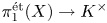 $\pi ^{{\mathrm {\acute {e}t}}}_1(X)\to K^\times$ in terms of moduli spaces: for projective $X$ over $K=\mathbb {C}_p$, it is given by Higgs line bundles with vanishing Chern classes like in complex geometry. However, in general, the correct condition is the strictly stronger assumption that the underlying line bundle is a topologically torsion element in the topological group $\operatorname {Pic}(X)$.


A GENERALISATION OF WITTEN’S CONJECTURE FOR THE PIXTON CLASS AND THE NONCOMMUTATIVE KDV HIERARCHY
- Part of
-
- Journal:
- Journal of the Institute of Mathematics of Jussieu / Volume 22 / Issue 6 / November 2023
- Published online by Cambridge University Press:
- 18 July 2022, pp. 2987-3009
- Print publication:
- November 2023
-
- Article
-
- You have access
- Open access
- HTML
- Export citation
Parametrised moduli spaces of surfaces as infinite loop spaces
- Part of
-
- Journal:
- Forum of Mathematics, Sigma / Volume 10 / 2022
- Published online by Cambridge University Press:
- 09 June 2022, e39
-
- Article
-
- You have access
- Open access
- HTML
- Export citation
-
We study the $E_2$-algebra $\Lambda \mathfrak {M}_{*,1}:= \coprod _{g\geqslant 0}\Lambda \mathfrak {M}_{g,1}$ consisting of free loop spaces of moduli spaces of Riemann surfaces with one parametrised boundary component, and compute the homotopy type of the group completion $\Omega B\Lambda \mathfrak {M}_{*,1}$: it is the product of $\Omega ^{\infty }\mathbf {MTSO}(2)$ with a certain free $\Omega ^{\infty }$-space depending on the family of all boundary-irreducible mapping classes in all mapping class groups $\Gamma _{g,n}$ with $g\geqslant 0$ and $n\geqslant 1$.


KSBA compactification of the moduli space of K3 surfaces with a purely non-symplectic automorphism of order four
- Part of
-
- Journal:
- Proceedings of the Edinburgh Mathematical Society / Volume 64 / Issue 1 / February 2021
- Published online by Cambridge University Press:
- 12 April 2021, pp. 99-127
-
- Article
- Export citation
-
We describe a compactification by KSBA stable pairs of the five-dimensional moduli space of K3 surfaces with a purely non-symplectic automorphism of order four and $U(2)\oplus D_4^{\oplus 2}$
 lattice polarization. These K3 surfaces can be realized as the minimal resolution of the double cover of $\mathbb {P}^{1}\times \mathbb {P}^{1}$
 branched along a specific $(4,\,4)$
 curve. We show that, up to a finite group action, this stable pairs compactification is isomorphic to Kirwan's partial desingularization of the GIT quotient $(\mathbb {P}^{1})^{8}{/\!/}\mathrm {SL}_2$
 with the symmetric linearization.


14 - Extending Lewisian Modal Metaphysics from a Specific Quantum Gravity Perspective
- from Part III - Issues of Interpretation
-
-
- Book:
- Beyond Spacetime
- Published online:
- 24 April 2020
- Print publication:
- 14 May 2020, pp 304-337
-
- Chapter
- Export citation
RELATIVE UNITARY RZ-SPACES AND THE ARITHMETIC FUNDAMENTAL LEMMA
- Part of
-
- Journal:
- Journal of the Institute of Mathematics of Jussieu / Volume 21 / Issue 1 / January 2022
- Published online by Cambridge University Press:
- 24 March 2020, pp. 241-301
- Print publication:
- January 2022
-
- Article
- Export citation
-
We prove a comparison isomorphism between certain moduli spaces of $p$-divisible groups and strict ${\mathcal{O}}_{K}$-modules (RZ-spaces). Both moduli problems are of PEL-type (polarization, endomorphism, level structure) and the difficulty lies in relating polarized $p$-divisible groups and polarized strict ${\mathcal{O}}_{K}$-modules. We use the theory of relative displays and frames, as developed by Ahsendorf, Lau and Zink, to translate this into a problem in linear algebra. As an application of these results, we verify new cases of the arithmetic fundamental lemma (AFL) of Wei Zhang: The comparison isomorphism yields an explicit description of certain cycles that play a role in the AFL. This allows, under certain conditions, to reduce the AFL identity in question to an AFL identity in lower dimension.


Moduli Spaces of Metrics of Positive Scalar Curvature on Topological Spherical Space Forms
- Part of
-
- Journal:
- Canadian Mathematical Bulletin / Volume 63 / Issue 4 / December 2020
- Published online by Cambridge University Press:
- 24 February 2020, pp. 901-908
- Print publication:
- December 2020
-
- Article
-
- You have access
- Open access
- Export citation
-
Let $M$ be a topological spherical space form, i.e., a smooth manifold whose universal cover is a homotopy sphere. We determine the number of path components of the space and moduli space of Riemannian metrics with positive scalar curvature on $M$ if the dimension of $M$ is at least 5 and $M$ is not simply-connected.


32 - Moduli Space; Soliton Scattering in Moduli Space Approximation; Collective Coordinates
- from Part II - Solitons and Topology; Non-Abelian Theory
-
- Book:
- Classical Field Theory
- Published online:
- 04 March 2019
- Print publication:
- 14 March 2019, pp 294-306
-
- Chapter
- Export citation
ON MAXIMALLY FROBENIUS DESTABILISED VECTOR BUNDLES
- Part of
-
- Journal:
- Bulletin of the Australian Mathematical Society / Volume 99 / Issue 2 / April 2019
- Published online by Cambridge University Press:
- 04 January 2019, pp. 195-202
- Print publication:
- April 2019
-
- Article
-
- You have access
- Export citation
-
Let $X$ be a smooth projective curve of genus $g\geq 2$ over an algebraically closed field $k$ of characteristic $p>0$. We show that for any integers $r$ and $d$ with $0<r<p$, there exists a maximally Frobenius destabilised stable vector bundle of rank $r$ and degree $d$ on $X$ if and only if $r\mid d$.


Determinant of the Laplacian on Tori of Constant Positive Curvature with one Conical Point
- Part of
-
- Journal:
- Canadian Mathematical Bulletin / Volume 62 / Issue 2 / June 2019
- Published online by Cambridge University Press:
- 04 January 2019, pp. 341-347
- Print publication:
- June 2019
-
- Article
-
- You have access
- Export citation
-
We find an explicit expression for the zeta-regularized determinant of (the Friedrichs extensions of) the Laplacians on a compact Riemann surface of genus one with conformal metric of curvature $1$ having a single conical singularity of angle $4\unicode[STIX]{x1D70B}$.


Parametric rigidity of real families of conformal diffeomorphisms tangent to x→−x
- Part of
-
- Journal:
- Proceedings of the Royal Society of Edinburgh. Section A: Mathematics / Volume 149 / Issue 1 / February 2019
- Published online by Cambridge University Press:
- 30 August 2018, pp. 261-277
- Print publication:
- February 2019
-
- Article
- Export citation
On Polarized K3 Surfaces of Genus 33
-
- Journal:
- Canadian Mathematical Bulletin / Volume 60 / Issue 3 / 01 September 2017
- Published online by Cambridge University Press:
- 20 November 2018, pp. 546-560
- Print publication:
- 01 September 2017
-
- Article
-
- You have access
- Export citation
-
We prove that the moduli space of smooth primitively polarized $\text{K3}$ surfaces of genus 33 is unirational.

The Craighero–Gattazzo surface is simply connected
- Part of
-
- Journal:
- Compositio Mathematica / Volume 153 / Issue 3 / March 2017
- Published online by Cambridge University Press:
- 28 February 2017, pp. 557-585
- Print publication:
- March 2017
-
- Article
- Export citation
-
We show that the Craighero–Gattazzo surface, the minimal resolution of an explicit complex quintic surface with four elliptic singularities, is simply connected. This was conjectured by Dolgachev and Werner, who proved that its fundamental group has a trivial profinite completion. The Craighero–Gattazzo surface is the only explicit example of a smooth simply connected complex surface of geometric genus zero with ample canonical class. We hope that our method will find other applications: to prove a topological fact about a complex surface we use an algebraic reduction mod $p$ technique and deformation theory.

