To save content items to your account,
please confirm that you agree to abide by our usage policies.
If this is the first time you use this feature, you will be asked to authorise Cambridge Core to connect with your account.
Find out more about saving content to .
To save content items to your Kindle, first ensure no-reply@cambridge.org
is added to your Approved Personal Document E-mail List under your Personal Document Settings
on the Manage Your Content and Devices page of your Amazon account. Then enter the ‘name’ part
of your Kindle email address below.
Find out more about saving to your Kindle.
Note you can select to save to either the @free.kindle.com or @kindle.com variations.
‘@free.kindle.com’ emails are free but can only be saved to your device when it is connected to wi-fi.
‘@kindle.com’ emails can be delivered even when you are not connected to wi-fi, but note that service fees apply.
Five specimens of the rare alpheid shrimp Betaeus levifrons Vinogradov, 1950 were collected from the burrows of the mud-shrimp Upogebia major (De Haan, 1841) in Akkeshi and Usu Bays, along the Pacific coast of Hokkaido, Japan. As B. levifrons has been previously only reported from the Russian coast of the Sea of Japan, the Hokkaido specimens represent the first record of this species from the western Pacific coast as well as a new to the Japanese fauna. Ovigerous females of B. levifrons were recorded for the first time based on specimens. This study provides additional data on this species, including its distribution, colour variation, and DNA sequences of the mitochondrial 16S rRNA and cytochrome c oxidase subunit I barcoding regions. Lastly, we revised the available data on the symbiotic fauna of U. major.
This review highlights the importance of dietary fibres (DF) intake and its interconnection with the gut microbiome and psychological well-being, while also exploring the effects of existing DF interventions on these aspects in adults. The gut microbiota is a complex and diverse ecosystem in which microbial species interact, influencing the human host. DF are heterogeneous, requiring different microbial species to degrade the complex DF structures. Emerging evidence suggests that microbial fermentation of DF produces short-chain fatty acids (SCFA), which may play a role in regulating psychological well-being by affecting neurotransmitter levels, including serotonin. The effectiveness of DF interventions depends on factors such as baseline gut microbiota composition, the dosage and the source of DF consumed. Although the gut microbiota of adults is relatively stable, studies have shown that the abundance of the species in the gut microbiota can change within 24 h of an intervention and may return to baseline following the termination of DF intervention. This review underscores the need for larger and well-powered dietary clinical trials incorporating longitudinal biological sample collections, advanced sequencing and omic techniques (including novel dietary biomarkers and microbial metabolites), validated subjective questionnaires and dietary records. Furthermore, mechanistic studies driven by clinical observations are crucial to understanding gut microbiota function and its underlying biological pathways, informing targeted dietary interventions.
Metabolic syndrome (MetS) is associated with an increased risk of CVD, type 2 diabetes and death from all causes. Dietary factors correlate with MetS, making diet a potential target for intervention. We used data from the 2012–2016 Korea National Health and Nutrition Examination Survey (KNHANES, n 12 122) to identify a dietary pattern (DP) using thirty-nine predefined food groups as predictors. MetS components were used as the response variable with the food groups in reduced rank regression followed by stepwise linear regression analyses. We then verified the Korean status of the DP externally in the Cardiovascular Disease Association Study (CAVAS) (n 8277) and the Health EXAminees (HEXA) study (n 48 610). The DP score, which included twenty food groups, showed significant positive associations with all MetS components and a higher prevalence ratio in KNHANES participants (P < 0·0001). Although the score was NS in CAVAS (P = 0·0913), it showed a strong positive association with MetS prevalence in HEXA (P < 0·0001). We identified and tested a DP associated with MetS in Korean populations. This DP may be a useful tool for assessing MetS risk. Although the score was linked to higher MetS risk, particularly in the predominantly urban population of the HEXA study, further validation in more diverse populations is needed.
Metarhizium guizhouense (Clavicipitaceae) is an insect pathogen employed as a mycoinsecticide against many insect pests worldwide. In this study, for the first time in a laboratory setting, the pathogenicity of the M. guizhouense isolate PSUM04 was evaluated against the coffee berry borer, Hypothenemus hampei (Coleoptera: Curculionidae: Scolytinae). Following the exposure (1 × 10⁹ spores/mL) of H. hampei to M. guizhouense PSUM04, morpho-histopathological changes and numbers of apoptotic cells via the TUNEL (terminal deoxynucleotidyl transferase (TdT), dUTP (deoxyuridine triphosphate) nick-end labelling) assay in H. hampei were evaluated at 12-hour intervals until 144 hours after exposure. The external morphology of H. hampei underwent drastic changes from 24 to 144 hours post-exposure accompanied by the degeneration of integument and adipose tissues. The semi-quantitative analytical score of TUNEL-positive cells showed a slight increase at 12 hours after exposure and a significant increase in TUNEL-positive apoptotic cells at 48 hours after exposure. These results suggest a series of tissue alterations of H. hampei during its process of infection with a strain of M. guizhouense, highlighting the pathogen’s potential as a biological control agent in natural settings.
We present a comprehensive analysis of the rise of fictions across human narratives, using large-scale datasets that collectively span over 65,000 works across various media (movies, literary works), cultures (over 30 countries, Western and non-Western), and time periods (2000 BCE to 2020 CE). We measured fictiveness – defined as the degree of departure from reality – across three narrative dimensions: protagonists, events, and settings. We used automatic annotations from large language models (LLMs) to systematically score fictiveness and ensured the robustness and validity of our measure, specifically by demonstrating predictable variations in fictiveness across different genres, in all media. Statistical analyses of the changes in fictiveness over time revealed a steady increase, culminating in the 20th and 21st centuries, across all narrative forms. Remarkably, this trend is also evident in our data spanning ancient times: fictiveness increased gradually in narratives dating back as far as 2000 BCE, with notable peaks of fictiveness during affluent periods such as the heights of the Roman Empire, the Tang Dynasty, and the European Renaissance. We explore potential psychological explanations for the rise in fictiveness, including changing audience preferences driven by ecological and social changes.
Plants in the genera Astragalus and Oxytropis, collectively referred to as “locoweeds,” contain swainsonine, a toxic alkaloid synthesized by their fungal endophyte Alternaria sect. Undifilum. The ecological role of this endophyte across the mutualism–commensalism–parasitism continuum is unknown. We examined the fitness traits of Astragalus and Oxytropis species growing with and without the endophyte, in a 9-yr, common-garden experiment. Silky crazyweed (Oxytropis sericea Nutt.) and woolly loco (Astragalus mollissimus Torr.) plants germinated from seeds that naturally host the endophyte (E+) and with it mechanically removed (E−) were established in a common garden in southwest Montana. We measured mortality, gas exchange, flower and seed production, seed germination, and final biomass. Astragalus mollissimus plants grew as annuals under common-garden conditions regardless of endophyte status. Oxytropis sericea plants grew as perennials with survival unaffected by endophyte; however, E+ O. sericea plants produced slightly more reproductive stems, flowers per stem, and crown and stem biomass. Maternal effects detected in the parental generation disappeared in subsequent generations. Gas exchange, fecundity, and seed germination were unaffected by endophyte. Contrary to our initial hypothesis of mutualism, the endophyte did not improve host survival or fecundity, nor did we detect transgenerational effects. However, the endophyte did slightly increase the number of reproductive stems and flowers per stem and crown and stem mass in O. sericea, suggesting endophytic effects on carbohydrate biochemistry and pollination parameters should be examined. Lack of selection for or against endophyte-containing plants allows both nontoxic and toxic swainsonine-producing plants to persist in Astragalus and Oxytropis populations, posing a continued threat to grazing livestock.
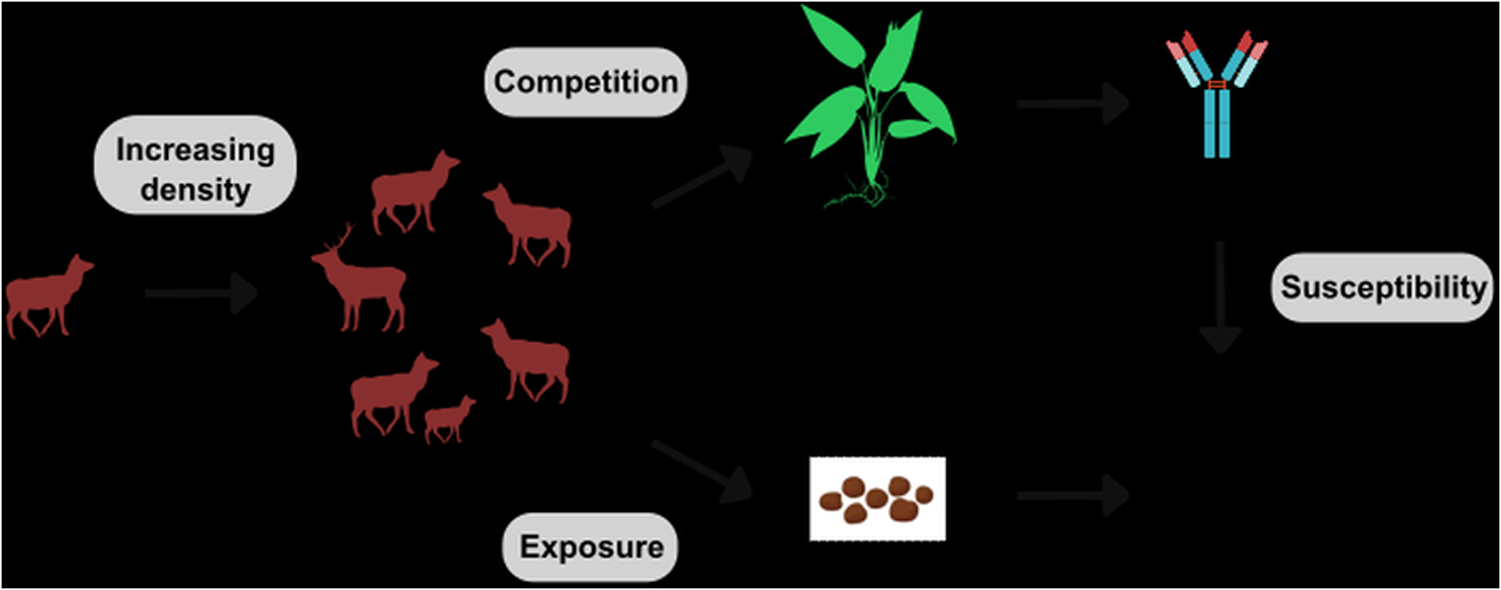
Exposure to environmentally transmitted parasites should increase with population density due to accumulation of infective parasites in space. However, resource competition also increases with density, lowering immunity and increasing susceptibility, offering an alternative pathway for density-dependent infection. To test the relationships between these two processes and parasitism, we examined associations between host density, resource availability, immunity, and counts of 3 common helminth parasites using a long-term study of red deer. We found evidence that immunity increased with resource availability while parasite counts declined with immunity. We also found that greater density correlated with reduced resource availability, and while density was positively associated with both strongyle and tissue worm burdens, resource availability was independently and negatively associated with the same burdens. Our results support separate roles of density-dependent exposure and susceptibility in driving infection, providing evidence that resource competition is an important driver of infection, exacerbating effects of density-dependent increases in exposure.
The aim of the study was to evaluate calcium anacardate (CAn), associated or not with citric acid (CAc) in laying hen diets on performance, egg quality, serum biochemical profile, serum lipid peroxidation (TBARS) and catalase (CAT) in reproductive tissue. A total of 432 laying hens from 63 to 74 weeks of age, were distributed in nine diets: Control; 0.25% CAn; 0.25% of CAn associated with 0.25% CAc; 0.50% CAn; 0.50% CAn associated with 0.25% CAc; 0.50% CAn associated with 0.50% CAc; 0.75% of CAn; 0.75% CAn associated with 0.25% CAc; 0.75% CAn associated with 0.50% CAc. There was no effect of CAn or CAc on laying hen performance. Yolk colour showed greater pigmentation for 0.75% CAn and its associations with CAc (0.25% and 0.50%). Lower egg yolk oxidation was observed for an isolated dose of 0.75% CAn. Higher values of TBARs were observed in eggs from birds fed control diet; 0.25% CAn; 0.50% CAn associated with 25% CAc and 0.75% CAn associated with 0.25 and 0.50% CAc. Dietary inclusion of CAn (0.75%) and its association with CAc (0.50% CAn with 0.50 CAc) for late-phase laying hens reduce serum peroxidation. CAn from 0.50% associated with CAc increases catalase in magnum. The addition of 0.75% CAn increases yolk pigmentation, reduces lipid oxidation in the yolk and blood plasma and increases CAT activity in the magnum in late-stage laying hens. These benefits can also be obtained with the combination of 0.50% CAn and 0.50% CAc.
Common peccaries (Tayassu pecari), wild boars (Sus scrofa) and collared peccaries (Dicotyles tajacu) are species that have gained attention in Brazil because of their close relationship with human beings, their influence on the environment and the parasitic fauna they host, which is common in free-ranging animals. In this study, we obtained the carcasses S. scrofa (n = 4), T. pecari (n = 12) and D. tajacu (n = 1) that were killed by hunting (only wild boars), or by being run over or burned. The animals were necropsied and searched for parasites. The parasites found in the gastrointestinal tract were fixed in ethanol for morphological identification. The parasites identified were Ascaris suum, Monodontus rarus, Monodontus semicircularis, Strongyloides spp., Lagochilascaris minor, Eucyathostomum dentatum, Oligacanthorhynchus major and Ascarops strongylina. In addition to observing the occurrence of different species of parasites in tayassuids and suids, we also aimed to raise awareness among the population about the dangers of consuming these animals, as well as the importance of ecological relationships for the propagation of parasitic fauna. Our results indicate that parasites are host switching, possibly related to the adaptation of L. minor and M. rarus.
Snakes serve as important hosts for parasites at the interface of wildlife, humans and domestic animals. However, their helminth fauna in tropical regions, particularly Thailand, remains poorly documented. This study investigates the helminth fauna, community structure, infection patterns and their co-occurrence dynamics in the monocled cobra (Naja kaouthia) from urbanized areas of central Thailand, based on comprehensive analyses of 34 wild-caught individuals. Using integrated morphological and molecular approaches (e.g. mitochondrial 16S rRNA and COI gene sequencing), 11 helminth species were identified – 9 nematodes (Kalicephalus bungari, Kalicephalus sp. I and II, Paracapillaria najae, Paracapillaria siamensis, Serpentirhabdias orientalis, Strongyloides sp., a filarioid nematode and an unknown encysted nematode), 1 cestode (Duthiersia expansa) and 1 acanthocephalan (Sphaerechinorhynchus sp.) – including 2 newly described species: P. siamensis (infected in gastrointestinal tract) and S. orientalis (in respiratory tract). Serpentirhabdias orientalis and K. bungari were the most prevalent species (75.8%), while encysted nematodes exhibited the highest infection intensities (up to 500 parasites per host). Host–parasite network analysis revealed strong organ tropism in some helminth species (e.g. Paracapillaria spp.) and non-random co-occurrence patterns. Parasite abundance was positively correlated with host body condition, and females harboured greater species richness than males (11 vs. 8 taxa). The absence of trematodes is consistent with the host’s terrestrial ecology, while the low prevalence of filarioids (3.0%) suggests limited transmission. These findings underscore the value of integrative taxonomy in revealing hidden parasite diversity and highlight ecological drivers of infection patterns in snakes, with implications for wildlife health and zoonotic risk in human-modified landscapes.
Nutrition intervention is an effective way to improve flesh qualities of fish. The effect of feed supplementation with glutamate (Glu) on flesh quality of gibel carp (Carassius gibelio) was investigated. In trial 1, the fish (initial weight: 37.49 ± 0.08 g) were fed two practical diets with 0 and 2% Glu supplementation. In trial 2, the fish (37.26 ± 0.04 g) were fed two purified diets with 0 and 3% Glu supplementation. The results after feeding trials showed that dietary Glu supplementation increased the hardness and springiness of muscle, whether using practical or purified diets. Glu-supplemented diets increased the thickness and density of myofibres and collagen content between myofibres. Furthermore, Glu promoted muscle protein deposition by regulating the IGF-1-AKT-mTOR signalling pathway, and enhanced the myofibre hypertrophy by upregulating genes related to myofibre growth and development (mef2a, mef2d, myod, myf5, mlc, tpi and pax7α). The protein deposition and myofibre hypertrophy in turn improved the flesh texture. In addition, IMP content in flesh increased when supplementing Glu whether to practical or to purified diet. Metabolomics confirmed that Glu promoted the deposition of muscle-flavoured substances and purine metabolic pathway most functioned, echoed by the upregulation of key genes (ampd, ppat and adsl) in purine metabolism. The sensory test also clarified that dietary Glu improved the flesh quality by enhancing the muscle texture and flavour. Conclusively, dietary Glu supplementation can improve the flesh quality in this fish, which can further support evidence from other studies more generally that improve flesh quality of cultured fish.
Highlights from the International Symposium on Twins, held at the University of Crete on May 23−24, 2025, are summarized. The symposium, organized by Dr Maria Markodimitraki, Professor in the Department of Preschool Education at the University of Crete, attracted scholars and practitioners from Greece and around the world. Meetings with a pair of reunited monozygotic female twins, and a female twin in search of her sister, also from Greece, are described. This review is followed by summaries of twin research on neonatal outcomes, growth discordance and restriction, and romantic partners and alcohol use. Human interest stories include a book documenting the extraordinary lives of identical twins Celia and Mamaine Paget, a museum wing honoring the lost Rockefeller twin, a remarkable conjoined twinning case in India, the death of an Australian sports icon, and a most unusual triplet birth.
Cryptosporidium parvum is a well-established cause of gastrointestinal illness in both humans and animals and often causes outbreaks at animal contact events, despite the availability of a code of practice that provides guidance on the safe management of these events. We describe a large C. parvum outbreak following a lamb-feeding event at a commercial farm in Wales in 2024, alongside findings from a cohort study to identify high-risk exposures. Sixty-seven cases were identified, 57 were laboratory-confirmed C. parvum, with similar genotypes. Environmental investigations found a lack of adherence to established guidance. The cohort study identified 168 individuals with cryptosporidiosis-like illness from 540 exposure questionnaires (distributed via email to 790 lead bookers). Cases were more likely to have had closer contact with lambs (odds ratio (OR) kissed lambs = 2.4, 95% confidence interval (95% CI): 1.2–4.8). A multivariable analysis found cases were more likely to be under 10 years (adjusted OR (aOR) = 4.5, 95% CI: 2.0–10.0) and have had visible faeces on their person (aOR = 3.6, 95% CI: 2.1–6.2). We provide evidence that close contact at lamb-feeding events presents an increased likelihood of illness, suggesting that farms should limit animal contact at these events and that revisions to established codes of practice may be necessary. Enhancing risk awareness among farmers and visitors is needed, particularly regarding children.
The need for critical minerals for various technologies for commercial and defense use has led to a range of national policy interventions. However, many of these new laws to encourage mining, or protect local industries have not considered as scientific data on mineral reserves or the economic viability of setting specific targets. The EU’s Critical Raw Materials Act is a pivotal case in point that illustrates this challenge. We present a review of the range of laws and policies that have been set forth worldwide.
Technical Summary
Growing international conflict between countries that have large mineral production and processing capacity and those which are in demand of critical raw materials for new technologies has led to a proliferation of policies that promote resource nationalism or ‘friend-shoring’. We analyzed over 400 critical raw material policies to date that have been documented by the International Energy Agency's policy tracking tool and present the findings of the six most active jurisdictions. The EU's Critical Raw Materials Act which came into force in May 2024 stands out as the most significant legislative step taken thus far but needs better interface with environmental and social data on impacts and benefits. By analyzing the challenges faced by lithium mining projects across a range of technologies and geographic locations in Europe, we suggest the use of data generated from life cycle analyses, economic geological calculations, and ecosystem service valuation in improving the implementation of such policies and also mitigate social conflicts.
Social Media Summary
There are now more than 400 critical raw material policies worldwide, but they need to be predicated in economic and geological data to be effective.
Several malaria control measures aim to reduce infection levels in mosquitoes, and evaluation of these measures usually relies on experimental infections of mosquitoes or evaluation in field populations. Both require robust statistical tools to account for multiple variables and non-normal distributions of parasites in the vector host. We argue that a well-chosen generalized linear or mixed model is the most appropriate statistical tool for analysing and interpreting these biological data. We suggest specific methods to overcome datasets where some groups have zero/close to zero prevalence, or many zero counts of parasite numbers (as would be seen with an effective transmission blocking intervention). These methods are more broadly applicable across many parasitic infections with similar patterns of parasite numbers across hosts.
Heartwater is a tick-borne disease (TBD) of wild and livestock ruminants that threatens food security and the economy throughout much of Africa. Furthermore, the geographic range of heartwater is expanding and is predicted to continue doing so. Despite this, our understanding of heartwater dynamics lags far behind that of many other TBDs. We are therefore limited in our ability to design effective disease control strategies. In this study, we derive and analyse a mathematical model of heartwater dynamics. We analyse our model to predict the most influential parameters for disease risk, both in terms of new outbreaks and in heartwater-endemic regions. We show that the host-finding efficiency of ticks is the most influential parameter affecting outbreak risk. Also, outbreak risk is highly sensitive to the impact of the heartwater pathogen on tick fitness – a previously unexplored concept for any TBD system. In areas where heartwater is established, we show that disease can be controlled via enzootic stability (prolonged host immunity attained via frequent pathogen exposure). However, the maintenance of enzootic stability was dependent on several ecological and physiological parameters. Regarding practical output, we suggest prioritizing tick control measures during periods when ticks are most active in terms of dispersing towards hosts, so as to mitigate heightened outbreak risk. In addition, given the specificity of conditions required for enzootic stability, we caution against relying solely on enzootic stability for long-term heartwater protection. More broadly, our study highlights important tick life history parameters that have been neglected by previous TBD models.