Refine listing
Actions for selected content:
1073 results in 05Cxx
SMALL-WORLD EFFECT IN GEOGRAPHICAL ATTACHMENT NETWORKS
- Part of
-
- Journal:
- Probability in the Engineering and Informational Sciences / Volume 35 / Issue 2 / April 2021
- Published online by Cambridge University Press:
- 12 September 2019, pp. 276-296
-
- Article
- Export citation
On the Chromatic Number of Matching Kneser Graphs
- Part of
-
- Journal:
- Combinatorics, Probability and Computing / Volume 29 / Issue 1 / January 2020
- Published online by Cambridge University Press:
- 12 September 2019, pp. 1-21
-
- Article
- Export citation
Transient and slim versus recurrent and fat: Random walks and the trees they grow
- Part of
-
- Journal:
- Journal of Applied Probability / Volume 56 / Issue 3 / September 2019
- Published online by Cambridge University Press:
- 01 October 2019, pp. 769-786
- Print publication:
- September 2019
-
- Article
- Export citation
-
The no restart random walk (NRRW) is a random network growth model driven by a random walk that builds the graph while moving on it, adding and connecting a new leaf node to the current position of the walker every s steps. We show a fundamental dichotomy in NRRW with respect to the parity of s: for ${s}=1$ we prove that the random walk is transient and non-leaf nodes have degrees bounded above by an exponential distribution; for s even we prove that the random walk is recurrent and non-leaf nodes have degrees bounded below by a power law distribution. These theoretical findings highlight and confirm the diverse and rich behaviour of NRRW observed empirically.

Degree correlations in scale-free random graph models
- Part of
-
- Journal:
- Journal of Applied Probability / Volume 56 / Issue 3 / September 2019
- Published online by Cambridge University Press:
- 01 October 2019, pp. 672-700
- Print publication:
- September 2019
-
- Article
- Export citation
-
We study the average nearest-neighbour degree a(k) of vertices with degree k. In many real-world networks with power-law degree distribution, a(k) falls off with k, a property ascribed to the constraint that any two vertices are connected by at most one edge. We show that a(k) indeed decays with k in three simple random graph models with power-law degrees: the erased configuration model, the rank-1 inhomogeneous random graph, and the hyperbolic random graph. We find that in the large-network limit for all three null models, a(k) starts to decay beyond $n^{(\tau-2)/(\tau-1)}$ and then settles on a power law $a(k)\sim k^{\tau-3}$, with $\tau$ the degree exponent.


Subgraphs in preferential attachment models
- Part of
-
- Journal:
- Advances in Applied Probability / Volume 51 / Issue 3 / September 2019
- Published online by Cambridge University Press:
- 03 September 2019, pp. 898-926
- Print publication:
- September 2019
-
- Article
- Export citation
-
We consider subgraph counts in general preferential attachment models with power-law degree exponent $\tau > 2$. For all subgraphs H, we find the scaling of the expected number of subgraphs as a power of the number of vertices. We prove our results on the expected number of subgraphs by defining an optimization problem that finds the optimal subgraph structure in terms of the indices of the vertices that together span it and by using the representation of the preferential attachment model as a Pólya urn model.

The Genus of a Random Bipartite Graph
- Part of
-
- Journal:
- Canadian Journal of Mathematics / Volume 72 / Issue 6 / December 2020
- Published online by Cambridge University Press:
- 29 August 2019, pp. 1607-1623
- Print publication:
- December 2020
-
- Article
-
- You have access
- Export citation
-
Archdeacon and Grable (1995) proved that the genus of the random graph $G\in {\mathcal{G}}_{n,p}$ is almost surely close to $pn^{2}/12$ if $p=p(n)\geqslant 3(\ln n)^{2}n^{-1/2}$. In this paper we prove an analogous result for random bipartite graphs in ${\mathcal{G}}_{n_{1},n_{2},p}$. If $n_{1}\geqslant n_{2}\gg 1$, phase transitions occur for every positive integer $i$ when $p=\unicode[STIX]{x1D6E9}((n_{1}n_{2})^{-i/(2i+1)})$. A different behaviour is exhibited when one of the bipartite parts has constant size, i.e., $n_{1}\gg 1$ and $n_{2}$ is a constant. In that case, phase transitions occur when $p=\unicode[STIX]{x1D6E9}(n_{1}^{-1/2})$ and when $p=\unicode[STIX]{x1D6E9}(n_{1}^{-1/3})$.


BISECTORS IN VECTOR GROUPS OVER INTEGERS
- Part of
-
- Journal:
- Bulletin of the Australian Mathematical Society / Volume 100 / Issue 3 / December 2019
- Published online by Cambridge University Press:
- 15 August 2019, pp. 353-361
- Print publication:
- December 2019
-
- Article
-
- You have access
- Export citation
ELASTIC GRAPHS
- Part of
-
- Journal:
- Forum of Mathematics, Sigma / Volume 7 / 2019
- Published online by Cambridge University Press:
- 13 August 2019, e24
-
- Article
-
- You have access
- Open access
- Export citation
Quasi-Sturmian colorings on regular trees
- Part of
-
- Journal:
- Ergodic Theory and Dynamical Systems / Volume 40 / Issue 12 / December 2020
- Published online by Cambridge University Press:
- 09 August 2019, pp. 3403-3419
- Print publication:
- December 2020
-
- Article
- Export citation
-
Quasi-Sturmian words, which are infinite words with factor complexity eventually $n+c$ share many properties with Sturmian words. In this article, we study the quasi-Sturmian colorings on regular trees. There are two different types, bounded and unbounded, of quasi-Sturmian colorings. We obtain an induction algorithm similar to Sturmian colorings. We distinguish them by the recurrence function.

CONJUGATING AUTOMORPHISMS OF GRAPH PRODUCTS: KAZHDAN’S PROPERTY (T) AND SQ-UNIVERSALITY
- Part of
-
- Journal:
- Bulletin of the Australian Mathematical Society / Volume 101 / Issue 2 / April 2020
- Published online by Cambridge University Press:
- 07 August 2019, pp. 272-282
- Print publication:
- April 2020
-
- Article
-
- You have access
- Export citation
PERFECT 1-FACTORISATIONS OF $K_{16}$
- Part of
-
- Journal:
- Bulletin of the Australian Mathematical Society / Volume 101 / Issue 2 / April 2020
- Published online by Cambridge University Press:
- 07 August 2019, pp. 177-185
- Print publication:
- April 2020
-
- Article
-
- You have access
- Export citation
-
We report the results of a computer enumeration that found that there are 3155 perfect 1-factorisations (P1Fs) of the complete graph $K_{16}$. Of these, 89 have a nontrivial automorphism group (correcting an earlier claim of 88 by Meszka and Rosa [‘Perfect 1-factorisations of $K_{16}$ with nontrivial automorphism group’, J. Combin. Math. Combin. Comput. 47 (2003), 97–111]). We also (i) describe a new invariant which distinguishes between the P1Fs of $K_{16}$, (ii) observe that the new P1Fs produce no atomic Latin squares of order 15 and (iii) record P1Fs for a number of large orders that exceed prime powers by one.


Expected Maximum Block Size in Critical Random Graphs
- Part of
-
- Journal:
- Combinatorics, Probability and Computing / Volume 28 / Issue 4 / July 2019
- Published online by Cambridge University Press:
- 25 July 2019, pp. 638-655
-
- Article
- Export citation
-
Let G(n,M) be a uniform random graph with n vertices and M edges. Let ${\wp_{n,m}}$ be the maximum block size of G(n,M), that is, the maximum size of its maximal 2-connected induced subgraphs. We determine the expectation of ${\wp_{n,m}}$ near the critical point M = n/2. When n − 2M ≫ n2/3, we find a constant c1 such thatInside the window of transition of G(n,M) with M = (n/2)(1 + λn−1/3), where λ is any real number, we find an exact analytic expression for
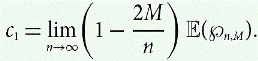 $$c_1 = \lim_{n \rightarrow \infty} \left({1 - \frac{2M}{n}} \right) \,\E({\wp_{n,m}}).$$This study relies on the symbolic method and analytic tools from generating function theory, which enable us to describe the evolution of
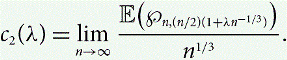 $$c_2(\lambda) = \lim_{n \rightarrow \infty} \frac{\E{\left({\wp_{n,{{(n/2)}({1+\lambda n^{-1/3}})}}}\right)}}{n^{1/3}}.$$ $n^{-1/3}\,\E{\left({\wp_{n,{{(n/2)}({1+\lambda n^{-1/3}})}}}\right)}$ as a function of λ.


On Komlós’ tiling theorem in random graphs
- Part of
-
- Journal:
- Combinatorics, Probability and Computing / Volume 29 / Issue 1 / January 2020
- Published online by Cambridge University Press:
- 25 July 2019, pp. 113-127
-
- Article
- Export citation
-
Given graphs G and H, a family of vertex-disjoint copies of H in G is called an H-tiling. Conlon, Gowers, Samotij and Schacht showed that for a given graph H and a constant γ>0, there exists C>0 such that if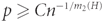 $p \ge C{n^{ - 1/{m_2}(H)}}$, then asymptotically almost surely every spanning subgraph G of the random graph 𝒢(n, p) with minimum degree at least contains an H-tiling that covers all but at most γn vertices. Here, χcr(H) denotes the critical chromatic number, a parameter introduced by Komlós, and m2(H) is the 2-density of H. We show that this theorem can be bootstrapped to obtain an H-tiling covering all but at most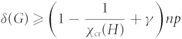 $\delta (G) \ge (1 - \frac{1}{{{\chi _{{\rm{cr}}}}(H)}} + \gamma )np$ $\gamma {(C/p)^{{m_2}(H)}}$ vertices, which is strictly smaller when $p \ge C{n^{ - 1/{m_2}(H)}}$. In the case where H = K3, this answers the question of Balogh, Lee and Samotij. Furthermore, for an arbitrary graph H we give an upper bound on p for which some leftover is unavoidable and a bound on the size of a largest H -tiling for p below this value.

INTERSECTIONS OF SUBGROUPS IN VIRTUALLY FREE GROUPS AND VIRTUALLY FREE PRODUCTS
- Part of
-
- Journal:
- Bulletin of the Australian Mathematical Society / Volume 101 / Issue 2 / April 2020
- Published online by Cambridge University Press:
- 18 July 2019, pp. 266-271
- Print publication:
- April 2020
-
- Article
-
- You have access
- Export citation
-
This note contains a (short) proof of the following generalisation of the Friedman–Mineyev theorem (earlier known as the Hanna Neumann conjecture): if $A$ and $B$ are nontrivial free subgroups of a virtually free group containing a free subgroup of index $n$, then $\text{rank}(A\cap B)-1\leq n\cdot (\text{rank}(A)-1)\cdot (\text{rank}(B)-1)$. In addition, we obtain a virtually-free-product analogue of this result.


On the Size-Ramsey Number of Cycles
- Part of
-
- Journal:
- Combinatorics, Probability and Computing / Volume 28 / Issue 6 / November 2019
- Published online by Cambridge University Press:
- 17 July 2019, pp. 871-880
-
- Article
- Export citation
-
For given graphs G1,…, Gk, the size-Ramsey number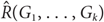 $\hat R({G_1}, \ldots ,{G_k})$ is the smallest integer m for which there exists a graph H on m edges such that in every k-edge colouring of H with colours 1,…,k, H contains a monochromatic copy of Gi of colour i for some 1 ≤ i ≤ k. We denote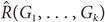 $\hat R({G_1}, \ldots ,{G_k})$ by ${\hat R_k}(G)$ when G1 = ⋯ = Gk = G.
Haxell, Kohayakawa and Łuczak showed that the size-Ramsey number of a cycle Cn is linear in n, ${\hat R_k}({C_n}) \le {c_k}n$ for some constant ck. Their proof, however, is based on Szemerédi’s regularity lemma so no specific constant ck is known.
In this paper, we give various upper bounds for the size-Ramsey numbers of cycles. We provide an alternative proof of ${\hat R_k}({C_n}) \le {c_k}n$, avoiding use of the regularity lemma, where ck is exponential and doubly exponential in k, when n is even and odd, respectively. In particular, we show that for sufficiently large n we have ${\hat R_2}({C_n}) \le {10^5} \times cn$, where c = 6.5 if n is even and c = 1989 otherwise.


Codegree Conditions for Tiling Complete k-Partite k-Graphs and Loose Cycles
- Part of
-
- Journal:
- Combinatorics, Probability and Computing / Volume 28 / Issue 6 / November 2019
- Published online by Cambridge University Press:
- 09 July 2019, pp. 840-870
-
- Article
- Export citation
Positive association of the oriented percolation cluster in randomly oriented graphs
- Part of
-
- Journal:
- Combinatorics, Probability and Computing / Volume 28 / Issue 6 / November 2019
- Published online by Cambridge University Press:
- 08 July 2019, pp. 811-815
-
- Article
- Export citation
Proof of the Brown–Erdős–Sós conjecture in groups
- Part of
-
- Journal:
- Mathematical Proceedings of the Cambridge Philosophical Society / Volume 169 / Issue 2 / September 2020
- Published online by Cambridge University Press:
- 04 July 2019, pp. 323-333
- Print publication:
- September 2020
-
- Article
- Export citation
-
The conjecture of Brown, Erdős and Sós from 1973 states that, for any k ≥ 3, if a 3-uniform hypergraph H with n vertices does not contain a set of k +3 vertices spanning at least k edges then it has o(n2) edges. The case k = 3 of this conjecture is the celebrated (6, 3)-theorem of Ruzsa and Szemerédi which implies Roth’s theorem on 3-term arithmetic progressions in dense sets of integers. Solymosi observed that, in order to prove the conjecture, one can assume that H consists of triples (a, b, ab) of some finite quasigroup Γ. Since this problem remains open for all k ≥ 4, he further proposed to study triple systems coming from finite groups. In this case he proved that the conjecture holds also for k = 4. Here we completely resolve the Brown–Erdős–Sós conjecture for all finite groups and values of k. Moreover, we prove that the hypergraphs coming from groups contain sets of size $\Theta (\sqrt k )$ which span k edges. This is best possible and goes far beyond the conjecture.

Types of embedded graphs and their Tutte polynomials
- Part of
-
- Journal:
- Mathematical Proceedings of the Cambridge Philosophical Society / Volume 169 / Issue 2 / September 2020
- Published online by Cambridge University Press:
- 02 July 2019, pp. 255-297
- Print publication:
- September 2020
-
- Article
- Export citation
On Erdős–Ko–Rado for random hypergraphs I
- Part of
-
- Journal:
- Combinatorics, Probability and Computing / Volume 28 / Issue 6 / November 2019
- Published online by Cambridge University Press:
- 25 June 2019, pp. 881-916
-
- Article
- Export citation
-
A family of sets is intersecting if no two of its members are disjoint, and has the Erdős–Ko–Rado property (or is EKR) if each of its largest intersecting subfamilies has non-empty intersection.
Denote by ${{\cal H}_k}(n,p)$ the random family in which each k-subset of {1, …, n} is present with probability p, independent of other choices. A question first studied by Balogh, Bohman and Mubayi asks:
 \begin{equation} {\rm{For what }}p = p(n,k){\rm{is}}{{\cal H}_k}(n,p){\rm{likely to be EKR}}? \end{equation}
Here, for fixed c < 1/4, and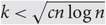 $k \lt \sqrt {cn\log n} $ we give a precise answer to this question, characterizing those sequences p = p(n, k) for which
 \begin{equation} {\mathbb{P}}({{\cal H}_k}(n,p){\rm{is EKR}}{\kern 1pt} ) \to 1{\rm{as }}n \to \infty . \end{equation}

