To save content items to your account,
please confirm that you agree to abide by our usage policies.
If this is the first time you use this feature, you will be asked to authorise Cambridge Core to connect with your account.
Find out more about saving content to .
To save content items to your Kindle, first ensure no-reply@cambridge.org
is added to your Approved Personal Document E-mail List under your Personal Document Settings
on the Manage Your Content and Devices page of your Amazon account. Then enter the ‘name’ part
of your Kindle email address below.
Find out more about saving to your Kindle.
Note you can select to save to either the @free.kindle.com or @kindle.com variations.
‘@free.kindle.com’ emails are free but can only be saved to your device when it is connected to wi-fi.
‘@kindle.com’ emails can be delivered even when you are not connected to wi-fi, but note that service fees apply.
Increased consumption of pulses can support healthy and sustainable diets; however, consumption of pulses in Western populations is low. Adolescents are an often overlooked yet important target group as they develop attitudes and behaviours that influence food choices into adulthood. To understand patterns of consumption, this study aimed to analyse characteristics and consumption patterns of Australian adolescents who consume pulses. Secondary analysis of the Australian National Nutrition and Physical Activity Survey data from 2011–2012 was carried out to identify adolescent (12–17 years, n 1007, nationally representative of n 101 130) pulse consumers, compare their nutritional and demographic characteristics with non-consumers and describe frequency, types and amounts of pulses consumed. Consumption of pulses amongst adolescents is low, with only 6 % of adolescents (48 % males) reporting consumption of pulses. Pulse consumption was associated with healthier weight and diet characteristics. After adjusting for age, sex and socio-economic index, overweight or obese adolescents were less likely to consume pulses than adolescents of a healthy weight or underweight (OR = 0·82; 95 % CI 0·69, 0·99; P = 0·043). Adolescent pulse consumers reported consuming more vegetables, dietary fibre and Fe and less discretionary foods, saturated fat and added sugars than non-consumers. Baked beans were the most commonly consumed type of pulses, followed by pulses as an ingredient in a vegetarian meal such as dahl. Future strategies are recommended to promote the consumption of pulses amongst adolescents due to the low consumption level, with consideration of familiar and appealing dishes to support adolescents in achieving healthier and sustainable diets.
Around the start of the 21st century, countries began to experience a unique demographic transition. After generations of declining dependency and expanding labor forces, increasing longevity and persistently low fertility have reversed dependency trajectories. This paper examines the political consequences of rapid demographic aging and retirement reforms. An empirical assessment of 41 countries from 1980 to 2020 suggests that efforts to postpone retirement are politically destabilizing. In particular, increases in average retirement age and labor force participation among older cohorts may increase political instability. Demographic forecasts for rich and middle-income countries indicate a massive growing demand for age-related public services, alongside a rapid decline in the relative size of economically active populations. Policy reform is therefore urgently needed to sustain pension systems, maintain economic growth, and mitigate political instability. The paper concludes that governments must consider country-specific demographic, political, and economic conditions when designing alternatives to potentially destabilizing retirement reforms.
This exploratory project aimed to develop online learning materials with interactive narratives for supporting persons living with dementia, with particular focus on initial diagnosis and helping children to understand changes which may occur.
Background:
Dementia is a range of neurological conditions that cause the ongoing decline in brain function, manifesting as loss of memory, language, and problem-solving abilities. Over 55 million people worldwide are living with dementia, straining health and social care resources in their ability to provide information, care, and support for the family. There is a need for easily accessible, high-quality, and nationally scalable resources for dementia support for this growing population.
Methods:
Twine was used to produce online digital storytelling media titled ‘Grandad Forgot My Name’, following the narrative of dementia care for family members. Design, theming, artwork, and story pathways reflected key aspects of dementia and dementia care to facilitate additional support for readers, and health and social care workers. Usage statistics were monitored and readers answered evaluative surveys with numerical scoring and descriptive free responses. Story pathways and information were continuously updated following survey responses.
Findings:
Twine and interactive storytelling had potential to reach a wide audience at minimal cost, bridging the gaps between initial concerns, diagnosis, and appointment. However, there were issues with stakeholder adoptability and uptake when sharing materials which must be resolved in full-scaled outputs. Grandad Forgot My Name successfully demonstrated key design and logistical considerations when creating support resources of national impact, with cross-generational communication and reader-centric design optimising engagement.
Aflatoxins (AFs) are contaminants of several agricultural crops, and aflatoxin B1 (AFB1) is the most toxic AF and a known carcinogen to humans and animals. A practical solution for decontamination of animal feed contaminated with AFB1 is to use bentonite, a natural raw material consisting primarily of the mineral montmorillonite (dioctahedral 2:1 layer aluminosilicate of the smectite group). The aims of this research were to compare mineralogical, structural, chemical, and physico-chemical characteristics of three bentonites from the Balkan region (Beretnica clay from Serbia (B-Clay), Yellow clay (Y-Clay) and Gray clay (G-Clay) from Bosnia) with the characteristics of a commercial pharmaceutical-grade bentonite (P-Clay), and to study the behavior of the bentonites in phosphate buffer at pH 3 and 7 with and without AFB1. AFB1 adsorption by bentonites followed non-linear isotherms with maximum amounts adsorbed from 75.43 mg g–1 at pH 3 and 62.91 mg g–1 at pH 7 for the P-Clay to 100.25 mg g–1 at pH 3 and 78.58 mg g–1 at pH 7 for the B-Clay. The Ca-bentonites (B-Clay-cis-vacant, 83% montmorillonite; Y-Clay-cis/trans-vacant, 98% montmorillonite; and G-Clay-trans-vacant, 88% montmorillonite) were efficient adsorbents of AFB1, with the greater adsorption observed at pH 3. The P-Clay (Na/Ca bentonite, cis-vacant, 63% montmorillonite), exhibited the lowest AFB1 adsorption at both pH values. The behavior of bentonites in buffers, in the presence of AFB1, indicated that ion exchange and AFB1 adsorption by montmorillonite occurred simultaneously. Cations with larger hydrated radii (Mg2+ and Ca2+) represented the primary active sites for AFB1 adsorption. The position of OH– groups in cis-montmorillonites at the same side of the octahedral site enhanced AFB1 adsorption, making them more available for protonation of edge sites and subsequent interaction with AFB1. Specific characteristics of the montmorillonite in bentonites play an important role in AFB1 adsorption, although the buffer composition also affects the adsorption process significantly.
The alternation between wet and dry seasons in tropical regions can dramatically affect parasite infection dynamics by influencing larval survival, intermediate-host density, definitive-host foraging behaviour, and host immune function. Freshwater chelonians are excellent models for studying parasite-host ecology. Their longevity, site fidelity, and dietary breadth make them valuable sentinel species for aquatic ecosystem health. Here, we identified the gastrointestinal helminth fauna of scorpion mud turtle (Kinosternon scorpioides) from Marajó Island and evaluated seasonal effects on parasite community dynamics. We observed a 71% reduction in parasite load during the dry season and substantial compositional shifts, in addition to species-specific responses: Spiroxys figueiredoi exclusively during floods and Nematophila grandis peaking during dry periods. Parasite species with flexible transmission pathways may thrive while specialists decline. Kinosternon scorpioides and its parasites function as sentinels, and monitoring helminth community composition could more accurately track ecosystem health than measuring host abundance alone.
It is known that the condition $|\arg f'(z)|<\pi /2$, $|z|<1$, is not sufficient for an analytic function $f(z)=z+a_2z^2+\cdots $ in $|z|<1$, to be starlike with respect to the origin. We look for the largest $\alpha>0$ such that the condition $|\arg f'(z)|<\alpha \pi /2$ in $|z|<1$ is a sufficient condition for f to be a univalent, starlike, convex, or Bazilevic̆ function.


In the contemporary ‘age of participation’, referendums are often celebrated as cornerstones of democratic engagement. Yet political parties sometimes take the seemingly paradoxical step of calling for referendum boycotts, urging citizens to abstain from direct democratic processes. This paper investigates the conditions under which such boycott calls occur and the motivations behind them. While previous research has largely focused on single cases or experimental designs, we offer the first comprehensive, comparative study of party-led referendum boycotts across Europe since 1972. Drawing on a novel dataset of 223 referendums in 37 countries, we combine quantitative and qualitative methods to explore how regime context, institutional design, and issue type shape boycott behavior. Our regression analyses show that turnout quorum requirements, lower levels of democratic maturity, and sovereignty-related referendum issues significantly increase the likelihood of boycotts. To complement these findings, we qualitatively analyze boycott justifications and develop a typology of six motivation types: legitimacy-based, procedural unfairness, instrumental, tactical, minority interest, and ideological boycotts. These results reveal a complex interplay between democratic institutions and political strategy, challenging the assumption that referendums are universally inclusive tools. Our findings have implications for the design, interpretation, and normative evaluation of direct democratic practices across diverse political systems.
Longevity risk significantly impacts the reserve adequacy ratio of annuity issuers, thereby reducing product profitability. Effectively managing this risk has thus become a priority for insurance companies. A natural hedging strategy, which involves balancing longevity risk through an optimised portfolio of life insurance and annuity products, offers a promising solution and has attracted considerable academic attention in recent years. In this study, we construct a realistic portfolio scenario comprising annuities and life insurance policies across various ages and genders. By applying Cholesky decomposition, we transform the portfolio into an uncorrelated linear model. Our objective function minimises the variance in portfolio value changes, allowing us to explore the impact of mortality on longevity risk mitigation through natural hedging. Using actuarial mathematics and the Bayesian MCMC algorithm, we analyse the factors influencing the hedging effectiveness of a portfolio with minimised variance. Empirical findings indicate that the optimal life-to-annuity ratio is influenced by multiple factors, including gender, age, projection period, and forecast horizon. Based on these findings, we recommend that insurance companies adjust their business structures and actively pursue product innovation to enhance longevity risk management.
Scalar words such as warm may give rise to inferences such as warm but not hot. Under standard accounts, such scalar implicatures are derived by negating stronger alternatives. In processing, weaker scale-mates (warm) prime stronger ones (hot), suggesting that the latter are used in implicature processing (De Carvalho et al., 2016. Frontiers in Psychology, 7, 1500; Ronai & Xiang, 2023. Experiments in Linguistic Meaning, 2, 229–240). We test whether the activation of alternatives holds when no implicature is expected to arise and examine what kinds of alternatives form the basis from which scalar implicature derivation proceeds. We employ two manipulations: negation and antonymy. In line with an account derived from the theoretical treatments of implicature (e.g., Horn, 1972. On the semantic properties of logical operators in English), negating scale-mates cancelled the activation of strong terms (hot). Contrary to these accounts, however, antonyms activated the same targets. In a joint analysis, we found that negation interacted with both scale-mate primes and antonym primes. We explain these findings within the Alternative Activation Account (Gotzner, 2017. Alternative sets in language processing: How focus alternatives are represented in the mind), which assumes an initial activation of a broad cohort of associated expressions and their subsequent grammatical and contextual narrowing.
This study aimed to identify echocardiographic predictors of successful weaning from extracorporeal membrane oxygenation in paediatric and congenital heart disease patients.
Methods:
We retrospectively analyzed pediatric patients who underwent venoarterial extracorporeal membrane oxygenation for cardiogenic shock or postoperative support between March 2018 and September 2023. Clinical and echocardiographic variables assessed at the time of weaning evaluation were compared between patients who were successfully weaned and those who were not.
Results:
Among the 46 enrolled patients, 31 were successfully weaned from extracorporeal membrane oxygenation. The mean age at extracorporeal membrane oxygenation initiation was 9.6 ± 13.9 years, and the mean duration of support was 12.3 ± 12.1 days. Patients in the successfully weaned group had significantly higher left ventricular ejection fraction (50.9 ± 16.4% vs. 27.3 ± 18.7%, p < 0.001) and higher velocity time integral at the left ventricular outflow tract (12.3 ± 8.0 cm vs. 4.1 ± 3.6 cm, p = 0.001) compared with the unsuccessfully weaned group. The cutoff values for predicting successful weaning were a left ventricular ejection fraction of 43.03% (sensitivity, 74.2%; specificity, 86.7%) and a velocity time integral of 4.45 cm (sensitivity, 92.0%; specificity, 66.7%).
Conclusions:
Left ventricular ejection fraction and velocity time integral provide valuable echocardiographic information for predicting successful weaning from extracorporeal membrane oxygenation in pediatric patients and may support clinical decision-making during weaning assessments.
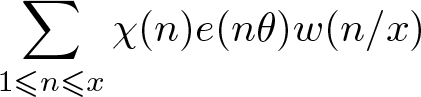
We prove that the average size of a mixed character sum
\begin{equation*}\sum_{1\leqslant n \leqslant x} \chi(n) e(n\theta) w(n/x)\end{equation*}
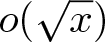
(for a suitable smooth function $w$) is on the order of $\sqrt{x}$ for all irrational real $\theta$ satisfying a weak Diophantine condition, where $\chi$ is drawn from the family of Dirichlet characters modulo a large prime $r$ and where $x\leqslant r$. In contrast, it was proved by Harper that the average size is $o(\sqrt{x})$ for rational $\theta$. Certain quadratic Diophantine equations play a key role in the present paper.
If A is in the p-Schatten class on ${\mathbb {R}}^n$, $1\leq p \leq {4n}/{(2n-1)}$, then the quantum translates of A are linearly independent. Moreover, there exists a nonzero operator in the p-Schatten class on ${\mathbb {R}}^n$, $p>{4n}/{(2n-1)}$, whose quantum translates are linearly dependent.
This article investigates the role of Catholic and non-Catholic local actors in shaping missionary activities in seventeenth-century Ottoman Europe. It examines jurisdictional conflicts and collaborations between Bosnian Franciscan friars, Ragusan merchants, Ottoman officials—particularly judges—and Serbian Orthodox clergy, whose interactions shaped the local landscape of Catholicism and defined the limits of Catholic engagement. Drawing primarily on Catholic missionary sources, the study argues that analysing missions through interconnected local, regional, and global lenses, while foregrounding the agency of local actors, provides a more nuanced understanding of early modern Catholicism. By expanding historiographical approaches that have primarily focused on Catholic missions outside Europe, the article advocates for the inclusion of Ottoman Europe as a significant yet understudied site of Catholic missionary activity. It further highlights the jurisdictional and institutional tensions within Catholic expansion and governance, revealing the complexities of missionary engagement in a politically fragmented and religiously plural environment.
Generative artificial intelligence (GenAI) shows promise for mental healthcare by increasing access to treatment. In this article, we analyse recent evidence on the use of GenAI chatbots as a treatment for common mental disorders. We examine key ethical and methodological considerations and discuss the specific risks for delusions. Adopting a precision psychiatry perspective, we propose that the therapeutic alliance can be improved by tailoring GenAI to mimic a user’s psychological traits, a version of socioaffective alignment.
Treatment-resistant schizophrenia (TRS) is a clinically challenging subtype of schizophrenia affecting up to 30% of patients, defined by persistent symptoms despite adequate trials of at least two antipsychotics. This review explores the complex neurobiology of TRS, highlighting the limitations of the dopamine hypothesis and emphasising the roles of glutamatergic, cholinergic and neurodevelopmental mechanisms. It outlines neuroimaging techniques (e.g. positron emission tomography, functional and structural magnetic resonance imaging, and proton magnetic resonance spectroscopy) used to explore neurotransmitter activity and structural brain changes in psychosis, and in TRS in particular, and gives an overview of their findings and utility. It also discusses frameworks like TRRIP and the INTEGRATE algorithm, which aim to facilitate earlier diagnosis and treatment. Integrating neuroimaging into practice may improve diagnosis and clinical outcomes and advance precision medicine approaches; emerging non-dopaminergic treatment options, such as xanomeline–trospium, may offer promising alternatives to standard clozapine treatment for TRS. Future research should prioritise biomarker discovery and the development of novel therapies beyond dopaminergic targets.



