Refine listing
Actions for selected content:
153980 results in Open Access
The GALL of it all: Grading and teaching in the age of GenAI-assisted language learning
-
- Journal:
- Language Teaching / Volume 58 / Issue 4 / October 2025
- Published online by Cambridge University Press:
- 30 June 2025, pp. 435-442
- Print publication:
- October 2025
-
- Article
-
- You have access
- Open access
- HTML
- Export citation
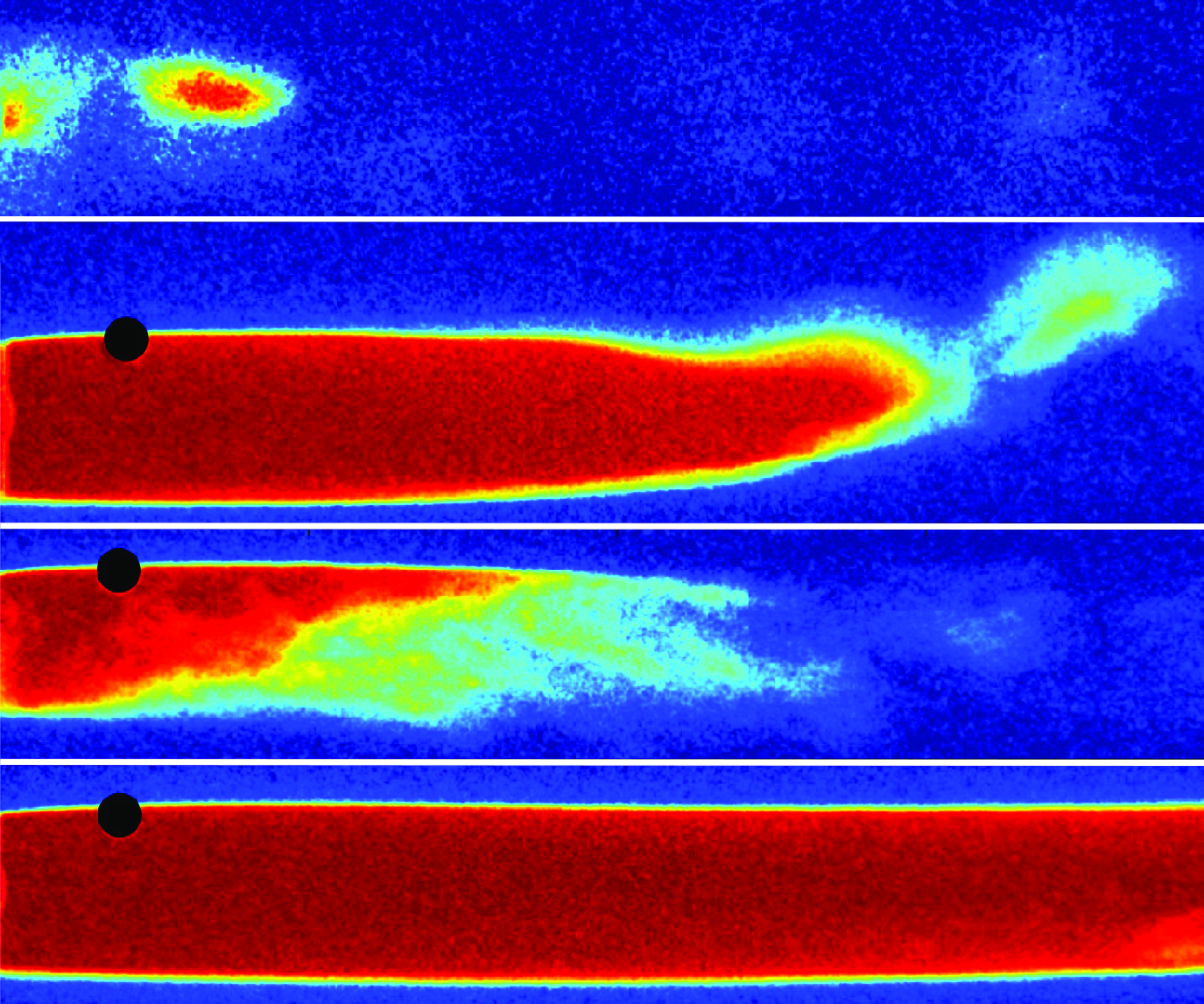
Examination of ventilated cavities in the wake of a two-dimensional bluff body using X-ray densitometry
-
- Journal:
- Journal of Fluid Mechanics / Volume 1014 / 10 July 2025
- Published online by Cambridge University Press:
- 30 June 2025, A14
-
- Article
-
- You have access
- Open access
- HTML
- Export citation
-
Ventilated cavities in the wake of a two-dimensional bluff body are studied experimentally via time-resolved X-ray densitometry. With a systematic variation of flow velocity and gas injection rate, expressed as Froude number ( $\textit{Fr}$) and ventilation coefficient ( $C_{qs}$), four cavities with different closure types are identified. A regime map governed by $\textit{Fr}$ and $C_{qs}$ is constructed to estimate flow conditions associated with each cavity closure type. Each closure exhibits a different gas ejection mechanism, which in turn dictates the cavity geometry and the pressure in the cavity. Three-dimensional cavity closure is seen to exist for the supercavities at low $\textit{Fr}$. However, closure is nominally two-dimensional for supercavities at higher $\textit{Fr}$. At low $C_{qs}$, cavity closure is seen to be wake-dominated, while supercavities are seen to have interfacial perturbation near the closure at higher $C_{qs}$, irrespective of $\textit{Fr}$. With the measured gas fraction, a gas balance analysis is performed to quantify the gas ejection rate at the transitional cavity closure during its formation. For a range of $\textit{Fr}$, the transitional cavity closure is seen to be characterised by re-entrant flow, whose intensity depends on the flow inertia, dictating the gas ejection rates. Two different ventilation strategies were employed to systematically investigate the formation and maintenance gas fluxes. The interaction of wake and gas injection is suspected to dominate the cavity formation process and not the maintenance, resulting in ventilation hysteresis. Consequently, the ventilation gas flux required to maintain the supercavity is significantly less than the gas flux required to form the supercavity.


How does interaction with LLM powered chatbots shape human understanding of culture? The need for Critical Interactional Competence (CritIC)
-
- Journal:
- Annual Review of Applied Linguistics / Volume 45 / March 2025
- Published online by Cambridge University Press:
- 30 June 2025, pp. 28-49
-
- Article
-
- You have access
- Open access
- HTML
- Export citation
Rapid systematic literature review: Camera trap sampling in ecological studies: Considerations of wildlife welfare
- Part of
-
- Journal:
- Animal Welfare / Volume 34 / 2025
- Published online by Cambridge University Press:
- 30 June 2025, e44
-
- Article
-
- You have access
- Open access
- HTML
- Export citation
IDEAS EXCHANGED: CONNECTIVITY, IDENTITY, AND HOW WE WRITE HISTORIES OF PRE-ROMAN ITALY
-
- Journal:
- The Classical Review / Volume 75 / Issue 2 / October 2025
- Published online by Cambridge University Press:
- 30 June 2025, pp. 367-375
- Print publication:
- October 2025
-
- Article
-
- You have access
- Open access
- HTML
- Export citation
The association between epigenetic ageing from childhood to early adulthood and psychotic-like experiences in early adulthood
-
- Journal:
- Psychological Medicine / Volume 55 / 2025
- Published online by Cambridge University Press:
- 30 June 2025, e182
-
- Article
-
- You have access
- Open access
- HTML
- Export citation
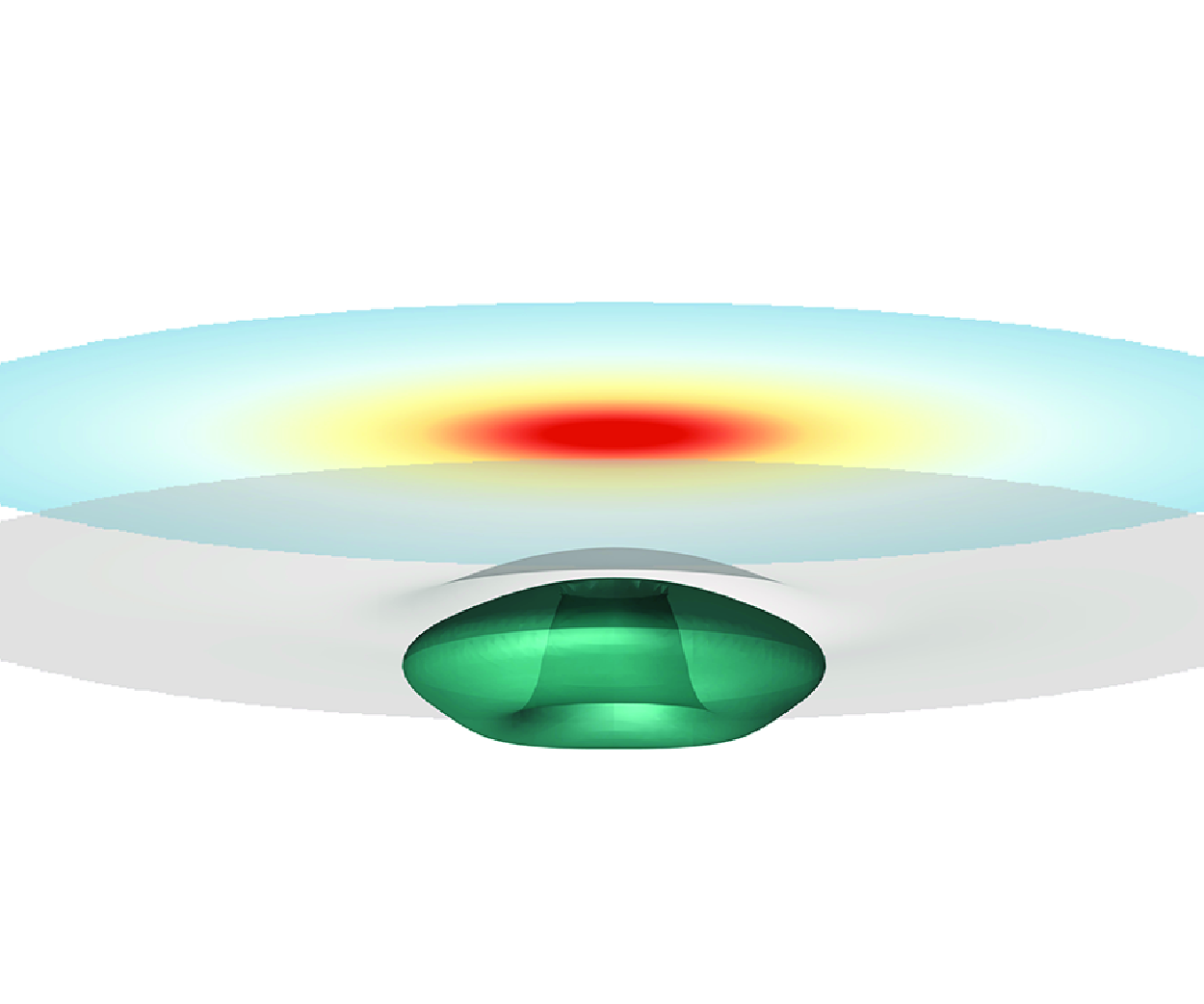
Investigation on the cavitation bubble dynamics and pressure characteristics near a wall with a viscous oil layer
-
- Journal:
- Journal of Fluid Mechanics / Volume 1014 / 10 July 2025
- Published online by Cambridge University Press:
- 30 June 2025, A9
-
- Article
-
- You have access
- Open access
- HTML
- Export citation
-
Cavitation bubble pulsation and liquid jet loads are the main causes of hydraulic machinery erosion. Methods to weaken the load influences have always been hot topics of related research. In this work, a method of attaching a viscous layer to a rigid wall is investigated in order to reduce cavitation pulsations and liquid jet loads, using both numerical simulations and experiments. A multiphase flow model incorporating viscous effects has been developed using the Eulerian finite element method (EFEM), and experimental methods of a laser-induced bubble near the viscous layer attached on a rigid wall have been carefully designed. The effects of the initial bubble–wall distance, the thickness of the viscous layer, and the viscosity on bubble pulsation, migration and wall pressure load are investigated. The results show that the bubble migration distance, the normalised thickness of the oil layer and the wall load generally decrease with the initial bubble–wall distance or the oil-layer parameters. Quantitative analysis reveals that when the initial bubble–wall distance remains unchanged, there exists a demarcation line for the comparison of the bubble period and the reference period (the bubble period without viscous layer under the same initial bubble–wall distance), and a logarithmic relationship is observed that $\delta \propto \log_{10} \mu ^*$, where $\delta =h/R_{max}$ is the thickness of the viscous layer h normalised by the maximum bubble radius $R_{max}$, $\mu ^* = \mu /({R_{max }}\sqrt {{\rho }{{\mathop {P}\nolimits } _{{atm}}}})$ is the dynamic viscosity $\mu$ normalised by water density $ \rho $ and atmospheric pressure $P_{atm}$. The results of this paper can provide technical support for related studies of hydraulic cavitation erosion.


Transcranial magnetic stimulation to left VLPFC or right DLPFC promotes forgetting in working memory
-
- Journal:
- Psychological Medicine / Volume 55 / 2025
- Published online by Cambridge University Press:
- 30 June 2025, e183
-
- Article
-
- You have access
- Open access
- HTML
- Export citation
Epistemic Exclusion: Theorizing Dalit Feminism
-
- Article
-
- You have access
- Open access
- HTML
- Export citation
K-Orbit closures and Hessenberg varieties
- Part of
-
- Journal:
- Forum of Mathematics, Sigma / Volume 13 / 2025
- Published online by Cambridge University Press:
- 30 June 2025, e103
-
- Article
-
- You have access
- Open access
- HTML
- Export citation
Climate Impacts on Human Mobility: Innovative Approaches to Finance the Response
- Part of
-
- Journal:
- AJIL Unbound / Volume 119 / 2025
- Published online by Cambridge University Press:
- 30 June 2025, pp. 118-123
-
- Article
-
- You have access
- Open access
- HTML
- Export citation
Beyond standardization: a comprehensive review of topic modeling validation methods for computational social science research
-
- Journal:
- Political Science Research and Methods , First View
- Published online by Cambridge University Press:
- 30 June 2025, pp. 1-19
-
- Article
-
- You have access
- Open access
- HTML
- Export citation
Concrete steps for bridging the scholar–practitioner divide
-
- Journal:
- Industrial and Organizational Psychology / Volume 18 / Issue 2 / June 2025
- Published online by Cambridge University Press:
- 30 June 2025, pp. 226-230
-
- Article
-
- You have access
- Open access
- HTML
- Export citation
Integration on complex Grassmannians, deformed monotone Hurwitz numbers, and interlacing phenomena
- Part of
-
- Journal:
- Canadian Journal of Mathematics , First View
- Published online by Cambridge University Press:
- 30 June 2025, pp. 1-40
-
- Article
-
- You have access
- Open access
- HTML
- Export citation
-
We introduce a family of polynomials, which arise in three distinct ways: in the large N expansion of a matrix integral, as a weighted enumeration of factorizations of permutations, and via the topological recursion. More explicitly, we interpret the complex Grassmannian $\mathrm {Gr}(M,N)$ as the space of $N \times N$ idempotent Hermitian matrices of rank M and develop a Weingarten calculus to integrate products of matrix elements over it. In the regime of large N and fixed ratio $\frac {M}{N}$, such integrals have expansions whose coefficients count factorizations of permutations into monotone sequences of transpositions, with each sequence weighted by a monomial in $t = 1 - \frac {N}{M}$. This gives rise to the desired polynomials, which specialise to the monotone Hurwitz numbers when $t = 1$. These so-called deformed monotone Hurwitz numbers satisfy a cut-and-join recursion, a one-point recursion, and the topological recursion. Furthermore, we conjecture on the basis of overwhelming empirical evidence that the deformed monotone Hurwitz numbers are real-rooted polynomials whose roots satisfy remarkable interlacing phenomena. An outcome of our work is the viewpoint that the topological recursion can be used to “topologise” sequences of polynomials, and we claim that the resulting families of polynomials may possess interesting properties.


A comparative study of antimicrobial prescribing practices for common infectious syndromes among physicians and nurse practitioners in a safety-net hospital
-
- Journal:
- Antimicrobial Stewardship & Healthcare Epidemiology / Volume 5 / Issue 1 / 2026
- Published online by Cambridge University Press:
- 30 June 2025, e140
-
- Article
-
- You have access
- Open access
- HTML
- Export citation
Managing combinatorial design challenges using flexibility and pathfinding algorithms
-
- Article
-
- You have access
- Open access
- HTML
- Export citation

Addressing microplastics in drinking water in the global plastics treaty – Gaps, challenges and opportunities
- Part of
-
- Journal:
- Cambridge Prisms: Plastics / Volume 3 / 2025
- Published online by Cambridge University Press:
- 30 June 2025, e20
-
- Article
-
- You have access
- Open access
- HTML
- Export citation
Challenges to EU Climate Finance under Shifting Priorities
- Part of
-
- Journal:
- AJIL Unbound / Volume 119 / 2025
- Published online by Cambridge University Press:
- 30 June 2025, pp. 95-100
-
- Article
-
- You have access
- Open access
- HTML
- Export citation
Interrater reliability of the DSM-5 and ICD-11 Criterion A for PTSD and complex PTSD in parents of children with autism using the Life Events Checklist – ERRATUM
-
- Journal:
- BJPsych Open / Volume 11 / Issue 4 / July 2025
- Published online by Cambridge University Press:
- 30 June 2025, e138
-
- Article
-
- You have access
- Open access
- HTML
- Export citation
Economic Resilience under the Indo-Pacific Economic Framework Supply Chain Agreement: Treading between Geoeconomic Ambitions and World Trade Organization Compatibility?
-
- Journal:
- World Trade Review / Volume 24 / Issue 5 / December 2025
- Published online by Cambridge University Press:
- 30 June 2025, pp. 645-661
-
- Article
-
- You have access
- Open access
- HTML
- Export citation
