To save content items to your account,
please confirm that you agree to abide by our usage policies.
If this is the first time you use this feature, you will be asked to authorise Cambridge Core to connect with your account.
Find out more about saving content to .
To save content items to your Kindle, first ensure no-reply@cambridge.org
is added to your Approved Personal Document E-mail List under your Personal Document Settings
on the Manage Your Content and Devices page of your Amazon account. Then enter the ‘name’ part
of your Kindle email address below.
Find out more about saving to your Kindle.
Note you can select to save to either the @free.kindle.com or @kindle.com variations.
‘@free.kindle.com’ emails are free but can only be saved to your device when it is connected to wi-fi.
‘@kindle.com’ emails can be delivered even when you are not connected to wi-fi, but note that service fees apply.
Recent studies suggest that value orientations, both pro-environmental values and concerns and left–right ideology, strongly predict climate policy support in some settings, but not in others, and that institutional quality determines the strength of these associations. These studies are based on a limited number of countries and do not investigate the mechanisms at work nor what aspects of quality of government (QoG) matter more specifically. Analyzing data from 135 European regions across 15 countries, this paper finds that QoG moderates the relationships of pro-environmental values and left–right ideology with climate tax support and suggests that political trust is an underlying individual-level mechanism. Moreover, corruption seems to be the most important aspect of QoG for policy support. In regions where corruption is prevalent and trust in state institutions is low, support for climate taxes is low even among those who are generally concerned about the environment and climate change and who favor state intervention. The study suggests additional analyses, adopting quantitative and qualitative approaches, to inform policymakers on how to increase public support for climate taxation and improve policy designs to mitigate policy concerns across various segments of the population.
The Personalized Advantage Index (PAI) shows promise as a method for identifying the most effective treatment for individual patients. Previous studies have demonstrated its utility in retrospective evaluations across various settings. In this study, we explored the effect of different methodological choices in predictive modelling underlying the PAI.
Methods
Our approach involved a two-step procedure. First, we conducted a review of prior studies utilizing the PAI, evaluating each study using the Prediction model study Risk Of Bias Assessment Tool (PROBAST). We specifically assessed whether the studies adhered to two standards of predictive modeling: refraining from using leave-one-out cross-validation (LOO CV) and preventing data leakage. Second, we examined the impact of deviating from these methodological standards in real data. We employed both a traditional approach violating these standards and an advanced approach implementing them in two large-scale datasets, PANIC-net (n = 261) and Protect-AD (n = 614).
Results
The PROBAST-rating revealed a substantial risk of bias across studies, primarily due to inappropriate methodological choices. Most studies did not adhere to the examined prediction modeling standards, employing LOO CV and allowing data leakage. The comparison between the traditional and advanced approach revealed that ignoring these standards could systematically overestimate the utility of the PAI.
Conclusion
Our study cautions that violating standards in predictive modeling may strongly influence the evaluation of the PAI's utility, possibly leading to false positive results. To support an unbiased evaluation, crucial for potential clinical application, we provide a low-bias, openly accessible, and meticulously annotated script implementing the PAI.
During the COVID-19 pandemic, the European Union (EU) observed a major centralisation of competence in public health policy – the EU Vaccines Strategy. Yet increased centralisation or integration is not always desirable because the EU lacks a layer of democratic control to ensure transparency and accountability. This feature highlights the need to better understand and assess the EU’s actions during the pandemic. This paper aims to assess the effectiveness of the EU Vaccines Strategy and contributes to the wider debate on the centralisation of power at Union level. The joint procurement of COVID-19 vaccines is considered a success, as it avoided a “vaccine scramble” by the EU Member States. However, the fact that the Member States were obliged to purchase more than they needed and the lack of transparency in the negotiations with companies on the procurement of vaccines have raised questions about the integrity of the Commission’s exercise of executive power.
This systematic review and meta-analysis explore the correlation between foreign language instruction and mathematical skills in young adolescents, highlighting the significance of high school mathematical education and the adaptability of the adolescent brain. Focused on students starting second language programs between ages 8 and 13, following PRISMA guidelines, this review included 25 studies (1978–2020) with 785,552 participants. Using a random-effects model, the overall effect size revealed a statistically significant relationship between our variables, indicating a threefold higher likelihood of passing or achieving higher grades in mathematical tests for language-learning students. Moderating variables analyses identified socioeconomic status (SES) and intervention length as influencers of observed heterogeneity, with SES being the primary factor. Sensitivity analyses, including adding potentially missing studies and removing outliers, confirmed the robustness of the overall effect. Nonetheless, additional research is needed to enhance global diversity and comprehensively understand the interplay between language learning and cognitive function.
On March 15, 2024, the Corporate Sustainability Due Diligence Directive (CSDDD or Directive) was adopted by the EU Council.1 This Directive represents the EU's first piece of mandatory due diligence legislation governing the responsibilities of companies for human rights due diligence and transition plans for climate mitigation. It also codifies the principle that “all businesses have a responsibility to respect human rights, which are universal, indivisible, interdependent and interrelated.”2 The Directive broadly follows the framework of the non-binding UN Guiding Principles on Business and Human Rights (UNGPs) which first introduced the concept of human rights due diligence.3 The CSDDD requires that businesses incorporate human rights due diligence into policies,4 identifying, assessing, preventing, mitigating, and ending actual and potential adverse human rights impacts,5 remedying any impacts and monitoring the effectiveness of these processes.6 The Directive also introduces significant sanctions for non-compliance.7
This study investigates Navajo verbs produced by four children, ages 4;07 to 11;02, during conversations with their caretakers. Analyses of 1600 verbs demonstrate that the bisyllabic verb form, consisting of a verb stem and a portion of the prefix string, is the most common pattern produced by the children. This indicates that Navajo-speaking children use meaningful units of verbal morphology that do not necessarily adhere to the linguistic boundaries normally ascribed to the Navajo verb complex. Further, the verbs are primarily intransitive and third-person singular constructions, which are minimally inflected. It is argued that these minimally-inflected verb forms are frequent not just because they are simpler, but also because they are highly productive as main verbs and are used to create phrasal verbs and nouns. These findings contribute to our general understanding of language development and to the growing body of research investigating children’s acquisition of endangered Indigenous languages.
This study demonstrates a kilowatt-level, spectrum-programmable, multi-wavelength fiber laser (MWFL) with wavelength, interval and intensity tunability. The central wavelength tuning range is 1060–1095 nm and the tunable number is controllable from 1 to 5. The wavelength interval can be tuned from 6 to 32 nm and the intensity of each channel can be adjusted independently. Maximum output power up to approximately 1100 W has been achieved by master oscillator power amplifier structures. We also investigate the wavelength evolution experimentally considering the difference of gain competition, which may give a primary reference for kW-level high-power MWFL spectral manipulation. To the best of our knowledge, this is the highest output power ever reported for a programmable MWFL. Benefiting from its high power and flexible spectral manipulability, the proposed MWFL has great potential in versatile applications such as nonlinear frequency conversion and spectroscopy.
Research by the Tlalancaleca Archaeological Project (PATP) has corroborated modifications to the Middle Formative chronology in Puebla-Tlaxcala (Lesure et al. 2006, 2014) using Bayesian modeling on 26 radiocarbon dates from Tlalancaleca. The present study is the first to evaluate the region’s Middle Formative chronology with radiocarbon dates from superposed stratigraphy. Nine Bayesian models were constructed with different combinations of radiocarbon dates and OxCal’s phase and sequence functions to determine the beginning and end of the Texoloc phase. Results place the Tlatempa-Texoloc transition at around 650 cal BC and the Texoloc-Tezoquipan transition at around 500 cal BC. The OxCal Interval function supports a timespan of approximately 150 years for the duration of the Texoloc phase. These results suggest the process of initial urbanization in Central Mexico was a rapid one.
The study explored the origin of the age of acquisition (AoA) effect in second language (L2) using ERPs technique. We simulated L2 AoA by manipulating the order at which English pseudowords entered into training. Chinese-English bilinguals (mean age 22.04, range 18–28) learned English pseudowords matched with Chinese (L1) words, investigating the order of acquisition (OoA) effect of English pseudowords and its relationship with the matched L1 words’ AoA. OoA effects were observed in lexical decision, naming and semantic judgment tasks on N170, P200 and N400. Furthermore, OoA effects were modulated by L1 AoA in the semantic judgment task. These results suggested that OoA effects were independent at orthographic and phonological levels but modulated by L1 AoA at the semantic level. The interpretation of L2 AoA effects requires not only the integration of Semantic and Arbitrary Mapping Hypotheses, as well as consideration of the representation and activation characteristics of L2 words.
The received view is that Kant denies all moral luck. But I show how Kant affirms constitutive moral luck in passages concerning radical evil from Religion within the Boundaries of Mere Reason. First, I explicate Kant’s claims about radical evil. It is a morally evil disposition that all human beings have necessarily, at least for the first part of their lives, and for which they are blameworthy. Second, since these properties about radical evil appear to contradict Kant’s even more famous claims about imputation, ‘ought implies can’, and free will, I unpack Henry Allison’s proof of radical evil and show how it is consistent with interpretations of Kant’s broader views about morality. Third, I define and illustrate the category of constitutive moral luck and argue that Kant embraces the existence of constitutive moral luck given Allison-style interpretations of radical evil. This provides a reason for philosophers to reject the received view, and it creates an occasion for Kantians and Kant scholars to check their reasons if they deny moral luck.
The recent enactment of supply chain due diligence regulation in various jurisdictions prompts reflection on how the law might best incentivize corporations to mitigate the impact they have on the environment.1 Beyond these specific pieces of legislation, judicial actors are similarly playing a role in expanding the responsibility of corporations for the harm their operations, products, and services cause to people and the environment, including throughout their supply chains. In this context, the present contribution takes aim at corporate accountability for climate change and appraises a number of recent developments in domestic jurisdictions that evidence a trend toward supply chain emission responsibility. While the focus of this piece is the contribution of domestic courts, an emphasis is placed on the role that informal international law and global norms have played in the reasoning of those decisions or the claims of litigants. In particular, it highlights the persuasive authority that such international law instruments and initiatives have had in this context.
Large-aperture gratings have significant applications in inertial confinement fusion, immersion lithography manufacturing and astronomical observation. Currently, it is challenging and expensive to manufacture sizable monolithic gratings. Therefore, tiled multiple small-aperture gratings are preferred. In this study, the impact of seam phase discontinuity on the modulation of the laser beam field was explored based on the measurement results of the Shenguang-II laser large-aperture multi-exposure-tiled grating. An innovative method for accurately calculating the phase jump of multi-exposure-tiled grating seams was proposed. An intensive electromagnetic field analysis was performed by applying rigorous coupled-wave analysis to a reasonably constructed micrometer-level periodic grating seam structure, and the phase jump appearing in millimeter-scale seams of large-aperture tiled gratings was obtained accurately.
The fragmentation of the Ilkhanate (1258–1335) midway through the fourteenth century coincided with the publication of several verse histories that were based upon the Blessed History (Tārīkh-i Mubārak) of Rashīd al-Dīn Hamadānī (d. 1318). Seen by many as lacking originality, these texts have often been treated as a new form of literary expression rather than a source of information about key episodes in Ilkhanid history. While it may be true that the verse histories are largely reliant on other sources for information about events that occurred before their time, the choice of what to copy and how it was presented reveals a great deal about changing attitudes to power, religion, and class as the Hülegüid Dynasty weakened and new power brokers appeared. This article will analyse how four verse histories—the Shāhnāmah-yi Chingīzī of Shams al-Dīn Kāshānī (1312–1316), the Ẓafarnāmah of Ḥamdallāh Mustawfī Qazvīnī (1335), the Shāhanshāhnāmah of Aḥmad Tabrīzī (1337), and the Ghāzānnāmah of Nūrī Azhdarī (1361)—reproduced the biography of the prominent Ilkhanid commander, Amīr Nawrūz (d. 1297), to gauge how changing circumstances influenced their view of the past. It will be shown that, although these stories may not offer much in the way of new information about Nawrūz, they do show how writers attempted to reshape their narratives to reinforce values of piety, justice, and loyalty during the Chinggisid crisis of the fourteenth century.
Much existing social commentary and scholarship around the regulation of the European digital economy is focused on how societies could better regulate that economy and its associated harms. Such analyses often portray a problematically viewed order as ungoverned, or not effectively governed, by law. Instead, I argue for more (re)descriptive analyses on how our pre-existing legal structures powerfully create order in the European digital economy. I explain why we should explore the productive connections between pre-existing European legal arrangements and socio-technical order, and discuss what such exploration could entail. The article covers three complementary ways in which legal arrangements are productively connected to sociotechnical order: as tools of ordering to address problems and promote values; as tools that can also enable projects unintended and unforeseen by policymakers; and as constitutive of technologies and other forms of order. It provides concrete examples of these productive connections from various contemporary struggles within the governance of the European digital economy. I argue that focusing on the analysis of productive connections may shed light on how pre-existing legal arrangements are baked into and shaped by the European socio-technical order. As the current order of the European digital economy is characterised by massive inequalities, these analyses can also direct our attention to how our pre-existing legal arrangements can produce and reproduce inequalities and oppression. Analyses of pre-existing legal arrangements might produce different attributions of responsibility and possibilities of contestation than analyses of legal deficiency.
Optical coherence tomography (OCT) and confocal microscopy are pivotal in retinal imaging, offering distinct advantages and limitations. In vivo OCT offers rapid, noninvasive imaging but can suffer from clarity issues and motion artifacts, while ex vivo confocal microscopy, providing high-resolution, cellular-detailed color images, is invasive and raises ethical concerns. To bridge the benefits of both modalities, we propose a novel framework based on unsupervised 3D CycleGAN for translating unpaired in vivo OCT to ex vivo confocal microscopy images. This marks the first attempt to exploit the inherent 3D information of OCT and translate it into the rich, detailed color domain of confocal microscopy. We also introduce a unique dataset, OCT2Confocal, comprising mouse OCT and confocal retinal images, facilitating the development of and establishing a benchmark for cross-modal image translation research. Our model has been evaluated both quantitatively and qualitatively, achieving Fréchet inception distance (FID) scores of 0.766 and Kernel Inception Distance (KID) scores as low as 0.153, and leading subjective mean opinion scores (MOS). Our model demonstrated superior image fidelity and quality with limited data over existing methods. Our approach effectively synthesizes color information from 3D confocal images, closely approximating target outcomes and suggesting enhanced potential for diagnostic and monitoring applications in ophthalmology.
This article addresses the teaching and learning of language attitudes within the context of a combined graduate/undergraduate Applied Linguistics course. Throughout the course, students critically discussed academic and research articles related to language attitudes towards some of the languages spoken by the students in the course (French, Spanish and Mandarin) and participated in a guided digital storytelling workshop. This article addresses the following research questions: (1) how do students embody their language attitudes through reflective storytelling? and (2) what do students gain in terms of learning outcomes from digital storytelling projects related to language attitudes? Common themes that emerged include (1) learning from others’ stories, (2) thinking creatively, (3) providing a platform for their voice, and (4) learning the connections between identity, language, and heritage. Digital storytelling can be used in other linguistics or problem-based courses as an alternative to final papers, with guidance that facilitates new understanding through collection of knowledge.
A key objective for upcoming surveys, and when re-analysing archival data, is the identification of variable stellar sources. However, the selection of these sources is often complicated by the unavailability of light curve data. Utilising a self-organising map (SOM), we demonstrate the selection of diverse variable source types from a catalogue of variable and non-variable SDSS Stripe 82 sources whilst employing only the median $u-g$, $g-r$, $r-i$, and $i-z$ photometric colours for each source as input, without using source magnitudes. This includes the separation of main sequence variable stars that are otherwise degenerate with non-variable sources ($u-g$,$g-r$) and ($r-i$,$i-z$) colour-spaces. We separate variable sources on the main sequence from all other variable and non-variable sources with a purity of $80.0\%$ and completeness of $25.1\%$, figures which can be modified depending on the application. We also explore the varying ability of the same method to simultaneously select other types of variable sources from the heterogeneous sample, including variable quasars and RR-Lyrae stars. The demonstrated ability of this method to select variable main sequence stars in colour-space holds promise for application in future survey reduction pipelines and for the analysis of archival data, where light curves may not be available or may be prohibitively expensive to obtain.
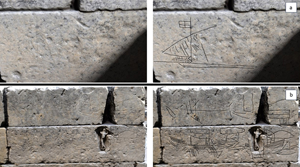
The Central Mediterranean Penal Heritage Project (CMPHP) employs remote-sensing techniques to study and preserve archaeological remains of human confinement. Within this larger project, digital photogrammetry was used to document part of the castle prison in Noto Antica to identify and digitally preserve graffiti depicting galleys and gameboards.