To save content items to your account,
please confirm that you agree to abide by our usage policies.
If this is the first time you use this feature, you will be asked to authorise Cambridge Core to connect with your account.
Find out more about saving content to .
To save content items to your Kindle, first ensure no-reply@cambridge.org
is added to your Approved Personal Document E-mail List under your Personal Document Settings
on the Manage Your Content and Devices page of your Amazon account. Then enter the ‘name’ part
of your Kindle email address below.
Find out more about saving to your Kindle.
Note you can select to save to either the @free.kindle.com or @kindle.com variations.
‘@free.kindle.com’ emails are free but can only be saved to your device when it is connected to wi-fi.
‘@kindle.com’ emails can be delivered even when you are not connected to wi-fi, but note that service fees apply.
This essay argues that the possibility of governing the development and deployment of solar radiation modification (SRM) technology is predicated on the assumption of a liberal international order informed by an understanding of state responsibility. However, this order is experiencing a period of disruption that has placed stress on extant and emerging global governance regimes and brought the assumption of their efficacy and viability into doubt. In addition, international order and existing global governance of technologies with planetary implications, such as nuclear weapons, have become the increasing focus of criticism because of the inequities embedded within these institutions, calling into question how much of a roadmap the existing governance architecture can or should provide. Leading developers and proponents of SRM have advocated for cooperative, transparent, science-led governance, which parallels the language of early nuclear governance advocates, but there is a long history of displacement and disruption of indigenous and otherwise marginalized populations without meaningful consultation to accommodate technological developments driven by powerful, industrialized countries. Developing an ethical framework for the governance of SRM will be challenging under the current conditions of increasing tensions and confrontations between major powers that may have non–climate-related interests in developing and controlling SRM technology. This essay will reflect on whether the current international order, stable or unstable, is capable of producing ethical governance of SRM.
Prediction is a crucial mechanism of language comprehension. Our research question asked whether learners of Spanish were capable of using word order cues to predict the semantic class of the upcoming verb, and how this ability develops with proficiency. To answer this question, we conducted a self-paced reading study with three L2 Spanish groups at different proficiency levels and one native control group. Among the advanced L2 learners and native speakers, we found that reading times increased after the verb appeared in a word order not strongly associated with its semantic class. Because the only cue to the sentences’ word order was the presence or absence of the object marker a before the first noun, we suggest that these groups use this morphosyntactic cue to anticipate the semantic class of the upcoming verb. However, this pattern of processing behavior was not detected in our less experienced L2 groups.
Este artículo analiza la importancia de los movimientos sociales rurales en los procesos de transición de la agricultura convencional hacia prácticas agro-sostenibles. A la luz del concepto de decrecimiento, a través de un análisis comparativo entre cuatro unidades rurales (campamento/asentamientos) con y sin presencia del Movimiento de los Trabajadores Rurales Sin Tierra (MST) en el Gran São Paulo, la investigación reflexiona sobre la presencia de elementos esenciales para los procesos de transición agroecológica en estas comunidades, explorando los datos históricos y constitutivos de las prácticas sociales agrícolas que allí se implementan. Identificando la importancia de los procesos de formación política y técnica, como base para las acciones emprendidas por el MST en el campo de la sostenibilidad, este trabajo analiza la experiencia de los campamentos del Movimiento como loci que forman los sujetos sin tierra, capaces de emprender acciones agro-sostenibles. El presente artículo concluye con reflexiones sobre la relevancia de las teorías del decrecimiento para analizar los procesos de transición agroecológica, así como sobre las medidas educativas ambientales como elementos fundamentales de las políticas públicas destinadas a la construcción de sociedades más igualitarias, autónomas, inclusivas y sostenibles.
Interactions of global change science, business and policymakers play a crucial role in shaping today’s regulatory frameworks for corporate sustainability. Our research question is why sustainability might actually be undermined by the ways that some prominent interfaces are informing corporate sustainability. Concentrating on ‘science-based’ initiatives that prescribe quantitative target-setting, business-driven task forces that define frameworks for businesses to assess and disclose information on strategies and targets, and the European Union (EU) as a supranational policymaking power, we scrutinise concepts, debates and developments involving these three globally influential non-state actors.
Although the conceptualisation of sustainability as a safe and just space is well established in academic and policy contexts, key premises are being lost in translation at science–business–policy interfaces, delaying or actually deflecting regulation of business. We call for science–business–policy interfaces to conceptualise corporate sustainability as business contributing to mitigating planetary biophysical pressures and securing social foundations worldwide. In this context, we argue that the research basis for ‘safe and just’ cannot be reduced to simplistic and separate quantifications. Treating global sustainability goals as an itemised checklist for business action, and using scientifically narrow and overly reductive approaches to quantification and target-setting, fall short of this systemic understanding of corporate sustainability.
The recognition of risks of unsustainability and the desire for sustainable value creation can act as drivers for change. Paradoxically, today’s business concept of ‘sustainable value’ actually undermines the potential for transformations to sustainability, and the dominant finance-driven treatment of ‘sustainability risks’ fall far short of capturing the hazards of continued unsustainabilities. In examining what the EU is actually doing, we find that the EU’s unprecedented attempts at regulating business for sustainability are being thwarted through powerful lobby interests, the outcomes of the science–business–policy interface, and the EU’s own fixation on economic growth and finance.
Sustainability involves dealing justly with today’s unsafe conditions, and dealing safely with unjust conditions. This requires radically more innovative responses from business, truly sustainability-oriented adaptive leadership from policymakers, and critically reflexive transdisciplinary engagement by a much wider range of sustainability scholars.
Arnold J. Toynbee is considered one of the most crucial figures in the historiography of twentieth-century world history. Although Toynbee’s reputation has significantly waned since the 1950s among many professional historians in the English-speaking world, especially in Britain, some renowned world historians, such as William H. McNeill and Jürgen Osterhammel, have reassessed Toynbee as a pioneering European historian who envisaged world history beyond Eurocentrism since the emergence of the field of global and world history in the 1980s. This article reconsiders the global meaning of Toynbee’s world history beyond this historiographical narrative on Toynbee in the anglophone context by revealing that influential Japanese historians had already found significant potential in his world history in the mid-twentieth century, almost three decades before his reassessment in English-speaking academia. In particular, the article demonstrates how Japanese historians, such as Suzuki Shigetaka, Eguchi Bokurō, and Uehara Senroku, received Toynbee’s idea of world history with various motivations and historical contexts. The research also argues that, despite the differences in their receptive intentions and backgrounds, they interpreted Toynbee as a significant European intellectual who made a self-critique of conventional historical studies in Europe and demonstrated the possibility of rewriting world history beyond Eurocentric assumptions.
Women own or co-own almost half of the land in the US Midwest and women landowners are playing an increasingly important role in production and financial decision-making. Despite their growing influence, women landowners are less engaged in conservation programs and networks, primarily due to inadequate access to conservation services and resources, leading to a scenario where men continue to dominate participation in both governmental and private conservation initiatives. The existing body of literature further echoes this disparity, with women's perspectives and voices markedly underrepresented in the United States' conservation discourse. Aiming to bridge this gap, this article delves into the attitudes of women landowners toward conservation using a 2021 survey conducted with 135 Iowa women landowners. The survey sought to shed light on their interests in various conservation topics, their concerns regarding conservation decision-making, and their preferences concerning the sources of information and the methods through which educational content is delivered. We find that women landowners are most interested in government conservation programs, followed by soil erosion control, soil fertilizer improvement, and cover crops. We provide statistical evidence that more women operating landowners are interested in conservation topics and concerned about conservation issues than women non-operating landowners in general. We further explore the variations in conservation interests among women landowners, considering their demographic and farm-specific characteristics, to highlight the diverse perspectives within this group. Additionally, we examine the preferred channels through which women landowners wish to receive educational information, offering valuable insights for policymaking and extension services. The results underscore a preference for a mix of delivery methods among women landowners, with a particular inclination toward virtual platforms, such as periodic (e-)newsletters and webinars, and printed materials such as fact sheets or infographics, over traditional in-person formats. This nuanced understanding of women landowners' educational preferences and conservation interests serves as a foundational step toward fostering more inclusive conservation programs and networks that effectively engage and represent women in the agricultural sector.
We provide explicit small-time formulae for the at-the-money implied volatility, skew, and curvature in a large class of models, including rough volatility models and their multi-factor versions. Our general setup encompasses both European options on a stock and VIX options, thereby providing new insights on their joint calibration. The tools used are essentially based on Malliavin calculus for Gaussian processes. We develop a detailed theoretical and numerical analysis of the two-factor rough Bergomi model and provide insights on the interplay between the different parameters for joint SPX–VIX smile calibration.
Aortic arch obstruction and/or coarctation of aorta is uncommon (5–20%) in balanced atrioventricular septal defects. Although technically challenging, prenatal diagnosis of aortic arch obstruction in atrioventricular septal defect is critical for delivery planning and improves prenatal counselling regarding the timing of cardiac surgery. We sought to identify prenatal predictors of coarctation of aorta in atrioventricular septal defect.
Methods:
Retrospective review of patients prenatally diagnosed with atrioventricular septal defect at two institutions.
Results:
Ninety-five fetuses with atrioventricular septal defect were identified and sufficient outcome data and diagnostic acoustic windows were available in 62. Six patients (10%) had coarctation of aorta after birth. Among the 38 patients with Trisomy 21, four (11%) had coarctation of aorta. On multivariable analysis, the proximal transverse aortic arch z score and ratio of left:right atrioventricular valve were independent predictors of coarctation of aorta with good interobserver reproducibility. Either proximal transverse aortic arch z score < −2, or ratio of left:right atrioventricular valve <0.7, predicted aortic arch obstruction with 100% sensitivity and 89% specificity.
Conclusion:
Proximal transverse aortic arch z score and lower ratio of left:right atrioventricular valve diameter are independent predictors of postnatal coarctation of aorta in fetal patients with atrioventricular septal defect. The next step is the prospective application of these parameters to create an algorithm directing fetal counselling in terms of delivery location, and expected timing of surgical interventions.
At first glance, in Valla’s thinking, his ‘poor’ conception of metaphysics seems to contrast with his appreciation of the ‘richness’ of rhetoric, as opposed to the indigence of dialectic. However, poverty can be understood in two senses: on the one hand, it designates a lack, even an insufficiency; on the other, it expresses the search for something simple, even essential. So, poverty, like nakedness (Séris 2021)1, is a concept with an opposite polarity. What is elementary can therefore be fundamental. Consequently, how can we understand, in Valla’s thought, the link between the ontological reduction of all transcendentals to the res and the opulence of rhetoric? To try to answer this question, this paper seeks to analyze the ambivalent nature of the opposition between poverty and wealth in order to reinterpret it in the opposition between simplicity and complexity. It is not certain that gain will be found on the side that we would expect to find it.
This essay investigates the fit between solar radiation modification (SRM) and climate politics. Researchers, activists, and politicians often present SRM technologies as “radical.” According to this frame, SRM comes into view as a last-ditch effort to avoid climate emergencies. Such a rationale may be applicable to the scientists researching the potential of SRM, yet it only partially accounts for political and policy interest in SRM. In this contribution, I argue that there is an increasingly tight fit between the promise of SRM technologies and the global regime of climate politics. Within this regime, SRM may not be a radical option but is more of a logical extension of current rationales. I argue that SRM corresponds to tightly controlled discursive rules within which climate politics operates, leading to a shifting narrative on the feasibility, desirability, and necessity of SRM. The ethical implications of this tight fit are threefold. First, it implies that SRM might be an instrument of mitigation deterrence, implicitly as much as explicitly. Second, ethical responsibility and political value debates are at risk of becoming invisible once SRM becomes embedded in the prevailing regime. Third, SRM use might become inevitable, despite the good intentions of most people involved.
These are, as their titles indicate, two very different Maya books: Christina Halperin's is at the hard-core end of theoretical interpretation and aimed at the professional market, while Traci Ardren's is an attempt to explain ancient Maya civilisation to a general audience. Both succeed in their basic objectives and both have annoying minor flaws.
Infants’ language is often measured indirectly via parent reports, but mothers may underestimate or overestimate their infants’ word comprehension. The current study examined estimations of mothers from diverse educational backgrounds regarding their infants’ word comprehension and how these estimations are associated with their verbal input and infants’ receptive vocabulary at 14 months. We compared 34 infants’ looking-while-listening (LWL) performances with the mothers’ Turkish Communicative Development Inventory (TCDI) reports to calculate the mothers’ overestimation and underestimation. During free-play sessions, we assessed the mothers’ number of words, number of clauses, lexical diversity, and linguistic complexity. We found that mothers have overestimations and underestimations regardless of their educational background. Crucially, mothers’ only overestimations were positively associated with their number of words and lexical diversity. Mothers’ verbal input was not related to infants’ receptive vocabulary scores. The findings suggest that mothers’ input might be aligned with their estimations of their infants’ language capabilities, which might not reflect the infants’ true performance.
Dispersion relations of electrostatic surface waves propagating in magnetized plasmas contained in an infinite duct and in an infinite cylindrical column surrounded by vacuum are derived by means of a Vlasov equation and fluid equations, respectively. The kinematic boundary condition imposed on the distribution function, the specular reflection conditions on the four sides of a duct, can be satisfied by placing infinite number of fictitious surface charge sheets spaced by the duct widths. The Vlasov equation that includes these surface charge sheets is solved by summing up the contribution due to the infinite charge sheets. The method of placing appropriate fictitious surface charge sheets enables one to treat the surface waves in bounded plasmas of Cartesian structure with mathematical efficiency, kinetically. The kinetic duct dispersion relation is compared with the dispersion relation for the magnetized cylindrical plasma column. When the square duct cross-sectional area as well as the cylinder radius become infinity, both dispersion relations become the dispersion relation of the upper-hybrid wave.
A high-energy pulsed vacuum ultraviolet (VUV) solid-state laser at 177 nm with high peak power by the sixth harmonic of a neodymium-doped yttrium aluminum garnet (Nd:YAG) amplifier in a KBe2BO3F2 prism-coupled device was demonstrated. The ultraviolet (UV) pump laser is a 352 ps pulsed, spatial top-hat super-Gaussian beam at 355 nm. A high energy of a 7.12 mJ VUV laser at 177 nm is obtained with a pulse width of 255 ps, indicating a peak power of 28 MW, and the conversion efficiency is 9.42% from 355 to 177 nm. The measured results fitted well with the theoretical prediction. It is the highest pulse energy and highest peak power ever reported in the VUV range for any solid-state lasers. The high-energy, high-peak-power, and high-spatial-uniformity VUV laser is of great interest for ultra-fine machining and particle-size measurements using UV in-line Fraunhofer holography diagnostics.
We provide an algorithm for constructing a Kirby diagram of a 4-dimensional open book given a Heegaard diagram of the page. As an application, we show that any open book with trivial monodromy is diffeomorphic to an open book constructed with a punctured handlebody as page and a composition of torus twists and sphere twists as monodromy.
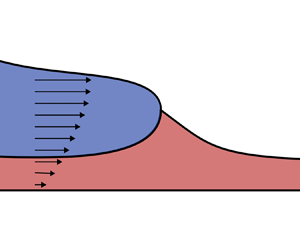
We examine the gravity-driven flow of a thin film of viscous fluid spreading over a rigid plate that is lubricated by another viscous fluid. We model the flow over such a ‘soft’ substrate by applying the principles of lubrication theory, assuming that vertical shear provides the dominant resistance to the flow. We do so in axisymmetric and two-dimensional geometries in settings in which the flow is self-similar. Different flow regimes arise, depending on the values of four key dimensionless parameters. As the viscosity ratio varies, the behaviour of the intruding layer ranges from that of a thin coating film, which exerts negligible traction on the underlying layer, to a very viscous gravity current spreading over a low-viscosity, near-rigid layer. As the density difference between the two layers approaches zero, the nose of the intruding layer steepens, approaching a shock front in the equal-density limit. We characterise a frontal stress singularity, which forms near the nose of the intruding layer, by performing an asymptotic analysis in a small neighbourhood of the front. We find from our asymptotic analysis that unlike single-layer viscous gravity currents, which exhibit a cube-root frontal singularity, the nose of a viscous gravity current propagating over another viscous fluid instead exhibits a square-root singularity, to leading order. We also find that large differences in the densities between the two fluids give rise to flows similar to that of thin films of a single viscous fluid spreading over a rigid, yet mobile, substrate.
Viewed from the perspective of public policy, behavioural public policy (BPP) faces challenges in four main areas: Systems, Impatience, Nudging, and Scaling. To address these challenges, several suggestions are proposed. First, understanding how BPP interventions unfold in complex systems requires better diagnostics and the development of predictive and generative models of human behaviour. Second, the rapid pace of policy processes necessitates a shift towards generating timely and fit-for-purpose evidence. Third, maximising the opportunities presented by BPP, beyond merely ‘nudging’, demands the early and proactive application of behavioural science in the policy cycle. Fourth, achieving widespread impact in BPP initiatives means considering scale-up from the start. Lastly, the consistent and comprehensive integration of behavioural science into standard policymaking practices would support sustainable progress in addressing these challenges.
The extent of de-novo biosynthesis of non-essential fatty acids (FA) and the endogenous biosynthesis of long chain PUFA in human fetuses remain largely unknown. We used natural variations in the 13C:12C (δ 13C) of plasma phospholipids of the woman at delivery and of cord blood to infer fetal biosynthesis of FA. We studied thirty-nine mother–fetus pairs with uncomplicated pregnancies and term delivery. Eighteen women were supplemented with DHA, from pregnancy week 20 until delivery, sourced from an algae (n 13) or fish oil (n 5), each with slightly different 13C content. Twenty-one women did not receive DHA supplementation. We measured the δ 13C value of selected phospholipid FA (C16:0, C18:0, C18:1n-9, C18:2n-6, C20:4n-6 and C22:6n-3) in maternal and cord plasma samples at delivery using isotope ratio MS. We found significant linear correlations for δ 13C values of FA between mothers and their fetuses (C16:0, r = 0·8535; C18:0, r = 0·9099; C18:1n-9, r = 0·8079; C18:2n-6, r = 0·9466; C20:4n-6, r = 0·9257 and C22:6n-3, r = 0·9706). Women supplemented with algal DHA had significantly lower DHA δ 13C values in their plasma phospholipids than those supplemented with fish DHA or those who did not receive DHA supplementation (P < 0·001). There was no significant difference in δ 13C values of FA between women at delivery and their fetuses. These findings strongly suggest that the human fetus is highly dependent on the placental transport of maternal plasma FA, particularly DHA. The limited fetal biosynthesis of major FA emphasises the crucial role of maternal nutrition and placental well-being in fetal development.