To save content items to your account,
please confirm that you agree to abide by our usage policies.
If this is the first time you use this feature, you will be asked to authorise Cambridge Core to connect with your account.
Find out more about saving content to .
To save content items to your Kindle, first ensure no-reply@cambridge.org
is added to your Approved Personal Document E-mail List under your Personal Document Settings
on the Manage Your Content and Devices page of your Amazon account. Then enter the ‘name’ part
of your Kindle email address below.
Find out more about saving to your Kindle.
Note you can select to save to either the @free.kindle.com or @kindle.com variations.
‘@free.kindle.com’ emails are free but can only be saved to your device when it is connected to wi-fi.
‘@kindle.com’ emails can be delivered even when you are not connected to wi-fi, but note that service fees apply.
This paper reports a replication of part of Tavakoli and Foster’s (2008) investigation into the influence of narrative task design on second language (L2) oral performance. The initial study found in part that narratives with both foreground and background information elicited significantly greater syntactic complexity than those with only foreground information. This close replication adds the variable of literacy, conducting the study with adult refugees to New Zealand with low first language (L1) literacy. Participants narrated two of the four cartoon strips in Tavakoli and Foster (2008). In contrast to the initial study, background information in the narrative tasks had no impact on the syntactic complexity, lexical diversity, or fluency of performances. However, given the tendency of participants to omit background events, this outcome is discussed in terms of visual literacy, and aptness to describe rather than connect the cartoon frames. The implications for the use of narrative tasks with such learners are explored.
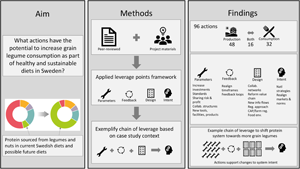
Food production and consumption need to substantially change to meet global environmental and public health goals. Increasing grain legume consumption in most countries is key to providing nourishing food for all while contributing to cropping system sustainability with relatively low environmental impact. But what actions have the potential to increase such consumption? The wide knowledge of how to cultivate grain legumes among Swedish farmers, low current consumption in most of the population, and prior shifts in dietary patterns make Sweden an interesting context for studying the potential increase of grain legumes in diets. We identify system-level actions in peer-reviewed and grey literature with the potential to increase grain legume consumption and apply the leverage points framework to evaluate the transformative potential of these actions for the food system in Sweden. Our findings show that most actions suggested in the literature so far focus on increased production, while fewer suggestions integrate production and consumption. Few actions address the deeper leverage points with most transformative potential compared with those with less transformative potential. We qualitatively analyze the actions and develop a chain of leverage illustrating how several actions together could be combined to support change at the deepest leverage point, creating social norms for the consumption of healthy foods. The chain includes developing new tools, facilities and products; changing standards; building feedback loops; changing the food environment; building new information flows between actors; and reforming the value chain. To implement the actions identified in this analysis, a range of value chain actors and supportive policies at the national and European Union levels will be needed.
Northern British Columbia, Canada, is an undersurveyed region for aquatic macroinvertebrates. We surveyed the Stellako River, a culturally and economically important river in the region, for adult caddisflies using Malaise traps, then identified species by using DNA barcoding, which revealed the presence of Protoptila coloma Ross (Trichoptera: Glossosomatidae). This is the first record of this species in Canada; it represents a 680-km northwards expansion of the species’ currently known range.
This chapter describes the journey that the scientific assessment travels from author nomination through to the drafting and reviewing of the emerging report, and explores the social scientific order that structures and imprints on the IPCC’s writing of climate change through the process. It is in the initial stages of the scientific assessment, in the government nomination and author selection processes, that asymmetries in global knowledge of climate change and their effects become apparent. While developed countries have institutionalised processes for identifying and nominating experts, the majority of developing countries do not submit any author nominations. Once compiled, it is scientific conventions and measures of authority that are used to select and appoint the expertise necessary to fulfil the government approved outline of the report. However, when these activities are situated in broader patterns and practices of knowledge production, it becomes apparent that these reproduce the structures and exclusions of the existing global knowledge economy. These asymmetries are also apparent in the order of relations in the author teams and the submission of government review comments, which reduces the space for more diverse understandings and knowledges of climate change that are relevant to and reflect the interests and needs of all IPCC member governments. The IPCC has attempted to address these asymmetries through selection criteria and other mechanisms to shape the social order of authorship, which to date have proven more successful in broadening gender representation than ensuring the full participation of developing country authors in the assessment.
In schizophrenia (SZ), impairments in cognitive functions, such as working memory, have been associated with alterations in certain types of inhibitory neurons that utilize the neurotransmitter γ-aminobutyric acid (GABA) in the dorsolateral prefrontal cortex (DLPFC). For example, GABA neurons that express parvalbumin (PV) or somatostatin (SST) have more prominent gene expression alterations than those that express vasoactive intestinal peptide (VIP). In bipolar disorder (BD) and major depression (MD), which exhibit similar, but less severe, cognitive impairments than SZ, alterations of transcript levels in GABA neurons have also been reported. However, the extent to which GABA neuron subtype-selective transcripts in the DLPFC are affected, and the relative magnitudes of the diagnosis-associated effects, have not been directly compared across SZ, BD, and MD in the same study.
Methods
We used quantitative polymerase chain reaction to examine levels of GABA neuron subtype-selective transcripts (PV, potassium voltage-gated channel modifier subfamily-S member-3, SST, VIP, and calretinin mRNAs), as well as the pan-GABA neuron marker 67 kDa glutamate decarboxylase mRNA, in DLPFC total gray matter of 160 individuals, including those with SZ, BD, or MD and unaffected comparison (UC) individuals.
Results
Relative to UC individuals, individuals with SZ exhibited large deficits in levels of all transcripts except for calretinin mRNA, whereas individuals with BD or MD showed a marked deficit only for PV or SST mRNAs, respectively.
Conclusions
These findings suggest that broader and more severe alterations in DLPFC GABA neurons might contribute to the greater cognitive impairments in SZ relative to BD and MD.
Hydroelectric turbine designers need to know the damping coefficient of a turbine blade to assess its longevity. Damping is difficult to simulate numerically. Current flow-added damping evaluation methods involve solving Reynolds-averaged Navier–Stokes simulations, which are numerically expensive and complex. This paper presents a new, simple and fast method to evaluate the added damping coefficient of a standalone and straight hydrofoil using NASTRAN's multiple modules. Using the vacuum and resting fluid natural frequencies, a proportionality matrix is implemented into NASTRAN's flutter solution using the added virtual mass incremental factor to evaluate the added damping adequately. The methodology is validated against experimental and numerical data from previously published articles and presents good agreement with existing results.
In March 2024, Daniel Kahneman – the man who did perhaps more than anyone else to shape the field of behavioural public policy – died. He is among a small handful of scholars who have had a huge effect on my own career, and in this essay – the first in a series of essays in a special section of the Journal that honour him – I reflect on how his work inspired much of my own.
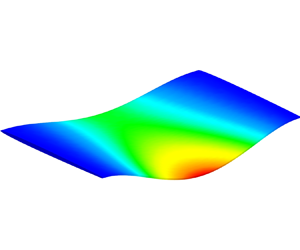
We derive a generalised asymptotic model for the flow of a thin fluid film over an arbitrarily parameterised non-axisymmetric curved substrate surface based on the lubrication approximation. In addition to surface tension, gravity and centrifugal force, our model incorporates the effects of the Coriolis force and disjoining pressure, together with a non-uniform initial condition, which have not been widely considered in existing literature. We use this model to investigate the impact of the Coriolis force and fingering instability on the spreading of a non-axisymmetric spin-coated film at a range of substrate angular velocities, first on a flat substrate, and then on parabolic cylinder- and saddle-shaped curved substrates. We show that, on flat substrates, the Coriolis force has a negligible impact at low angular velocities, and at high angular velocities results in a small deflection of fingers formed at the contact line against the direction of substrate rotation. On curved substrates, we demonstrate that, as the angular velocity is increased, spin-coated films transition from being dominated by gravitational drainage with no fingering to spreading and fingering in the direction with the greatest component of centrifugal force tangent to the substrate surface. For both curved substrates and all angular velocities considered, we show that the film thickness and total wetted substrate area remain similar over time to those on a flat substrate, with the key difference being the shape of the spreading droplet.
The Master of Science in Clinical Research Management program at Rutgers Biomedical Health Sciences underwent significant restructuring aligned with the Clinical and Translational Science Award funding parameters. This evolution necessitated formal evaluation through accreditation by the Commission on Accreditation of Allied Health Education Programs. The years-long accreditation process posed challenges, particularly regarding the collection of course learning outcomes data aligned with accreditation competency standards. The objective of this special communication is to report the rationale behind pursuing accreditation for clinical research degrees, the data collection challenges during the accreditation process, and a potential solution. In order to address existing university metric data gaps, Research Electronic Data Capture (REDCap) software was used to develop a data collection tool that streamlined the accreditation process and reduced the administrative burden. REDCap was effective in allowing faculty to self-report 3 years of course outcomes data for accreditation. There was an elevated level of user satisfaction compared to alternative data collection methods. A SWOT analysis identified the strengths and weaknesses of using REDCap, emphasizing strengths in functionality that include customizability, data validation, and compliance with regulatory standards. Overall, the advantages of leveraging REDCap for accreditation data collection, including customization, data security, and user-friendliness outweigh the key disadvantage of REDCap, which is its limited reporting capabilities.
This article analyzes the transformation of an image of ritual violence on the Kenyan coast from the sixteenth century to the present. Drawing on a range of sources, it shows how understandings of “mung'aro” — a ritual of senior male initiation among Mijikenda-speaking peoples — changed as it became an object of inquiry for generations of missionaries, explorers, colonial administrators, local intellectuals, and foreign historians and anthropologists. In the mid-twentieth century, mung'aro became a key feature of Mijikenda traditions of origin in Singwaya, but in such a way that it reversed the direction of a specific form of ritual violence described in nineteenth-century traditions. By focusing on the transposition and recombination of ritual motifs across practical and discursive modalities (namely, ritual and narrative), this article offers a new approach to “the limits of invention” regarding traditions of origin.
Overwhelmingly, philosophers tend to work on the assumption that epistemic justification is a normative status that supervenes on the relation between a cognitive subject, some body of evidence, and a particular proposition (or “hypothesis”). This article will explore some motivations for moving in the direction of a rather different view. On this view, we are invited to think of the relevant epistemic norm(s) as applying more widely to the competent exercise of epistemic agency, where it is understood that cognitive subjects are simultaneously engaged in a number of different epistemic pursuits (distinct “lines of inquiry”), each placing irreconcilable demands on our limited cognitive resources. In effect, adopting this view would require shifting our normative epistemic concern away from the question of how a subject stands with respect to the evidence bearing on the hypothesis at stake in any one line of inquiry, and over onto the question of how well they cope with the inherent risks of epistemic resource management across several lines of inquiry. While this conclusion brings to light important connections between practical and epistemic rationality, it does not collapse the distinction between them. It does, however, constitute a step in the direction of a more systematically developed account of “non-ideal epistemology.”
Primary healthcare (PHC) plays a crucial role in improving health outcomes and reducing healthcare burden, especially in low-to-middle-income countries (LMICs). However, PHC has not received adequate attention in Pakistan despite its recognized importance. This study aims to examine the current state of PHC in Pakistan, identifying factors compromising its quality and effectiveness.
Methods:
To find relevant data, the authors conducted a thorough literature search on PubMed, Google Scholar, and Cochrane Library from inception till 2 July 2022, without any language restriction. The following keywords were employed during the literature search, separated by Boolean operators AND, OR: “Primary Healthcare”, “PHC”, “Healthcare primary”, “Primary Health”, and “Pakistan”.
Results:
Pakistan’s PHC infrastructure shows promise, with a considerable number of healthcare facilities in place. However, various factors hinder its effectiveness and compromise the quality of care provided. Insufficient investment, resource constraints, inadequate training of healthcare providers, lack of oversight, and limited access to essential medicines and equipment are some of the key challenges observed. Improving PHC in Pakistan is vital for addressing the population’s healthcare needs, particularly in rural areas. Adequate investment, enhanced training programs, improved oversight mechanisms, and increased availability of essential resources are necessary to strengthen the PHC system. By prioritizing PHC and addressing the identified challenges, Pakistan can enhance healthcare access, reduce healthcare burden, and improve overall health outcomes for its population.
Conclusion:
It is high time LMICs like Pakistan recognize PHC as the most economically feasible pathway toward accomplishing healthcare targets and adopt adequate measures to elevate its standards.
We propose a qualitative method of assessing a policy mix’s content, which can be utilized alongside currently common quantitative techniques such as counting the number of tools, policies, and levels of government involved. Focussing on whether or not the mix promotes flexibility or standardization and whether it is intended to be maintaining or innovating helps to better map existing policy mixes and inform design decisions than do more contentless quantitative methods. It has implications for theories of policy-making in improving on current depictions of the nature and dynamics of policy mixes, especially with respect to the impact of procedural tools, and also helps underscore the significance of what often appear in quantitative studies to be marginal or incremental shifts in instruments and goals. The utility of the model and its improvement on existing methods are illustrated through examination of two cases of banking regulation and pension policy in Canada.
Historians have tended to view postwar labor migration, including the Turkish-German case, as a one-directional story whose consequences manifested within host country borders. This chapter complicates this narrative by arguing that Turkish migrants were mobile border crossers who traveled as tourists throughout Western Europe and took annual vacations to their homeland. These seasonal remigrations entailed a three-day car ride across Central Europe and the Balkans at the height of the Cold War. The drive traversed an international highway (Europastraße 5) extending from West Germany to Turkey through Austria, socialist Yugoslavia, and communist Bulgaria. Migrants’ unsavory travel experiences along the way underscored East/West divides, and they transmuted their disdain for the “East” onto their impoverished home villages. Moreover, the cars and “Western” consumer goods they transported reshaped their identities. Those in the homeland came to view the Almancı as superfluous spenders who were spending their money selfishly rather than for the good of their communities. Overall, the idea that a migrant could become German shows that those in the homeland could intervene from afar in debates about German identity amid rising racism: although many derided Turks as unable to integrate, they had integrated enough to face difficulties reintegrating into Turkey.
When Helmut Kohl became chancellor in October 1982, he resolved to fulfill the CDU’s promise of turning a remigration law into reality. But given the potential backlash at home and abroad, he knew that achieving his goal – getting rid of half of the Turkish migrant population – would be difficult. How, after perpetrating the Holocaust forty years prior, could West Germans kick out the Turks without compromising their post-fascist values of liberalism and democracy? How could they do so while minimizing criticism from the Turkish government? The answer, codified in the 1983 Law for the Promotion of the Voluntary Return of Foreigners (Rückkehrförderungsgesetz), was to pay Turks to leave. The West German government offered unemployed former guest workers a “remigration premium” to take their families and leave by September 30, 1984, with no option to return. While the remigration law fell short of Kohl’s 50 percent goal, it sparked one of the largest mass remigrations in modern European history. Between November 1983 and September 1984, 15 percent of the Turkish migrant population – 250,000 people – returned to Turkey. Nearly half of those return migrants came to regret their decision, as they encountered difficulties “reintegrating” both socially and economically into their own homeland.
Humanitarian crises often require urgent medical care to people of concern. Such medical aid includes assessing and treating acute medical needs and ongoing chronic health conditions. Among the people of concern there are children, who are often the most vulnerable population in humanitarian contexts because they often lack the experience, independence, and cognitive and verbal skills to deal with the ordeals they are facing. These limitations might prevent identification and diagnosis of pain. The under-diagnosis and under-treated pain by health care providers might be also due to the perceived urgency of more acute or life-threatening medical needs with limited medical equipment and personnel, lack of awareness, or assessment tools in such contexts. Additionally, due to issues of anonymity and lack of formal guidelines, there is a severe lack of standardized registration of children’s pain conditions in humanitarian crises. Finally, acute pain is also a predictor of post-traumatic stress disorder, a common outcome in such disasters. We call on health care providers to use standardized scales to assess children’s pain intensity, frequency, and duration, and to treat it appropriately. These will not only reduce children’s physical suffering but may also prevent subsequent risk of PTSD.