To save content items to your account,
please confirm that you agree to abide by our usage policies.
If this is the first time you use this feature, you will be asked to authorise Cambridge Core to connect with your account.
Find out more about saving content to .
To save content items to your Kindle, first ensure no-reply@cambridge.org
is added to your Approved Personal Document E-mail List under your Personal Document Settings
on the Manage Your Content and Devices page of your Amazon account. Then enter the ‘name’ part
of your Kindle email address below.
Find out more about saving to your Kindle.
Note you can select to save to either the @free.kindle.com or @kindle.com variations.
‘@free.kindle.com’ emails are free but can only be saved to your device when it is connected to wi-fi.
‘@kindle.com’ emails can be delivered even when you are not connected to wi-fi, but note that service fees apply.
A surge of Mittie Glacier, a 50 km-long tidewater outlet glacier of Manson Icefield, occurred between approximately 1992 and 2007. Velocities increased slowly at first, but then increased rapidly to reach a peak of 4800 m a−1 in early 1996, the highest ever reported for a glacier in the Canadian Arctic. The surge initiated at the terminus and propagated up-glacier, with a maximum terminus advance of 7.3 km between 1994 and 1999. The surge was almost entirely restricted to the lower ~30 km of the glacier, in a region which radio-echo sounding shows to be grounded below sea level. A 3 km-wide crevasse with a 150 m opening occurred at the separation between faster moving ice downstream and slower moving ice upstream. Surge initiation appears to have been triggered by flotation of the lower terminus, caused by long-term thinning of this region during quiescence.
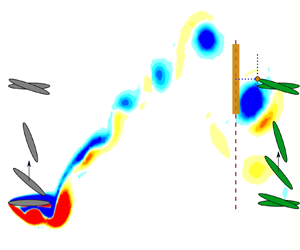
This research investigates the wake–foil interactions between two oscillating foils in a tandem configuration undergoing energy harvesting kinematics. Oscillating foils have been shown to extract hydrokinetic energy from free-stream flows through a combination of periodic heave and pitch motions, at relatively higher amplitudes and lower reduced frequency than thrust generating foils. When placed in tandem, the wake–foil interactions can govern the energy harvesting efficiency of the system due to a reduced relative flow velocity in combination with a structured and coherent wake of vortices shed from the high amplitude flapping of upstream foils. This work utilizes simulations of two tandem foils to parameterize and model the energy harvesting performance as a function of array configuration and foil kinematics. Once the wake of the leading foil has been fully parameterized, the placement, phase angle and kinematic stroke of the second foil is utilized to estimate the time-dependent power curve. The algorithm predicts the power of the second foil through the mean and unsteady wake characteristics, including the direct impingement of a vortex with the trailing foil.
To deeply explore the solar system, it will be necessary to become less reliant on the resupply tether to Earth. An approach explored in this study is to convert hydrocarbons in asteroids to human edible food. After comparing the experimental pyrolysis breakdown products, which were able to be converted to biomass using a consortia, it was hypothesized that equivalent chemicals found on asteroids could also be converted to biomass with the same nutritional content as the pyrolyzed products. This study is a mathematical exercise that explores the potential food yield that could be produced from these methodologies. This study uses the abundance of aliphatic hydrocarbons in the Murchison meteorite (>35 ppm) as a baseline for the calculations, representing the minimum amount of organic matter that could theoretically be attributed to biomass production. Calculations for the total carbon in solvent-insoluble organic matter (IOM) represent the maximum amount of organic matter that could theoretically be attributed to food production. These two values will provide a range of realistic yields to determine how much food could theoretically be extractable from an asteroid. The results of this study found that if only the aliphatic hydrocarbons can be converted into biomass (minimum scenario) the resulting mass of edible biomass extractable from asteroid Bennu ranges from 5.070 × 10⁷ g to 2.390 × 10⁸ g. If the biomass extraction process, however, is more efficient, and all IOM is converted into edible biomass (maximum scenario), then the mass of edible biomass extractable from asteroid Bennu ranges from 1.391 × 10⁹ g to 6.556 × 10⁹ g. This would provide between 5.762 × 10⁸ and 1.581 × 10¹⁰ calories that is enough to support between 600 and 17 000 astronaut life years. The asteroid mass needed to support one astronaut for one year is between 160 000 metric tons and 5000 metric tons. Based on these results, this approach of using carbon in asteroids to provide a distributed food source for humans appears promising, but there are substantial areas of future work.
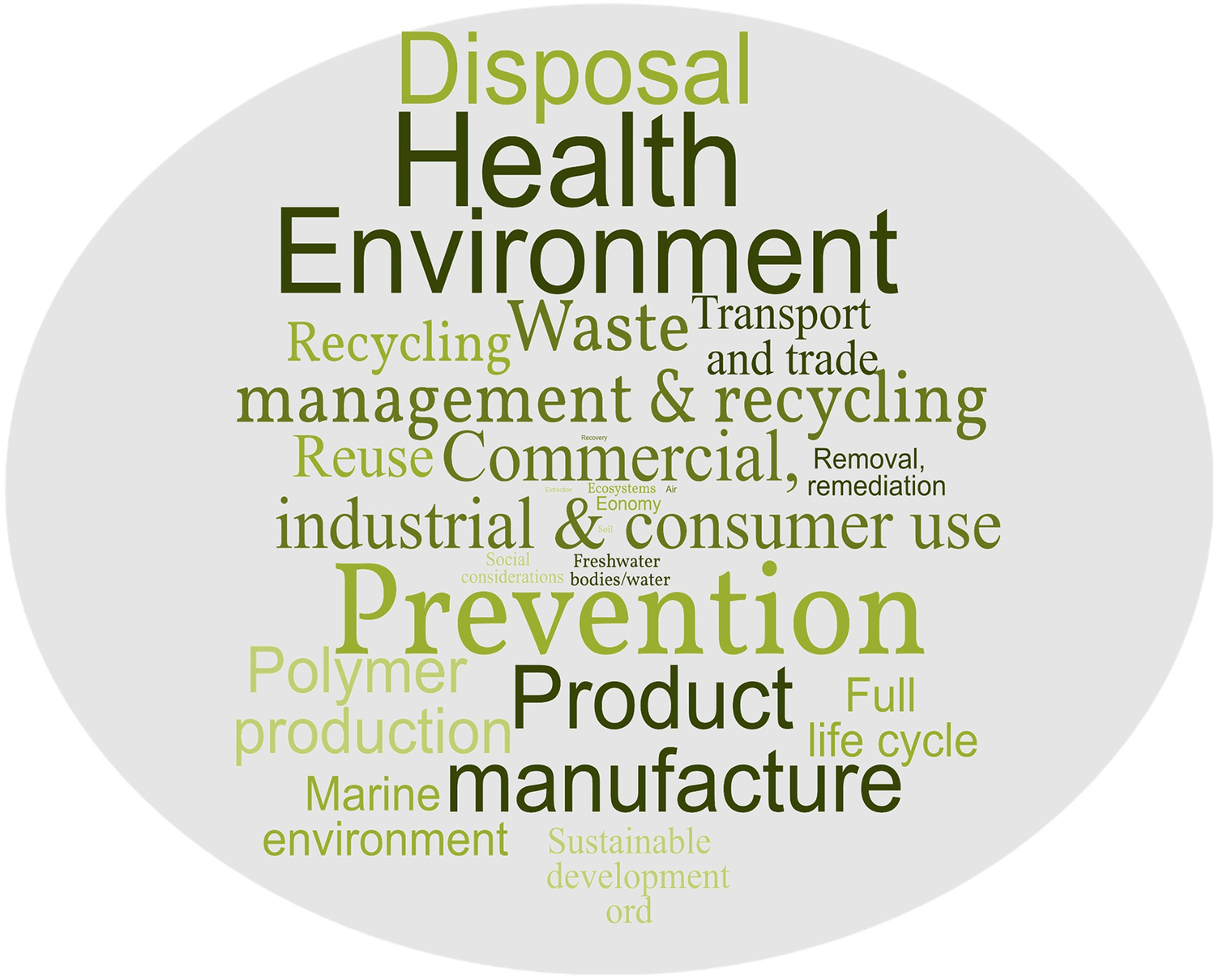
With the ongoing negotiations for an international legally binding instrument on plastic pollution, including in the marine environment, and the frustration at the end of Intergovernmental Negotiating Committee (INC-3), analyzing the zero draft text, which formed the basis for this negotiation round, is crucial. This analysis examines to what extent the zero draft conveys a clear problem definition as the foundation for an internationally legally binding instrument on plastic pollution. We find that the draft lacks a clear problem definition. Additionally, we investigate how the zero draft balances the focus between marine environments and other affected areas and discusses the implications for governance strategies. We find that the draft focuses particularly on fishing gear and hence has a downstream perspective, while upstream measures are equally important. Furthermore, this study delves into the key motivations driving the treaty negotiations, revealing that health and environmental concerns predominate. In comparing our results with previous research, we align with recent publications analyzing INC submissions and onsite statements. In addition, we identify significant differences in key motivations to tackle the plastic pollution issues between the EU and the international level. These disparities, evident in how health and economic arguments are prioritized, reflect varied approaches to combating plastic pollution across political spheres.
Having social support improves one's health outcomes and self-esteem, and buffers the negative impact of stressors. Previous studies have explored the association between social support and brain activity, but evidence from task-dependent functional connectivity is still limited.
Aims
We aimed to explore how gradually decreasing levels of social support influence task-dependent functional connectivity across several major neural networks.
Method
We designed a social support task and recruited 72 young adults from real-life social groups. Of the four members in each group, one healthy participant (18 participants in total) completed the functional magnetic resonance imaging (fMRI) scan. The fMRI task included three phases with varying levels of social support: high-support phase, fair phase and low-support phase. Functional connectivity changes according to three phases were examined by generalised psychophysiological interaction analysis.
Results
The results of the analysis demonstrated that participants losing expected support showed increased connectivity among salience network, default mood network and frontoparietal network nodes during the fair phase compared with the high-support phase. During the low-support phase, participants showed increased connectivity among only salience network nodes compared with the high-support phase.
Conclusions
The results indicate that the loss of support was perceived as a threat signal and induced widespread increased functional connectivity within brain networks. The observation of significant functional connectivity changes between fair and high-support phases suggests that even a small loss of social support from close ones leads to major changes in brain function.
A numerical method is proposed for a class of one-dimensional stochastic control problems with unbounded state space. This method solves an infinite-dimensional linear program, equivalent to the original formulation based on a stochastic differential equation, using a finite element approximation. The discretization scheme itself and the necessary assumptions are discussed, and a convergence argument for the method is presented. Its performance is illustrated by examples featuring long-term average and infinite horizon discounted costs, and additional optimization constraints.
Evaluate the 5-year changes in the consumers’ food environment in the area of a health promotion service in Brazilian primary health care. Our hypothesis is that the consumers’ food environment in the areas with primary healthcare services has changes that may favour healthy eating habits over time.
Design:
Longitudinal study.
Setting:
The territory around the primary healthcare services in Belo Horizonte, Minas Gerais, Brazil.
Participants:
All food stores and open-air food markets that sell fruits and vegetables around the primary healthcare services in 2013 (n 272) and in 2018 (n 265).
Results:
Fruit diversity increased by 13·4 % (P < 0·001) and vegetables variety and quality by 16·1 % (P = 0·003) and 12·5 % (P < 0·001), respectively. Corn snacks showed an increase in availability (13·5 %; P = 0·002). The increase in advertising was observed for fruits and vegetables (34·6 %; P < 0·001) and ultra-processed foods (47·6 %; P < 0·001). Supermarkets showed an increase in the Healthy Food Store Index (three points; P < 0·001), while fruits and vegetables stores showed a decrease of one point in the index (P < 0·001).
Conclusions:
The unequal changes in the consumers’ food environment according to the food stores types demonstrate the importance of food supply policies that promote a healthy environment and favour the maintenance of traditional healthy food retailers.
This paper calls for the lawyering profession – which is often viewed as unabridged – to be reframed into two distinct occupations: legal aid practice and private practice, to better incorporate the divisions in labour. In order to better understand contemporary legal aid work and its workers, the hidden realities must be unveiled from behind their private counterparts, which opposingly signify wealth, professionalism, autonomy and privilege. Set within a context of crumbling professional identities, a shrinking industry and financial constraints, the paper draws on ethnographic and interview data. It finds that those working in legal aid undoubtedly face a more stagnated, under-resourced and precarious working environment, which means that their professional experience is vastly different from their private counterparts. Likewise, those in the field face toxic narratives from the government, the media, the public, and their private counterparts alike, resulting in persistent discourse of vilification. Ultimately, it calls for a refocus of legal aid work as a separate vocation due to its altruistic underpinnings, unique ‘professional’ identity, and values.
Associations between adversity and youth psychopathology likely vary based on the types and timing of experiences. Major theories suggest that the impact of childhood adversity may either be cumulative in type (the more types of adversity, the worse outcomes) or in timing (the longer exposure, the worse outcomes) or, alternatively, specific concerning the type (e.g., parenting, home, neighborhood) or the timing of adversity (e.g., specific developmental periods). In a longitudinal sample from the Future of Families and Wellbeing Study (N = 4,210), we evaluated these competing hypotheses using a data-driven structured life-course modeling approach using risk factors examined at child age 1 (infancy), 3 (toddlerhood), 5 (early childhood), and 9 (middle childhood). Results showed that exposures to more types of adversity for longer durations (i.e., cumulative in both type and timing) best predicted youth psychopathology. Adversities that occurred at age 9 were better predictors of youth psychopathology as compared to those experienced earlier, except for neglect, which was predictive of internalizing symptoms when experienced at age 3. Throughout childhood (across ages 1–9), aside from the accumulation of all adversities, parental stress and low collective efficacy were the strongest predictors of internalizing symptoms, whereas psychological aggression was predictive of externalizing symptoms.
To assess trends in antibiotic prescribing for patients hospitalized with COVID-19 with and without sepsis.
Design:
Retrospective cohort study using electronic health record (EHR) data.
Setting:
Five hospitals in eastern Massachusetts.
Patients:
Adults (≥18 years) hospitalized with community-onset SARS-CoV-2 infections between March 2020 and November 2022.
Methods:
We assessed quarterly trends in the use of prolonged initial antibiotic therapy (≥4 antibiotic days within one week of admission, including discharge antibiotics) amongst COVID-19 patients with and without sepsis, defined using clinical signs of organ dysfunction before hospital day 3. Poisson regression models were used to adjust for baseline characteristics and severity of illness.
Results:
Of 431,017 hospitalizations in the study period, 21,563 (5.0%) had community-onset COVID-19. 4,769/21,563 (20.5%) presented with sepsis. Prolonged antibiotics were prescribed in 2,323/4,769 (48.7%) COVID-19 patients with sepsis and 2,866/16,794 (17.1%) without sepsis despite low rates of positive bacterial cultures on admission (15.0% vs 6.3%, respectively). Quarterly rates of prolonged antibiotics declined between the first and second pandemic quarters for both sepsis (66.8% to 43.9%) and no-sepsis (31.8% to 24.4%) groups. However, there was no significant change thereafter through November 2022 in either group (quarterly aORs 1.02, 95% CI 0.99–1.05 and 1.01, 95% CI 0.99–1.03, respectively).
Conclusions:
Prolonged antibiotics were common in hospitalized COVID-19 patients with and without sepsis during the first 33 months of the pandemic despite low rates of proven bacterial infection. Decreases in antibiotic utilization occurred primarily between the first and second pandemic quarter with no further reduction thereafter.
The Qing dynasty enforced a policy of separate governance for the people of the Eight Banners, ruling that bannermen were neither to be administered under the regular civilian administrative system, nor listed on the civilian register. Institutionally and legally, the labels “Banner” (qi 旗) and “civilian” (min 民) marked a fundamental divide between different social groups in the Qing. However, in actual practice, the boundary between the two was less rigid. An ambiguous area existed within the seemingly strict legal and administrative regime, providing opportunists with an abundance of loopholes to exploit. Some changed their status from “civilian commoner” to “bannermen” to acquire land, while others moved from “bannermen” status to “civilian commoner” status to pursue promotion in the civil service. Shedding light on the everyday lives of these people, this article delves into the intricate Banner–civilian classification of the Qing dynasty, with a focus on the overlapping area between the parallel systems. It aims to rectify the conventional binary perspective that strictly dichotomizes Banner and civilian status. By doing so, it highlights the multifaceted nature and diversity inherent in Qing ethnic relations and local society.
The spatial evolution of various statistical parameters of fetch-limited waves generated by steadily blowing wind over mean water flow in a wind-wave flume is investigated experimentally. Measurements are performed in both along- and against-wind current conditions, and compared with measurements in the absence of current. A rake of capacitance-type wave gauges is used to measure surface elevation for a wide range of wind and water current velocities; additionally, an optical wave gauge is used to measure the directional properties of the wind-wave field in the presence of a mean water current at multiple locations. The variation with fetch of essential wave parameters such as characteristic wave energy, dominant frequency, power spectra and temporal coherence, as well as higher-order statistical moments that characterize wave shape, is presented for co- and counter-wind water currents, and compared with the no-current condition. The findings in the presence of mean water flow are interpreted in the framework of the viscous shear flow instability model of Geva & Shemer (Phys. Rev. Lett., vol. 128, 2022, 124501).
Utilizing online survey data of US consumers, this study examines the extent to which consumers' acceptance of genetically modified (GM) and gene-edited (GE) food is driven by their risk attitudes. Our results indicate that individuals with high-risk propensity are more likely to accept both GM and GE food than individuals with low- and medium-risk propensity. Our results also find differences in consumers' attitudes toward plants and animal products in the context of both GM and GE. Intriguingly, these attitudinal differences can be explained by consumers' risk propensities. Specifically, both low- and medium-risk propensity consumers differentiate between plants and animal products; the latter is less acceptable than the former, indicating a tendency to have more concerns about the application of biotechnology to animals than plants. However, individuals with high-risk propensity do not differentiate between GM and GE plants and animal products. Our results suggest that policymakers, the food industry, and researchers need to consider these attitudinal differences while studying consumer attitudes toward GM and GE food. Failing to capture these attitudinal differences in studies focusing on consumer behavior toward GM and GE food may result in either overestimating or underestimating consumer response.
Penicillin allergy delabeling may benefit antimicrobial stewardship (AS). Cost of initial penicillin treatments following risk-stratified inpatient delabeling were compared to two hypothetical treatment regimens if delabeling had not occurred: (1) AS-guided and (2) Common Treatment. Penicillin allergy delabeling improved antimicrobial spectrum index, was cost-neutral, and averted unnecessary penicillin desensitizations.
Nebraska is one of the top five corn-growing states in the United States, with the planting of corn on 3.5 to 4 million hectares annually. Harvest loss of corn results in volunteer corn interference in the crop grown in rotation. Estimating the extent of harvest loss and expected volunteer corn density is a key to planning an integrated volunteer corn management program. This study aimed to evaluate the harvest loss of corn and estimate the potential for volunteerism. Harvest loss samples were collected after corn harvest from a total of 47 fields in six counties, including 26 corn fields in 2020, and 21 fields in 2021, in south-central and southeastern Nebraska. An individual cornfield size was 16 to 64 ha. A total of 16 samples were collected from each field after corn harvest in 2020 and 2021. Harvest loss of corn was 1.5% and 0.7% of the average yield of 15,300 kg ha−1 in 2020 and 2021, respectively. Corn harvest loss was 191 and 80 kg ha−1 from dryland fields, and 206 and 114 kg ha−1 from irrigated fields in 2020 and 2021, respectively. An average kernel loss of 68 and 33 m−2 occurred in 2020 and 2021, respectively. The germination percentage of corn kernels collected from harvest loss was 51%, which implies that volunteer corn plants of 35 and 17 m−2 from 2020 and 2021, respectively, could be expected in successive years. A volunteer corn management plan is required, because if it is not controlled, this level of volunteer corn density can cause yield reduction depending on the crop grown in rotation.
The closed material procedure (CMP) – ever since its introduction to English law – has been subjected to a very significant amount of academic criticism. But over time, the CMP has become increasingly settled as a fixture in English law. Whilst the existence of the CMP per se in English law seems settled, the extent of its deployment is not. Given this development, it seems important and constructive to examine whether – and the conditions under which – a CMP can ever be normatively justified, all things considered. Two propositions will be made. First, a common argument for the CMP – the maximising argument – does not demonstrate that the CMP is normatively justified, all things considered, for it does not sufficiently mitigate the two main objections to the CMP, based respectively on the principles of natural justice and open justice. Secondly, where the clear advantage variation is deployed – ie when a CMP allows the excluded party to make use of material that: (a) clearly advantages him; and (b) would otherwise be unavailable for the court's consideration – both objections are sufficiently mitigated. In such a case, the CMP is normatively justified, all things considered. This constitutes a limited normative case for the CMP.
Globally, companies are developing and implementing their strategies to reduce greenhouse gas emissions to limit the global temperature increase to 1.5 degrees Celsius above pre-industrial levels, in line with the Paris Agreement. However, there is also growing recognition and awareness of the potential negative impacts of these activities on human rights. Recent pressure from international normative standards and ESG expectations, emerging legislative developments, and legal precedents are driving companies to consider human rights impacts across their climate action. This piece explores some of the human rights risks associated with the transition to renewable energy; the transformation to regenerative agriculture; the scaling up of the circular economy; and the implementation of nature-based solutions. It then explores the challenges of conducting effective human rights due diligence given the scale and scope of the transitions needed and provides examples of how companies are seeking to respect human rights in their climate action.