To save content items to your account,
please confirm that you agree to abide by our usage policies.
If this is the first time you use this feature, you will be asked to authorise Cambridge Core to connect with your account.
Find out more about saving content to .
To save content items to your Kindle, first ensure no-reply@cambridge.org
is added to your Approved Personal Document E-mail List under your Personal Document Settings
on the Manage Your Content and Devices page of your Amazon account. Then enter the ‘name’ part
of your Kindle email address below.
Find out more about saving to your Kindle.
Note you can select to save to either the @free.kindle.com or @kindle.com variations.
‘@free.kindle.com’ emails are free but can only be saved to your device when it is connected to wi-fi.
‘@kindle.com’ emails can be delivered even when you are not connected to wi-fi, but note that service fees apply.
The numerous ephemeral glacial meltwater streams that flow during the summer in the McMurdo Dry Valleys of South Victoria Land, Antarctica, provide habitats for microbial mats. One of the common mat types is composed of Chlorophyta (colloquially known as a ‘green mat’ due to its colour). While the presence of these mats is regularly monitored, their taxonomic makeup is still under investigation. Using 18S rRNA gene sequencing, the composition of the chlorophyte-dense mats from between rocks and in the main channel from several streams across two valleys was examined. Samples were maintained in native stream water, and select samples from representative locations were transferred to Bristol Medium. The appearance of other eukaryotic species - diatoms and tardigrades - in these green mats completed this integrated study. The results show that the relative abundance of Chlorophyta was significantly increased with the introduction of inorganic nitrogen from Bristol Medium. Chlorophyte taxa in the Hazenia and Pleurastrum genera dominated the samples across both sample types (rock or exposed) and treatments (Antarctic water or Bristol Medium). Furthermore, a reduction in overall sample diversity was observed in samples in Bristol Medium, suggesting preferential nitrogen utilization by these chlorophytes.
Weed diversity plays an important role in the functioning of agroecosystems. Moreover, a number of endangered/threatened plant species occur as weeds in arable fields and/or field boundaries. Agricultural intensification has imposed negative consequences on weed diversity in general, and the survival of the endangered/threatened plant species in particular. The objective of this review is to provide a theoretical framework for promoting cropland weed diversity through precision agriculture. A systematic review was conducted based on literature analysis, existing knowledge gaps, and current needs to identify a suitable approach for promoting cropland biodiversity while protecting crop yields. While nonchemical weed management methods and economic threshold–based approaches are touted to improve weed diversity, they are either ineffective or insufficient for this purpose; long-term economic consequences and the risk of weed adaptation are major concerns. A plant functional trait-based approach to promoting weed diversity, one that considers a plant’s ecosystem service potential and competitiveness with the crop, among other factors, has been proposed by researchers. This approach has tremendous potential for weed diversity conservation in commercial production systems, but field implementation has been limited thus far due to our inability to selectively control weeds at the individual-plant level. However, recent advancements in computer vision, machine learning, and site-specific weed management technologies may allow for the accurate elimination of unwanted plants while retaining the important ones. Here, we present a novel framework for the utilization of precision agriculture for the conservation of cropland weed diversity, including the protection of endangered/threatened plant species, while protecting crop yields. This approach is the first of its kind in which the control priority is ranked on an individual-plant basis, by integrating intrinsic weed trait values with field infestation characteristics, while management thresholds are tailored to specific goals and priorities.
Funisia dorothea Droser in Droser and Gehling, 2008 is an inferred metazoan-grade tubular organism, endemic to the Ediacara Member, Rawnsley Quartzite, of South Australia (~555–550 Myr), which is characterized by a hollow, elongate body constructed of uniserially repeating modular elements and is one of the most abundantly reported members of the Ediacara biota. Thus, Funisia Droser in Droser and Gehling, 2008 has broad significance for developing understanding of the Ediacara biota and provides a large dataset for testing hypotheses on the biological traits of Ediacaran tubular organisms. This study investigates size changes in Funisia’s modular elements to provide further insight into the paleobiology of this organism through the development of a holistic growth model. Results demonstrate that growth in Funisia was highly regulated to maintain uniform modular element width along the length of an individual and, thereby, an overall cylindrical form despite increasing module width throughout ontogeny. The growth model proposed here is compared with the pre-established growth model for another modular Ediacaran tubular organism, Wutubus annularis Chen et al., 2014, demonstrating that the two taxa had distinct growth patterns and disparate autecological strategies, despite a shared constructional morphology.
To identify politico-economic factors relating to policy surrounding the production, processing and trade of sugar in Indonesia and identify strategies to support improved integration of national nutrition and food security priorities with respect to sugar.
Design:
This study was a qualitative policy analysis, informed by political economy and power analysis approaches and drawing on both documentary policy data and interviews.
Setting:
Indonesia.
Participants:
Interviewees from various national and sub-national government and non-government sectors, with expertise in health and food safety (n 7), finance and economics (n 2), trade and industry (n 3) and others (n 4).
Results:
Sugar was articulated as a policy priority in three distinct ways: (1) sugar as an economic good; (2) sugar in relation to health and (3) sugar as a commodity for food security. High political priority was given to national economic development, as well as concerns relating to farmer rights and welfare. Nutrition priorities and objectives to reduce sugar consumption were addressed in health policies; however, they were not reflected in production and economic policies promoting sugar.
Conclusions:
Creating opportunities to diversify agricultural production and ensuring a just transition to protect the livelihoods of sugar farmers in Indonesia will be crucial in enabling the achievement of nutrition priorities to reduce sugar consumption.
Haemonchosis is a fatal disease of livestock caused by Haemonchus contortus (HC) – a blood-sucking parasite of the abomasum. This parasite is quite prevalent in sheep, causing mortality and production losses. The suppressor of cytokine signalling-2 (SOCS2) gene plays a vital role in sheep’s immune response against gastrointestinal parasites. This study aimed to estimate the parasitic load of HC in three sheep breeds (Balkhi, Ghalji, and Michni) through faecal egg count and to identify SNPs in the SOCS2 gene associated with the susceptibility of sheep against HC. The results showed that the mean number of HC eggs per gram (EPG) was higher in the faecal samples of Ghalji (4022 ± 1162 EPG), followed by Michni (1988 ± 367 EPG), while the HC EPG was the lowest in Balkhi sheep (1535 ± 552 eggs/gm). Sequencing results showed polymorphisms in the SOCS2 gene between the low-infection and high-infection categories of the three sheep breeds. A total number of six genic variants were observed, of which three were SNPs, one was insertion, and two were deletions. Polymorphisms were observed in the intronic and 3′ UTR regions of the SOCS2 gene. A deletion (c.1083delGCA) in intron 1 and an insertion (c.3304insT) in intron 2 showed positive correlations (0.833 and 0.889, respectively) with the HC infection, while one SNP in the 3′ UTR region showed negative correlation (–0.654). This study provides a basis for selecting resistant sheep against HC infection based on the SOCS2 gene molecular markers.
The cold storage of biological control agents, such as parasitoids, is a valuable method utilised in mass rearing to ensure the availability of sufficient individuals when needed. This study evaluated the effects of storage temperatures of 9°C and 12°C, along with incubation periods of 7, 14, 21, 28, and 35 days, on the biological fitness of Bracon adoxophyesi Minamikawa (Hymenoptera: Braconidae). The results demonstrated that the survival rates of adult wasps exceeded 90.0% after being stored at both 9°C and 12°C for 35 days. At these temperatures, female wasps exhibited their longest lifespan at 14 days, whereas male longevity decreased progressively from 7 to 35 days. The parasitism rates observed were 43.0% at 9°C and 46.0% at 12°C after 7 days of refrigeration, with a subsequent reduction noted after 35 days. The fecundity of parasitic wasps decreased with the extension of storage time, but no significant difference was found in total egg production within 28 days of storage. Additionally, cold storage did not significantly affect the survival of the offspring; however, the proportion of females among the raised offspring was higher than in the control group. In comparing fitness parameters to the control, wasp vitality was notably higher after 21 days of storage at 9°C or 14 days at 12°C, indicating that these combinations of temperature and time are optimal. The findings of this study serve as a reference for optimising cold storage techniques and facilitating the large-scale application of B. adoxophyesi.
Manganese (Mn) is a crucial trace element that actively participates in a diverse array of physiological processes. Mn is maintained at appropriate levels in the body by absorption and excretion by the body. Dysregulation of Mn homeostasis can lead to a variety of diseases, especially the accumulation of Mn in the brain, resulting in toxic side effects. We reviewed the metabolism and distribution of Mn at multiple levels, including organ, cellular and sub-cell levels. Mitochondria are the main sites of Mn metabolism and energy conversion in cells. Enhanced Mn superoxide dismutase activity reduces mitochondrial oxidative stress and inhibits cancer development. In addition, Mn enhances anti-cancer immune responses through the cGAS–STING pathway. We introduced various delivery vectors for Mn delivery to cancer sites for Mn supplementation and anti-cancer immunity. This review aims to provide new research perspectives for the application of Mn in the prevention and treatment of human diseases, especially by enhancing anti-cancer immune responses to inhibit cancer progression.
Current breast cancer (BC) diagnostics include detailed pathological and genetic analysis for biological subtype identification; however, throughout the course of the disease, new alterations determining the progression of the disease or resistance to treatment appear. The tests based on liquid biopsy allow minimally invasive real-time monitoring of tumour-specific alteration during the entire disease treatment. Tumour-specific genetic material fragments occur in bodily fluids, and cell-free nucleic acids are a convenient tool for analysing genetic and epigenetic changes in tumours. Evidence for the diagnostic and prognostic value of epigenetic biomarkers is gradually increasing. Although, up to date, there is limited access to in vitro diagnostic (IVD) epigenetic liquid biopsy-based tests for BC management, the data on the clinical potential of such tests and biomarkers are accumulating rapidly.
Methods
In this review, we focused on research involving cell-free DNA methylation biomarkers in blood serum or plasma samples from BC patients.
Results
Our review systematises data from genome-wide and targeted studies of DNA methylation changes in liquid biopsies from BC patients, aiming to highlight the most critical biomarkers suitable for early BC diagnosis, treatment personalisation and prognosis.
Conclusion
In summary, cell-free DNA methylation biomarkers show strong potential to enhance breast cancer diagnosis, prognosis, and personalised treatment through integrated clinical profiling.
To assess the degree to which cohabiting couples (men and women) in Cameroon responded differently to the Food Insecurity Experience Scale and, where discordance exists, to test hypothesised drivers of difference.
Design:
This cross-sectional study employed descriptive statistics and multivariable regression analyses using R.
Setting:
Nationally representative sample of cohabiting adults in Cameroon.
Participants:
2889 couples (male/female; 5778 total adults) from the Cameroon Demographic and Health Survey (2018) couples recode.
Results:
Food insecurity was more prevalent and reported with higher severity among men compared with women. Discordance in reported food insecurity was evident in 57–79 % of cohabiting couples in the dataset, depending on the measure used. Discordance was not clearly associated with household wealth. Further, among couples with discordant food insecurity experiences, men more often affirmed items that their partners did not affirm. Contrary to our hypotheses, items reflecting household food security did not show greater agreement among couples than did individual items. Of our hypothesised predictors, only current employment status among men was significantly associated with the difference in food security scores among couples.
Conclusions:
This study highlights the importance of examining intrahousehold differences in food security. Understanding how individuals within a household experience and perceive their food situation and the underlying factors driving disparities is crucial for improving the effectiveness of targeted food and nutrition policies.
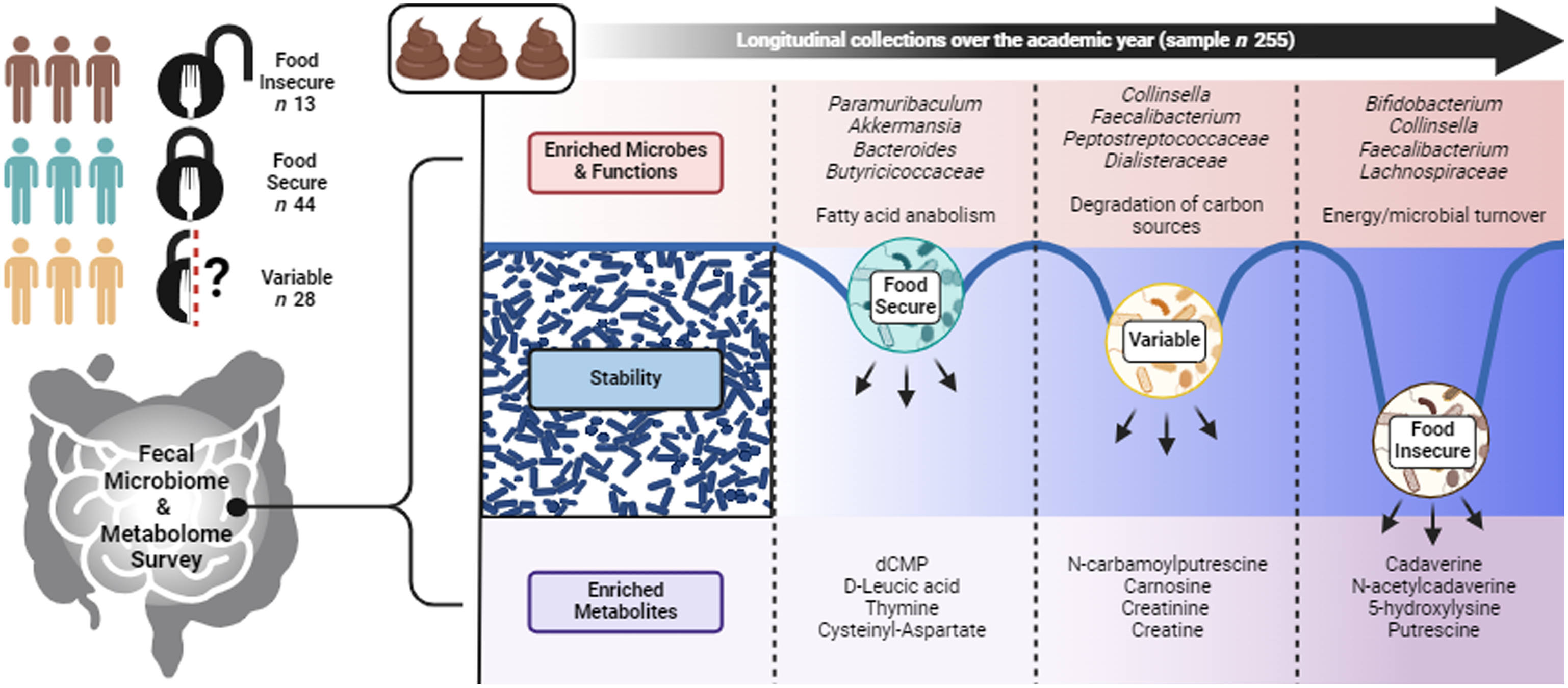
Food insecurity affects the health of college-aged individuals, but its impact on the gut microbiome (GM) over time is poorly understood. This study explored the association between food insecurity and the GM in eighty-five college students, identifying microbial taxa, metabolites and pathways linked to food security status and examining GM stability and microbe–metabolite interactions. Longitudinal GM and metabolomic data were collected from first-year students over an academic year, encompassing periods of variable food security status. Participants were categorised into three groups: food insecure (FI, n 13), food secure (FS, n 44) and variable (VAR, n 28) status. GM composition varied significantly between FS classifications (Bray–Curtis dissimilarity, P ≤ 0·005). Stability analysis revealed correlations between stability scores and microbial features, pathways and metabolites. Specific microbes (e.g. Bifidobacterium species, Faecalibacterium prausnitizii D and Lachnospiraceae), pathways (energy and microbial turnover) and metabolites (cadaverine, N-acetylcadaverine, putrescine, testosterone sulfate and creatine) associated with FI status were identified. Multi-omic integration revealed metabolic pathways influenced by differentially abundant microbial species and co-occurring fecal metabolites in FI participants related to the microbial production of polyamines, detoxification and energy metabolism. The transition from FS to FI showed no significant differences at specific taxonomic, functional or metabolite levels. This study uncovers complex interactions between food security, GM composition and metabolism. Significant differences were found in microbial community variability and metabolic pathways associated with food security status, but the transition from food security to insecurity disrupted the GM without clear taxonomic or functional distinctions, emphasising the need for further research into these mechanisms.
Climbing aroids, despite their abundance in tropical forests, remain underexplored. This study is focused on species richness, abundance, density, and distribution patterns of climbing aroid community in a lowland rainforest in Los Tuxtlas, Veracruz, Mexico. Over two years, two censuses were conducted across 14 plots, recording 12 aroid species from five genera and their potential hosts. Ontogenetic classes were defined and validated, showing a positive correlation between total plant length/apex height and ontogenetic stage, indicating distinct growth phases. Host size (DBH) was significant predictor of the establishment probability across ontogenetic classes. Vertical distribution varied significantly among species, ranging from Philodendron hederaceum (7 m) to Anthurium flexile (0.88 m), with some species predominantly distributed on specific host sizes. Tree falls impacted specific species. Although limitations, including a short study period, restrict broader generalizations, this research establishes a foundational understanding of climbing aroid ecology and underscores the need for standardized methods and long-term monitoring to elucidate their population dynamics and ecological strategies.
Resource partitioning remains a central ecological issue for understanding the structures of animal communities. As members of the generalist New World Thraupidae bird family, tanagers can help reinforce knowledge of animal communities. Thus, to study bird trophic ecology and relationships, I followed six tanager species (Schistochlamys ruficapillus, Tangara desmaresti, Stilpnia cayana, Stephanophorus diadematus, Thraupis sayaca and Dacnis cayana) from the Ibitipoca State Park, south-eastern Brazil, for 12 months. I expected 1) more similarities among frugivorous behaviours when compared to the similarities in the frugivorous diet, 2) no differences between the predation behaviours on arthropods against the use of substrates to capture them, 3) no specialisation in the bird–fruit seed dispersal network and 4) similarities of frugivorous diet and substrate use equal those expected by chance due to the absence of specialisation in frugivory and limited use of substrates. Several ecological and behavioural factors seemed to determine the ways in which Ibitipoca tanagers consumed fruits to reduce similarities in diets and reveal network specialisation. On the other hand, the analysis of predation behaviour indicated that tanager species used similar tactics to reach arthropods randomly on substrates. In general, frugivory seems to be more relevant in trophic partitioning than foraging on arthropods in Ibitipoca tanagers.
Previously, we reported the persistence of the bacterial pathogen Neisseria meningitidis on fomites, indicating a potential route for environmental transmission. The current goal was to identify proteins that vary among strains of meningococci that have differing environmental survival. We carried out a proteomic analysis of two strains that differ in their potential for survival outside the host. The Group B epidemic strain NZ98/254 and Group W carriage strain H34 were cultured either at 36 °C, 5% CO2, and 95% relative humidity (RH) corresponding to host conditions in the nasopharynx, or at lower humidities of 22% or 30% RH at 30 °C, for which there was greater survival on fomites. For NZ98/254, the shift to lower RH and temperature was associated with increased abundance of proteins involved in metabolism, stress responses, and outer membrane components, including pili and porins. In contrast, H34 responded to lower RH by decreasing the abundance of multiple proteins, indicating that the lower viability of H34 may be linked to decreased capacity to mount core protective responses. The results provide a snapshot of bacterial proteins and metabolism that may be related to normal fitness, to the greater environmental persistence of NZ98/254 compared to H34, and potentially to differences in transmission and pathogenicity.
This study aims to assess consumer preferences for fifteen proposed front-of-package ‘Healthy’ label candidates under the Food and Drug Administration’s (FDA) of the US updated guidelines for the ‘Healthy’ label. The goal of this study is to identify which label designs best align with consumer preferences, thereby supporting the FDA’s efforts to promote healthier dietary choices through effective labelling.
Design:
A best-worst scaling (BWS) experiment was conducted using a balanced incomplete block design to assess consumer preferences for the fifteen FDA-proposed ‘Healthy’ labels. Participants completed fifteen best-worst scaling choice tasks where they identified the ‘best’ and ‘worst’ design from three randomly presented options in each task.
Setting:
The experiment was conducted in a controlled laboratory setting in the USA.
Participants:
Three hundred and eight US adult consumers who are primary household shoppers without dietary restrictions.
Results:
Results from the random parameter logit model indicate that labels 12 and 8 emerged as the most preferred designs, with preference shares of 16·7 and 16·1 %, respectively. These two labels featured a prominent ‘Healthy’ display with bold blue font, balanced colour themes and check marks, which likely contributed to their appeal. The Krinsky and Robb bootstrapping method confirmed the statistical significance of the preferences for these labels over others.
Conclusions:
This study identifies two labels as the most preferred FDA-proposed ‘Healthy’ label designs, offering clear guidance to policymakers on effective labelling strategies. By adopting a consumer-preferred design, the FDA’s ‘Healthy’ label may have greater potential to influence healthier food choices.
‘Tropicalization’, the phenomenon of species shifting their ranges, has become increasingly prevalent as a response to environmental modifications induced by global change. This study points to an accelerated tropicalization process of marine fish species in the Gulf of Cadiz, a bioinvasion hotspot adjacent to the Strait of Gibraltar. We report accelerated, unusual, and rare occurrences of 15 fish species expanding and potentially establishing their ranges in the Gulf of Cadiz, driven by ocean warming over the past decade. These new insights are the combined consequence of a range expansion of some species, likely facilitated by temperature increases, an intensification of maritime traffic (with a consequent rise in propagule pressure), and a possible increase in sampling efforts and citizen science.