Refine search
Actions for selected content:
26063 results in Abstract analysis
Incidence geometry and polynomial expansion over finite fields
- Part of
-
- Journal:
- Proceedings of the Royal Society of Edinburgh. Section A: Mathematics , First View
- Published online by Cambridge University Press:
- 23 February 2026, pp. 1-12
-
- Article
-
- You have access
- Open access
- HTML
- Export citation
Solitons of the spacelike mean curvature flow in standard static spacetimes
-
- Journal:
- Proceedings of the Edinburgh Mathematical Society , First View
- Published online by Cambridge University Press:
- 19 February 2026, pp. 1-14
-
- Article
- Export citation
Concavity of spacetimes
- Part of
-
- Journal:
- Proceedings of the Royal Society of Edinburgh. Section A: Mathematics , First View
- Published online by Cambridge University Press:
- 18 February 2026, pp. 1-22
-
- Article
-
- You have access
- Open access
- HTML
- Export citation
A simple model for twisted arrow $\infty$-categories
- Part of
-
- Journal:
- Glasgow Mathematical Journal , First View
- Published online by Cambridge University Press:
- 18 February 2026, pp. 1-28
-
- Article
- Export citation
-
Twisted arrow $\infty$-categories of $(\infty ,1)$-categories were introduced by Lurie, and they have various applications in higher category theory. Abellán García and Stern gave a generalization to twisted arrow $\infty$-categories of $(\infty ,2)$-categories. In this paper, we introduce another simple model for twisted arrow $\infty$-categories of $(\infty ,2)$-categories.


Ranges of polynomials control degree ranks of Green and Tao over finite prime fields
- Part of
-
- Journal:
- Proceedings of the Edinburgh Mathematical Society , First View
- Published online by Cambridge University Press:
- 18 February 2026, pp. 1-28
-
- Article
-
- You have access
- Open access
- HTML
- Export citation
-
Let $p$ be a prime, let $1 \le t \lt d \lt p$ be integers, and let $S$ be a non-empty subset of $\mathbb{F}_p$. We establish that if a polynomial $P:\mathbb{F}_p^n \to \mathbb{F}_p$ with degree $d$ is such that the image $P(S^n)$ does not contain the full image $A(\mathbb{F}_p)$ of any non-constant polynomial $A: \mathbb{F}_p \to \mathbb{F}_p$ with degree at most $t$, then $P$ coincides on $S^n$ with a polynomial that in particular has bounded degree- $\lfloor d/(t+1) \rfloor$-rank in the sense of Green and Tao. Similarly, we prove that if the assumption holds even for $t=d$, then $P$ coincides on $S^n$ with a polynomial determined by a bounded number of coordinates.


Periodic dynamics in a time-switching advection-diffusion model for competing Aedes mosquitoes
- Part of
-
- Journal:
- European Journal of Applied Mathematics , First View
- Published online by Cambridge University Press:
- 16 February 2026, pp. 1-21
-
- Article
-
- You have access
- Open access
- HTML
- Export citation
A characterization of quasi-homogeneity in terms of liftable vector fields
- Part of
-
- Journal:
- Proceedings of the Royal Society of Edinburgh. Section A: Mathematics , First View
- Published online by Cambridge University Press:
- 16 February 2026, pp. 1-28
-
- Article
-
- You have access
- Open access
- HTML
- Export citation
Higher topological complexity of Seifert fibred manifolds
- Part of
-
- Journal:
- Proceedings of the Royal Society of Edinburgh. Section A: Mathematics , First View
- Published online by Cambridge University Press:
- 16 February 2026, pp. 1-20
-
- Article
- Export citation
-
In this article, we investigate the higher topological complexity of oriented Seifert fibred manifolds that are Eilenberg–MacLane spaces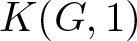 $K(G,1)$ with infinite fundamental group $G$. We first refine the cohomological lower bounds for higher topological complexity by introducing the notion of higher topological complexity weights. As an application, we show that the $r^{\text{th}}$ topological complexity of these manifolds lies in $\{3r-1, 3r, 3r+1\}$, and characterize large families where the value is $3r$ or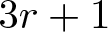 $3r+1$. Additionally, we establish a sufficient condition for higher topological complexity to be exactly $3r$ when the base surface is orientable and aspherical. Finally, we show that the higher topological complexity of the wedge of finitely many closed, orientable, aspherical $3$-manifolds is exactly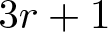 $3r+1$.


Decay estimate for subcritical semilinear damped wave equations with slowly decreasing data – CORRIGENDUM
-
- Journal:
- Proceedings of the Royal Society of Edinburgh. Section A: Mathematics , First View
- Published online by Cambridge University Press:
- 16 February 2026, p. 1
-
- Article
-
- You have access
- HTML
- Export citation
Almost Erdős sets
- Part of
-
- Journal:
- Proceedings of the Edinburgh Mathematical Society , First View
- Published online by Cambridge University Press:
- 12 February 2026, pp. 1-9
-
- Article
- Export citation
-
A set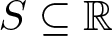 $S \subseteq \mathbb{R}$ is almost Erdős if, for every $\varepsilon \gt 0$, there exists a set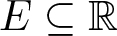 $E \subseteq \mathbb{R}$ of positive Lebesgue measure such that $\{x \in S : ax+b \notin E\}$ is nonempty for all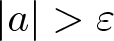 $|a| \gt \varepsilon$ and $b \in \mathbb{R}$. In this note, we show that any decreasing null sequence $(x_n)$ with decay rate greater than $1/2$ is an almost Erdős set.


On the energy dissipation phenomena for Navier–Stokes equations of compressible fluid flow
- Part of
-
- Journal:
- Proceedings of the Royal Society of Edinburgh. Section A: Mathematics , First View
- Published online by Cambridge University Press:
- 06 February 2026, pp. 1-26
-
- Article
- Export citation
-
This paper is concerned with the Cauchy problem of compressible Navier–Stokes equations. Both the anomalous energy dissipation and the vanishing global dissipation are surveyed. First, we construct a family of smooth solutions which exhibit anomalous dissipation when the viscous coefficient $\epsilon$ tends to zero. Second, assume that the weak solutions have additional (uniformly in $\epsilon$) regularity, then the convergence rate of vanishing global dissipation is proportional to a power function of $\epsilon$. The results indicate that the inviscid singularity is caused by the lack of smoothness of solutions, not the viscosity.


Graphical sequences and plane trees
- Part of
-
- Journal:
- Combinatorics, Probability and Computing / Volume 35 / Issue 3 / May 2026
- Published online by Cambridge University Press:
- 05 February 2026, pp. 316-328
-
- Article
-
- You have access
- Open access
- HTML
- Export citation
-
Balister, the second author, Groenland, Johnston, and Scott recently showed that there are asymptotically $C4^n/n^{3/4}$ many unordered sequences that occur as degree sequences of graphs with $n$ vertices. Combining limit theory for infinitely divisible distributions with a new connection between a class of random walk trajectories and a subset counting formula from additive number theory, we describe $C$ in terms of Walkup’s number of rooted plane trees. The bijection is related to an instance of the Lévy–Khintchine formula. Our main result complements a result of Stanley, that ordered graphical sequences are related to quasi-forests.


Cohomology of restricted twisted Heisenberg Lie algebras – CORRIGENDUM
-
- Journal:
- Proceedings of the Royal Society of Edinburgh. Section A: Mathematics , First View
- Published online by Cambridge University Press:
- 05 February 2026, pp. 1-2
-
- Article
-
- You have access
- HTML
- Export citation
THE CLASS OF THE PRYM-BRILL-NOETHER DIVISOR
- Part of
-
- Journal:
- Journal of the Institute of Mathematics of Jussieu / Volume 25 / Issue 2 / March 2026
- Published online by Cambridge University Press:
- 05 February 2026, pp. 1281-1310
- Print publication:
- March 2026
-
- Article
-
- You have access
- Open access
- HTML
- Export citation
-
For $r\geq 3$ and $g= \frac {r(r+1)}{2}$, we study the Prym-Brill-Noether variety $V^r(C,\eta )$ associated to Prym curves $[C,\eta ]$. The locus $\mathcal {R}_g^r$ in $\mathcal {R}_g$ parametrizing Prym curves $(C, \eta )$ with nonempty $V^r(C,\eta )$ is a divisor. We compute some key coefficients of the class $[\overline {\mathcal {R}}_g^r]$ in $\mathrm {Pic}_{\mathbb {Q}}(\overline {\mathcal {R}}_g)$. Furthermore, we examine a strongly Brill-Noether divisor in $\overline {\mathcal {M}}_{g-1,2}$: we show its irreducibility and compute some of its coefficients in $\mathrm {Pic}_{\mathbb {Q}}(\overline {\mathcal {M}}_{g-1,2})$. As a consequence of our results, the moduli space $\mathcal {R}_{14,2}$ is of general type.


Time-inhomogeneous random walks on finite groups and cokernels of random integer block matrices
- Part of
-
- Journal:
- Combinatorics, Probability and Computing / Volume 35 / Issue 3 / May 2026
- Published online by Cambridge University Press:
- 02 February 2026, pp. 329-355
-
- Article
- Export citation
Families of twists of tuples of hyperelliptic curves
- Part of
-
- Journal:
- Glasgow Mathematical Journal , First View
- Published online by Cambridge University Press:
- 02 February 2026, pp. 1-7
-
- Article
-
- You have access
- Open access
- HTML
- Export citation
-
Let $f \in \mathbb{Q}[x]$ be a square-free polynomial of degree at least $3$,
$3$,  $m_i$, $i=1,2,3$, odd positive integers, and $a_i$, $i=1,2,3$, non-zero rational numbers. We show the existence of a rational function $D\in \mathbb{Q}(v_1,v_2,v_3,v_4)$ such that the Jacobian of the quadratic twist of $y^2=f(x)$ and the Jacobian of the $m_i$-twist, respectively, $2m_i$-twist, of $y^2=x^{m_i}+a_i^2$, $i=1,2,3$, by $D$ are all of positive Mordell–Weil ranks. As an application, we present families of hyperelliptic curves with large Mordell–Weil rank.


HÖLDER CONTINUITY AND LAMINARITY OF THE GREEN CURRENTS FOR HÉNON-LIKE MAPS
- Part of
-
- Journal:
- Journal of the Institute of Mathematics of Jussieu / Volume 25 / Issue 2 / March 2026
- Published online by Cambridge University Press:
- 02 February 2026, pp. 1363-1392
- Print publication:
- March 2026
-
- Article
- Export citation
-
Under a natural assumption on the dynamical degrees, we prove that the Green currents associated to any Hénon-like map in any dimension have Hölder continuous super-potentials, i.e., give Hölder continuous linear functionals on suitable spaces of forms and currents. As a consequence, the unique measure of maximal entropy is the Monge-Ampère of a Hölder continuous plurisubharmonic function and has strictly positive Hausdorff dimension. Under the same assumptions, we also prove that the Green currents are woven. When they are of bidegree $(1,1)$, they are laminar. In particular, our results generalize results known until now only in algebraic settings, or in dimension 2.

ON THE GROWTH OF TORSION IN THE COHOMOLOGY OF SOME ARITHMETIC GROUPS OF $\mathbb {Q}$-RANK ONE
-
- Journal:
- Journal of the Institute of Mathematics of Jussieu / Volume 25 / Issue 2 / March 2026
- Published online by Cambridge University Press:
- 30 January 2026, pp. 1311-1362
- Print publication:
- March 2026
-
- Article
-
- You have access
- Open access
- HTML
- Export citation
-
Given a number field F with ring of integers $\mathcal {O}_{F}$, one can associate to any torsion free subgroup of $\operatorname {SL}(2,\mathcal {O}_{F})$ of finite index a complete Riemannian manifold of finite volume with fibered cusp ends. For natural choices of flat vector bundles on such a manifold, we show that analytic torsion is identified with the Reidemeister torsion of the Borel-Serre compactification. This is used to obtain exponential growth of torsion in the cohomology for sequences of congruence subgroups.


Truncated Jacobi triple product series II: Li, Lin, and Wang’s nonnegativity conjecture – ERRATUM
-
- Journal:
- Proceedings of the Royal Society of Edinburgh. Section A: Mathematics , First View
- Published online by Cambridge University Press:
- 30 January 2026, p. 1
-
- Article
-
- You have access
- HTML
- Export citation
PEM series 2 volume 69 issue 1 Cover and Front matter
-
- Journal:
- Proceedings of the Edinburgh Mathematical Society / Volume 69 / Issue 1 / February 2026
- Published online by Cambridge University Press:
- 29 January 2026, pp. f1-f2
-
- Article
-
- You have access
- Export citation
