Refine search
Actions for selected content:
26063 results in Abstract analysis
PEM series 2 volume 69 issue 1 Cover and Back matter
-
- Journal:
- Proceedings of the Edinburgh Mathematical Society / Volume 69 / Issue 1 / February 2026
- Published online by Cambridge University Press:
- 29 January 2026, pp. b1-b2
-
- Article
-
- You have access
- Export citation
First-order homogenization
- Part of
-
- Journal:
- Proceedings of the Royal Society of Edinburgh. Section A: Mathematics , First View
- Published online by Cambridge University Press:
- 29 January 2026, pp. 1-36
-
- Article
-
- You have access
- Open access
- HTML
- Export citation
HOMOLOGICAL STRATIFICATION AND DESCENT
- Part of
-
- Journal:
- Journal of the Institute of Mathematics of Jussieu / Volume 25 / Issue 2 / March 2026
- Published online by Cambridge University Press:
- 29 January 2026, pp. 1081-1125
- Print publication:
- March 2026
-
- Article
-
- You have access
- Open access
- HTML
- Export citation
Average sizes of mixed character sums
- Part of
-
- Journal:
- Proceedings of the Royal Society of Edinburgh. Section A: Mathematics , First View
- Published online by Cambridge University Press:
- 26 January 2026, pp. 1-15
-
- Article
-
- You have access
- Open access
- HTML
- Export citation
-
We prove that the average size of a mixed character sum
(for a suitable smooth function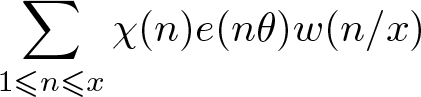 \begin{equation*}\sum_{1\leqslant n \leqslant x} \chi(n) e(n\theta) w(n/x)\end{equation*} $w$) is on the order of $\sqrt{x}$ for all irrational real $\theta$ satisfying a weak Diophantine condition, where $\chi$ is drawn from the family of Dirichlet characters modulo a large prime $r$ and where $x\leqslant r$. In contrast, it was proved by Harper that the average size is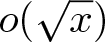 $o(\sqrt{x})$ for rational $\theta$. Certain quadratic Diophantine equations play a key role in the present paper.


ON RESIDUES OF INTERTWINING OPERATORS FOR HEISENBERG PARABOLIC SUBGROUPS
- Part of
-
- Journal:
- Journal of the Institute of Mathematics of Jussieu / Volume 25 / Issue 2 / March 2026
- Published online by Cambridge University Press:
- 26 January 2026, pp. 867-1080
- Print publication:
- March 2026
-
- Article
- Export citation
-
We consider induced representations $\operatorname {\mathrm {Ind}}_{\mathrm {P}(F)}^{\operatorname {\mathrm {G}}(F)} \pi $, where $\mathrm {P}$ is a maximal parabolic subgroup of a reductive group $\operatorname {\mathrm {G}}$ over a p-adic field F, and $(\pi , V)$ is a unitary supercuspidal representation of $\operatorname {\mathrm {M}}(F)$, $\operatorname {\mathrm {M}}$ being some Levi subgroup of $\mathrm {P}$. Imposing a certain ‘Heisenberg parabolic subgroup’ assumption on $\mathrm {P}$, we apply the method of Goldberg, Shahidi and Spallone to obtain an expression for a certain constant $R(\tilde {\pi })$, which captures the residue of a family $s \mapsto A(s, \pi , w_0)$ of intertwining operators associated to this situation, in terms of harmonic analysis on the twisted Levi subgroup $\tilde {\operatorname {\mathrm {M}}}(F) := \operatorname {\mathrm {M}}(F) w_0$. For $\operatorname {\mathrm {G}}$ absolutely almost simple and simply connected of type $G_2$ or $D_4$ (resp., $B_3$), and $\mathrm {P}$ satisfying the ‘Heisenberg’ condition, if the central character of $\pi $ is nontrivial (resp., trivial) on $\operatorname {\mathrm {A}}_{\operatorname {\mathrm {M}}}(F)$, where $\operatorname {\mathrm {A}}_{\operatorname {\mathrm {M}}}$ is the connected centre of $\operatorname {\mathrm {M}}$, our formula for $R(\tilde {\pi })$ can be rewritten in terms of the Langlands parameter of $\pi $, in the spirit of a prediction of Arthur. For the same collection of $\operatorname {\mathrm {G}}$ and $\mathrm {P}$, when these central character conditions are not satisfied, Arthur’s prediction combined with our formula for $R(\tilde {\pi })$ suggests a harmonic analytic formula for a product of one or two $\gamma $-factors associated to the situation.


Superlinear problems involving nonlinear superposition operators of mixed fractional order
- Part of
-
- Journal:
- Proceedings of the Royal Society of Edinburgh. Section A: Mathematics , First View
- Published online by Cambridge University Press:
- 22 January 2026, pp. 1-26
-
- Article
- Export citation
-
In this work, we study a class of elliptic problems involving nonlinear superpositions of fractional operators of the form
where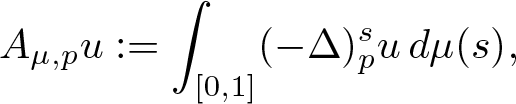 \begin{equation*}A_{\mu,p}u := \int_{[0,1]} (-\Delta)_{p}^{s} u \, d\mu(s),\end{equation*} $\mu$ is a signed measure on $[0,1]$, coupled with nonlinearities of superlinear type. This kind of operator was introduced by S. Dipierro, K. Perera, C. Sportelli, and E. Valdinoci in [11]. Our analysis covers a variety of superlinear growth assumptions, beginning with the classical Ambrosetti–Rabinowitz condition. Within this framework, we construct a suitable variational setting and apply the Fountain Theorem to establish the existence of infinitely many weak solutions. The results obtained are novel even in the special cases of superpositions of fractional $p$-Laplacians, or combinations of the fractional $p$-Laplacian with the $p$-Laplacian. More generally, our approach applies to finite sums of fractional $p$-Laplacians with different orders, as well as to operators in which fractional Laplacians appear with ‘wrong’ signs. A distinctive contribution of the paper lies in providing a unified variational framework that systematically accommodates this broad class of operators.


Clique density vs blowups
- Part of
-
- Journal:
- Combinatorics, Probability and Computing / Volume 35 / Issue 3 / May 2026
- Published online by Cambridge University Press:
- 22 January 2026, pp. 294-315
-
- Article
-
- You have access
- Open access
- HTML
- Export citation
-
A well-known theorem of Nikiforov asserts that any graph with a positive $K_{r}$-density contains a logarithmic blowup of $K_r$. In this paper, we explore variants of Nikiforov’s result in the following form. Given $r,t\in \mathbb{N}$, when a positive $K_{r}$-density implies the existence of a significantly larger (with almost linear size) blowup of $K_t$? Our results include:
• For an $n$-vertex ordered graph $G$ with no induced monotone path $P_{6}$, if its complement $\overline {G}$ has positive triangle density, then $\overline {G}$ contains a biclique of size $\Omega ({n \over {\log n}})$. This strengthens a recent result of Pach and Tomon. For general $k$, let $g(k)$ be the minimum $r\in \mathbb{N}$ such that for any $n$-vertex ordered graph $G$ with no induced monotone $P_{2k}$, if $\overline {G}$ has positive $K_r$-density, then $\overline {G}$ contains a biclique of size $\Omega ({n \over {\log n}})$. Using concentration of measure and the isodiametric inequality on high dimensional spheres, we provide constructions showing that, surprisingly, $g(k)$ grows quadratically. On the other hand, we relate the problem of upper bounding $g(k)$ to a certain Ramsey problem and determine $g(k)$ up to a factor of 2.
• Any incomparability graph with positive $K_{r}$-density contains a blowup of $K_r$ of size $\Omega ({n \over {\log n}}).$ This confirms a conjecture of Tomon in a stronger form. In doing so, we obtain a strong regularity type lemma for incomparability graphs with no large blowups of a clique, which is of independent interest. We also prove that any $r$-comparability graph with positive $K_{(2h-2)^{r}+1}$-density contains a blowup of $K_h$ of size $\Omega (n)$, where the constant $(2h-2)^{r}+1$ is optimal.
The ${n \over {\log n}}$ size of the blowups in all our results are optimal up to a constant factor.


BEAUVILLE–LASZLO GLUING OF ALGEBRAIC SPACES
- Part of
-
- Journal:
- Journal of the Institute of Mathematics of Jussieu / Volume 25 / Issue 2 / March 2026
- Published online by Cambridge University Press:
- 21 January 2026, pp. 1193-1235
- Print publication:
- March 2026
-
- Article
-
- You have access
- Open access
- HTML
- Export citation
-
For a complete discrete valuation field K, we show that one may always glue a separated formal algebraic space $\mathfrak {X}$ over $\mathcal {O}_K$ to a separated algebraic space U over K along an open immersion of rigid spaces $j\colon \mathfrak {X}^{\mathrm {rig}}\to U^{\mathrm {an}}$, producing a separated algebraic space X over $\mathcal {O}_K$. This process gives rise to an equivalence between such ‘gluing triples’ $(U,\mathfrak {X},j)$ and separated algebraic spaces X over $\mathcal {O}_K$, which one might interpret as a version of the Beauville–Laszlo theorem for algebraic spaces rather than coherent sheaves. Moreover, an analogous equivalence exists over any excellent base. Examples due to Matsumoto imply that the result of such a gluing might be a genuine algebraic space (not a scheme) even if U and the special fibre of $\mathfrak {X}$ are projective. The proof is a combination of the Nagata compactification theorem for algebraic spaces and of Artin’s contraction theorem. We give multiple examples and applications of this idea.


PRISMATIC COHOMOLOGY OF RIGID ANALYTIC SPACES OVER DE RHAM PERIOD RING
- Part of
-
- Journal:
- Journal of the Institute of Mathematics of Jussieu / Volume 25 / Issue 2 / March 2026
- Published online by Cambridge University Press:
- 20 January 2026, pp. 1127-1191
- Print publication:
- March 2026
-
- Article
-
- You have access
- Open access
- HTML
- Export citation
-
Inspired by Bhatt–Scholze [BS22], in this article, we introduce prismatic cohomology for rigid analytic spaces with l.c.i. singularities, with coefficients over Fontaine’s de Rham period ring ${\mathrm {B_{dR}^+}}$.

Asymptotic behaviours of multiscale multivalued stochastic systems with small noises
-
- Journal:
- Proceedings of the Royal Society of Edinburgh. Section A: Mathematics , First View
- Published online by Cambridge University Press:
- 16 January 2026, pp. 1-57
-
- Article
- Export citation
Multivariate multifractal analysis of Lévy functions. Part I: Determination of multifractal spectra
- Part of
-
- Journal:
- Proceedings of the Royal Society of Edinburgh. Section A: Mathematics , First View
- Published online by Cambridge University Press:
- 13 January 2026, pp. 1-32
-
- Article
- Export citation
THE LOCAL/LOGARITHMIC CORRESPONDENCE AND THE DEGENERATION FORMULA FOR QUASIMAPS
- Part of
-
- Journal:
- Journal of the Institute of Mathematics of Jussieu / Volume 25 / Issue 2 / March 2026
- Published online by Cambridge University Press:
- 13 January 2026, pp. 1237-1280
- Print publication:
- March 2026
-
- Article
-
- You have access
- Open access
- HTML
- Export citation
Competition of small targets in planar domains: from Dirichlet to Robin and Steklov boundary condition
- Part of
-
- Journal:
- European Journal of Applied Mathematics , First View
- Published online by Cambridge University Press:
- 12 January 2026, pp. 1-48
-
- Article
-
- You have access
- Open access
- HTML
- Export citation
Ground states of the planar nonlinear Schrödinger–Newton system with a point interaction
- Part of
-
- Journal:
- Proceedings of the Royal Society of Edinburgh. Section A: Mathematics , First View
- Published online by Cambridge University Press:
- 12 January 2026, pp. 1-26
-
- Article
- Export citation
-
We establish sufficient conditions for the existence of ground states of the following normalized nonlinear Schrödinger–Newton system with a point interaction:
 \begin{equation*}\begin{cases}- \Delta_\alpha u + \omega u=w u+\beta u |u|^{p - 2}&\text{on} ~ \mathbb{R}^2;\\- \Delta w=2 \pi |u|^2&\text{on} ~ \mathbb{R}^2;\\\|u\|_{L^2}^2 = c,\end{cases}\end{equation*}
where $p \gt 2$;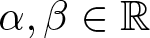 $\alpha, \beta \in \mathbb{R}$; $c \gt 0$ and $- \Delta_\alpha$ denotes the Laplacian of point interaction with s-wave scattering length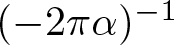 $(- 2 \pi \alpha)^{- 1}$, the unknowns being $u \colon \mathbb{R}^2 \to \mathbb{C}$, $w \colon \mathbb{R}^2 \to \lbrack0, \infty\lbrack$ and the Lagrange multiplier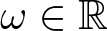 $\omega \in \mathbb{R}$. Additionally, we show that critical points of the corresponding constrained energy functional are naturally associated with standing waves of the evolution problem
 \begin{equation*}\mathrm{i} \psi' (t)=- \Delta_\alpha \psi (t)-(\log |\cdot| \ast |\psi (t)|^2)\psi (t)-\beta\psi (t)|\psi (t)|^{p - 2}.\end{equation*}


Rigidity for the heat equation with density on Riemannian manifolds through a conformal change
- Part of
-
- Journal:
- Proceedings of the Royal Society of Edinburgh. Section A: Mathematics , First View
- Published online by Cambridge University Press:
- 12 January 2026, pp. 1-41
-
- Article
- Export citation
-
We investigate uniqueness of solution to the heat equation with a density $\rho$ on complete, non-compact weighted Riemannian manifolds of infinite volume. Our main goal is to identify sufficient conditions under which the solution $u$ vanishes identically, assuming that $u$ belongs to a certain weighted Lebesgue space with exponential or polynomial weight, $L^p_{\phi}$. We distinguish between the cases $p \gt 1$ and $p = 1$ which required stronger assumptions on the manifold and the density function $\rho$. We develop a unified method based on a conformal transformation of the metric, which allows us to reduce the problem to a standard heat equation on a suitably weighted manifold. In addition, we construct explicit counterexamples on model manifolds which demonstrate optimality of our assumptions on the density $\rho$.


A note on time-asymptotic bounds with a sharp algebraic rate and a transitional exponent for the sublinear Fujita problem
- Part of
-
- Journal:
- Proceedings of the Royal Society of Edinburgh. Section A: Mathematics , First View
- Published online by Cambridge University Press:
- 08 January 2026, pp. 1-10
-
- Article
-
- You have access
- Open access
- HTML
- Export citation
Enriched cycle structures and roots of permutations
- Part of
-
- Journal:
- Proceedings of the Edinburgh Mathematical Society , First View
- Published online by Cambridge University Press:
- 08 January 2026, pp. 1-18
-
- Article
-
- You have access
- HTML
- Export citation
-
This paper is concerned with a duality between $r$-regular permutations and $r$-cycle permutations, and a monotone property due to Bóna-McLennan-White on the probability $p_r(n)$ for a random permutation of $\{1,2,\ldots, n\}$ to have an $r$th root, where $r$ is a prime. For $r=2$, the duality relates permutations with odd cycles to permutations with even cycles. For the general case where $r\geq 2$, we define an $r$-enriched permutation as a permutation with $r$-singular cycles coloured by one of the colours $1, 2, \ldots, r-1 $. In this setup, we discover a bijection between $r$-regular permutations and enriched $r$-cycle permutations, which in turn yields a stronger version of an inequality of Bóna-McLennan-White. This leads to a fully combinatorial understanding of the monotone property, thereby answering their question. When $r$ is a prime power $q^l$, we further show that $p_r(n)$ is monotone. In the case that $n+1 \not\equiv 0 \pmod q$, the equality $p_r(n)=p_r(n+1)$ has been established by Chernoff.


Axisymmetric stationary surfaces for the moment of inertia
- Part of
-
- Journal:
- Proceedings of the Royal Society of Edinburgh. Section A: Mathematics , First View
- Published online by Cambridge University Press:
- 07 January 2026, pp. 1-27
-
- Article
-
- You have access
- Open access
- HTML
- Export citation
-
We investigate axisymmetric surfaces in Euclidean space that are stationary for the energy $E_\alpha=\int_\Sigma |p|^\alpha\, d\Sigma$. Using a phase plane analysis, we classify these surfaces under the assumption that they intersect the rotation axis orthogonally. We also provide applications of the maximum principle, characterizing closed stationary surfaces and compact stationary surfaces with circular boundary in the case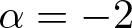 $\alpha=-2$. Finally, we prove that helicoidal stationary surfaces must in fact be rotational surfaces.
Adversarial robustness of artificial intelligence
-
- Journal:
- European Journal of Applied Mathematics / Volume 37 / Issue 1 / February 2026
- Published online by Cambridge University Press:
- 06 January 2026, pp. 1-2
-
- Article
-
- You have access
- Open access
- HTML
- Export citation
Strong discrete Morse theory
- Part of
-
- Journal:
- Proceedings of the Royal Society of Edinburgh. Section A: Mathematics , First View
- Published online by Cambridge University Press:
- 05 January 2026, pp. 1-26
-
- Article
-
- You have access
- Open access
- HTML
- Export citation
-
The purpose of this work is to develop a version of Forman’s discrete Morse theory for simplicial complexes, based on internal strong collapses. Classical discrete Morse theory can be viewed as a generalization of Whitehead’s collapses, where each Morse function on a simplicial complex $K$ defines a sequence of elementary internal collapses. This reduction guarantees the existence of a CW-complex that is homotopy equivalent to $K$, with cells corresponding to the critical simplices of the Morse function. However, this approach lacks an explicit combinatorial description of the attaching maps, which limits the reconstruction of the homotopy type of $K$. By restricting discrete Morse functions to those induced by total orders on the vertices, we develop a strong discrete Morse theory, generalizing the strong collapses introduced by Barmak and Minian. We show that, in this setting, the resulting reduced CW-complex is regular, enabling us to recover its homotopy type combinatorially. We also provide an algorithm to compute this reduction and apply it to obtain efficient structures for complexes in the library of triangulations by Benedetti and Lutz.


