Refine search
Actions for selected content:
26077 results in Abstract analysis
2 - Lower Bounds and a Property of Λ
-
- Book:
- Large Deviations for Markov Chains
- Published online:
- 03 August 2022
- Print publication:
- 27 October 2022, pp 14-35
-
- Chapter
- Export citation
Appendix C - The Convergence Parameter
-
- Book:
- Large Deviations for Markov Chains
- Published online:
- 03 August 2022
- Print publication:
- 27 October 2022, pp 212-218
-
- Chapter
- Export citation
11 - Large Deviations for Vector-Valued Additive Functionals
-
- Book:
- Large Deviations for Markov Chains
- Published online:
- 03 August 2022
- Print publication:
- 27 October 2022, pp 154-196
-
- Chapter
- Export citation
Appendix H - Relative Compactness in the V Topology
-
- Book:
- Large Deviations for Markov Chains
- Published online:
- 03 August 2022
- Print publication:
- 27 October 2022, pp 231-232
-
- Chapter
- Export citation
Appendix G - Daniell’s Theorem
-
- Book:
- Large Deviations for Markov Chains
- Published online:
- 03 August 2022
- Print publication:
- 27 October 2022, pp 230-230
-
- Chapter
- Export citation
Appendix J - On the Axioms V.1–V.3 and V.1’–V.4
-
- Book:
- Large Deviations for Markov Chains
- Published online:
- 03 August 2022
- Print publication:
- 27 October 2022, pp 236-239
-
- Chapter
- Export citation
Dedication
-
- Book:
- Large Deviations for Markov Chains
- Published online:
- 03 August 2022
- Print publication:
- 27 October 2022, pp v-vi
-
- Chapter
- Export citation
10 - Examples
-
- Book:
- Large Deviations for Markov Chains
- Published online:
- 03 August 2022
- Print publication:
- 27 October 2022, pp 143-153
-
- Chapter
- Export citation
5 - Necessary Conditions: Bounds on the Rate Function, Invariant Measures, Irreducibility, and Recurrence
-
- Book:
- Large Deviations for Markov Chains
- Published online:
- 03 August 2022
- Print publication:
- 27 October 2022, pp 68-78
-
- Chapter
- Export citation
Preface
-
- Book:
- Large Deviations for Markov Chains
- Published online:
- 03 August 2022
- Print publication:
- 27 October 2022, pp xi-xii
-
- Chapter
- Export citation
6 - Upper Bounds II: Equivalent Analytic Conditions
-
- Book:
- Large Deviations for Markov Chains
- Published online:
- 03 August 2022
- Print publication:
- 27 October 2022, pp 79-93
-
- Chapter
- Export citation
Subject Index
-
- Book:
- Large Deviations for Markov Chains
- Published online:
- 03 August 2022
- Print publication:
- 27 October 2022, pp 248-249
-
- Chapter
- Export citation
Frontmatter
-
- Book:
- Large Deviations for Markov Chains
- Published online:
- 03 August 2022
- Print publication:
- 27 October 2022, pp i-iv
-
- Chapter
- Export citation
Appendix D - Approximation of P by Pt
-
- Book:
- Large Deviations for Markov Chains
- Published online:
- 03 August 2022
- Print publication:
- 27 October 2022, pp 219-222
-
- Chapter
- Export citation
GOOD REDUCTION AND CYCLIC COVERS
- Part of
-
- Journal:
- Journal of the Institute of Mathematics of Jussieu / Volume 23 / Issue 1 / January 2024
- Published online by Cambridge University Press:
- 24 October 2022, pp. 463-494
- Print publication:
- January 2024
-
- Article
-
- You have access
- Open access
- HTML
- Export citation
ON MORPHISMS KILLING WEIGHTS AND STABLE HUREWICZ-TYPE THEOREMS
- Part of
-
- Journal:
- Journal of the Institute of Mathematics of Jussieu / Volume 23 / Issue 2 / March 2024
- Published online by Cambridge University Press:
- 24 October 2022, pp. 521-556
- Print publication:
- March 2024
-
- Article
- Export citation
-
For a weight structure w on a triangulated category $\underline {C}$ we prove that the corresponding weight complex functor and some other (weight-exact) functors are ‘conservative up to weight-degenerate objects’; this improves earlier conservativity formulations. In the case $w=w^{sph}$ (the spherical weight structure on $SH$), we deduce the following converse to the stable Hurewicz theorem: $H^{sing}_{i}(M)=\{0\}$ for all $i<0$ if and only if $M\in SH$ is an extension of a connective spectrum by an acyclic one. We also prove an equivariant version of this statement.
The main idea is to study M that has no weights $m,\dots ,n$ (‘in the middle’). For $w=w^{sph}$, this is the case if there exists a distinguished triangle $LM\to M\to RM$, where $RM$ is an n-connected spectrum and $LM$ is an $m-1$-skeleton (of M) in the sense of Margolis’s definition; this happens whenever $H^{sing}_i(M)=\{0\}$ for $m\le i\le n$ and $H^{sing}_{m-1}(M)$ is a free abelian group. We also consider morphisms that kill weights $m,\dots ,n$; those ‘send n-w-skeleta into $m-1$-w-skeleta’.


Multiple solutions for a class of quasilinear problems with double criticality
- Part of
-
- Journal:
- Proceedings of the Edinburgh Mathematical Society / Volume 65 / Issue 4 / November 2022
- Published online by Cambridge University Press:
- 21 October 2022, pp. 1011-1047
-
- Article
- Export citation
-
We establish multiplicity results for the following class of quasilinear problemsP
\begin{equation*} \left\{ \begin{array}{@{}l} -\Delta_{\Phi}u=f(x,u) \quad \mbox{in} \quad \Omega, \\ u=0 \quad \mbox{on} \quad \partial \Omega, \end{array} \right. \end{equation*}where $\Delta _{\Phi }u=\text {div}(\varphi (x,|\nabla u|)\nabla u)$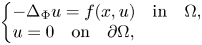
 for a generalized N-function $\Phi (x,t)=\int _{0}^{|t|}\varphi (x,s)s\,ds$
 . We consider $\Omega \subset \mathbb {R}^{N}$
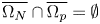
 to be a smooth bounded domain that contains two disjoint open regions $\Omega _N$
 and $\Omega _p$
 such that $\overline {\Omega _N}\cap \overline {\Omega _p}=\emptyset$
 . The main feature of the problem $(P)$
 is that the operator $-\Delta _{\Phi }$
 behaves like $-\Delta _N$
 on $\Omega _N$
 and $-\Delta _p$
 on $\Omega _p$
 . We assume the nonlinearity $f:\Omega \times \mathbb {R}\to \mathbb {R}$
 of two different types, but both behave like $e^{\alpha |t|^{\frac {N}{N-1}}}$
 on $\Omega _N$
 and $|t|^{p^{*}-2}t$
 on $\Omega _p$
 as $|t|$
 is large enough, for some $\alpha >0$
 and $p^{*}=\frac {Np}{N-p}$
 being the critical Sobolev exponent for $1< p< N$
 . In this context, for one type of nonlinearity $f$
 , we provide a multiplicity of solutions in a general smooth bounded domain and for another type of nonlinearity $f$
 , in an annular domain $\Omega$
 , we establish existence of multiple solutions for the problem $(P)$
 that are non-radial and rotationally non-equivalent.


Symmetry actions and brackets for adjoint-symmetries. I: Main results and applications
- Part of
-
- Journal:
- European Journal of Applied Mathematics / Volume 34 / Issue 5 / October 2023
- Published online by Cambridge University Press:
- 19 October 2022, pp. 947-973
-
- Article
-
- You have access
- Open access
- HTML
- Export citation
PEM series 2 volume 65 issue 3 Cover and Back matter
-
- Journal:
- Proceedings of the Edinburgh Mathematical Society / Volume 65 / Issue 3 / August 2022
- Published online by Cambridge University Press:
- 18 October 2022, pp. b1-b2
-
- Article
-
- You have access
- Export citation
Approximately symmetric forms far from being exactly symmetric
- Part of
-
- Journal:
- Combinatorics, Probability and Computing / Volume 32 / Issue 2 / March 2023
- Published online by Cambridge University Press:
- 18 October 2022, pp. 299-315
-
- Article
- Export citation
-
Let $V$ be a finite-dimensional vector space over $\mathbb{F}_p$. We say that a multilinear form $\alpha \colon V^k \to \mathbb{F}_p$ in $k$ variables is $d$-approximately symmetric if the partition rank of difference $\alpha (x_1, \ldots, x_k) - \alpha (x_{\pi (1)}, \ldots, x_{\pi (k)})$ is at most $d$ for every permutation $\pi \in \textrm{Sym}_k$. In a work concerning the inverse theorem for the Gowers uniformity $\|\!\cdot\! \|_{\mathsf{U}^4}$ norm in the case of low characteristic, Tidor conjectured that any $d$-approximately symmetric multilinear form $\alpha \colon V^k \to \mathbb{F}_p$ differs from a symmetric multilinear form by a multilinear form of partition rank at most $O_{p,k,d}(1)$ and proved this conjecture in the case of trilinear forms. In this paper, somewhat surprisingly, we show that this conjecture is false. In fact, we show that approximately symmetric forms can be quite far from the symmetric ones, by constructing a multilinear form $\alpha \colon \mathbb{F}_2^n \times \mathbb{F}_2^n \times \mathbb{F}_2^n \times \mathbb{F}_2^n \to \mathbb{F}_2$ which is 3-approximately symmetric, while the difference between $\alpha$ and any symmetric multilinear form is of partition rank at least $\Omega (\sqrt [3]{n})$.


