Refine listing
Actions for selected content:
1073 results in 05Cxx
Local Conditions for Exponentially Many Subdivisions
- Part of
-
- Journal:
- Combinatorics, Probability and Computing / Volume 26 / Issue 3 / May 2017
- Published online by Cambridge University Press:
- 28 November 2016, pp. 423-430
-
- Article
- Export citation
COMPACT SPACES OF THE FIRST BAIRE CLASS THAT HAVE OPEN FINITE DEGREE
- Part of
-
- Journal:
- Journal of the Institute of Mathematics of Jussieu / Volume 17 / Issue 5 / November 2018
- Published online by Cambridge University Press:
- 21 November 2016, pp. 1173-1196
- Print publication:
- November 2018
-
- Article
- Export citation
-
We introduce the open degree of a compact space, and we show that for every natural number $n$, the separable Rosenthal compact spaces of degree $n$ have a finite basis.


FINITELY DEPENDENT COLORING
- Part of
-
- Journal:
- Forum of Mathematics, Pi / Volume 4 / 2016
- Published online by Cambridge University Press:
- 03 November 2016, e9
-
- Article
-
- You have access
- Open access
- Export citation
-
We prove that proper coloring distinguishes between block factors and finitely dependent stationary processes. A stochastic process is finitely dependent if variables at sufficiently well-separated locations are independent; it is a block factor if it can be expressed as an equivariant finite-range function of independent variables. The problem of finding non-block-factor finitely dependent processes dates back to 1965. The first published example appeared in 1993, and we provide arguably the first natural examples. Schramm proved in 2008 that no stationary 1-dependent 3-coloring of the integers exists, and asked whether a $k$ -dependent $q$ -coloring exists for any $k$ and $q$ . We give a complete answer by constructing a 1-dependent 4-coloring and a 2-dependent 3-coloring. Our construction is canonical and natural, yet very different from all previous schemes. In its pure form it yields precisely the two finitely dependent colorings mentioned above, and no others. The processes provide unexpected connections between extremal cases of the Lovász local lemma and descent and peak sets of random permutations. Neither coloring can be expressed as a block factor, nor as a function of a finite-state Markov chain; indeed, no stationary finitely dependent coloring can be so expressed. We deduce extensions involving $d$ dimensions and shifts of finite type; in fact, any nondegenerate shift of finite type also distinguishes between block factors and finitely dependent processes.


COMPARING THE GENERALISED ROUNDNESS OF METRIC SPACES
- Part of
-
- Journal:
- Bulletin of the Australian Mathematical Society / Volume 95 / Issue 2 / April 2017
- Published online by Cambridge University Press:
- 02 November 2016, pp. 299-314
- Print publication:
- April 2017
-
- Article
-
- You have access
- Export citation
-
Motivated by the local theory of Banach spaces, we introduce a notion of finite representability for metric spaces. This allows us to develop a new technique for comparing the generalised roundness of metric spaces. We illustrate this technique by applying it to Banach spaces and metric trees. In the realm of Banach spaces we obtain results such as the following: (1) if ${\mathcal{U}}$ is any ultrafilter and $X$ is any Banach space, then the second dual $X^{\ast \ast }$ and the ultrapower $(X)_{{\mathcal{U}}}$ have the same generalised roundness as $X$ , and (2) no Banach space of positive generalised roundness is uniformly homeomorphic to $c_{0}$ or $\ell _{p}$ , $2<p<\infty$ . For metric trees, we give the first examples of metric trees of generalised roundness one that have finite diameter. In addition, we show that metric trees of generalised roundness one possess special Euclidean embedding properties that distinguish them from all other metric trees.


RAMANUJAN CAYLEY GRAPHS OF FROBENIUS GROUPS
- Part of
-
- Journal:
- Bulletin of the Australian Mathematical Society / Volume 94 / Issue 3 / December 2016
- Published online by Cambridge University Press:
- 26 September 2016, pp. 373-383
- Print publication:
- December 2016
-
- Article
-
- You have access
- Export citation
-
We determine a bound for the valency in a family of dihedrants of twice odd prime orders which guarantees that the Cayley graphs are Ramanujan graphs. We take two families of Cayley graphs with the underlying dihedral group of order $2p$ : one is the family of all Cayley graphs and the other is the family of normal ones. In the normal case, which is easier, we discuss the problem for a wider class of groups, the Frobenius groups. The result for the family of all Cayley graphs is similar to that for circulants: the prime $p$ is ‘exceptional’ if and only if it is represented by one of six specific quadratic polynomials.


KŐNIG’S LINE COLORING AND VIZING’S THEOREMS FOR GRAPHINGS
- Part of
-
- Journal:
- Forum of Mathematics, Sigma / Volume 4 / 2016
- Published online by Cambridge University Press:
- 19 September 2016, e27
-
- Article
-
- You have access
- Open access
- Export citation
-
The classical theorem of Vizing states that every graph of maximum degree $d$ admits an edge coloring with at most $d+1$ colors. Furthermore, as it was earlier shown by Kőnig, $d$ colors suffice if the graph is bipartite. We investigate the existence of measurable edge colorings for graphings (or measure-preserving graphs). A graphing is an analytic generalization of a bounded-degree graph that appears in various areas, such as sparse graph limits, orbit equivalence and measurable group theory. We show that every graphing of maximum degree $d$ admits a measurable edge coloring with $d+O(\sqrt{d})$ colors; furthermore, if the graphing has no odd cycles, then $d+1$ colors suffice. In fact, if a certain conjecture about finite graphs that strengthens Vizing’s theorem is true, then our method will show that $d+1$ colors are always enough.


Saturated Subgraphs of the Hypercube
- Part of
-
- Journal:
- Combinatorics, Probability and Computing / Volume 26 / Issue 1 / January 2017
- Published online by Cambridge University Press:
- 19 September 2016, pp. 52-67
-
- Article
- Export citation
-
We say a graph is (Q n ,Q m )-saturated if it is a maximal Q m -free subgraph of the n-dimensional hypercube Q n . A graph is said to be (Q n ,Q m )-semi-saturated if it is a subgraph of Q n and adding any edge forms a new copy of Q m . The minimum number of edges a (Q n ,Q m )-saturated graph (respectively (Q n ,Q m )-semi-saturated graph) can have is denoted by sat(Q n ,Q m ) (respectively s-sat(Q n ,Q m )). We prove that
for fixed m, disproving a conjecture of Santolupo that, when m=2, this limit is 1/4. Further, we show by a different method that sat(Q n , Q 2)=O(2n ), and that s-sat(Q n , Q m )=O(2n ), for fixed m. We also prove the lower bound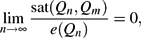 $$\begin{linenomath}\lim_{n\to\infty}\ffrac{\sat(Q_n,Q_m)}{e(Q_n)}=0,\end{linenomath}$$ thus determining sat(Q n ,Q 2) to within a constant factor, and discuss some further questions.
 $$\begin{linenomath}\ssat(Q_n,Q_m)\geq \ffrac{m+1}{2}\cdot 2^n,\end{linenomath}$$
On the Chromatic Number of Random Cayley Graphs
- Part of
-
- Journal:
- Combinatorics, Probability and Computing / Volume 26 / Issue 2 / March 2017
- Published online by Cambridge University Press:
- 09 September 2016, pp. 248-266
-
- Article
- Export citation
-
Let G be an abelian group of cardinality n, where hcf(n, 6) = 1, and let A be a random subset of G. Form a graph ΓA on vertex set G by joining x to y if and only if x + y ∈ A. Then, with high probability as n → ∞, the chromatic number χ(ΓA ) is at most $(1 + o(1))\tfrac{n}{2\log_2 n}$ . This is asymptotically sharp when G = ℤ/nℤ, n prime.

The Threshold Probability for Long Cycles
- Part of
-
- Journal:
- Combinatorics, Probability and Computing / Volume 26 / Issue 2 / March 2017
- Published online by Cambridge University Press:
- 08 September 2016, pp. 208-247
-
- Article
- Export citation
Longest paths in random Apollonian networks and largest r-ary subtrees of random d-ary recursive trees
- Part of
-
- Journal:
- Journal of Applied Probability / Volume 53 / Issue 3 / September 2016
- Published online by Cambridge University Press:
- 24 October 2016, pp. 846-856
- Print publication:
- September 2016
-
- Article
- Export citation
Degrees and distances in random and evolving apollonian networks
- Part of
-
- Journal:
- Advances in Applied Probability / Volume 48 / Issue 3 / September 2016
- Published online by Cambridge University Press:
- 19 September 2016, pp. 865-902
- Print publication:
- September 2016
-
- Article
- Export citation
On the relation between graph distance and Euclidean distance in random geometric graphs
- Part of
-
- Journal:
- Advances in Applied Probability / Volume 48 / Issue 3 / September 2016
- Published online by Cambridge University Press:
- 19 September 2016, pp. 848-864
- Print publication:
- September 2016
-
- Article
- Export citation
WIENER INDEX ON TRACEABLE AND HAMILTONIAN GRAPHS
- Part of
-
- Journal:
- Bulletin of the Australian Mathematical Society / Volume 94 / Issue 3 / December 2016
- Published online by Cambridge University Press:
- 30 August 2016, pp. 362-372
- Print publication:
- December 2016
-
- Article
-
- You have access
- Export citation
On the Lower Tail Variational Problem for Random Graphs
- Part of
-
- Journal:
- Combinatorics, Probability and Computing / Volume 26 / Issue 2 / March 2017
- Published online by Cambridge University Press:
- 16 August 2016, pp. 301-320
-
- Article
- Export citation
-
We study the lower tail large deviation problem for subgraph counts in a random graph. Let X H denote the number of copies of H in an Erdős–Rényi random graph $\mathcal{G}(n,p)$ . We are interested in estimating the lower tail probability $\mathbb{P}(X_H \le (1-\delta) \mathbb{E} X_H)$ for fixed 0 < δ < 1.
Thanks to the results of Chatterjee, Dembo and Varadhan, this large deviation problem has been reduced to a natural variational problem over graphons, at least for p ≥ n −α H (and conjecturally for a larger range of p). We study this variational problem and provide a partial characterization of the so-called ‘replica symmetric’ phase. Informally, our main result says that for every H, and 0 < δ < δH for some δH > 0, as p → 0 slowly, the main contribution to the lower tail probability comes from Erdős–Rényi random graphs with a uniformly tilted edge density. On the other hand, this is false for non-bipartite H and δ close to 1.

Judicious Partitioning of Hypergraphs with Edges of Size at Most 2†
- Part of
-
- Journal:
- Combinatorics, Probability and Computing / Volume 26 / Issue 2 / March 2017
- Published online by Cambridge University Press:
- 16 August 2016, pp. 267-284
-
- Article
- Export citation
-
Judicious partitioning problems on graphs and hypergraphs ask for partitions that optimize several quantities simultaneously. Let k ≥ 2 be an integer and let G be a hypergraph with m i edges of size i for i=1,2. Bollobás and Scott conjectured that G has a partition into k classes, each of which contains at most $m_1/k+m_2/k^2+O(\sqrt{m_1+m_2})$ edges. In this paper, we confirm the conjecture affirmatively by showing that G has a partition into k classes, each of which contains at most edges. This bound is tight up to O(1).
 $$m_1/k+m_2/k^2+\ffrac{k-1}{2k^2}\sqrt{2(km_1+m_2)}+O(1)$$.
COMPLEX NETWORK TOOLS TO ENABLE IDENTIFICATION OF A CRIMINAL COMMUNITY
- Part of
-
- Journal:
- Bulletin of the Australian Mathematical Society / Volume 94 / Issue 2 / October 2016
- Published online by Cambridge University Press:
- 16 August 2016, pp. 350-352
- Print publication:
- October 2016
-
- Article
-
- You have access
- Export citation
On the Widom–Rowlinson Occupancy Fraction in Regular Graphs
- Part of
-
- Journal:
- Combinatorics, Probability and Computing / Volume 26 / Issue 2 / March 2017
- Published online by Cambridge University Press:
- 09 August 2016, pp. 183-194
-
- Article
- Export citation
Asymptotic normality of degree counts in a preferential attachment model
- Part of
-
- Journal:
- Advances in Applied Probability / Volume 48 / Issue A / July 2016
- Published online by Cambridge University Press:
- 25 July 2016, pp. 283-299
- Print publication:
- July 2016
-
- Article
- Export citation
INVARIANT MEASURES CONCENTRATED ON COUNTABLE STRUCTURES
- Part of
-
- Journal:
- Forum of Mathematics, Sigma / Volume 4 / 2016
- Published online by Cambridge University Press:
- 28 June 2016, e17
-
- Article
-
- You have access
- Open access
- Export citation
-
Let $L$ be a countable language. We say that a countable infinite $L$ -structure ${\mathcal{M}}$ admits an invariant measure when there is a probability measure on the space of $L$ -structures with the same underlying set as ${\mathcal{M}}$ that is invariant under permutations of that set, and that assigns measure one to the isomorphism class of ${\mathcal{M}}$ . We show that ${\mathcal{M}}$ admits an invariant measure if and only if it has trivial definable closure, that is, the pointwise stabilizer in $\text{Aut}({\mathcal{M}})$ of an arbitrary finite tuple of ${\mathcal{M}}$ fixes no additional points. When ${\mathcal{M}}$ is a Fraïssé limit in a relational language, this amounts to requiring that the age of ${\mathcal{M}}$ have strong amalgamation. Our results give rise to new instances of structures that admit invariant measures and structures that do not.


BROOKS’ THEOREM FOR MEASURABLE COLORINGS
- Part of
-
- Journal:
- Forum of Mathematics, Sigma / Volume 4 / 2016
- Published online by Cambridge University Press:
- 24 June 2016, e16
-
- Article
-
- You have access
- Open access
- Export citation
-
We generalize Brooks’ theorem to show that if $G$ is a Borel graph on a standard Borel space $X$ of degree bounded by $d\geqslant 3$ which contains no $(d+1)$ -cliques, then $G$ admits a ${\it\mu}$ -measurable $d$ -coloring with respect to any Borel probability measure ${\it\mu}$ on $X$ , and a Baire measurable $d$ -coloring with respect to any compatible Polish topology on $X$ . The proof of this theorem uses a new technique for constructing one-ended spanning subforests of Borel graphs, as well as ideas from the study of list colorings. We apply the theorem to graphs arising from group actions to obtain factor of IID $d$ -colorings of Cayley graphs of degree $d$ , except in two exceptional cases.


