Refine listing
Actions for selected content:
1073 results in 05Cxx
On the Normalized Shannon Capacity of a Union
- Part of
-
- Journal:
- Combinatorics, Probability and Computing / Volume 25 / Issue 5 / September 2016
- Published online by Cambridge University Press:
- 03 March 2016, pp. 766-767
-
- Article
- Export citation
-
Let G 1 × G 2 denote the strong product of graphs G 1 and G 2, that is, the graph on V(G 1) × V(G 2) in which (u 1, u 2) and (v 1, v 2) are adjacent if for each i = 1, 2 we have ui = vi or u i v i ∈ E(G i ). The Shannon capacity of G is c(G) = limn → ∞ α(Gn )1/n , where Gn denotes the n-fold strong power of G, and α(H) denotes the independence number of a graph H. The normalized Shannon capacity of G is
Alon [1] asked whether for every ε < 0 there are graphs G and G′ satisfying C(G), C(G′) < ε but with C(G + G′) > 1 − ε. We show that the answer is no.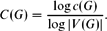 $$C(G) = \ffrac {\log c(G)}{\log |V(G)|}.$$
Structure of the $Fi_{24}^{\prime }$ maximal $2$ -local geometry point-line collinearity graph
- Part of
-
- Journal:
- LMS Journal of Computation and Mathematics / Volume 19 / Issue 1 / 2016
- Published online by Cambridge University Press:
- 01 March 2016, pp. 105-154
-
- Article
-
- You have access
- Export citation
-
The point-line collinearity graph ${\mathcal{G}}$ of the maximal 2-local geometry for the largest simple Fischer group, $Fi_{24}^{\prime }$ , is extensively analysed. For an arbitrary vertex $a$ of ${\mathcal{G}}$ , the $i\text{th}$ -disc of $a$ is described in detail. As a consequence, it follows that ${\mathcal{G}}$ has diameter $5$ . The collapsed adjacency matrix of ${\mathcal{G}}$ is given as well as accompanying computer files which contain a wealth of data about ${\mathcal{G}}$ .


SELECTED TOPICS IN SPECTRAL GRAPH THEORY
- Part of
-
- Journal:
- Bulletin of the Australian Mathematical Society / Volume 93 / Issue 3 / June 2016
- Published online by Cambridge University Press:
- 17 February 2016, pp. 511-512
- Print publication:
- June 2016
-
- Article
-
- You have access
- Export citation
ON ARC-REGULAR FROBENIUS METACIRCULANTS
- Part of
-
- Journal:
- Bulletin of the Australian Mathematical Society / Volume 94 / Issue 1 / August 2016
- Published online by Cambridge University Press:
- 10 February 2016, pp. 20-29
- Print publication:
- August 2016
-
- Article
-
- You have access
- Export citation
Coexistence in Preferential Attachment Networks
- Part of
-
- Journal:
- Combinatorics, Probability and Computing / Volume 25 / Issue 6 / November 2016
- Published online by Cambridge University Press:
- 09 February 2016, pp. 797-822
-
- Article
- Export citation
Inapproximability of the Partition Function for the Antiferromagnetic Ising and Hard-Core Models
- Part of
-
- Journal:
- Combinatorics, Probability and Computing / Volume 25 / Issue 4 / July 2016
- Published online by Cambridge University Press:
- 02 February 2016, pp. 500-559
-
- Article
- Export citation
-
Recent inapproximability results of Sly (2010), together with an approximation algorithm presented by Weitz (2006), establish a beautiful picture of the computational complexity of approximating the partition function of the hard-core model. Let λc ( $\mathbb{T}_{\Delta}$ ) denote the critical activity for the hard-model on the infinite Δ-regular tree. Weitz presented an FPTAS for the partition function when λ < λc ( $\mathbb{T}_{\Delta}$ ) for graphs with constant maximum degree Δ. In contrast, Sly showed that for all Δ ⩾ 3, there exists εΔ > 0 such that (unless RP = NP) there is no FPRAS for approximating the partition function on graphs of maximum degree Δ for activities λ satisfying λc ( $\mathbb{T}_{\Delta}$ ) < λ < λc ( $\mathbb{T}_{\Delta}$ ) + εΔ.
We prove that a similar phenomenon holds for the antiferromagnetic Ising model. Sinclair, Srivastava and Thurley (2014) extended Weitz's approach to the antiferromagnetic Ising model, yielding an FPTAS for the partition function for all graphs of constant maximum degree Δ when the parameters of the model lie in the uniqueness region of the infinite Δ-regular tree. We prove the complementary result for the antiferromagnetic Ising model without external field, namely, that unless RP = NP, for all Δ ⩾ 3, there is no FPRAS for approximating the partition function on graphs of maximum degree Δ when the inverse temperature lies in the non-uniqueness region of the infinite tree
$\mathbb{T}_{\Delta}$ . Our proof works by relating certain second moment calculations for random Δ-regular bipartite graphs to the tree recursions used to establish the critical points on the infinite tree.

CAYLEY GRAPHS OVER A FINITE CHAIN RING AND GCD-GRAPHS
- Part of
-
- Journal:
- Bulletin of the Australian Mathematical Society / Volume 93 / Issue 3 / June 2016
- Published online by Cambridge University Press:
- 22 January 2016, pp. 353-363
- Print publication:
- June 2016
-
- Article
-
- You have access
- Export citation
A 2-ARC TRANSITIVE PENTAVALENT CAYLEY GRAPH OF $\text{A}_{39}$
- Part of
-
- Journal:
- Bulletin of the Australian Mathematical Society / Volume 93 / Issue 3 / June 2016
- Published online by Cambridge University Press:
- 11 January 2016, pp. 441-446
- Print publication:
- June 2016
-
- Article
-
- You have access
- Export citation
-
Zhou and Feng [‘On symmetric graphs of valency five’, Discrete Math. 310 (2010), 1725–1732] proved that all connected pentavalent 1-transitive Cayley graphs of finite nonabelian simple groups are normal. We construct an example of a nonnormal 2-arc transitive pentavalent symmetric Cayley graph on the alternating group $\text{A}_{39}$. Furthermore, we show that the full automorphism group of this graph is isomorphic to the alternating group $\text{A}_{40}$.


ORTHOGONAL COLORINGS OF THE SPHERE
- Part of
-
- Journal:
- Mathematika / Volume 62 / Issue 2 / 2016
- Published online by Cambridge University Press:
- 04 February 2016, pp. 492-501
- Print publication:
- 2016
-
- Article
- Export citation
-
An orthogonal coloring of the two-dimensional unit sphere $\mathbb{S}^{2}$ , is a partition of $\mathbb{S}^{2}$ into parts such that no part contains a pair of orthogonal points: that is, a pair of points at spherical distance ${\it\pi}/2$ apart. It is a well-known result that an orthogonal coloring of $\mathbb{S}^{2}$ requires at least four parts, and orthogonal colorings with exactly four parts can easily be constructed from a regular octahedron centered at the origin. An intriguing question is whether or not every orthogonal 4-coloring of $\mathbb{S}^{2}$ is such an octahedral coloring. In this paper, we address this question and show that if every color class has a non-empty interior, then the coloring is octahedral. Some related results are also given.


UPPER BOUND THEOREM FOR ODD-DIMENSIONAL FLAG TRIANGULATIONS OF MANIFOLDS
- Part of
-
- Journal:
- Mathematika / Volume 62 / Issue 3 / 2016
- Published online by Cambridge University Press:
- 01 June 2016, pp. 909-928
- Print publication:
- 2016
-
- Article
- Export citation
-
We prove that among all flag triangulations of manifolds of odd dimension $2r-1$ , with a sufficient number of vertices, the unique maximizer of the entries of the $f$ -, $h$ -, $g$ - and $\unicode[STIX]{x1D6FE}$ -vector is the balanced join of $r$ cycles. Our proof uses methods from extremal graph theory.


The Multiple-Orientability Thresholds for Random Hypergraphs†
- Part of
-
- Journal:
- Combinatorics, Probability and Computing / Volume 25 / Issue 6 / November 2016
- Published online by Cambridge University Press:
- 28 December 2015, pp. 870-908
-
- Article
- Export citation
Manipulative Waiters with Probabilistic Intuition
- Part of
-
- Journal:
- Combinatorics, Probability and Computing / Volume 25 / Issue 6 / November 2016
- Published online by Cambridge University Press:
- 21 December 2015, pp. 823-849
-
- Article
- Export citation
-
For positive integers n and q and a monotone graph property $\mathcal{A}$ , we consider the two-player, perfect information game WC(n, q, $\mathcal{A}$ ), which is defined as follows. The game proceeds in rounds. In each round, the first player, called Waiter, offers the second player, called Client, q + 1 edges of the complete graph Kn which have not been offered previously. Client then chooses one of these edges which he keeps and the remaining q edges go back to Waiter. If, at the end of the game, the graph which consists of the edges chosen by Client satisfies the property $\mathcal{A}$ , then Waiter is declared the winner; otherwise Client wins the game. In this paper we study such games (also known as Picker–Chooser games) for a variety of natural graph-theoretic parameters, such as the size of a largest component or the length of a longest cycle. In particular, we describe a phase transition type phenomenon which occurs when the parameter q is close to n and is reminiscent of phase transition phenomena in random graphs. Namely, we prove that if q ⩾ (1 + ϵ)n, then Client can avoid components of order cϵ−2 ln n for some absolute constant c > 0, whereas for q ⩽ (1 − ϵ)n, Waiter can force a giant, linearly sized component in Client's graph. In the second part of the paper, we prove that Waiter can force Client's graph to be pancyclic for every q ⩽ cn, where c > 0 is an appropriate constant. Note that this behaviour is in stark contrast to the threshold for pancyclicity and Hamiltonicity of random graphs.

Local Maxima of Quadratic Boolean Functions
- Part of
-
- Journal:
- Combinatorics, Probability and Computing / Volume 25 / Issue 4 / July 2016
- Published online by Cambridge University Press:
- 21 December 2015, pp. 633-640
-
- Article
- Export citation
-
How many strict local maxima can a real quadratic function on {0, 1}n have? Holzman conjectured a maximum of $\binom{n }{ \lfloor n/2 \rfloor}$ . The aim of this paper is to prove this conjecture. Our approach is via a generalization of Sperner's theorem that may be of independent interest.

Path Ramsey Number for Random Graphs
- Part of
-
- Journal:
- Combinatorics, Probability and Computing / Volume 25 / Issue 4 / July 2016
- Published online by Cambridge University Press:
- 07 December 2015, pp. 612-622
-
- Article
- Export citation
-
Answering a question raised by Dudek and Prałat, we show that if pn → ∞, w.h.p., whenever G = G(n, p) is 2-edge-coloured there is a monochromatic path of length (2/3 + o(1))n. This result is optimal in the sense that 2/3 cannot be replaced by a larger constant.
As part of the proof we obtain the following result. Given a graph G on n vertices with at least $(1-\varepsilon)\binom{n}{2}$ edges, whenever G is 2-edge-coloured, there is a monochromatic path of length at least $(2/3 - 110\sqrt{\varepsilon})n$ . This is an extension of the classical result by Gerencsér and Gyárfás which says that whenever Kn is 2-coloured there is a monochromatic path of length at least 2n/3.

Contagions in random networks with overlapping communities
- Part of
-
- Journal:
- Advances in Applied Probability / Volume 47 / Issue 4 / December 2015
- Published online by Cambridge University Press:
- 21 March 2016, pp. 973-988
- Print publication:
- December 2015
-
- Article
-
- You have access
- Export citation
The extinction time of a subcritical branching process related to the SIR epidemic on a random graph
- Part of
-
- Journal:
- Journal of Applied Probability / Volume 52 / Issue 4 / December 2015
- Published online by Cambridge University Press:
- 30 March 2016, pp. 1195-1201
- Print publication:
- December 2015
-
- Article
-
- You have access
- Export citation
RELATIVE ELEMENTARY ABELIAN GROUPS AND A CLASS OF EDGE-TRANSITIVE CAYLEY GRAPHS
- Part of
-
- Journal:
- Journal of the Australian Mathematical Society / Volume 100 / Issue 2 / April 2016
- Published online by Cambridge University Press:
- 20 November 2015, pp. 241-251
-
- Article
-
- You have access
- Export citation
-
Motivated by a problem of characterising a family of Cayley graphs, we study a class of finite groups $G$ which behave similarly to elementary abelian $p$-groups with $p$ prime, that is, there exists a subgroup $N$ such that all elements of $G\setminus N$ are conjugate or inverse-conjugate under $\mathsf{Aut}(G)$. It is shown that such groups correspond to complete multipartite graphs which are normal edge-transitive Cayley graphs.


AUTOMORPHISM GROUPS OF SELF-COMPLEMENTARY VERTEX-TRANSITIVE GRAPHS
- Part of
-
- Journal:
- Bulletin of the Australian Mathematical Society / Volume 93 / Issue 2 / April 2016
- Published online by Cambridge University Press:
- 11 November 2015, pp. 238-247
- Print publication:
- April 2016
-
- Article
-
- You have access
- Export citation
-
Li et al. [‘On finite self-complementary metacirculants’, J. Algebraic Combin.40 (2014), 1135–1144] proved that the automorphism group of a self-complementary metacirculant is either soluble or has $\text{A}_{5}$ as the only insoluble composition factor, and gave a construction of such graphs with insoluble automorphism groups (which are the first examples of self-complementary graphs with this property). In this paper, we will prove that each simple group is a subgroup (so is a section) of the automorphism groups of infinitely many self-complementary vertex-transitive graphs. The proof involves a construction of such graphs. We will also determine all simple sections of the automorphism groups of self-complementary vertex-transitive graphs of $4$-power-free order.


Perfect Packings in Quasirandom Hypergraphs II
- Part of
-
- Journal:
- Combinatorics, Probability and Computing / Volume 25 / Issue 4 / July 2016
- Published online by Cambridge University Press:
- 27 October 2015, pp. 595-611
-
- Article
- Export citation
TRANSFERENCE FOR THE ERDŐS–KO–RADO THEOREM
- Part of
-
- Journal:
- Forum of Mathematics, Sigma / Volume 3 / 2015
- Published online by Cambridge University Press:
- 26 October 2015, e23
-
- Article
-
- You have access
- Open access
- Export citation
-
For natural numbers $n,r\in \mathbb{N}$ with $n\geqslant r$, the Kneser graph $K(n,r)$ is the graph on the family of $r$-element subsets of $\{1,\ldots ,n\}$ in which two sets are adjacent if and only if they are disjoint. Delete the edges of $K(n,r)$ with some probability, independently of each other: is the independence number of this random graph equal to the independence number of the Kneser graph itself? We shall answer this question affirmatively as long as $r/n$ is bounded away from $1/2$, even when the probability of retaining an edge of the Kneser graph is quite small. This gives us a random analogue of the Erdős–Ko–Rado theorem, since an independent set in the Kneser graph is the same as a uniform intersecting family. To prove our main result, we give some new estimates for the number of disjoint pairs in a family in terms of its distance from an intersecting family; these might be of independent interest.


