Refine listing
Actions for selected content:
1073 results in 05Cxx
The Minimum Number of Edges in Uniform Hypergraphs with Property O
- Part of
-
- Journal:
- Combinatorics, Probability and Computing / Volume 27 / Issue 4 / July 2018
- Published online by Cambridge University Press:
- 19 December 2017, pp. 531-538
-
- Article
- Export citation
GENERALISATIONS OF THE DOYEN–WILSON THEOREM
- Part of
-
- Journal:
- Bulletin of the Australian Mathematical Society / Volume 97 / Issue 1 / February 2018
- Published online by Cambridge University Press:
- 04 December 2017, pp. 166-167
- Print publication:
- February 2018
-
- Article
-
- You have access
- Export citation
Stretch factor in a planar Poisson–Delaunay triangulation with a large intensity
- Part of
-
- Journal:
- Advances in Applied Probability / Volume 50 / Issue 1 / March 2018
- Published online by Cambridge University Press:
- 20 March 2018, pp. 35-56
- Print publication:
- March 2018
-
- Article
- Export citation
On the phase transition curve in a directed exponential random graph model
- Part of
-
- Journal:
- Advances in Applied Probability / Volume 50 / Issue 1 / March 2018
- Published online by Cambridge University Press:
- 20 March 2018, pp. 272-301
- Print publication:
- March 2018
-
- Article
- Export citation
The probability of unusually large components in the near-critical Erdős–Rényi graph
- Part of
-
- Journal:
- Advances in Applied Probability / Volume 50 / Issue 1 / March 2018
- Published online by Cambridge University Press:
- 20 March 2018, pp. 245-271
- Print publication:
- March 2018
-
- Article
- Export citation
Jigsaw percolation on random hypergraphs
- Part of
-
- Journal:
- Journal of Applied Probability / Volume 54 / Issue 4 / December 2017
- Published online by Cambridge University Press:
- 30 November 2017, pp. 1261-1277
- Print publication:
- December 2017
-
- Article
- Export citation
Phase transition in random distance graphs on the torus
- Part of
-
- Journal:
- Journal of Applied Probability / Volume 54 / Issue 4 / December 2017
- Published online by Cambridge University Press:
- 30 November 2017, pp. 1278-1294
- Print publication:
- December 2017
-
- Article
- Export citation
Central limit theorem for the Horton–Strahler bifurcation ratio of general branch order
- Part of
-
- Journal:
- Journal of Applied Probability / Volume 54 / Issue 4 / December 2017
- Published online by Cambridge University Press:
- 30 November 2017, pp. 1111-1124
- Print publication:
- December 2017
-
- Article
- Export citation
SYMMETRIC AND ASYMMETRIC RAMSEY PROPERTIES IN RANDOM HYPERGRAPHS
- Part of
-
- Journal:
- Forum of Mathematics, Sigma / Volume 5 / 2017
- Published online by Cambridge University Press:
- 23 November 2017, e28
-
- Article
-
- You have access
- Open access
- Export citation
-
A celebrated result of Rödl and Ruciński states that for every graph $F$ , which is not a forest of stars and paths of length 3, and fixed number of colours $r\geqslant 2$ there exist positive constants $c,C$ such that for $p\leqslant cn^{-1/m_{2}(F)}$ the probability that every colouring of the edges of the random graph $G(n,p)$ contains a monochromatic copy of $F$ is $o(1)$ (the ‘0-statement’), while for $p\geqslant Cn^{-1/m_{2}(F)}$ it is $1-o(1)$ (the ‘1-statement’). Here $m_{2}(F)$ denotes the 2-density of $F$ . On the other hand, the case where $F$ is a forest of stars has a coarse threshold which is determined by the appearance of a certain small subgraph in $G(n,p)$ . Recently, the natural extension of the 1-statement of this theorem to $k$ -uniform hypergraphs was proved by Conlon and Gowers and, independently, by Friedgut, Rödl and Schacht. In particular, they showed an upper bound of order $n^{-1/m_{k}(F)}$ for the 1-statement, where $m_{k}(F)$ denotes the $k$ -density of $F$ . Similarly as in the graph case, it is known that the threshold for star-like hypergraphs is given by the appearance of small subgraphs. In this paper we show that another type of threshold exists if $k\geqslant 4$ : there are $k$ -uniform hypergraphs for which the threshold is determined by the asymmetric Ramsey problem in which a different hypergraph has to be avoided in each colour class. Along the way we obtain a general bound on the 1-statement for asymmetric Ramsey properties in random hypergraphs. This extends the work of Kohayakawa and Kreuter, and of Kohayakawa, Schacht and Spöhel who showed a similar result in the graph case. We prove the corresponding 0-statement for hypergraphs satisfying certain balancedness conditions.


ALTERNATING AND SYMMETRIC GROUPS WITH EULERIAN GENERATING GRAPH
- Part of
-
- Journal:
- Forum of Mathematics, Sigma / Volume 5 / 2017
- Published online by Cambridge University Press:
- 10 November 2017, e24
-
- Article
-
- You have access
- Open access
- Export citation
-
Given a finite group $G$ , the generating graph $\unicode[STIX]{x1D6E4}(G)$ of $G$ has as vertices the (nontrivial) elements of $G$ and two vertices are adjacent if and only if they are distinct and generate $G$ as group elements. In this paper we investigate properties about the degrees of the vertices of $\unicode[STIX]{x1D6E4}(G)$ when $G$ is an alternating group or a symmetric group of degree $n$ . In particular, we determine the vertices of $\unicode[STIX]{x1D6E4}(G)$ having even degree and show that $\unicode[STIX]{x1D6E4}(G)$ is Eulerian if and only if $n\geqslant 3$ and $n$ and $n-1$ are not equal to a prime number congruent to 3 modulo 4.


Induced Turán Numbers
- Part of
-
- Journal:
- Combinatorics, Probability and Computing / Volume 27 / Issue 2 / March 2018
- Published online by Cambridge University Press:
- 02 November 2017, pp. 274-288
-
- Article
- Export citation
New Classes of Degree Sequences with Fast Mixing Swap Markov Chain Sampling
- Part of
-
- Journal:
- Combinatorics, Probability and Computing / Volume 27 / Issue 2 / March 2018
- Published online by Cambridge University Press:
- 02 November 2017, pp. 186-207
-
- Article
- Export citation
ON THE COMPLEMENT OF THE ZERO-DIVISOR GRAPH OF A PARTIALLY ORDERED SET
- Part of
-
- Journal:
- Bulletin of the Australian Mathematical Society / Volume 97 / Issue 2 / April 2018
- Published online by Cambridge University Press:
- 02 November 2017, pp. 185-193
- Print publication:
- April 2018
-
- Article
-
- You have access
- Export citation
Linear Turán Numbers of Linear Cycles and Cycle-Complete Ramsey Numbers
- Part of
-
- Journal:
- Combinatorics, Probability and Computing / Volume 27 / Issue 3 / May 2018
- Published online by Cambridge University Press:
- 02 November 2017, pp. 358-386
-
- Article
- Export citation
-
An r-uniform hypergraph is called an r-graph. A hypergraph is linear if every two edges intersect in at most one vertex. Given a linear r-graph H and a positive integer n, the linear Turán number exL(n,H) is the maximum number of edges in a linear r-graph G that does not contain H as a subgraph. For each ℓ ≥ 3, let Crℓ denote the r-uniform linear cycle of length ℓ, which is an r-graph with edges e1, . . ., eℓ such that, for all i ∈ [ℓ−1], |ei ∩ ei+1|=1, |eℓ ∩ e1|=1 and ei ∩ ej = ∅ for all other pairs {i,j}, i ≠ j. For all r ≥ 3 and ℓ ≥ 3, we show that there exists a positive constant c = cr,ℓ, depending only r and ℓ, such that exL(n,Crℓ) ≤ cn1+1/⌊ℓ/2⌋. This answers a question of Kostochka, Mubayi and Verstraëte [30]. For even ℓ, our result extends the result of Bondy and Simonovits [7] on the Turán numbers of even cycles to linear hypergraphs.
Using our results on linear Turán numbers, we also obtain bounds on the cycle-complete hypergraph Ramsey numbers. We show that there are positive constants a = am,r and b = bm,r, depending only on m and r, such that
 \begin{equation}R(C^r_{2m}, K^r_t)\leq a \Bigl(\frac{t}{\ln t}\Bigr)^{{m}/{(m-1)}}\quad\text{and}\quadR(C^r_{2m+1}, K^r_t)\leq b t^{{m}/{(m-1)}}.\end{equation}
MAXIMUM GENUS EMBEDDINGS OF LATIN SQUARES
- Part of
-
- Journal:
- Glasgow Mathematical Journal / Volume 60 / Issue 2 / May 2018
- Published online by Cambridge University Press:
- 30 October 2017, pp. 495-504
-
- Article
-
- You have access
- Export citation
INTERPOLATED SCHUR MULTIPLE ZETA VALUES
- Part of
-
- Journal:
- Journal of the Australian Mathematical Society / Volume 104 / Issue 3 / June 2018
- Published online by Cambridge University Press:
- 25 October 2017, pp. 289-307
-
- Article
-
- You have access
- Export citation
On Edge-Disjoint Spanning Trees in a Randomly Weighted Complete Graph
- Part of
-
- Journal:
- Combinatorics, Probability and Computing / Volume 27 / Issue 2 / March 2018
- Published online by Cambridge University Press:
- 09 October 2017, pp. 228-244
-
- Article
- Export citation
Colourings of Uniform Hypergraphs with Large Girth and Applications
- Part of
-
- Journal:
- Combinatorics, Probability and Computing / Volume 27 / Issue 2 / March 2018
- Published online by Cambridge University Press:
- 09 October 2017, pp. 245-273
-
- Article
- Export citation
-
This paper deals with a combinatorial problem concerning colourings of uniform hypergraphs with large girth. We prove that if H is an n-uniform non-r-colourable simple hypergraph then its maximum edge degree Δ(H) satisfies the inequality
for some absolute constant c > 0.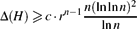 $$\Delta(H)\geqslant c\cdot r^{n-1}\ffrac{n(\ln\ln n)^2}{\ln n}$$
 As an application of our probabilistic technique we establish a lower bound for the classical van der Waerden number W(n, r), the minimum natural N such that in an arbitrary colouring of the set of integers {1,. . .,N} with r colours there exists a monochromatic arithmetic progression of length n. We prove that
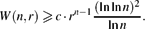 $$W(n,r)\geqslant c\cdot r^{n-1}\ffrac{(\ln\ln n)^2}{\ln n}.$$
SOME NEW LOWER BOUNDS FOR THE KIRCHHOFF INDEX OF A GRAPH
- Part of
-
- Journal:
- Bulletin of the Australian Mathematical Society / Volume 97 / Issue 1 / February 2018
- Published online by Cambridge University Press:
- 04 October 2017, pp. 1-10
- Print publication:
- February 2018
-
- Article
-
- You have access
- Export citation
-
Let $G$ be a simple connected graph with $n$ vertices and $m$ edges and $d_{1}\geq d_{2}\geq \cdots \geq d_{n}>0$ its sequence of vertex degrees. If $\unicode[STIX]{x1D707}_{1}\geq \unicode[STIX]{x1D707}_{2}\geq \cdots \geq \unicode[STIX]{x1D707}_{n-1}>\unicode[STIX]{x1D707}_{n}=0$ are the Laplacian eigenvalues of $G$ , then the Kirchhoff index of $G$ is $\mathit{Kf}(G)=n\sum _{i=1}^{n-1}\unicode[STIX]{x1D707}_{i}^{-1}$ . We prove some new lower bounds for $\mathit{Kf}(G)$ in terms of some of the parameters $\unicode[STIX]{x1D6E5}=d_{1}$ , $\unicode[STIX]{x1D6E5}_{2}=d_{2}$ , $\unicode[STIX]{x1D6E5}_{3}=d_{3}$ , $\unicode[STIX]{x1D6FF}=d_{n}$ , $\unicode[STIX]{x1D6FF}_{2}=d_{n-1}$ and the topological index $\mathit{NK}=\prod _{i=1}^{n}d_{i}$ .


Bisections of Graphs Without Short Cycles
- Part of
-
- Journal:
- Combinatorics, Probability and Computing / Volume 27 / Issue 1 / January 2018
- Published online by Cambridge University Press:
- 28 September 2017, pp. 44-59
-
- Article
- Export citation
