Refine listing
Actions for selected content:
415 results in 35Jxx
Three Solutions for a Singular Quasilinear Elliptic Problem
- Part of
-
- Journal:
- Proceedings of the Edinburgh Mathematical Society / Volume 62 / Issue 1 / February 2019
- Published online by Cambridge University Press:
- 14 September 2018, pp. 179-196
-
- Article
- Export citation
TWO-SIDED ESTIMATES FOR POSITIVE SOLUTIONS OF SUPERLINEARELLIPTIC BOUNDARY VALUE PROBLEMS
- Part of
-
- Journal:
- Bulletin of the Australian Mathematical Society / Volume 98 / Issue 3 / December 2018
- Published online by Cambridge University Press:
- 30 August 2018, pp. 465-473
- Print publication:
- December 2018
-
- Article
-
- You have access
- Export citation
-
We give two-sided estimates for positive solutions of the superlinearelliptic problem $-\unicode[STIX]{x1D6E5}u=a(x)|u|^{p-1}u$ with zero Dirichlet boundary condition in a boundedLipschitz domain. Our result improves the well-known a priori $L^{\infty }$ -estimate and provides information about the boundary decayrate of solutions.

Least Energy Nodal Solutions for a Defocusing Schrödinger Equation with Supercritical Exponent
- Part of
-
- Journal:
- Proceedings of the Edinburgh Mathematical Society / Volume 62 / Issue 1 / February 2019
- Published online by Cambridge University Press:
- 16 August 2018, pp. 1-23
-
- Article
- Export citation
-
In this paper we consider the existence of least energy nodal solution for the defocusing quasilinear Schrödinger equation
where λ≥0 is a real parameter, V(x) is a non-vanishing function, a(x) can be a vanishing positive function at infinity, the nonlinearity g(u) is of subcritical growth, the exponent p≥22*, and N≥3. The proof is based on a dual argument on Nehari manifold by employing a deformation argument and an $$-\Delta u - u \Delta u^2 + V(x)u = a(x)[g(u) + \lambda \vert u \vert ^{p-2}u] \hbox{in} {\open R}^N,$$ $L</italic>^{\infty}({\open R}^{N})$-estimative.

Existence and Concentration of Positive Solutions for Nonlinear Kirchhoff-Type Problems with a General Critical Nonlinearity
- Part of
-
- Journal:
- Proceedings of the Edinburgh Mathematical Society / Volume 61 / Issue 4 / November 2018
- Published online by Cambridge University Press:
- 17 July 2018, pp. 1023-1040
-
- Article
- Export citation
-
We are concerned with the following Kirchhoff-type equation
where M ∈ C(ℝ+, ℝ+), V ∈ C(ℝN, ℝ+) and f(s) is of critical growth. In this paper, we construct a localized bound state solution concentrating at a local minimum of V as ε → 0 under certain conditions on f(s), M and V. In particular, the monotonicity of f(s)/s and the Ambrosetti–Rabinowitz condition are not required. $$ - \varepsilon ^2M\left( {\varepsilon ^{2 - N}\int_{{\open R}^N} {\vert \nabla u \vert^2{\rm d}x} } \right)\Delta u + V(x)u = f(u),\quad x \in {{\open R}^N},\quad N{\rm \ges }2,$$
SERIES SOLUTION OF LAPLACE PROBLEMS
- Part of
-
- Journal:
- The ANZIAM Journal / Volume 60 / Issue 1 / July 2018
- Published online by Cambridge University Press:
- 06 July 2018, pp. 1-26
-
- Article
-
- You have access
- Export citation
Space-like hypersurfaces with functionally bounded mean curvature in Lorentzian warped products and generalized Calabi–Bernstein-type problems
- Part of
-
- Journal:
- Proceedings of the Royal Society of Edinburgh. Section A: Mathematics / Volume 149 / Issue 4 / August 2019
- Published online by Cambridge University Press:
- 22 June 2018, pp. 849-868
- Print publication:
- August 2019
-
- Article
- Export citation
-
We study space-like hypersurfaces with functionally bounded mean curvature in Lorentzian warped products
 , where F is a (non-compact) complete Riemannian manifold whose universal covering is parabolic. In particular, we provide several rigidity results under appropriate mathematical and physical assumptions. As an application, several Calabi–Bernstein-type results are obtained which widely extend the previous ones in this setting.
 , where
 A uniqueness result for a singular elliptic equation with gradient term
- Part of
-
- Journal:
- Proceedings of the Royal Society of Edinburgh. Section A: Mathematics / Volume 148 / Issue 5 / October 2018
- Published online by Cambridge University Press:
- 22 June 2018, pp. 983-994
- Print publication:
- October 2018
-
- Article
- Export citation
-
We prove the uniqueness of a solution for a problem whose simplest model is

with k ≥ 1, 0
 f ∈ L∞(Ω) and Ω is a bounded domain of ℝN, N ≥ 2. So far, uniqueness results are known for k < 1, while existence holds for any k ≥ 1 and f positive in open sets compactly embedded in a neighbourhood of the boundary. We extend the uniqueness results to the k ≥ 1 case and show, with an example, that existence does not hold if f is zero near the boundary. We even deal with the uniqueness result when f is replaced by a nonlinear term λuq with 0 < q < 1 and λ > 0.

Nodal Solutions for Nonlinear Non-Homogeneous Robin Problems with an Indefinite Potential
- Part of
-
- Journal:
- Proceedings of the Edinburgh Mathematical Society / Volume 61 / Issue 4 / November 2018
- Published online by Cambridge University Press:
- 13 June 2018, pp. 943-959
-
- Article
- Export citation
Existence of a Solution for a Non-Local Problem in ℝN via Bifurcation Theory
- Part of
-
- Journal:
- Proceedings of the Edinburgh Mathematical Society / Volume 61 / Issue 3 / August 2018
- Published online by Cambridge University Press:
- 21 May 2018, pp. 825-845
-
- Article
- Export citation
-
In this paper, we study the existence of a solution for the following class of non-local problems:P
where N ≥ 3, λ > 0, γ ∈ [1, 2), f : ℝ → ℝ is a positive continuous function and K : ℝN × ℝN → ℝ is a non-negative function. The functions f and K satisfy some conditions that permit us to use bifurcation theory to prove the existence of a solution for (P).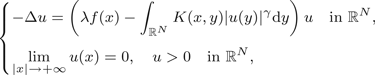 $$\eqalign{\big\{&-\Delta u=\left(\lambda f(x)-\int_{{open R}^N}K(x,y)\vert u(y)\vert ^{\gamma}\hbox{d}y\right)u\quad \mbox{in } \R^{N}, \cr &\lim_{\vert x\vert \to +\infty}u(x)=0,\quad u \gt 0 \quad \text{in } {open R}^{N},}$$
Variable Hardy Spaces Associated with Operators Satisfying Davies–Gaffney Estimates
- Part of
-
- Journal:
- Proceedings of the Edinburgh Mathematical Society / Volume 61 / Issue 3 / August 2018
- Published online by Cambridge University Press:
- 21 May 2018, pp. 759-810
-
- Article
- Export citation
-
Let L be a one-to-one operator of type ω in L2(ℝn), with ω∈[0, π/2), which has a bounded holomorphic functional calculus and satisfies the Davies–Gaffney estimates. Let p(·): ℝn→(0, 1] be a variable exponent function satisfying the globally log-Hölder continuous condition. In this article, the authors introduce the variable Hardy space $H_L^{p(\cdot )} ({\open R}^n)$ associated with L. By means of variable tent spaces, the authors establish the molecular characterization of $H_L^{p(\cdot )} ({\open R}^n)$. Then the authors show that the dual space of $H_L^{p(\cdot )} ({\open R}^n)$ is the bounded mean oscillation (BMO)-type space ${\rm BM}{\rm O}_{p(\cdot ),{\kern 1pt} L^ * }({\open R}^n)$, where L* denotes the adjoint operator of L. In particular, when L is the second-order divergence form elliptic operator with complex bounded measurable coefficients, the authors obtain the non-tangential maximal function characterization of $H_L^{p(\cdot )} ({\open R}^n)$ and show that the fractional integral L−α for α∈(0, (1/2)] is bounded from $H_L^{p(\cdot )} ({\open R}^n)$ to $H_L^{q(\cdot )} ({\open R}^n)$ with (1/p(·))−(1/q(·))=2α/n, and the Riesz transform ∇ L−1/2 is bounded from $H_L^{p(\cdot )} ({\open R}^n)$ to the variable Hardy space Hp(·)(ℝn).


Quasilinear Scalar Field Equations Involving Critical Sobolev Exponents and Potentials Vanishing at Infinity
- Part of
-
- Journal:
- Proceedings of the Edinburgh Mathematical Society / Volume 61 / Issue 3 / August 2018
- Published online by Cambridge University Press:
- 30 April 2018, pp. 705-733
-
- Article
- Export citation
-
We are concerned with the existence of positive weak solutions, as well as the existence of bound states (i.e. solutions in W1, p (ℝN)), for quasilinear scalar field equations of the form
where Δpu: = div(|∇ u|p−2∇u), 1 < p < N, p*: = Np/(N − p) is the critical Sobolev exponent, q ∈ (p, p*), while V(·) and K(·) are non-negative continuous potentials that may decay to zero as |x| → ∞ but are free from any integrability or symmetry assumptions. $$ - \Delta _pu + V(x) \vert u \vert ^{p - 2}u = K(x) \vert u \vert ^{q - 2}u + \vert u \vert ^{p^ * - 2}u,\qquad x \in {\open R}^N,$$
Poincaré inequalities for Sobolev spaces with matrix-valued weights and applications to degenerate partial differential equations
- Part of
-
- Journal:
- Proceedings of the Royal Society of Edinburgh. Section A: Mathematics / Volume 149 / Issue 1 / February 2019
- Published online by Cambridge University Press:
- 22 April 2018, pp. 61-100
- Print publication:
- February 2019
-
- Article
- Export citation
Nonlinear Dirac equations with Coulomb-type potentials and nonlinearities resonating at essential spectrums
- Part of
-
- Journal:
- Proceedings of the Royal Society of Edinburgh. Section A: Mathematics / Volume 148 / Issue 4 / August 2018
- Published online by Cambridge University Press:
- 15 April 2018, pp. 713-730
- Print publication:
- August 2018
-
- Article
- Export citation
-
We consider the nonlinear Dirac equation

The potential function V satisfies the conditions that the essential spectrum of the Dirac operator
 is
is  and this Dirac operator has infinitely many eigenvalues in (−1, 1) accumulating at 1. This potential function V may change sign in ℝ3 and contains the classical Coulomb potential V (x) = −γ/|x| with γ > 0 as a special case. The nonlinearity F satisfies the resonance-type condition lim
 . Under some additional conditions on V and F, we prove that this equation has infinitely many solutions.
 is
is  and this Dirac operator has infinitely many eigenvalues in (
 . Under some additional conditions on
 THE OCEAN’S GLOBAL IRON, PHOSPHORUS AND SILICON CYCLES: INVERSE MODELLING AND NOVEL DIAGNOSTICS
- Part of
-
- Journal:
- Bulletin of the Australian Mathematical Society / Volume 97 / Issue 3 / June 2018
- Published online by Cambridge University Press:
- 28 March 2018, pp. 518-519
- Print publication:
- June 2018
-
- Article
-
- You have access
- Export citation
Existence of positive radial solutions for a superlinear semipositone p-Laplacian problem on the exterior of a ball
- Part of
-
- Journal:
- Proceedings of the Royal Society of Edinburgh. Section A: Mathematics / Volume 148 / Issue 2 / April 2018
- Published online by Cambridge University Press:
- 21 March 2018, pp. 409-428
- Print publication:
- April 2018
-
- Article
- Export citation
On the Harnack inequality for quasilinear elliptic equations with a first-order term
- Part of
-
- Journal:
- Proceedings of the Royal Society of Edinburgh. Section A: Mathematics / Volume 148 / Issue 5 / October 2018
- Published online by Cambridge University Press:
- 22 February 2018, pp. 1075-1095
- Print publication:
- October 2018
-
- Article
- Export citation
-
We consider weak solutions to

with p > 1, q ≥ max{p − 1, 1}. We exploit the Moser iteration technique to prove a Harnack comparison inequality for C1 weak solutions. As a consequence we deduce a strong comparison principle.
An Elliptic PDE with Convex Solutions
- Part of
-
- Journal:
- Proceedings of the Edinburgh Mathematical Society / Volume 61 / Issue 1 / February 2018
- Published online by Cambridge University Press:
- 24 January 2018, pp. 201-214
-
- Article
- Export citation
Quasilinear systems involving curl
- Part of
-
- Journal:
- Proceedings of the Royal Society of Edinburgh. Section A: Mathematics / Volume 148 / Issue 2 / April 2018
- Published online by Cambridge University Press:
- 28 December 2017, pp. 243-279
- Print publication:
- April 2018
-
- Article
- Export citation
Spectral flow and bifurcation for a class of strongly indefinite elliptic systems
- Part of
-
- Journal:
- Proceedings of the Royal Society of Edinburgh. Section A: Mathematics / Volume 148 / Issue 5 / October 2018
- Published online by Cambridge University Press:
- 28 December 2017, pp. 1097-1113
- Print publication:
- October 2018
-
- Article
- Export citation
Fractional eigenvalue problems that approximate Steklov eigenvalue problems
- Part of
-
- Journal:
- Proceedings of the Royal Society of Edinburgh. Section A: Mathematics / Volume 148 / Issue 3 / June 2018
- Published online by Cambridge University Press:
- 28 December 2017, pp. 499-516
- Print publication:
- June 2018
-
- Article
- Export citation
