Refine listing
Actions for selected content:
2102725 results in Journals
Progression of clinical diagnostic features and cognitive decline in mild cognitive impairment with Lewy bodies
-
- Journal:
- Psychological Medicine / Volume 55 / 2025
- Published online by Cambridge University Press:
- 24 June 2025, e175
-
- Article
-
- You have access
- Open access
- HTML
- Export citation
How variability in language experience modulates multilingual listening effort
-
- Journal:
- Bilingualism: Language and Cognition / Volume 29 / Issue 2 / March 2026
- Published online by Cambridge University Press:
- 24 June 2025, pp. 501-515
-
- Article
-
- You have access
- Open access
- HTML
- Export citation
The replicator coalescent
- Part of
-
- Journal:
- Journal of Applied Probability / Volume 62 / Issue 4 / December 2025
- Published online by Cambridge University Press:
- 24 June 2025, pp. 1534-1548
- Print publication:
- December 2025
-
- Article
-
- You have access
- Open access
- HTML
- Export citation
-
We consider a stochastic model, called the replicator coalescent, describing a system of blocks of k different types that undergo pairwise mergers at rates depending on the block types: with rate $C_{ij}\geq 0$ blocks of type i and j merge, resulting in a single block of type i. The replicator coalescent can be seen as a generalisation of Kingman’s coalescent death chain in a multi-type setting, although without an underpinning exchangeable partition structure. The name is derived from a remarkable connection between the instantaneous dynamics of this multi-type coalescent when issued from an arbitrarily large number of blocks, and the so-called replicator equations from evolutionary game theory. By dilating time arbitrarily close to zero, we see that initially, on coming down from infinity, the replicator coalescent behaves like the solution to a certain replicator equation. Thereafter, stochastic effects are felt and the process evolves more in the spirit of a multi-type death chain.

Evaluation of the referral pathway to Irish specialist adult attention deficit hyperactivity disorder services
-
- Journal:
- Irish Journal of Psychological Medicine / Volume 42 / Issue 4 / December 2025
- Published online by Cambridge University Press:
- 24 June 2025, pp. 295-301
- Print publication:
- December 2025
-
- Article
-
- You have access
- Open access
- HTML
- Export citation
Hollywood Is Burning: Imagery and Polycrisis
- Part of
-
- Journal:
- Public Humanities / Volume 1 / 2025
- Published online by Cambridge University Press:
- 24 June 2025, e107
-
- Article
-
- You have access
- Open access
- HTML
- Export citation
War and Responsibility
-
- Journal:
- American Political Science Review / Volume 120 / Issue 1 / February 2026
- Published online by Cambridge University Press:
- 24 June 2025, pp. 267-290
- Print publication:
- February 2026
-
- Article
-
- You have access
- Open access
- HTML
- Export citation

Closing the diagnostic gap in male genital schistosomiasis (MGS): current detection tools and novel strategies
-
- Journal:
- Parasitology / Volume 152 / Issue 14 / December 2025
- Published online by Cambridge University Press:
- 24 June 2025, pp. 1426-1435
-
- Article
-
- You have access
- Open access
- HTML
- Export citation
Efficacy of pain management for cattle castration: A systematic review and meta-analysis
-
- Journal:
- Animal Welfare / Volume 34 / 2025
- Published online by Cambridge University Press:
- 24 June 2025, e43
-
- Article
-
- You have access
- Open access
- HTML
- Export citation

Dual scaling and the $2/3$ power law for the second-order scalar structure function in homogeneous turbulence with a mean scalar gradient
-
- Journal:
- Journal of Fluid Mechanics / Volume 1013 / 25 June 2025
- Published online by Cambridge University Press:
- 24 June 2025, A46
-
- Article
- Export citation
-
A dual scaling of the second-order scalar structure function $\overline {{(\delta \theta )}^2}$, i.e. a scaling based on the Batchelor–Kolmogorov scales $\theta _B$, $\eta$ and another based on $\theta '$, $L$, representative of the large-scale motion, is examined in the context of the transport equation for $\overline {{(\delta \theta )}^2}$. Direct numerical simulation data over a relatively wide range of the Taylor microscale Reynolds number $Re_\lambda$ and a Schmidt number of order 1 in statistically stationary homogeneous isotropic turbulence with a uniform mean scalar gradient are used. It is observed that as $Re_\lambda$ increases, a dual scaling appears to emerge, where the scaling based on $\theta '$, $L$ extends to increasingly smaller values of $r/L$, where $r$ is the separation associated with the increment $ {{\delta \theta }}$, while the scaling based on $\theta _B$, $\eta$ extends to increasingly larger values of $r/\eta$. This suggests that both scalings should eventually overlap over a range of scales as $Re_\lambda$ continues to increase. Further, it is shown that such a dual scaling leads to the power-law relation $\overline {{(\delta \theta )}^2} \sim r^{\zeta _2}$, where $\zeta _2=2/3$ in the overlap region. The use of an empirical model for the local slope of $\overline {{(\delta \theta )}^2}$ (i.e. $\zeta _2$) shows that a value of $Re_\lambda$ of order $10^4$ is required for the slope to first reach the value $2/3$. Clearly, values larger than $10^4$ will be required before a $r^{2/3}$ inertial range is established.


LEG volume 31 issue 1 Cover and Front matter
-
- Journal:
- Legal Theory / Volume 31 / Issue 1 / March 2025
- Published online by Cambridge University Press:
- 24 June 2025, pp. f1-f2
-
- Article
-
- You have access
- Export citation
Fracture criteria and tensile strength for natural glacier ice calibrated from remote sensing observations of Antarctic ice shelves – ERRATUM
-
- Journal:
- Journal of Glaciology / Volume 71 / 2025
- Published online by Cambridge University Press:
- 24 June 2025, e77
-
- Article
-
- You have access
- Open access
- HTML
- Export citation
On the $\mathfrak{M}_H(G)$-property
- Part of
-
- Journal:
- Mathematical Proceedings of the Cambridge Philosophical Society / Volume 179 / Issue 2 / September 2025
- Published online by Cambridge University Press:
- 24 June 2025, pp. 449-501
- Print publication:
- September 2025
-
- Article
- Export citation
-
Let E be an elliptic curve defined over ${{\mathbb{Q}}}$ which has good ordinary reduction at the prime p. Let K be a number field with at least one complex prime which we assume to be totally imaginary if $p=2$. We prove several equivalent criteria for the validity of the $\mathfrak{M}_H(G)$-property for ${{\mathbb{Z}}}_p$-extensions other than the cyclotomic extension inside a fixed ${{\mathbb{Z}}}_p^2$-extension $K_\infty/K$. The equivalent conditions involve the growth of $\mu$-invariants of the Selmer groups over intermediate shifted ${{\mathbb{Z}}}_p$-extensions in $K_\infty$, and the boundedness of $\lambda$-invariants as one runs over ${{\mathbb{Z}}}_p$-extensions of K inside of $K_\infty$.
Using these criteria we also derive several applications. For example, we can bound the number of ${{\mathbb{Z}}}_p$-extensions of K inside $K_\infty$ over which the Mordell–Weil rank of E is not bounded, thereby proving special cases of a conjecture of Mazur. Moreover, we show that the validity of the $\mathfrak{M}_H(G)$-property sometimes can be shifted to a larger base field K′.


Bilateral radiation-induced squamous cell carcinoma of the external auditory canal: the effect of immunosuppressive therapy
-
- Journal:
- The Journal of Laryngology & Otology / Volume 139 / Issue 10 / October 2025
- Published online by Cambridge University Press:
- 24 June 2025, pp. 999-1001
- Print publication:
- October 2025
-
- Article
-
- You have access
- Open access
- HTML
- Export citation
LEG volume 31 issue 1 Cover and Back matter
-
- Journal:
- Legal Theory / Volume 31 / Issue 1 / March 2025
- Published online by Cambridge University Press:
- 24 June 2025, pp. b1-b2
-
- Article
-
- You have access
- Export citation
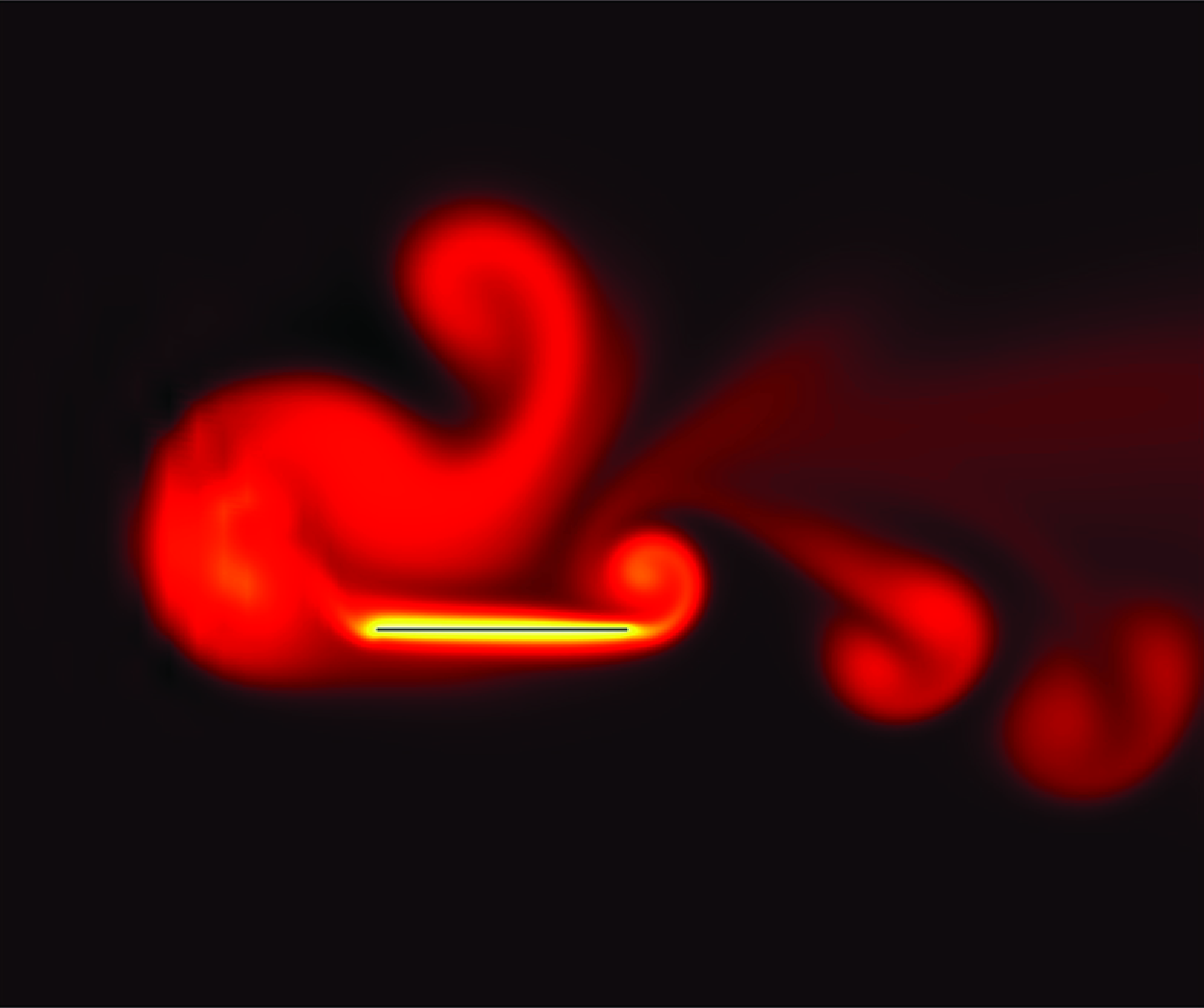
How vortices enhance heat transfer from an oscillating plate
-
- Journal:
- Journal of Fluid Mechanics / Volume 1013 / 25 June 2025
- Published online by Cambridge University Press:
- 24 June 2025, A47
-
- Article
-
- You have access
- Open access
- HTML
- Export citation
Opposing average congruence class biases in the cyclicity and Koblitz conjectures for elliptic curves
- Part of
-
- Journal:
- Canadian Journal of Mathematics , First View
- Published online by Cambridge University Press:
- 24 June 2025, pp. 1-51
-
- Article
-
- You have access
- Open access
- HTML
- Export citation
-
The cyclicity and Koblitz conjectures ask about the distribution of primes of cyclic and prime-order reduction, respectively, for elliptic curves over $\mathbb {Q}$. In 1976, Serre gave a conditional proof of the cyclicity conjecture, but the Koblitz conjecture (refined by Zywina in 2011) remains open. The conjectures are now known unconditionally “on average” due to work of Banks–Shparlinski and Balog–Cojocaru–David. Recently, there has been a growing interest in the cyclicity conjecture for primes in arithmetic progressions (AP), with relevant work by Akbal–Güloğlu and Wong. In this article, we adapt Zywina’s method to formulate the Koblitz conjecture for AP and refine a theorem of Jones to establish results on the moments of the constants in both the cyclicity and Koblitz conjectures for AP. In doing so, we uncover a somewhat counterintuitive phenomenon: On average, these two constants are oppositely biased over congruence classes. Finally, in an accompanying repository, we give Magma code for computing the constants discussed in this article.

The petrochemical historical bloc: Exposing the extent and depth of opposition to a high-ambition plastics treaty
- Part of
-
- Journal:
- Cambridge Prisms: Plastics / Volume 3 / 2025
- Published online by Cambridge University Press:
- 24 June 2025, e16
-
- Article
-
- You have access
- Open access
- HTML
- Export citation
MODEL AVERAGING FOR TREATMENT EFFECT ESTIMATION WITH HETEROGENEITY AND HETEROSKEDASTICITY
-
- Journal:
- Econometric Theory / Volume 41 / Issue 6 / December 2025
- Published online by Cambridge University Press:
- 24 June 2025, pp. 1468-1505
-
- Article
- Export citation
Theoretical Virtues, Truth, and the Epistemic Aim of Scientific Theorizing
-
- Journal:
- Philosophy of Science ,
- Published online by Cambridge University Press:
- 24 June 2025, pp. 1-21
-
- Article
-
- You have access
- Open access
- HTML
- Export citation
Review of Cameron J. Buckner’s From Deep Learning to Rational Machines: What the History of Philosophy Can Teach Us about the Future of Artificial Intelligence - Cameron J. Buckner, From Deep Learning to Rational Machines: What the History of Philosophy Can Teach Us about the Future of Artificial Intelligence. Oxford University Press.
-
- Journal:
- Philosophy of Science / Volume 92 / Issue 4 / October 2025
- Published online by Cambridge University Press:
- 24 June 2025, pp. 1031-1034
- Print publication:
- October 2025
-
- Article
- Export citation
