To save content items to your account,
please confirm that you agree to abide by our usage policies.
If this is the first time you use this feature, you will be asked to authorise Cambridge Core to connect with your account.
Find out more about saving content to .
To save content items to your Kindle, first ensure no-reply@cambridge.org
is added to your Approved Personal Document E-mail List under your Personal Document Settings
on the Manage Your Content and Devices page of your Amazon account. Then enter the ‘name’ part
of your Kindle email address below.
Find out more about saving to your Kindle.
Note you can select to save to either the @free.kindle.com or @kindle.com variations.
‘@free.kindle.com’ emails are free but can only be saved to your device when it is connected to wi-fi.
‘@kindle.com’ emails can be delivered even when you are not connected to wi-fi, but note that service fees apply.
Cognitive behavioural therapy (CBT) interventions are effective in reducing subjective stress. Nevertheless, the longitudinal links between mental health indicators are rarely studied in intervention research. Therefore, it is unknown how the intervention effects are sustained.
Aim:
The current study investigated mechanisms explaining sustained intervention effects in a sample of medical nurses who receive a CBT-based internet-delivered stress recovery program.
Method:
A single-group longitudinal study design with three measurement points, pre-test, post-test, and 3-month follow-up, was used in the current study. The sample consisted of nurses and assistant nurses from Lithuania (n=111, age: M (SD) = 41.69 years (10.85)) who had participated in a 6-week CBT internet intervention targeting stress recovery. Data were collected as the randomised control trial, the treatment samples were combined, and the data were analysed using cross-lagged panel analysis with four variables representing the psychological well-being and symptoms of stress, anxiety, and depression.
Results:
The results revealed that decreased anxiety and increased psychological well-being at post-test predicted reduced stress levels at the 3-month follow-up. In addition, decreased anxiety at post-test predicted decreased depression at follow-up.
Conclusions:
Decreased anxiety and increased well-being could explain the sustainability of reduced stress following a CBT-based internet intervention for nurses. The implications of this for research and practice are discussed.
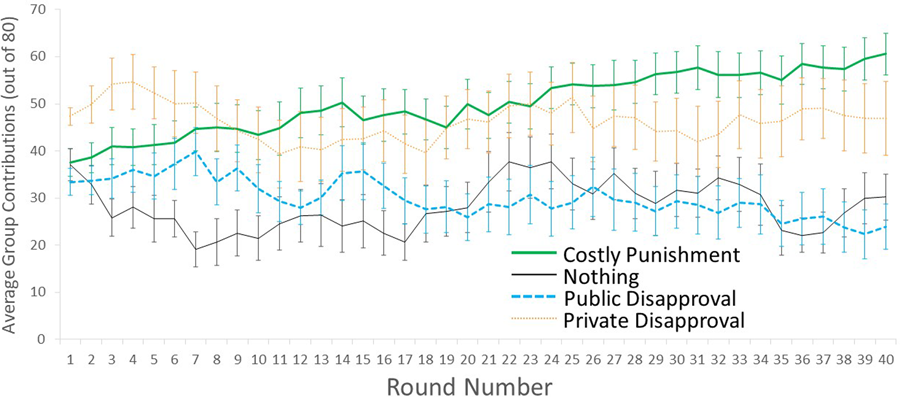
Punishment plays a role in human cooperation, but it is costly. Prior research shows that people are more cooperative when they expect to receive negative feedback for non-cooperation, even in the absence of costly punishment, which would have interesting implications for theory and applications. However, based on theories of habituation and cue-based learning, we propose that people will learn to ignore expressions of disapproval that are not clearly associated with material costs or benefits. To test this hypothesis, we conducted a between-subjects, 40-round public goods game (i.e. much longer than most studies), where participants could respond to others’ contributions by sending numerical disapproval messages, paying to reduce others’ earnings, or neither. Consistent with previous results, we observed steadily increasing contributions in the costly punishment condition. In contrast, contributions declined after the early rounds in the expressed disapproval condition, and were eventually no higher than the basic control condition with neither costly punishment nor disapproval ratings. In other words, costless disapproval may temporarily increase cooperation, but the effects fade. We discuss the theoretical and applied implications of our findings, including the unexpectedly high levels of cooperation in a second control condition.
Mamyshev oscillators (MOs) exhibit the potential for generating high average power and ultrashort pulses. Herein, we construct an MO using flexible double-cladding ytterbium-fiber with a fusion-spliced-combiner pumped scheme. Consistent with the most reported research results, the offset filter separation significantly affects the pulse characteristics (spectrum, pulse duration, etc.). Notably, in comparison with red-shifting, blue-shifting the peak spectral emission of the grating filter relative to a constant central wavelength of the bandpass filter substantially enhances the laser output characteristics. This phenomenon, which has not been previously reported, results in an average power up to 2.23 W and a pulse duration as short as 49 fs. To our knowledge, this is the highest average power achieved in sub-50 fs pulse duration in the nonlinear polarization rotation-assisted mode-locked MO laser architecture. The presented technique offers unique scientific proof for developing ultrafast laser sources with higher average power and shorter pulse duration.
Cannabis is the most commonly used illicit substance in Ireland and globally. It is most likely to be used in adolescence, a period of biopsychosocial vulnerability to maladaptive behaviours. This study aims to investigate the risk and protective factors for cannabis use among adolescents.
Methods:
This study is a secondary analysis of the cross-sectional Planet Youth survey (2021). The sample comprised 4,404 adolescents aged 15–16 from one urban and two rural areas in Ireland. The outcome of interest was current cannabis use, defined as cannabis use within the last 30 days. Independent variables i.e., risk and protective factors, were selected a priori following a literature review. Associations between cannabis use and the independent variables were explored using mixed-effects logistic regressions.
Results:
The prevalence of current cannabis use was 7.3% and did not differ significantly between males and females. In fully-adjusted models, significant risk factors for cannabis use were: Having peers that used cannabis (Adjusted Odds Ration (aOR) 10.17, 95% CI: 5.96–17.35); Parental ambivalence towards cannabis use (aOR 3.69, 95% CI: 2.41–5.66); Perception of cannabis as non-harmful (aOR 2.32,95% CI 1.56–£.45): Other substance use (aORs ranging from 2-67–3.15); Peer pressure to use cannabis (aOR 1.85,95% CI 1.05–3.26), and Low parental supervision (aOR 1.11, 95% CI: 1.01–1.22).
Conclusions:
This study identified key individual, peer-to-peer and parental risk factors associated with adolescent cannabis use, several of which have the potential to be modified through drug prevention strategies.
In a cross-sectional study of L2 Danish, we examined the production of correct verb-second (V2) word order. We tested the effect of (1) the learners’ language background, (2) test level and (3) the length of the sentence constituents. The texts were written by 217 students (3 test levels (A2-B1), 52 different L1s). Interrogative clauses had high accuracy, but 25% of the 491 declarative sentences with non-initial subjects had incorrect V3 word order. Our study shows that V2 is not difficult for all learners. Learners whose L1 is a V2 language had a significantly higher share of correct V2 word order, and they never overused V2. For non-V2 learners, the share of correct V2 significantly increased with proficiency level. For constituent length, accuracy decreased significantly with the length of the first constituent and for subjects consisting of multiple words.
Despite the recognised links between food insecurity and parenting, few studies have evaluated the perceived impacts of livelihood or food security interventions on parental practices, intra-household functioning, adolescent behaviour and psychosocial outcomes in HIV-affected households in sub-Saharan Africa.
Aims
The study aimed to understand the perceived effects of food security on parenting practices and how this was experienced by both adolescent girls (aged 13–19 years) and their caregivers in rural Kenya.
Method
We conducted semi-structured, individual interviews with 62 caregiver–adolescent dyads who were participants in the adolescent Shamba Maisha (NCT03741634), a sub-study of adolescent girls and caregivers with a household member participating in the Shamba Maisha agricultural and finance intervention trial (NCT01548599). Data were analysed following the principles of thematic analysis.
Results
Compared to control households, the Shamba Maisha intervention households had improved food security and strengthened economic security, which, in turn, improved parenting practices. Intervention households described changes in parenting experiences, including decreased parental stress, reduced absenteeism and harsh parenting and improved caregiver– adolescent relationships. These positive caregiving practices, in turn, contributed to improved mental health and fewer behavioural problems among adolescent girls. Changes in the control households were less noticeable.
Conclusion
These findings demonstrate how an income-generating agricultural intervention may improve food security and positively affect parenting practices, intra-household dynamics and adolescent psychosocial well-being and behaviour. Further research is needed to explore how to harness the social benefits of agricultural interventions to best address the critical intersections among food insecurity, parenting practices and adolescent mental health.
We study experimentally the onset of Faraday waves near the end walls of a rectangular vessel containing two stably stratified fluid layers, subject to horizontal oscillations. These subharmonic waves (SWs) are excited, because the horizontal inertial forcing drives a harmonic propagating wave which displaces the interface in the vertical direction at the end walls. We find that the onset of SWs is regulated by a balance between capillary and viscous forces, where the rate of damping is set by the Stokes layer thickness at the wall rather than the wavelength of the SWs. We model the onset of SWs with a weakly damped Mathieu equation and find that the dimensional critical acceleration scales as $\nu _m^{1/2} \omega ^{3/2}$, where $\nu _m$ is the mean viscosity and $\omega$ is the frequency of forcing, in excellent agreement with the experiment over a wide range of parameters.
Subdwarf B stars are a well-known class of hot, low-mass stars thought to be formed through interactions in stellar binary systems. While different formation channels for subdwarf B stars have been studied through a binary population synthesis approach, it has also become evident that the characteristics of the found populations depend on the initial set of assumptions that describe the sometimes poorly constrained physical processes, such as common envelope episodes or angular momentum loss during mass transfer events. In this work we present a parameter study of subdwarf B populations, including a novel analytic prescription that approximates the evolution of subdwarf B stars with hydrogen-rich outer shells, an element previously overlooked in rapid binary population synthesis. We find that all studied parameters strongly impact the properties of the population, with the possibility of igniting helium below the expected core-mass value near the tip of the red giant branch strongly affecting the total number of subdwarf B candidates. Critically, our newly proposed prescription for the evolution of subdwarf B stars with hydrogen-shells helps to reconcile theoretical predictions of surface gravity and effective temperature with observational results. Our prescription is useful in the context of rapid binary population synthesis studies and can be applied to other rapid binary population synthesis codes’ output.
There is evidence to suggest that the effects of bilingualism on executive functions (EFs) need to be examined along a continuum rather than a dichotomy. The present study addressed this need by examining the influence of different bilingual experiences on executive functioning using a Flanker and Stroop mouse-tracking task that taps into more dynamic cognitive processes than typical behavioral paradigms. We sampled 98 bilingual young adults and investigated conflict and sequential congruency effects (SCEs). We found that mouse-tracking metrics captured links that were not identified with overall reaction times. SCEs were more sensitive to detecting relations between L2 experiences and EF than simple conflict effects. Second-language age of acquisition and L1/L2 switching frequency consistently predicted EF outcomes. This association was moderated by the attentional demands of the task. These findings highlight the complexity of the effects of bilingualism on cognition, and the use of more sensitive measures to capture these effects.
How do citizens want to be represented in politics? We investigate citizens’ multidimensional preferences regarding six conceptions of representation that are derived from political theory. Using original item batteries and a conjoint experiment, we elicit the relative importance of the dimensions and the types of representation people prefer on each dimension. Our results from surveys fielded in the United States, the United Kingdom, and Germany show that 1) descriptive representation has comparatively limited appeal for citizens at large, but is more important for historically marginalized groups; 2) citizens do not focus on local politicians when thinking about who represents them, but also seek representation from politicians in other districts; 3) while citizens strongly value substantive representation, they are largely indifferent as to whether their representatives are responsive to electoral sanctions. Our findings have important implications for how political scientists study democratic representation.
The aim of this paper is to characterise the internal structures and ice-flow history of representative valley glaciers in Svalbard and infer from them dynamic changes over centennial timescales. Three polythermal and one cold valley glacier are investigated using field- and laboratory-based techniques and remote sensing. Structures along flow-unit boundaries indicate that ice-flow configuration in three of the glaciers has remained stable spanning the residence time of the ice. Deformation of a flow-unit boundary in the fourth reveals an ice-flow instability, albeit one that has been maintained since its most recent advance. Macro-crystallographic, sedimentological and isotopic analyses indicate that basal ice is elevated to the glacier surface, as shown by entrained sediments and enrichment in heavy isotopes. In narrow zones of enhanced cumulative strain, new ice facies are generated through dynamic recrystallisation. The surface density of longitudinal foliation is shown to represent the relative magnitude of cumulative strain. Geometric similarities between flow-unit boundaries in Svalbard valley glaciers and larger scale longitudinal surface structures in ice sheets suggest that deformation mechanisms are common to both.
In response to increasing hypertension rates, South Africa implemented a regulation which set a maximum total Na content for certain packaged food categories. We assess changes in reported Na intake among 18–39 years old adults living in one township in the Western Cape as a result of the implementation of the regulation in 2016.
Design:
By linking one set of 24-h dietary recall data to two versions of the South Africa Food Composition Database which reflect the pre-regulation and post-regulation periods, we calculated changes in Na intake due to reformulation of food products, not behaviour change. We statistically tested differences in mean consumption in this sample with paired t tests.
Setting:
Langa, Western Cape, South Africa
Participants:
Surveyed participants were residents of Langa between 18 and 39 years old (n 2148)
Results:
Before and after the implementation of the regulation, there was a statistically significant decrease in the estimated Na intake among adults of 189·4 mg (137·5, 241·4; P = 0·00). Reported Na from cured meat (such as Russians) and certain types of soup powder, cereals and salted peanuts had a 9 to 33 per cent lower calculated Na consumption.
Conclusions:
Our conclusions show that independent of any behavioural changes on the part of consumers, it is possible to lower Na intake by using regulations to induce food manufacturers to lower the Na levels in their products. As countries explore similar regulatory strategies, this work can add to that body of evidence to inform policies to improve the food system.
We explore the interaction of natural convection and mechanical ventilation in a room where fresh air is supplied at low level and stale air is extracted at high level. Turbulent buoyant plumes rising from heat sources interact with this upward airflow and establish a steady-state stratification with a warm upper layer above a layer of the cold supply air. Adapting the volume balance model used in natural ventilation (Linden et al., J. Fluid Mech., vol. 212, 1990, pp. 309–335) leads to the prediction that the upper layer will vent from the room when the ventilation volume flux exceeds the volume flux in the plumes at the ceiling. However, our new laboratory experiments establish that there is still a stable two-layer stratification beyond this point of critical ventilation. Motivated by our observations, we propose that the kinetic energy flux supplied by the plume leads to turbulent mixing in the upper layer. We propose a new model of this mixing which is consistent with our experiments in both the over- and under-ventilated regimes. This has important implications for air recirculation in buildings with large ventilation flows, particularly hospital operating theatres and clean rooms.
The ability to control international flows of information constitutes one of the core elements of the soft power of any modern state aspiring to exercise some level of regional or global hegemony. This phenomenon has been previously examined by those who study long-distance communications mainly in the context of the nineteenth-century telegraph or the twentieth-century broadcast. However, inquiries focusing on the analogous historical role performed by the postal service during the early modern era are much more scarce. Building upon this premise, this study examines the strategic advantages gained by the Republic of Venice through its control of the mail exchange between Europe and the Middle East – a de facto postal monopoly established during the sixteenth century. Venice deliberately subsidized this service in order to prevent the rise of potential competition. Despite the substantial cost, this was seen as an effective investment through which the republic gained a set of tangible strategic advantages. In particular, it helped to extend Venice’s relevance on the European political scene long past the point when its traditional political, economic, and naval–military power was already fading away.
Liquid flowing down a fibre readily destabilises into a train of beads, commonly called a bead-on-fibre pattern. Bead formation results from capillary-driven instability and gives rise to patterns with constant velocity and time-invariant bead frequency $f$ whenever the instability is absolute. In this study, we develop a scaling law for $f$ that relates the Strouhal number $St$ and capillary number $Ca$ for Ostwaldian power-law liquids with Newtonian liquids recovered as a limiting case. We validate our proposed scaling law by comparing it with prior experimental data and new experimental data using xanthan gum solutions to produce a low capillary number $Ca \leq 10^{-2}$ regime. The experimental data encompasses both Ostwaldian and Newtonian flow, as well as symmetric and asymmetric patterns, and we find the data collapses along the predicted trend across seven orders of magnitude in $Ca$. Our proposed scaling law is a powerful tool for studying and applying bead-on-fibre flows where $f$ is critical, such as heat and mass transfer systems.
Previous economic evidence about interventions for schizophrenia is outdated, non-transparent and/or limited to a specific clinical context.
Aims
We developed a de novo discrete event simulation (DES) model for estimating the cost-effectiveness of interventions in schizophrenia in the UK.
Method
The DES model was developed based on the structure of previous models, populated with demographic, clinical and cost data from the UK, and antipsychotics' effects from recent network meta-analyses. We simulated treatment pathways for patients with first-episode schizophrenia including events such as relapse, remission, treatment discontinuation, cardiovascular disease and death and estimated costs (2020£) taking the National Health Service perspective and quality-adjusted life years (QALYs) over ten years. Using the model, we ranked ten first-line antipsychotics based on their QALYs and cost-effectiveness.
Results
Amisulpride was associated with the highest QALYs, followed by risperidone long-acting injection (LAI), aripiprazole-LAI (6.121, 6.084, 6.070, respectively) and others (5.947–6.058). The most cost-effective antipsychotics were amisulpride, olanzapine and risperidone-LAI, with total probability of rankings of 1, ≤2, ≤3, that is, 95%, 89%, 80%, respectively; meanwhile, the least cost-effective were cariprazine, lurasidone and quetiapine, with total probability of rankings of 10, ≥9, ≥8, that is, 96%, 92%, 81%, respectively. Results were robust across sensitivity analyses and influenced primarily by relapse relevant parameters.
Conclusions
Our findings suggest amisulpride (or risperidone-LAI where oral treatment is inappropriate) as the best overall first-line option based on QALYs and cost-effectiveness. Our ranking may be used to guide decision-making between antipsychotics. Our model is open source and could be applied to the other settings.
This Element offers a review of advancements in willingness to communicate (WTC) in a second language (L2) over the past twenty-five years. It begins with the origin of the concept of WTC in first language (L1) communication research and the seminal and novel conceptualizations of WTC in the L2 context. This Element then categorizes six key perspectives that have informed WTC research: social psychological, cultural, dynamic, ecological, multimodal, and digital. By analyzing representative studies, it elucidates insights gained from these perspectives. The Element then discusses key factors associated with WTC, including individual attributes, situational factors, and outcome factors. This is followed by an overview of and critical commentary on methodological approaches in WTC research. Implications for enhancing L2 learners' WTC in in-class, out-of-class, and digital contexts are discussed. The Element concludes by proposing important venues for future WTC research. This title is also available as Open Access on Cambridge Core.
A calcium-silicate xenolith (no. 11) from the ignimbrite of the Upper Chegem Caldera in Kabardino-Balkaria, Russia, has revealed a diverse mineral assemblage with As- and B-bearing phases from the apatite supergroup such as the svabite and johnbaumite–hydroxylellestadite series, in addition to cahnite and datolite. Three distinct zones of variable arsenic content have been investigated. Notably, the outermost altered zone adjacent to the ignimbrite hosts the highest concentration of arsenic and arsenate minerals. A detailed structural analysis using Raman spectroscopy was carried out to investigate the distribution of boron and arsenic in tetrahedral coordination. This has provided the basis for describing a solid-solution system between hydroxylellestadite, svabite and johnbaumite and can be used as a novel technique for identifying apatite-supergroup minerals. One aim of the analysis was to elucidate the origin of various elements and content levels, particularly in relation to the distance from the xenolith–ignimbrite contact. The presence of boron and arsenic, probably derived from ignimbrites, highlights the important role of volcanic rocks as potential contributors of these elements in mineral formation processes.
One of the most popular instruments used to assess perceived social support is the Multidimensional Scale of Perceived Social Support (MSPSS). Although the original structure of the MSPSS was defined to include three specific factors (significant others, friends and family), studies in the literature propose different factor solutions. In this study, we addressed the controversial factor structure of the MSPSS using a meta-analytic confirmatory factor analysis approach. For this purpose, we utilized studies in the literature that examined and reported the internal structure of the MSPSS. However, we used summary data from 59 samples of 54 studies (total N = 27,905) after excluding studies that did not meet the inclusion criteria. We tested five different models discussed in the literature and found that the fit indices of the correlated 3-factor model and the bifactor model were quite good. Therefore, we also examined both models’ factor loadings and omega coefficients. Since there was no sharp difference between the two models and the theoretical structure of the scale was represented by the correlated three factors, we decided that the correlated three-factor model was more appropriate for the internal structure of the MSPSS. We then examined the measurement invariance for this model according to language and sample type (clinical and nonclinical) and found that metric invariance was achieved. As a result, we found that the three-factor structure of the MSPSS was supported in this study.
This article tells the story of 36 Chinese peasants and their audacious campaign to defend their private rights on two tiny islands in Manchuria from the Japanese empire and a Chinese warlord regime. A borderland in Northeast Asia, Manchuria was a site of intense inter-imperial rivalry in the first half of the twentieth century. Using newly discovered local Chinese archival documents as well as sources produced by Japanese, Korean, and American actors, I discuss how the peasants leveraged their knowledge of multiple property regimes in the borderland to delay and deflect the demands of two states. This microhistory of a transnational dispute illustrates the workings of a form of convergent legal pluralism in the Northeast Asian borderland. While historians agree that state capacity grew substantially in the East Asian borderlands in the early twentieth century, the case shows how that growth also complicated the nature of the state and created new possibilities of bottom-up socio-legal action. It exemplifies the kind of legal cosmopolitanism grassroots actors practised in a world of justice dominated by not-so-cosmopolitan nation-states.