Refine listing
Actions for selected content:
142571 results in Open Access
The Antiquity of the Commandments in the Thought of Yaʿqūb al-Qirqisānī: An Analysis of Kitāb al-Anwār w-al-Marāqib 4:52–58
-
- Journal:
- Harvard Theological Review / Volume 117 / Issue 4 / October 2024
- Published online by Cambridge University Press:
- 31 December 2024, pp. 744-769
- Print publication:
- October 2024
-
- Article
-
- You have access
- Open access
- HTML
- Export citation
Ties that Bind: The Long Emancipation and Status Ambiguity in Early Twentieth-Century Southwestern Tanzania
-
- Journal:
- American Antiquity / Volume 89 / Issue 4 / October 2024
- Published online by Cambridge University Press:
- 03 March 2025, pp. 608-626
- Print publication:
- October 2024
-
- Article
-
- You have access
- Open access
- HTML
- Export citation
De-gendering and De-sexing Motherhood
-
- Article
-
- You have access
- Open access
- HTML
- Export citation
Leveraging multi-database linkages to assess racial and ethnic disparities among Carbapenem-resistant Enterobacterales cases in Tennessee, 2015–2019
-
- Journal:
- Infection Control & Hospital Epidemiology / Volume 45 / Issue 10 / October 2024
- Published online by Cambridge University Press:
- 02 October 2024, pp. 1190-1196
- Print publication:
- October 2024
-
- Article
-
- You have access
- Open access
- HTML
- Export citation
Characterizing the role of unpredictability within different dimensions of early life adversity
-
- Journal:
- Development and Psychopathology / Volume 37 / Issue 4 / October 2025
- Published online by Cambridge University Press:
- 01 October 2024, pp. 1996-2010
-
- Article
-
- You have access
- Open access
- HTML
- Export citation
FURFO PROJECT (BARISCIANO, L'AQUILA): THE 2023 SEASON
-
- Journal:
- Papers of the British School at Rome / Volume 92 / October 2024
- Published online by Cambridge University Press:
- 18 December 2024, pp. 338-342
- Print publication:
- October 2024
-
- Article
-
- You have access
- Open access
- HTML
- Export citation
Technology and the Civilianization of Warfare
-
- Journal:
- Ethics & International Affairs / Volume 38 / Issue 1 / Spring 2024
- Published online by Cambridge University Press:
- 01 October 2024, pp. 64-74
-
- Article
-
- You have access
- Open access
- HTML
- Export citation
Remembering Revolution
-
- Journal:
- Iranian Studies / Volume 57 / Issue 4 / October 2024
- Published online by Cambridge University Press:
- 09 January 2025, pp. 674-680
- Print publication:
- October 2024
-
- Article
-
- You have access
- Open access
- HTML
- Export citation
Reclassification of an art and design library
-
- Journal:
- Art Libraries Journal / Volume 49 / Issue 4 / October 2024
- Published online by Cambridge University Press:
- 20 January 2025, pp. 136-141
- Print publication:
- October 2024
-
- Article
-
- You have access
- Open access
- HTML
- Export citation
Expertise and Inequality Amid Environmental Crisis: A View from the Yukon-Kuskokwim Delta
-
- Journal:
- PS: Political Science & Politics / Volume 57 / Issue 4 / October 2024
- Published online by Cambridge University Press:
- 14 November 2024, pp. 473-478
- Print publication:
- October 2024
-
- Article
-
- You have access
- Open access
- HTML
- Export citation
Unequal Power Relations at the Center of Social Vulnerability to Climate Change: Empirical Insights from Coastal Bangladesh
-
- Journal:
- PS: Political Science & Politics / Volume 57 / Issue 4 / October 2024
- Published online by Cambridge University Press:
- 08 November 2024, pp. 540-544
- Print publication:
- October 2024
-
- Article
-
- You have access
- Open access
- HTML
- Export citation
A medical student's perspective on improving confidence in assessment and management of mental health conditions in UK foundation training
-
- Journal:
- BJPsych Bulletin / Volume 48 / Issue 5 / October 2024
- Published online by Cambridge University Press:
- 16 December 2024, p. 318
- Print publication:
- October 2024
-
- Article
-
- You have access
- Open access
- HTML
- Export citation
THE EXERCISE OF STATE POWER OVER MIGRANTS AT SEA THROUGH TECHNOLOGIES OF REMOTE CONTROL: RECONCEPTUALIZING HUMAN RIGHTS JURISDICTION
-
- Journal:
- International & Comparative Law Quarterly / Volume 73 / Issue 4 / October 2024
- Published online by Cambridge University Press:
- 18 December 2024, pp. 931-961
- Print publication:
- October 2024
-
- Article
-
- You have access
- Open access
- HTML
- Export citation
General
-
- Journal:
- Greece & Rome / Volume 71 / Issue 2 / October 2024
- Published online by Cambridge University Press:
- 31 October 2024, pp. 344-348
- Print publication:
- October 2024
-
- Article
-
- You have access
- Open access
- HTML
- Export citation
SkyMapper Southern Survey: Data release 4
-
- Journal:
- Publications of the Astronomical Society of Australia / Volume 41 / 2024
- Published online by Cambridge University Press:
- 01 October 2024, e061
-
- Article
-
- You have access
- Open access
- HTML
- Export citation
-
We present the fourth data release (DR4) of the SkyMapper Southern Survey (SMSS), the last major step in our hemispheric survey with six optical filters: u, v, g, r, i, z. SMSS DR4 covers 26 000 deg $^{2}$ from over 400 000 images acquired by the 1.3 m SkyMapper telescope between 2014-03 and 2021-09. The 6-band sky coverage extends from the South Celestial Pole to $\delta=+16^{\circ}$, with some images reaching $\delta\sim +28^{\circ}$. In contrast to previous DRs, we include all good-quality images from the facility taken during that time span, not only those explicitly taken for the public Survey. From the image dataset, we produce a catalogue of over 15 billion detections made from $\sim$700 million unique astrophysical objects. The typical 10 $\sigma$ depths for each field range between 18.5 and 20.5 mag, depending on the filter, but certain sky regions include longer exposures that reach as deep as 22 mag in some filters. As with previous SMSS catalogues, we have cross-matched with a host of other imaging and spectroscopic datasets to facilitate additional science outcomes. SMSS DR4 is now available to the worldwide astronomical community.


The Same Storm, but Different Boats: Unpicking the ‘Housing Crisis’
-
- Journal:
- Social Policy and Society / Volume 23 / Issue 4 / October 2024
- Published online by Cambridge University Press:
- 13 November 2024, pp. 927-937
- Print publication:
- October 2024
-
- Article
-
- You have access
- Open access
- HTML
- Export citation
Threshold transient growth as a criterion for turbulent mean profiles
-
- Journal:
- Journal of Fluid Mechanics / Volume 996 / 10 October 2024
- Published online by Cambridge University Press:
- 01 October 2024, A32
-
- Article
-
- You have access
- Open access
- HTML
- Export citation
-
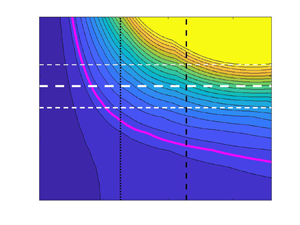
Lozano-Duran et al. (J. Fluid Mech., vol. 914, 2021, p. A8) have recently identified the ability of streamwise-averaged turbulent streak fields ${\mathcal {U}}(y,z,t)\hat {\boldsymbol {x}}$ in minimal channels to produce short-term transient growth as the key linear mechanism needed to sustain turbulence at $Re_{\tau }=180$. Here, in an attempt to extend this result to larger domains and higher $Re_{\tau }$, we model this streak transient growth as a two-stage linear process by first selecting the dominant streak structure expected to emerge over the eddy turnover time on the turbulent mean profile $U(y)\hat {\boldsymbol {x}}$, and then examining the secondary growth on this (frozen) streak field ${\mathcal {U}}(y,z)\hat {\boldsymbol {x}}$. Choosing the mean streak amplitude and eddy turnover time consistent with simulations captures the growth thresholds found by Lozano-Duran et al. (2021) for sustained turbulence. In a larger domain at $Re_{\tau }=180$, the most energetic near-wall streaks observed in simulations are close to the predicted optimal streaks. This most energetic streak spacing, approaches the optimal streak at $Re_{\tau }=550$ where the secondary growth possible on each also comes together. A key prediction from the model is that the threshold transient growth required to sustain turbulence decreases with increasing $Re_{\tau }$. More fundamentally, the work of Lozano-Duran et al. (2021) and our results suggest a subtle but significant revision of Malkus's (J. Fluid Mech., vol. 1, 1956, pp. 521–539) classic hypothesis concerning realisable turbulent mean profiles. The key property for a realisable turbulent mean profile could be the ability to generate sufficient short-term transient growth rather than dependence on its (long-term) linear stability characteristics, which was Malkus's original idea.


What We Owe to Ukrainians: A Moral Perspective on Nuclear Coercion and Military Intervention
-
- Journal:
- Ethics & International Affairs / Volume 38 / Issue 1 / Spring 2024
- Published online by Cambridge University Press:
- 01 October 2024, pp. 31-53
-
- Article
-
- You have access
- Open access
- HTML
- Export citation
Placing the Scottish Romer's Gap tetrapods within a Tournaisian time frame
- Part of
-
- Journal:
- Earth and Environmental Science Transactions of The Royal Society of Edinburgh / Volume 115 / Issue 3-4 / October 2024
- Published online by Cambridge University Press:
- 20 October 2025, pp. 99-112
- Print publication:
- October 2024
-
- Article
-
- You have access
- Open access
- HTML
- Export citation
Miracle Stories and Praise: Two Neglected Topics in Luke
-
- Journal:
- New Testament Studies / Volume 70 / Issue 4 / October 2024
- Published online by Cambridge University Press:
- 14 April 2025, pp. 452-469
- Print publication:
- October 2024
-
- Article
-
- You have access
- Open access
- HTML
- Export citation
