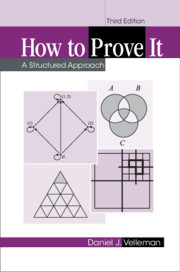
How to Prove It
A Structured Approach
3rd edition
, Amherst College, Massachusetts
Online ISBN: 9781108539890
Online publication date:
04 July 2019
Hardback ISBN: 9781108424189
Hardback publication date: 29 August 2019
Paperback ISBN: 9781108439534
Paperback publication date: 29 August 2019
- Textbook
Proofs play a central role in advanced mathematics and theoretical computer science, yet many students struggle the first time they take a course in which proofs play a significant role. This bestselling text's third edition helps students transition from solving problems to proving theorems by teaching them the techniques needed to read and write proofs. Featuring over 150 new exercises and a new chapter on number theory, this new edition introduces students to the world of advanced mathematics through the mastery of proofs. The book begins with the basic concepts of logic and set theory to familiarize students with the language of mathematics and how it is interpreted. These concepts are used as the basis for an analysis of techniques that can be used to build up complex proofs step by step, using detailed 'scratch work' sections to expose the machinery of proofs about numbers, sets, relations, and functions. Assuming no background beyond standard high school mathematics, this book will be useful to anyone interested in logic and proofs: computer scientists, philosophers, linguists, and, of course, mathematicians.
Proofs play a central role in advanced mathematics and theoretical computer science, yet many students struggle the first time they take a course in which proofs play a significant role. This bestselling text's third edition helps students transition from solving problems to proving theorems by teaching them the techniques needed to read and write proofs. Featuring over 150 new exercises and a new chapter on number theory, this new edition introduces students to the world of advanced mathematics through the mastery of proofs. The book begins with the basic concepts of logic and set theory to familiarize students with the language of mathematics and how it is interpreted. These concepts are used as the basis for an analysis of techniques that can be used to build up complex proofs step by step, using detailed 'scratch work' sections to expose the machinery of proofs about numbers, sets, relations, and functions. Assuming no background beyond standard high school mathematics, this book will be useful to anyone interested in logic and proofs: computer scientists, philosophers, linguists, and, of course, mathematicians.