Refine search
Actions for selected content:
243589 results in Mathematics
In search of common ground: Exploring value networks at the UNFCCC climate change talks
-
- Journal:
- Network Science / Volume 14 / 2026
- Published online by Cambridge University Press:
- 13 April 2026, e7
-
- Article
-
- You have access
- Open access
- HTML
- Export citation
Data, algorithmic targeting, and artificial intelligence (AI) technologies in adaptive social cash systems: towards an AI governance framework
-
- Journal:
- Data & Policy / Volume 8 / 2026
- Published online by Cambridge University Press:
- 13 April 2026, e12
-
- Article
-
- You have access
- Open access
- HTML
- Export citation

On the cross-flow vibration response and vortex dynamics of a circular cylinder under combined current–oscillatory flows
-
- Journal:
- Journal of Fluid Mechanics / Volume 1033 / 25 April 2026
- Published online by Cambridge University Press:
- 13 April 2026, A7
-
- Article
-
- You have access
- Open access
- HTML
- Export citation
-
This study examines the cross-flow vortex-induced vibration (VIV) of a circular cylinder in combined current–oscillatory inflows, revealing a distinct multi-frequency response characterised by beat-like modulation. Systematic water-channel experiments were conducted across a range of reduced velocities, inflow oscillation intensities and frequency ratios to investigate the synchronisation mechanisms among inflow velocity variations, cylinder motion and hydrodynamic loading. Results show that the presence of oscillatory inflow can lead to significant deviations of vibration amplitudes from quasi-steady predictions within the upper-branch regime. At a given reduced velocity, the cylinder motion is dominated by a primary frequency component similar to that observed in steady flow, but accompanied by two secondary components. The contributions of these supplementary frequencies increase with inflow oscillation intensity but diminish as the oscillation frequency rises. Analysis of time-varying hydrodynamic forces reveals that, in the upper-branch regime, the vortex-force phase angle deviates substantially from quasi-steady estimation based on instantaneous reduced velocity, which is associated with non-quasi-steady vortex-shedding patterns. Particle image velocimetry measurements reveal that when the minimum vortex-force phase angle lies between 0 $^\circ$ and 180 $^\circ$ over the inflow oscillation cycle, a mixed vortex-shedding mode emerges. This mode is characterised by a vortex sequence resembling the ‘2P’ (two-pair) shedding pattern but with negligible secondary vortices, occurring predominantly during intervals of low inflow velocity. A theoretical framework incorporating nonlinear damping and excitation coefficients assuming quasi-steady response well predicts VIV amplitudes and elucidates the influence of inflow oscillation intensity and frequency on the emergence of supplementary vibration frequencies.


County of San Diego, California, Investigates Salmonella Typhimurium Outbreak Linked to Unpasteurized Milk — September 2023–January 2024
-
- Journal:
- Epidemiology & Infection / Accepted manuscript
- Published online by Cambridge University Press:
- 13 April 2026, pp. 1-24
-
- Article
-
- You have access
- Open access
- Export citation

Bubble coalescence dynamics in a high-Reynolds number decaying turbulent flow
-
- Journal:
- Journal of Fluid Mechanics / Volume 1033 / 25 April 2026
- Published online by Cambridge University Press:
- 13 April 2026, A6
-
- Article
-
- You have access
- Open access
- HTML
- Export citation
-
This study experimentally investigates bubble size evolution and void fraction redistribution in an unexplored, coalescence-dominated regime of a decaying turbulent bubbly flow. The flow is generated downstream of a regenerative pump in a duct, with bulk Reynolds number (Re) $\sim \mathcal{O}(10^5)$, Taylor-scale Reynolds number (Re $_\lambda$) $\sim \mathcal{O}(10^3)$ and void fraction ( $\phi$) $\sim \mathcal{O}(1\,\%)$, where the inlet turbulence is extremely intense (turbulence intensity $\gt 30\,\%$) but decays rapidly along the duct. Shadowgraph imaging and particle shadow velocimetry are used for measurements. The experimentally obtained turbulent dissipation in the duct flow decays as $\varepsilon \sim \mathcal{L}^{-2}$, where $\mathcal{L}$ is the axial position, in close agreement with the homogeneous isotropic turbulence prediction of $\varepsilon \sim \mathcal{L}^{-2.2}$. High-speed imaging and statistical analysis reveal that bubble coalescence dominates over breakup across most of the domain, leading to monotonic growth in the Sauter mean diameter ( $d_{32}$) and progressive broadening of the bubble size distribution. The normalised extreme-to-mean diameter ratio ( $\mathcal{D}$) increases axially and asymptotically from ${\sim} 1.9$ (breakup regime) and saturates at ${\sim} 2.2$ (coalescence regime), indicating the emergence of a quasi-self-similar bubble size distribution. The probability density function of the bubble diameter exhibits a dual power-law tail with exponents $-10/3$ and $-3/2$ near the duct inlet. However, after a few hydraulic diameters, a single $-3/2$ power-law scaling emerges, indicating a regime of pure coalescence in which all bubbles are smaller than the Hinze scale. The cumulative distribution plotted against $d/d_{32}$ shows that the slope decreases and the distribution width increases with both axial position and void fraction $(\phi )$. Although classical Hinze scaling gives $d_{\textit{H}} \propto \mathcal{L}^{0.9}$, our theory for $d_{32}$ and $d_{99.8}$ (99.8th percentile bubble diameter) in a pure-coalescence regime predicts the slower law $\propto \mathcal{L}^{0.5}$, which our experimental results confirm – indicating negligible breakup and sub-Hinze growth. Concurrently, in contrast to current models, transient $\phi$ profiles evolve from nearly uniform to sharply core-peaked Gaussian distributions in the developing regime, with increasing centreline values and decreasing near-wall values, due to lift-force reversal. These results provide the first spatially resolved characterisation of coalescence-dominated bubbly flows at high Re, advancing the design of industrial systems as in nuclear cooling and multiphase forming processes (e.g. paper manufacturing, chemical reactors).


FRACTAL UNCERTAINTY PRINCIPLE FOR RANDOM CANTOR SETS
- Part of
-
- Journal:
- Journal of the Australian Mathematical Society , First View
- Published online by Cambridge University Press:
- 13 April 2026, pp. 1-22
-
- Article
- Export citation
-
We continue our investigation of the fractal uncertainty principle (FUP) for random fractal sets. In the prequel Eswarathasan and Han [‘Fractal uncertainty principle for discrete Cantor sets with random alphabet’, Math. Res. Lett. 30(6) (2023), 1657–1679], we considered the Cantor sets in the discrete setting with alphabets randomly chosen from a base of digits so the dimension $\delta \in (0,\frac 23)$. We proved that, with overwhelming probability, the FUP with an exponent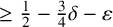 $\ge \frac 12-\frac 34\delta -\varepsilon $ holds for these discrete Cantor sets with random alphabets. In this paper, we construct random Cantor sets with dimension $\delta \in (0,\frac 23)$ in $\mathbb {R}$ via a different random procedure from the previous one used in Eswarathasan and Han [‘Fractal uncertainty principle for discrete Cantor sets with random alphabet’, Math. Res. Lett. 30(6) (2023), 1657–1679]. We prove that, with overwhelming probability, the FUP with an exponent $\ge \frac 12-\frac 34\delta -\varepsilon $ holds. The proof follows from establishing a Fourier decay estimate of the corresponding random Cantor measures, which is in turn based on a concentration of measure phenomenon in an appropriate probability space for the random Cantor sets.


ON THE GROWTH OF TATE–SHAFAREVICH GROUPS OF $\boldsymbol {p}$-SUPERSINGULAR ABELIAN VARIETIES OF $\textbf {GL}_{\textbf {2}}$-TYPE OVER $\boldsymbol {\mathbb {Z}}_{\boldsymbol {p}}$-EXTENSIONS OF NUMBER FIELDS
- Part of
-
- Journal:
- Journal of the Australian Mathematical Society , First View
- Published online by Cambridge University Press:
- 13 April 2026, pp. 1-29
-
- Article
- Export citation
-
We study the boundedness of the Mordell–Weil rank and the growth of the v-primary part of the Tate–Shafarevich group of p-supersingular abelian varieties of $\mathrm {GL}_2$-type with real multiplication over $\mathbb Z_p$-extensions of number fields, where v is a prime lying above p. Building on the work of Iovita and Pollack in the case of elliptic curves, under precise ramification and splitting conditions on p, we construct explicit systems of local points using the theory of Lubin–Tate formal groups. We then define signed Coleman maps, which in turn allow us to formulate and analyse signed Selmer groups. Assuming these Selmer groups are cotorsion, we prove that the Mordell–Weil groups are bounded over any subextensions of the ${\mathbb Z}_p$-extension and provide an asymptotic formula for the growth of the v-primary part of the Tate–Shafarevich groups. Our results extend those of Kobayashi, Pollack, and Sprung on p-supersingular elliptic curves.


A consistent treatment of dynamic contact angles in the sharp-interface framework with the Generalised Navier Boundary Condition
-
- Journal:
- Journal of Fluid Mechanics / Volume 1033 / 25 April 2026
- Published online by Cambridge University Press:
- 13 April 2026, A2
-
- Article
-
- You have access
- Open access
- HTML
- Export citation
-
In this work, we revisit the Generalised Navier Boundary Condition (GNBC) introduced by Qian et al. in the sharp interface volume-of-fluid context. We replace the singular uncompensated Young stress by a smooth function with a characteristic width $\varepsilon \gt 0$ that is understood as a physical parameter of the model. Therefore, we call the model the ‘contact region GNBC’ (CR-GNBC). We show that the model is consistent with the fundamental kinematics of the contact angle transport described by Fricke, Köhne and Bothe. We implement the model in the geometrical volume-of-fluid solver Basilisk using a ‘free angle’ approach. This means that the dynamic contact angle is not prescribed, but reconstructed from the interface geometry and subsequently applied as an input parameter to compute the uncompensated Young stress. We couple this approach to the two-phase Navier–Stokes solver and study the withdrawing tape problem with a receding contact line. It is shown that the model allows for grid-independent solutions and leads to a full regularisation of the singularity at the moving contact line, which is in accordance with the thin film equation subject to this boundary condition. In particular, it is shown that the curvature at the moving contact line is finite and mesh converging. As predicted by the fundamental kinematics, the parallel shear stress component vanishes at the moving contact line for quasi-stationary states (i.e. for $\dot \theta _d=0$), and the dynamic contact angle is determined by a balance between the uncompensated Young stress and an effective contact line friction. Furthermore, a nonlinear generalisation of the model is proposed, which aims at reproducing the molecular kinetic theory of Blake and Haynes for quasi-stationary states.


Free boundary minimal annuli in $S^2_+\times S^1$
- Part of
-
- Journal:
- Proceedings of the Edinburgh Mathematical Society , First View
- Published online by Cambridge University Press:
- 13 April 2026, pp. 1-4
-
- Article
- Export citation
-
Let M be a compact three-dimensional Riemannian manifold with non-negative Ricci curvature and a non-empty boundary $\partial M$. Fraser and Li [2] established a compactness theorem for the space of compact, properly embedded minimal surfaces of fixed topological type in M with a free boundary on $\partial M$, assuming that $\partial M$ is strictly convex with respect to the inward unit normal. In this paper, we show that the strict convexity condition on $\partial M$ cannot be relaxed.


A Note on the Equal Sum and Product Problem with a Fixed Coefficient
-
- Journal:
- Canadian Mathematical Bulletin / Accepted manuscript
- Published online by Cambridge University Press:
- 13 April 2026, pp. 1-10
-
- Article
-
- You have access
- Export citation
A star is born: Explosive Crump–Mode–Jagers branching processes
- Part of
-
- Journal:
- Journal of Applied Probability , First View
- Published online by Cambridge University Press:
- 13 April 2026, pp. 1-19
-
- Article
-
- You have access
- Open access
- HTML
- Export citation
I. Kalimullin, A. Melnikov, A. Montalbán. Punctual definability on structures. Annals of Pure and Applied Logic, vol. 172, no. 8 (2021), Paper 102987, 18 pp. - R. Downey, M. Harrison-Trainor, I. Kalimullin, A. Melnikov, D. Turetsky. Graphs are not universal for online computability, Journal of Computer and System Sciences, vol. 112 (2020), pp. 1–12. - N. Greenberg, M. Harrison-Trainor, A. Melnikov, D. Turetsky. Non-density in punctual computability, Annals of Pure and Applied Logic, vol. 172, no. 9 (2021), Paper 102985, 17 pp.
-
- Journal:
- Bulletin of Symbolic Logic , First View
- Published online by Cambridge University Press:
- 13 April 2026, pp. 1-3
-
- Article
- Export citation

Onset of separation unsteadiness in hypersonic shock–boundary-layer interaction on a cone-step
-
- Journal:
- Journal of Fluid Mechanics / Volume 1033 / 25 April 2026
- Published online by Cambridge University Press:
- 13 April 2026, A11
-
- Article
-
- You have access
- Open access
- HTML
- Export citation
-
Shock–boundary-layer interactions on hypersonic cone-step flows exhibit a range of intrinsic unsteady behaviours, from shear-layer oscillations to large-scale pulsations. This work investigates the unsteadiness in a cone-step geometry at Mach 6 under quiet-flow conditions at different free-stream Reynolds numbers using time-resolved schlieren imaging and spectral proper orthogonal decomposition. Experimental results are compared with high-fidelity axisymmetric and three-dimensional simulations. Results demonstrate regime transition in the parameter space, across the unsteadiness boundary, all the way from shear-layer breakdown to shock system oscillations and ultimately to large-amplitude pulsations. The dominant mode in the experiments and the simulations corresponds to a Strouhal number St $\approx 0.17$ for small oscillations reducing to St $ \approx 0.13$ for large pulsations. A detailed description of the unsteady shock dynamics and an analysis of the nonlinear limit cycle is presented.


Frobenius monoidal functors induced by Frobenius extensions of Hopf algebras
-
- Journal:
- Canadian Journal of Mathematics / Accepted manuscript
- Published online by Cambridge University Press:
- 13 April 2026, pp. 1-38
-
- Article
-
- You have access
- Export citation

A unified framework for bed shear stress and boundary layer thickness for rough and smooth beds in bare and vegetated channels
-
- Journal:
- Journal of Fluid Mechanics / Volume 1033 / 25 April 2026
- Published online by Cambridge University Press:
- 13 April 2026, A17
-
- Article
- Export citation
Tropical Tevelev degrees
- Part of
-
- Journal:
- Mathematical Proceedings of the Cambridge Philosophical Society , First View
- Published online by Cambridge University Press:
- 13 April 2026, pp. 1-30
-
- Article
-
- You have access
- Open access
- HTML
- Export citation
-
We define the tropical Tevelev degrees, ${\mathsf{Tev}}_g^{\mathtt{trop}}$, as the degree of a natural finite morphism between certain tropical moduli spaces, in analogy to the algebraic case. We develop an explicit combinatorial construction that computes ${\mathsf{Tev}}_g^{\mathtt{trop}} = 2^g$. We prove that these tropical enumerative invariants agree with their algebraic counterparts, giving an independent tropical computation of the algebraic degrees ${\mathsf{Tev}}_g$.


Model of incompressible turbulent flows via a kinetic theory
-
- Journal:
- Journal of Fluid Mechanics / Volume 1033 / 25 April 2026
- Published online by Cambridge University Press:
- 13 April 2026, A12
-
- Article
- Export citation
Tamagawa numbers and positive rank of elliptic curves
- Part of
-
- Journal:
- Mathematical Proceedings of the Cambridge Philosophical Society , First View
- Published online by Cambridge University Press:
- 13 April 2026, pp. 1-45
-
- Article
-
- You have access
- Open access
- HTML
- Export citation

On the role of liquid viscosity during droplet-pair impacts on solid surfaces
-
- Journal:
- Journal of Fluid Mechanics / Volume 1033 / 25 April 2026
- Published online by Cambridge University Press:
- 13 April 2026, A19
-
- Article
-
- You have access
- Open access
- HTML
- Export citation
Local genomic epidemiology investigations of SARS-CoV-2 during the early pandemic response: A global systematic review
-
- Journal:
- Epidemiology & Infection / Accepted manuscript
- Published online by Cambridge University Press:
- 10 April 2026, pp. 1-28
-
- Article
-
- You have access
- Open access
- Export citation
