Refine listing
Actions for selected content:
1801 results in 05xxx
Partial automorphisms and the reconstruction conjecture
- Part of
-
- Journal:
- Journal of the Australian Mathematical Society. Series A. Pure Mathematics and Statistics / Volume 37 / Issue 3 / December 1984
- Published online by Cambridge University Press:
- 09 April 2009, pp. 317-336
-
- Article
-
- You have access
- Export citation
The lattice of stable marriages and permutations
- Part of
-
- Journal:
- Journal of the Australian Mathematical Society. Series A. Pure Mathematics and Statistics / Volume 33 / Issue 3 / December 1982
- Published online by Cambridge University Press:
- 09 April 2009, pp. 401-410
-
- Article
-
- You have access
- Export citation
Constructions of balanced ternary designs
- Part of
-
- Journal:
- Journal of the Australian Mathematical Society. Series A. Pure Mathematics and Statistics / Volume 48 / Issue 2 / April 1990
- Published online by Cambridge University Press:
- 09 April 2009, pp. 320-332
-
- Article
-
- You have access
- Export citation
Graphs associated with triangulations of lattice polygons
- Part of
-
- Journal:
- Journal of the Australian Mathematical Society. Series A. Pure Mathematics and Statistics / Volume 47 / Issue 3 / December 1989
- Published online by Cambridge University Press:
- 09 April 2009, pp. 391-398
-
- Article
-
- You have access
- Export citation
Balanced directed cycle designs based on cyclic groups
- Part of
-
- Journal:
- Journal of the Australian Mathematical Society. Series A. Pure Mathematics and Statistics / Volume 58 / Issue 2 / April 1995
- Published online by Cambridge University Press:
- 09 April 2009, pp. 210-218
-
- Article
-
- You have access
- Export citation
-
A balanced directed cycle design with parameters (υ, k, 1), sometimes called a (υ, k, 1)
 -design, is a decomposition of the complete directed graph
  into edge disjoint directed cycles of length k. A complete classification is given of (υ, k, 1)
 -designs admitting the holomorph {øa, b: x ↦ ax + b∣ a, b ∈ Zυ, (a, υ1) = 1} of the cyclic group Zυ as a group of automorphisms. In particular it is shown that such a design exists if and ony if one of (a) k = 2, (b) p ≡ 1 (mod k) for each prime p dividing υ, or (c) k is the least prime dividing υ, k2 does not divide υ, and p ≡ 1 (mod k) for each prime p < k dividing υ.
 -design, is a decomposition of the complete directed graph
  into edge disjoint directed cycles of length
  -designs admitting the holomorph {ø
Primitive permutation groups with a doubly transitive subconstituent
- Part of
-
- Journal:
- Journal of the Australian Mathematical Society. Series A. Pure Mathematics and Statistics / Volume 45 / Issue 1 / August 1988
- Published online by Cambridge University Press:
- 09 April 2009, pp. 66-77
-
- Article
-
- You have access
- Export citation
Another class of graceful trees
- Part of
-
- Journal:
- Journal of the Australian Mathematical Society. Series A. Pure Mathematics and Statistics / Volume 31 / Issue 2 / August 1981
- Published online by Cambridge University Press:
- 09 April 2009, pp. 226-235
-
- Article
-
- You have access
- Export citation
Bhaskar Rao designs from cyclotomy
- Part of
-
- Journal:
- Journal of the Australian Mathematical Society. Series A. Pure Mathematics and Statistics / Volume 29 / Issue 4 / June 1980
- Published online by Cambridge University Press:
- 09 April 2009, pp. 425-430
-
- Article
-
- You have access
- Export citation
Directed packings of pairs into quadruples
- Part of
-
- Journal:
- Journal of the Australian Mathematical Society. Series A. Pure Mathematics and Statistics / Volume 33 / Issue 2 / October 1982
- Published online by Cambridge University Press:
- 09 April 2009, pp. 179-184
-
- Article
-
- You have access
- Export citation
Nonexistence of an extremal graph of a certain type
- Part of
-
- Journal:
- Journal of the Australian Mathematical Society. Series A. Pure Mathematics and Statistics / Volume 30 / Issue 1 / September 1980
- Published online by Cambridge University Press:
- 09 April 2009, pp. 55-64
-
- Article
-
- You have access
- Export citation
Some results concerning frames, Room squares, and subsquares
- Part of
-
- Journal:
- Journal of the Australian Mathematical Society. Series A. Pure Mathematics and Statistics / Volume 31 / Issue 3 / October 1981
- Published online by Cambridge University Press:
- 09 April 2009, pp. 376-384
-
- Article
-
- You have access
- Export citation
Reducible 2 – (11, 5, 4) and 3 – (12, 6, 4) designs
- Part of
-
- Journal:
- Journal of the Australian Mathematical Society. Series A. Pure Mathematics and Statistics / Volume 39 / Issue 2 / October 1985
- Published online by Cambridge University Press:
- 09 April 2009, pp. 194-215
-
- Article
-
- You have access
- Export citation
Pair-packings and projective planes
- Part of
-
- Journal:
- Journal of the Australian Mathematical Society. Series A. Pure Mathematics and Statistics / Volume 37 / Issue 1 / August 1984
- Published online by Cambridge University Press:
- 09 April 2009, pp. 27-38
-
- Article
-
- You have access
- Export citation
Automorphisms of Cayley graphs of metacyclic groups of prime-power order
- Part of
-
- Journal:
- Journal of the Australian Mathematical Society / Volume 71 / Issue 2 / October 2001
- Published online by Cambridge University Press:
- 09 April 2009, pp. 223-232
-
- Article
-
- You have access
- Export citation
A series of BIB designs
- Part of
-
- Journal:
- Journal of the Australian Mathematical Society. Series A. Pure Mathematics / Volume 27 / Issue 1 / February 1979
- Published online by Cambridge University Press:
- 09 April 2009, pp. 88-90
-
- Article
-
- You have access
- Export citation
-
A series of balanced incomplete block (BIB) designs with parameters
 ,
,  is constructed, where
  , w any integer.
 ,
, Some asymptotic methods in combinatorics
- Part of
-
- Journal:
- Journal of the Australian Mathematical Society. Series A. Pure Mathematics / Volume 28 / Issue 4 / December 1979
- Published online by Cambridge University Press:
- 09 April 2009, pp. 452-460
-
- Article
-
- You have access
- Export citation
Balanced tournament designs with almost orthogonal resolutions
- Part of
-
- Journal:
- Journal of the Australian Mathematical Society. Series A. Pure Mathematics and Statistics / Volume 49 / Issue 2 / October 1990
- Published online by Cambridge University Press:
- 09 April 2009, pp. 175-195
-
- Article
-
- You have access
- Export citation
-
A balanced tournament design, BTD(n), defined on a 2n—set V is an arrangement of the (
 ) distinct unordered pairs of the elements of V into an n × 2n − 1 array such that (1) every element of V is contained in precisely one cell of each column, and (2) every element of V is contained in at most two cells of each row. In this paper, we investigate the existence of balanced tournament designs with a pair of almost orthogonal resolutions. These designs can be used to construct doubly resolvable (ν, 3, 2)- BIBD s and, in our smallest applications, have been used to construct previously unknown doubly resolvable (ν, 3, 2)- B I B D s.
 ) distinct unordered pairs of the elements of
 On r-graphs and r-multihypergraphs with given maximum degree
- Part of
-
- Journal:
- Journal of the Australian Mathematical Society. Series A. Pure Mathematics and Statistics / Volume 50 / Issue 2 / April 1991
- Published online by Cambridge University Press:
- 09 April 2009, pp. 204-212
-
- Article
-
- You have access
- Export citation
On the ranks of some (0, 1)-matrices with constant row sums
- Part of
-
- Journal:
- Journal of the Australian Mathematical Society. Series A. Pure Mathematics and Statistics / Volume 31 / Issue 2 / August 1981
- Published online by Cambridge University Press:
- 09 April 2009, pp. 193-201
-
- Article
-
- You have access
- Export citation
-
Let g(n, m) denote the maximal number of distinct rows in any (0, 1 )-matrix with n columns, rank < n, – 1, and all row sums equal to m. This paper determines g(n, m) in all cases:
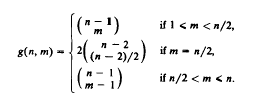
In addition, it is shown that if V is a k-dimensional vector subspace of any vector space, then V contains at most 2k vectors all of whose coordinates are 0 or 1.
Incomplete self-orthogonal latin squares
- Part of
-
- Journal:
- Journal of the Australian Mathematical Society. Series A. Pure Mathematics and Statistics / Volume 42 / Issue 3 / June 1987
- Published online by Cambridge University Press:
- 09 April 2009, pp. 365-384
-
- Article
-
- You have access
- Export citation
