Refine listing
Actions for selected content:
2838 results in 11xxx
On Gaussian primes in sparse sets
- Part of
-
- Journal:
- Compositio Mathematica / Volume 161 / Issue 2 / February 2025
- Published online by Cambridge University Press:
- 17 June 2025, pp. 181-243
- Print publication:
- February 2025
-
- Article
-
- You have access
- Open access
- HTML
- Export citation
-
We show that there exists some $\delta > 0$ such that, for any set of integers B with $|B\cap[1,Y]|\gg Y^{1-\delta}$ for all $Y \gg 1$, there are infinitely many primes of the form $a^2+b^2$ with $b\in B$. We prove a quasi-explicit formula for the number of primes of the form $a^2+b^2 \leq X$ with $b \in B$ for any $|B|=X^{1/2-\delta}$ with $\delta < 1/10$ and $B \subseteq [\eta X^{1/2},(1-\eta)X^{1/2}] \cap {\mathbb{Z}}$, in terms of zeros of Hecke L-functions on ${\mathbb{Q}}(i)$. We obtain the expected asymptotic formula for the number of such primes provided that the set B does not have a large subset which consists of multiples of a fixed large integer. In particular, we get an asymptotic formula if B is a sparse subset of primes. For an arbitrary B we obtain a lower bound for the number of primes with a weaker range for $\delta$, by bounding the contribution from potential exceptional characters.


Complete verification of strong BSD for many modular abelian surfaces over ${\mathbf {Q}}$
- Part of
-
- Journal:
- Forum of Mathematics, Sigma / Volume 13 / 2025
- Published online by Cambridge University Press:
- 30 January 2025, e20
-
- Article
-
- You have access
- Open access
- HTML
- Export citation
-
We develop the theory and algorithms necessary to be able to verify the strong Birch–Swinnerton-Dyer Conjecture for absolutely simple modular abelian varieties over ${\mathbf {Q}}$. We apply our methods to all 28 Atkin–Lehner quotients of $X_0(N)$ of genus $2$, all 97 genus $2$ curves from the LMFDB whose Jacobian is of this type and six further curves originally found by Wang. We are able to verify the strong BSD Conjecture unconditionally and exactly in all these cases; this is the first time that strong BSD has been confirmed for absolutely simple abelian varieties of dimension at least $2$. We also give an example where we verify that the order of the Tate–Shafarevich group is $7^2$ and agrees with the order predicted by the BSD Conjecture.


THE SHORT EXACT SEQUENCE IN DEFINABLE GALOIS COHOMOLOGY
- Part of
-
- Journal:
- The Journal of Symbolic Logic , First View
- Published online by Cambridge University Press:
- 30 January 2025, pp. 1-15
-
- Article
-
- You have access
- Open access
- HTML
- Export citation
-
In [2], Pillay introduced definable Galois cohomology, a model-theoretic generalization of Galois cohomology. Let M be an atomic and strongly $\omega $-homogeneous structure over a set of parameters A. Let B be a normal extension of A in M. We show that a short exact sequence of automorphism groups $1 \to \operatorname {\mathrm {Aut}}(M/B) \to \operatorname {\mathrm {Aut}}(M/A) \to \operatorname {\mathrm {Aut}}(B/A) \to 1$ induces a short exact sequence in definable Galois cohomology. We also discuss compatibilities with [3]. Our result complements the long exact sequence in definable Galois cohomology developed in [4].

Canonical heights for abelian group actions of maximal dynamical rank
- Part of
-
- Journal:
- Forum of Mathematics, Sigma / Volume 13 / 2025
- Published online by Cambridge University Press:
- 28 January 2025, e18
-
- Article
-
- You have access
- Open access
- HTML
- Export citation
-
Let X be a smooth projective variety of dimension $n\geq 2$ and $G\cong \mathbf {Z}^{n-1}$ a free abelian group of automorphisms of X over $\overline {\mathbf {Q}}$. Suppose that G is of positive entropy. We construct a canonical height function $\widehat {h}_G$ associated with G, corresponding to a nef and big $\mathbf {R}$-divisor, satisfying the Northcott property. By characterizing the zero locus of $\widehat {h}_G$, we prove the Kawaguchi–Silverman conjecture for each element of G. As for other applications, we determine the height counting function for non-periodic points and show that X satisfies potential density.


Irreducible factors of a polynomial
- Part of
-
- Journal:
- Proceedings of the Edinburgh Mathematical Society / Volume 68 / Issue 2 / May 2025
- Published online by Cambridge University Press:
- 24 January 2025, pp. 573-582
-
- Article
- Export citation
-
Let (K, v) be a valued field and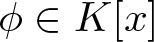 $\phi\in K[x]$ be any key polynomial for a residue-transcendental extension w of v to K(x). In this article, using the ϕ-Newton polygon of a polynomial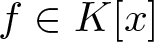 $f\in K[x]$ (with respect to w), we give a lower bound for the degree of an irreducible factor of f. This generalizes the result given in Jakhar and Srinivas (On the irreducible factors of a polynomial II, J. Algebra 556 (2020), 649–655).
Finding product sets in some classes of amenable groups
- Part of
-
- Journal:
- Forum of Mathematics, Sigma / Volume 13 / 2025
- Published online by Cambridge University Press:
- 24 January 2025, e10
-
- Article
-
- You have access
- Open access
- HTML
- Export citation
-
In [15], using methods from ergodic theory, a longstanding conjecture of Erdős (see [5, Page 305]) about sumsets in large subsets of the natural numbers was resolved. In this paper, we extend this result to several important classes of amenable groups, including all finitely generated virtually nilpotent groups and all abelian groups $(G,+)$ with the property that the subgroup $2G := \{g+g : g\in G\}$ has finite index. We prove that in any group G from the above classes, any $A\subset G$ with positive upper Banach density contains a shifted product set of the form $\{tb_ib_j\colon i<j\}$, for some infinite sequence $(b_n)_{n\in \mathbb {N}}$ and some $t\in G$. In fact, we show this result for all amenable groups that posses a property which we call square absolute continuity. Our results provide answers to several questions and conjectures posed in [13].


On even K-groups over p-adic Lie extensions of global function fields
- Part of
-
- Journal:
- Canadian Mathematical Bulletin / Volume 68 / Issue 3 / September 2025
- Published online by Cambridge University Press:
- 22 January 2025, pp. 729-743
- Print publication:
- September 2025
-
- Article
- Export citation
-
Let p be a fixed prime number, and let F be a global function field with characteristic not equal to p. In this article, we shall study the variation properties of the Sylow p-subgroups of the even K-groups in a p-adic Lie extension of F. When the p-adic Lie extension is assumed to contain the cyclotomic $\mathbb {Z}_p$-extension of F, we obtain growth estimate of these groups. We also establish a duality between the direct limit and inverse limit of the even K-groups.

TWISTED RUELLE ZETA FUNCTION ON HYPERBOLIC MANIFOLDS AND COMPLEX-VALUED ANALYTIC TORSION
- Part of
-
- Journal:
- Journal of the Institute of Mathematics of Jussieu / Volume 24 / Issue 3 / May 2025
- Published online by Cambridge University Press:
- 22 January 2025, pp. 813-845
- Print publication:
- May 2025
-
- Article
-
- You have access
- Open access
- HTML
- Export citation
-
In this paper, we study the twisted Ruelle zeta function associated with the geodesic flow of a compact, hyperbolic, odd-dimensional manifold X. The twisted Ruelle zeta function is associated with an acyclic representation $\chi \colon \pi _{1}(X) \rightarrow \operatorname {\mathrm {GL}}_{n}(\mathbb {C})$, which is close enough to an acyclic, unitary representation. In this case, the twisted Ruelle zeta function is regular at zero and equals the square of the refined analytic torsion, as it is introduced by Braverman and Kappeler in [6], multiplied by an exponential, which involves the eta invariant of the even part of the odd-signature operator, associated with $\chi $.

L-series for Vector-Valued Weakly Holomorphic Modular Forms and Converse Theorems
- Part of
-
- Journal:
- Canadian Journal of Mathematics , First View
- Published online by Cambridge University Press:
- 21 January 2025, pp. 1-26
-
- Article
- Export citation
ON THE CONVERGENCE OF ZETA FUNCTIONS OF PREHOMOGENEOUS VECTOR SPACES
- Part of
-
- Journal:
- Nagoya Mathematical Journal / Volume 258 / June 2025
- Published online by Cambridge University Press:
- 20 January 2025, pp. 311-356
- Print publication:
- June 2025
-
- Article
-
- You have access
- Open access
- HTML
- Export citation
Small Mahler measures with bounds on the house and shortness
- Part of
-
- Journal:
- Canadian Mathematical Bulletin / Volume 68 / Issue 2 / June 2025
- Published online by Cambridge University Press:
- 20 January 2025, pp. 603-619
- Print publication:
- June 2025
-
- Article
-
- You have access
- Open access
- HTML
- Export citation
-
We show that for any $\varepsilon>0$, the number of monic, reciprocal, length- $5$ integer polynomials that have house at least $1+\varepsilon $ is finite. The proof is algorithmic, and we are consequently able to compute a complete list (not imposing any bound on the degree) of small Mahler measures of length- $5$ polynomials that have house at least $1.01$.
For larger lengths, the analogous finiteness statement is false, as we show by examples. For length $6$ we show that if one also imposes an upper bound for the Mahler measure that is strictly below the smallest Pisot number $\theta = 1.32471\cdots $, and if the length $6$ polynomial is a cyclotomic multiple of an irreducible polynomial, then the number of polynomials with house at least $1+\varepsilon $ is finite.
We pursue these ideas to search opportunistically for small Mahler measures represented by longer polynomials. We find one new small measure.
We give an algorithm that finds all Salem numbers in an interval $[a,b]$ that are the Mahler measure of an integer polynomial of length at most $6$, provided $1<a \le b < \theta $.


A single source theorem for primitive points on curves
- Part of
-
- Journal:
- Forum of Mathematics, Sigma / Volume 13 / 2025
- Published online by Cambridge University Press:
- 20 January 2025, e6
-
- Article
-
- You have access
- Open access
- HTML
- Export citation
-
Let C be a curve defined over a number field K and write g for the genus of C and J for the Jacobian of C. Let $n \ge 2$. We say that an algebraic point $P \in C(\overline {K})$ has degree n if the extension $K(P)/K$ has degree n. By the Galois group of P we mean the Galois group of the Galois closure of $K(P)/K$ which we identify as a transitive subgroup of $S_n$. We say that P is primitive if its Galois group is primitive as a subgroup of $S_n$. We prove the following ‘single source’ theorem for primitive points. Suppose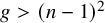 $g>(n-1)^2$ if $n \ge 3$ and $g \ge 3$ if $n=2$. Suppose that either J is simple or that $J(K)$ is finite. Suppose C has infinitely many primitive degree n points. Then there is a degree n morphism $\varphi : C \rightarrow \mathbb {P}^1$ such that all but finitely many primitive degree n points correspond to fibres $\varphi ^{-1}(\alpha )$ with $\alpha \in \mathbb {P}^1(K)$.
We prove, moreover, under the same hypotheses, that if C has infinitely many degree n points with Galois group $S_n$ or $A_n$, then C has only finitely many degree n points of any other primitive Galois group.


UPPER BOUNDS ON POLYNOMIAL ROOT SEPARATION
- Part of
-
- Journal:
- Bulletin of the Australian Mathematical Society / Volume 112 / Issue 2 / October 2025
- Published online by Cambridge University Press:
- 20 January 2025, pp. 274-289
- Print publication:
- October 2025
-
- Article
-
- You have access
- Open access
- HTML
- Export citation
-
We consider the relationship between the Mahler measure $M(f)$ of a polynomial f and its separation $\operatorname {sep}(f)$. Mahler [‘An inequality for the discriminant of a polynomial’, Michigan Math. J. 11 (1964), 257–262] proved that if $f(x) \in \mathbb {Z}[x]$ is separable of degree n, then $\operatorname {sep}(f) \gg _n M(f)^{-(n-1)}$. This spurred further investigations into the implicit constant involved in that relationship and led to questions about the optimal exponent on $M(f)$. However, there has been relatively little study concerning upper bounds on $\operatorname {sep}(f)$ in terms of $M(f)$. We prove that if $f(x) \in \mathbb {C}[x]$ has degree n, then $\operatorname {sep}(f) \ll n^{-1/2}M(f)^{1/(n-1)}$. Moreover, this bound is sharp up to the implied constant factor. We further investigate the constant factor under various additional assumptions on $f(x)$; for example, if it has only real roots.


ON PERFECT POWERS AS SUMS OR DIFFERENCES OF TWO k-GENERALISED PELL NUMBERS
- Part of
-
- Journal:
- Bulletin of the Australian Mathematical Society / Volume 112 / Issue 2 / October 2025
- Published online by Cambridge University Press:
- 20 January 2025, pp. 227-236
- Print publication:
- October 2025
-
- Article
- Export citation
-
For an integer $k \geq 2$, let $P_{n}^{(k)}$ be the k-generalised Pell sequence, which starts with $0, \ldots ,0,1$ (k terms), and each term thereafter is given by the recurrence $P_{n}^{(k)} = 2 P_{n-1}^{(k)} +P_{n-2}^{(k)} +\cdots +P_{n-k}^{(k)}$. We search for perfect powers, which are sums or differences of two k-generalised Pell numbers.


AN UPPER BOUND FOR THE GENERALISED GREATEST COMMON DIVISOR OF RATIONAL POINTS
- Part of
-
- Journal:
- Bulletin of the Australian Mathematical Society / Volume 112 / Issue 2 / October 2025
- Published online by Cambridge University Press:
- 20 January 2025, pp. 248-253
- Print publication:
- October 2025
-
- Article
- Export citation
-
Let X be a smooth projective variety defined over a number field K. We give an upper bound for the generalised greatest common divisor of a point $x\in X$ with respect to an irreducible subvariety $Y\subseteq X$ also defined over K. To prove the result, we establish a rather uniform Riemann–Roch-type inequality.


DERIVATIVES OF THETA FUNCTIONS AS TRACES OF PARTITION EISENSTEIN SERIES
- Part of
-
- Journal:
- Nagoya Mathematical Journal / Volume 258 / June 2025
- Published online by Cambridge University Press:
- 20 January 2025, pp. 284-295
- Print publication:
- June 2025
-
- Article
-
- You have access
- Open access
- HTML
- Export citation
-
In his “lost notebook,” Ramanujan used iterated derivatives of two theta functions to define sequences of q-series $\{U_{2t}(q)\}$ and $\{V_{2t}(q)\}$ that he claimed to be quasimodular. We give the first explicit proof of this claim by expressing them in terms of “partition Eisenstein series,” extensions of the classical Eisenstein series $E_{2k}(q),$ defined by
  $$ \begin{align*}\lambda=(1^{m_1}, 2^{m_2},\dots, n^{m_n}) \vdash n \ \ \ \longmapsto \ \ \ E_{\lambda}(q):= E_2(q)^{m_1} E_4(q)^{m_2}\cdots E_{2n}(q)^{m_n}. \end{align*} $$
For functions $\phi : \mathcal {P}\mapsto {\mathbb C}$ on partitions, the weight $2n$ partition Eisenstein trace is
  $$ \begin{align*}\operatorname{\mathrm{Tr}}_n(\phi;q):=\sum_{\lambda \vdash n} \phi(\lambda)E_{\lambda}(q). \end{align*} $$
For all t, we prove that $U_{2t}(q)=\operatorname {\mathrm {Tr}}_t(\phi _U;q)$ and $V_{2t}(q)=\operatorname {\mathrm {Tr}}_t(\phi _V;q),$ where $\phi _U$ and $\phi _V$ are natural partition weights, giving the first explicit quasimodular formulas for these series.


Control theorems for Hilbert modular varieties
- Part of
-
- Journal:
- Canadian Mathematical Bulletin / Volume 68 / Issue 2 / June 2025
- Published online by Cambridge University Press:
- 14 January 2025, pp. 530-549
- Print publication:
- June 2025
-
- Article
-
- You have access
- Open access
- HTML
- Export citation
LOW RANK SPECIALISATIONS OF ELLIPTIC SURFACES
- Part of
-
- Journal:
- Bulletin of the Australian Mathematical Society / Volume 112 / Issue 1 / August 2025
- Published online by Cambridge University Press:
- 13 January 2025, pp. 118-127
- Print publication:
- August 2025
-
- Article
-
- You have access
- Open access
- HTML
- Export citation
-
Let $E/\mathbb {Q}(T)$ be a nonisotrivial elliptic curve of rank r. A theorem due to Silverman [‘Heights and the specialization map for families of abelian varieties’, J. reine angew. Math. 342 (1983), 197–211] implies that the rank $r_t$ of the specialisation $E_t/\mathbb {Q}$ is at least r for all but finitely many $t \in \mathbb {Q}$. Moreover, it is conjectured that $r_t \leq r+2$, except for a set of density $0$. When $E/\mathbb {Q}(T)$ has a torsion point of order $2$, under an assumption on the discriminant of a Weierstrass equation for $E/\mathbb {Q}(T)$, we produce an upper bound for $r_t$ that is valid for infinitely many t. We also present two examples of nonisotrivial elliptic curves $E/\mathbb {Q}(T)$ such that $r_t \leq r+1$ for infinitely many t.


The isotrivial case in the Mordell-Lang conjecture for semiabelian varieties defined over fields of positive characteristic
- Part of
-
- Journal:
- Canadian Mathematical Bulletin / Volume 68 / Issue 2 / June 2025
- Published online by Cambridge University Press:
- 13 January 2025, pp. 461-476
- Print publication:
- June 2025
-
- Article
- Export citation
-
Let G be a semiabelian variety defined over a finite subfield of an algebraically closed field K of prime characteristic. We describe the intersection of a subvariety X of G with a finitely generated subgroup of $G(K)$.

FURTHER ARITHMETIC PROPERTIES OF OVERCUBIC PARTITION TRIPLES
- Part of
-
- Journal:
- Bulletin of the Australian Mathematical Society / Volume 112 / Issue 2 / October 2025
- Published online by Cambridge University Press:
- 10 January 2025, pp. 260-273
- Print publication:
- October 2025
-
- Article
- Export citation
