Refine listing
Actions for selected content:
415 results in 35Jxx
Existence of singular rotationally symmetric gradient Ricci solitons in higher dimensions
- Part of
-
- Journal:
- Canadian Mathematical Bulletin / Volume 67 / Issue 3 / September 2024
- Published online by Cambridge University Press:
- 21 March 2024, pp. 842-859
- Print publication:
- September 2024
-
- Article
-
- You have access
- Open access
- HTML
- Export citation
-
By using fixed point argument, we give a proof for the existence of singular rotationally symmetric steady and expanding gradient Ricci solitons in higher dimensions with metric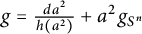 $g=\frac {da^2}{h(a^2)}+a^2g_{S^n}$ for some function h where $g_{S^n}$ is the standard metric on the unit sphere $S^n$ in $\mathbb {R}^n$ for any $n\ge 2$. More precisely, for any $\lambda \ge 0$ and $c_0>0$, we prove that there exist infinitely many solutions ${h\in C^2((0,\infty );\mathbb {R}^+)}$ for the equation $2r^2h(r)h_{rr}(r)=(n-1)h(r)(h(r)-1)+rh_r(r)(rh_r(r)-\lambda r-(n-1))$, $h(r)>0$, in $(0,\infty )$ satisfying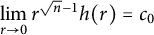 $\underset {\substack {r\to 0}}{\lim }\,r^{\sqrt {n}-1}h(r)=c_0$ and prove the higher-order asymptotic behavior of the global singular solutions near the origin. We also find conditions for the existence of unique global singular solution of such equation in terms of its asymptotic behavior near the origin.


VISCOSITY SOLUTIONS TO THE INFINITY LAPLACIAN EQUATION WITH SINGULAR NONLINEAR TERMS
- Part of
-
- Journal:
- Journal of the Australian Mathematical Society / Volume 117 / Issue 3 / December 2024
- Published online by Cambridge University Press:
- 20 March 2024, pp. 345-374
-
- Article
- Export citation
-
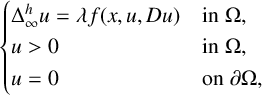
In this paper, we study the singular boundary value problem
 $$ \begin{align*} \begin{cases} \Delta_\infty^h u=\lambda f(x,u,Du) \quad &\mathrm{in}\; \Omega, \\ u>0\quad &\mathrm{in}\; \Omega,\\ u=0 \quad &\mathrm{on} \;\partial\Omega, \end{cases} \end{align*} $$
where $\lambda>0$ is a parameter, $h>1$ and $\Delta _\infty ^h u=|Du|^{h-3} \langle D^2uDu,Du \rangle $ is the highly degenerate and h-homogeneous operator related to the infinity Laplacian. The nonlinear term $f(x,t,p):\Omega \times (0,\infty )\times \mathbb {R}^{n}\rightarrow \mathbb {R}$ is a continuous function and may exhibit singularity at $t\rightarrow 0^{+}$. We establish the comparison principle by the double variables method for the general equation $\Delta _\infty ^h u=F(x,u,Du)$ under some conditions on the term $F(x,t,p)$. Then, we establish the existence of viscosity solutions to the singular boundary value problem in a bounded domain based on Perron’s method and the comparison principle. Finally, we obtain the existence result in the entire Euclidean space by the approximation procedure. In this procedure, we also establish the local Lipschitz continuity of the viscosity solution.


Necessary and sufficient conditions for ground state solutions to planar Kirchhoff-type equations
- Part of
-
- Journal:
- Proceedings of the Royal Society of Edinburgh. Section A: Mathematics / Volume 155 / Issue 5 / October 2025
- Published online by Cambridge University Press:
- 11 March 2024, pp. 1938-1959
- Print publication:
- October 2025
-
- Article
- Export citation
-
In this paper, we are concerned with the ground states of the following planar Kirchhoff-type problem:
\[ -\left(1+b\displaystyle\int_{\mathbb{R}^2}|\nabla u|^2\,{\rm d}x\right)\Delta u+\omega u=|u|^{p-2}u, \quad x\in\mathbb{R}^2. \]where $b,\, \omega >0$
 are constants, $p>2$
 . Based on variational methods, regularity theory and Schwarz symmetrization, the equivalence of ground state solutions for the above problem with the minimizers for some minimization problems is obtained. In particular, a new scale technique, together with Lagrange multipliers, is delicately employed to overcome some intrinsic difficulties.


A class of Hessian quotient equations in de Sitter space
- Part of
-
- Journal:
- Canadian Mathematical Bulletin / Volume 67 / Issue 3 / September 2024
- Published online by Cambridge University Press:
- 06 March 2024, pp. 805-821
- Print publication:
- September 2024
-
- Article
- Export citation
On a critical time-harmonic Maxwell equation in nonlocal media
- Part of
-
- Journal:
- Proceedings of the Royal Society of Edinburgh. Section A: Mathematics / Volume 155 / Issue 5 / October 2025
- Published online by Cambridge University Press:
- 29 February 2024, pp. 1747-1791
- Print publication:
- October 2025
-
- Article
- Export citation
-
In this paper, we study the existence of solutions for a critical time–harmonic Maxwell equation in nonlocal media
\[ \begin{cases} \nabla\times(\nabla\times u)+\lambda u=\left(I_{\alpha}\ast|u|^{2^{{\ast}}_{\alpha}}\right)|u|^{2^{{\ast}}_{\alpha}-2}u & \mathrm{in}\ \Omega,\\ \nu\times u=0 & \mathrm{on}\ \partial\Omega, \end{cases} \]where $\Omega \subset \mathbb {R}^{3}$
 is a bounded domain, either convex or with $\mathcal {C}^{1,1}$
 boundary, $\nu$
 is the exterior normal, $\lambda <0$
 is a real parameter, $2^{\ast }_{\alpha }=3+\alpha$
 with $0<\alpha <3$
 is the upper critical exponent due to the Hardy–Littlewood–Sobolev inequality. By introducing some suitable Coulomb spaces involving curl operator $W^{\alpha,2^{\ast }_{\alpha }}_{0}(\mathrm {curl};\Omega )$
 , we are able to obtain the ground state solutions of the curl–curl equation via the method of constraining Nehari–Pankov manifold. Correspondingly, some sharp constants of the Sobolev-like inequalities with curl operator are obtained by a nonlocal version of the concentration–compactness principle.


Multiplicity of positive solutions for a class of nonhomogeneous elliptic equations in the hyperbolic space
- Part of
-
- Journal:
- Proceedings of the Royal Society of Edinburgh. Section A: Mathematics / Volume 155 / Issue 5 / October 2025
- Published online by Cambridge University Press:
- 27 February 2024, pp. 1708-1746
- Print publication:
- October 2025
-
- Article
-
- You have access
- Open access
- HTML
- Export citation
-
The paper is concerned with positive solutions to problems of the type
\[ -\Delta_{\mathbb{B}^{N}} u - \lambda u = a(x) |u|^{p-1}\;u + f \text{ in }\mathbb{B}^{N}, \quad u \in H^{1}{(\mathbb{B}^{N})}, \]where $\mathbb {B}^N$
 denotes the hyperbolic space, $1< p<2^*-1:=\frac {N+2}{N-2}$
 , $\;\lambda < \frac {(N-1)^2}{4}$
 , and $f \in H^{-1}(\mathbb {B}^{N})$
 ($f \not \equiv 0$
 ) is a non-negative functional. The potential $a\in L^\infty (\mathbb {B}^N)$
 is assumed to be strictly positive, such that $\lim _{d(x, 0) \rightarrow \infty } a(x) \rightarrow 1,$
 where $d(x,\, 0)$
 denotes the geodesic distance. First, the existence of three positive solutions is proved under the assumption that $a(x) \leq 1$
 . Then the case $a(x) \geq 1$
 is considered, and the existence of two positive solutions is proved. In both cases, it is assumed that $\mu ( \{ x : a(x) \neq 1\}) > 0.$
 Subsequently, we establish the existence of two positive solutions for $a(x) \equiv 1$
 and prove asymptotic estimates for positive solutions using barrier-type arguments. The proofs for existence combine variational arguments, key energy estimates involving hyperbolic bubbles.


Qualitative properties of solutions for system involving the fractional Laplacian
- Part of
-
- Journal:
- Proceedings of the Royal Society of Edinburgh. Section A: Mathematics / Volume 155 / Issue 5 / October 2025
- Published online by Cambridge University Press:
- 26 February 2024, pp. 1661-1676
- Print publication:
- October 2025
-
- Article
- Export citation
-
In this paper, we consider the following non-linear system involving the fractional Laplacian0.1
\begin{equation} \left\{\begin{array}{@{}ll} (-\Delta)^{s} u (x)= f(u,\,v), \\ (-\Delta)^{s} v (x)= g(u,\,v), \end{array} \right. \end{equation}in two different types of domains, one is bounded, and the other is an infinite cylinder, where $0< s<1$
 . We employ the direct sliding method for fractional Laplacian, different from the conventional extension and moving planes methods, to derive the monotonicity of solutions for (0.1) in $x_n$
 variable. Meanwhile, we develop a new iteration method for systems in the proofs. Hopefully, the iteration method can also be applied to solve other problems.


On the Γ-convergence of the Allen–Cahn functional with boundary conditions
- Part of
-
- Journal:
- Proceedings of the Royal Society of Edinburgh. Section A: Mathematics / Volume 155 / Issue 5 / October 2025
- Published online by Cambridge University Press:
- 12 February 2024, pp. 1557-1579
- Print publication:
- October 2025
-
- Article
-
- You have access
- Open access
- HTML
- Export citation
-
We study minimizers of the Allen–Cahn system. We consider the $\varepsilon$
 -energy functional with Dirichlet values and we establish the $\Gamma$
 -limit. The minimizers of the limiting functional are closely related to minimizing partitions of the domain. Finally, utilizing that the triod and the straight line are the only minimal cones in the plane together with regularity results for minimal curves, we determine the precise structure of the minimizers of the limiting functional, and thus the limit of minimizers of the $\varepsilon$
 -energy functional as $\varepsilon \rightarrow 0$
 .
.


On the existence of a nodal solution for p-Laplacian equations depending on the gradient
- Part of
-
- Journal:
- Proceedings of the Royal Society of Edinburgh. Section A: Mathematics / Volume 155 / Issue 4 / August 2025
- Published online by Cambridge University Press:
- 31 January 2024, pp. 1492-1513
- Print publication:
- August 2025
-
- Article
- Export citation
-
In the present paper we deal with a quasi-linear elliptic equation depending on a sublinear nonlinearity involving the gradient. We prove the existence of a nontrivial nodal solution employing the theory of invariant sets of descending flow together with sub-supersolution techniques, gradient regularity arguments, strong comparison principle for the $p$
 -Laplace operator. The same conclusion is obtained for an eigenvalue problem under a different set of assumptions.

MULTIPLE SOLUTIONS FOR $p(x)$-LAPLACIAN EQUATIONS WITH NONLINEARITY SUBLINEAR AT ZERO
- Part of
-
- Journal:
- Bulletin of the Australian Mathematical Society / Volume 110 / Issue 2 / October 2024
- Published online by Cambridge University Press:
- 29 January 2024, pp. 346-354
- Print publication:
- October 2024
-
- Article
- Export citation
-
We consider the Dirichlet problem for $p(x)$-Laplacian equations of the form
  $$ \begin{align*} -\Delta_{p(x)}u+b(x)\vert u\vert ^{p(x)-2}u=f(x,u),\quad u\in W_{0}^{1,p(x)}(\Omega). \end{align*} $$
The odd nonlinearity $f(x,u)$ is $p(x)$-sublinear at $u=0$ but the related limit need not be uniform for $x\in \Omega $. Except being subcritical, no additional assumption is imposed on $f(x,u)$ for $|u|$ large. By applying Clark’s theorem and a truncation method, we obtain a sequence of solutions with negative energy and approaching the zero function $u=0$.


On generalized eigenvalue problems of fractional (p, q)-Laplace operator with two parameters
- Part of
-
- Journal:
- Proceedings of the Royal Society of Edinburgh. Section A: Mathematics / Volume 155 / Issue 4 / August 2025
- Published online by Cambridge University Press:
- 22 January 2024, pp. 1385-1430
- Print publication:
- August 2025
-
- Article
- Export citation
-
For $s_1,\,s_2\in (0,\,1)$
 and $p,\,q \in (1,\, \infty )$
 , we study the following nonlinear Dirichlet eigenvalue problem with parameters $\alpha,\, \beta \in \mathbb {R}$
 driven by the sum of two nonlocal operators:\[ (-\Delta)^{s_1}_p u+(-\Delta)^{s_2}_q u=\alpha|u|^{p-2}u+\beta|u|^{q-2}u\ \text{in }\Omega, \quad u=0\ \text{in } \mathbb{R}^d \setminus \Omega, \quad \mathrm{(P)} \]where $\Omega \subset \mathbb {R}^d$
 is a bounded open set. Depending on the values of $\alpha,\,\beta$
 , we completely describe the existence and non-existence of positive solutions to (P). We construct a continuous threshold curve in the two-dimensional $(\alpha,\, \beta )$
 -plane, which separates the regions of the existence and non-existence of positive solutions. In addition, we prove that the first Dirichlet eigenfunctions of the fractional $p$
 -Laplace and fractional $q$
 -Laplace operators are linearly independent, which plays an essential role in the formation of the curve. Furthermore, we establish that every nonnegative solution of (P) is globally bounded.


On Calderon's problem for the connection Laplacian
- Part of
-
- Journal:
- Proceedings of the Royal Society of Edinburgh. Section A: Mathematics / Volume 155 / Issue 3 / June 2025
- Published online by Cambridge University Press:
- 05 January 2024, pp. 1087-1112
- Print publication:
- June 2025
-
- Article
- Export citation
Systems involving mean value formulas on trees
- Part of
-
- Journal:
- Canadian Journal of Mathematics / Volume 77 / Issue 2 / April 2025
- Published online by Cambridge University Press:
- 03 January 2024, pp. 351-383
- Print publication:
- April 2025
-
- Article
- Export citation
Semilinear elliptic equations involving power nonlinearities and Hardy potentials with boundary singularities
- Part of
-
- Journal:
- Proceedings of the Royal Society of Edinburgh. Section A: Mathematics / Volume 155 / Issue 3 / June 2025
- Published online by Cambridge University Press:
- 21 December 2023, pp. 993-1050
- Print publication:
- June 2025
-
- Article
- Export citation
-
Let $\Omega \subset \mathbb {R}^N$
 ($N\geq 3$
 ) be a $C^2$
 bounded domain and $\Sigma \subset \partial \Omega$
 be a $C^2$
 compact submanifold without boundary, of dimension $k$
 , $0\leq k \leq N-1$
 . We assume that $\Sigma = \{0\}$
 if $k = 0$
 and $\Sigma =\partial \Omega$
 if $k=N-1$
 . Let $d_{\Sigma }(x)=\mathrm {dist}\,(x,\Sigma )$
 and $L_\mu = \Delta + \mu \,d_{\Sigma }^{-2}$
 , where $\mu \in {\mathbb {R}}$
 . We study boundary value problems ($P_\pm$
 ) $-{L_\mu} u \pm |u|^{p-1}u = 0$
 in $\Omega$
 and $\mathrm {tr}_{\mu,\Sigma}(u)=\nu$
 on $\partial \Omega$
 , where $p>1$
 , $\nu$
 is a given measure on $\partial \Omega$
 and $\mathrm {tr}_{\mu,\Sigma}(u)$
 denotes the boundary trace of $u$
 associated to $L_\mu$
 . Different critical exponents for the existence of a solution to ($P_\pm$
 ) appear according to concentration of $\nu$
 . The solvability for problem ($P_+$
 ) was proved in [3, 29] in subcritical ranges for $p$
 , namely for $p$
 smaller than one of the critical exponents. In this paper, assuming the positivity of the first eigenvalue of $-L_\mu$
 , we provide conditions on $\nu$
 expressed in terms of capacities for the existence of a (unique) solution to ($P_+$
 ) in supercritical ranges for $p$
 , i.e. for $p$
 equal or bigger than one of the critical exponents. We also establish various equivalent criteria for the existence of a solution to ($P_-$
 ) under a smallness assumption on $\nu$
 .
.


Symmetrized and non-symmetrized asymptotic mean value Laplacian in metric measure spaces
- Part of
-
- Journal:
- Proceedings of the Royal Society of Edinburgh. Section A: Mathematics / Volume 155 / Issue 3 / June 2025
- Published online by Cambridge University Press:
- 28 November 2023, pp. 916-953
- Print publication:
- June 2025
-
- Article
- Export citation
-
The asymptotic mean value Laplacian—AMV Laplacian—extends the Laplace operator from $\mathbb {R}^n$
 to metric measure spaces through limits of averaging integrals. The AMV Laplacian is however not a symmetric operator in general. Therefore, we consider a symmetric version of the AMV Laplacian, and focus lies on when the symmetric and non-symmetric AMV Laplacians coincide. Besides Riemannian and 3D contact sub-Riemannian manifolds, we show that they are identical on a large class of metric measure spaces, including locally Ahlfors regular spaces with suitably vanishing distortion. In addition, we study the context of weighted domains of $\mathbb {R}^n$
 —where the two operators typically differ—and provide explicit formulae for these operators, including points where the weight vanishes.


Multiplicity and stability of normalized solutions to non-autonomous Schrödinger equation with mixed non-linearities
- Part of
-
- Journal:
- Proceedings of the Edinburgh Mathematical Society / Volume 67 / Issue 1 / February 2024
- Published online by Cambridge University Press:
- 09 November 2023, pp. 1-27
-
- Article
- Export citation
-
This paper first studies the multiplicity of normalized solutions to the non-autonomous Schrödinger equation with mixed nonlinearities
where \begin{equation*}\begin{cases}-\Delta u=\lambda u+h(\epsilon x)|u|^{q-2}u+\eta |u|^{p-2}u,\quad x\in \mathbb{R}^N, \\\int_{\mathbb{R}^N}|u|^2\,\textrm{d}x=a^2,\end{cases}\end{equation*}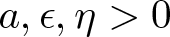 $a, \epsilon, \eta \gt 0$, q is L2-subcritical, p is L2-supercritical, $\lambda\in \mathbb{R}$ is an unknown parameter that appears as a Lagrange multiplier and h is a positive and continuous function. It is proved that the numbers of normalized solutions are at least the numbers of global maximum points of h when ϵ is small enough. The solutions obtained are local minimizers and probably not ground state solutions for the lack of symmetry of the potential h. Secondly, the stability of several different sets consisting of the local minimizers is analysed. Compared with the results of the corresponding autonomous equation, the appearance of the potential h increases the number of the local minimizers and the number of the stable sets. In particular, our results cover the Sobolev critical case $p=2N/(N-2)$.
LELONG NUMBERS OF m-SUBHARMONIC FUNCTIONS ALONG SUBMANIFOLDS
- Part of
-
- Journal:
- Journal of the Institute of Mathematics of Jussieu / Volume 23 / Issue 4 / July 2024
- Published online by Cambridge University Press:
- 07 November 2023, pp. 1797-1820
- Print publication:
- July 2024
-
- Article
-
- You have access
- Open access
- HTML
- Export citation
-
We study the possible singularities of an m-subharmonic function $\varphi $ along a complex submanifold V of a compact Kähler manifold, finding a maximal rate of growth for $\varphi $ which depends only on m and k, the codimension of V. When $k < m$, we show that $\varphi $ has at worst log poles along V, and that the strength of these poles is moreover constant along V. This can be thought of as an analogue of Siu’s theorem.


Existence of renormalized solutions to fully anisotropic and inhomogeneous elliptic problems
- Part of
-
- Journal:
- Proceedings of the Royal Society of Edinburgh. Section A: Mathematics / Volume 155 / Issue 3 / June 2025
- Published online by Cambridge University Press:
- 31 October 2023, pp. 821-857
- Print publication:
- June 2025
-
- Article
- Export citation
From topological recursion to wave functions and PDEs quantizing hyperelliptic curves
- Part of
-
- Journal:
- Forum of Mathematics, Sigma / Volume 11 / 2023
- Published online by Cambridge University Press:
- 31 October 2023, e99
-
- Article
-
- You have access
- Open access
- HTML
- Export citation
-
Starting from loop equations, we prove that the wave functions constructed from topological recursion on families of degree $2$ spectral curves with a global involution satisfy a system of partial differential equations, whose equations can be seen as quantizations of the original spectral curves. The families of spectral curves can be parametrized with the so-called times, defined as periods on second type cycles, and with the poles. These equations can be used to prove that the WKB solution of many isomonodromic systems coincides with the topological recursion wave function, which proves that the topological recursion wave function is annihilated by a quantum curve. This recovers many known quantum curves for genus zero spectral curves and generalizes this construction to hyperelliptic curves.

Prescribing nearly constant curvatures on balls
- Part of
-
- Journal:
- Proceedings of the Royal Society of Edinburgh. Section A: Mathematics / Volume 155 / Issue 3 / June 2025
- Published online by Cambridge University Press:
- 27 October 2023, pp. 756-791
- Print publication:
- June 2025
-
- Article
- Export citation
-
In this paper, we address two boundary cases of the classical Kazdan–Warner problem. More precisely, we consider the problem of prescribing the Gaussian and boundary geodesic curvature on a disk of $\mathbb {R}^2$
 , and the scalar and mean curvature on a ball in higher dimensions, via a conformal change of the metric. We deal with the case of negative interior curvature and positive boundary curvature. Using a Ljapunov–Schmidt procedure, we obtain new existence results when the prescribed functions are close to constants.

