Refine listing
Actions for selected content:
230 results in 35Rxx
Cauchy problem and periodic homogenization for nonlocal Hamilton–Jacobi equations with coercive gradient terms
- Part of
-
- Journal:
- Proceedings of the Royal Society of Edinburgh. Section A: Mathematics / Volume 150 / Issue 6 / December 2020
- Published online by Cambridge University Press:
- 17 September 2019, pp. 3028-3059
- Print publication:
- December 2020
-
- Article
- Export citation
Liouville theorem for fractional Hénon–Lane–Emden systems on a half space
- Part of
-
- Journal:
- Proceedings of the Royal Society of Edinburgh. Section A: Mathematics / Volume 150 / Issue 6 / December 2020
- Published online by Cambridge University Press:
- 17 September 2019, pp. 3060-3073
- Print publication:
- December 2020
-
- Article
- Export citation
-
This paper is concerned with the fractional system
where n ⩾ 2, 0 < α, β < 2, a > −α, b > −β and p, q ⩾ 1. By exploiting a direct method of scaling spheres for fractional systems, we prove that if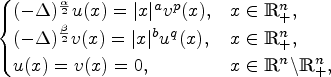 \begin{cases} (-\Delta)^{\frac{\alpha}{2}} u(x) = \vert x \vert ^a v^p(x), &x\in\mathbb{R}^n_+,\\ (-\Delta)^{\frac{\beta}{2}} v(x) = \vert x \vert ^b u^q(x), &x\in\mathbb{R}^n_+,\\ u(x)=v(x)=0, &x\in\mathbb{R}^n{\setminus}\mathbb{R}^n_+, \end{cases} $p \leqslant \frac {n+\alpha +2a}{n-\beta }$, $q \leqslant \frac {n+\beta +2b}{n-\alpha }$, $p+q<\frac {n+\alpha +2a}{n-\beta }+\frac {n+\beta +2b}{n-\alpha }$ and (u, v) is a nonnegative strong solution of the system, then u ≡ v ≡ 0.


A double obstacle model for pricing bi-leg defaultable interest rate swaps
- Part of
-
- Journal:
- European Journal of Applied Mathematics / Volume 31 / Issue 3 / June 2020
- Published online by Cambridge University Press:
- 04 September 2019, pp. 511-543
-
- Article
- Export citation
Scattering coefficients of inhomogeneous objects and their application in target classification in wave imaging
- Part of
-
- Journal:
- European Journal of Applied Mathematics / Volume 31 / Issue 4 / August 2020
- Published online by Cambridge University Press:
- 03 July 2019, pp. 553-573
-
- Article
- Export citation
Asymptotic behaviour of solutions of Fisher–KPP equation with free boundaries in time-periodic environment
- Part of
-
- Journal:
- European Journal of Applied Mathematics / Volume 31 / Issue 3 / June 2020
- Published online by Cambridge University Press:
- 25 March 2019, pp. 423-449
-
- Article
- Export citation
-
We study a free boundary problem of the form: ut = uxx + f(t, u) (g(t) < x < h(t)) with free boundary conditions h′(t) = −ux(t, h(t)) – α(t) and g′(t) = −ux(t, g(t)) + β(t), where β(t) and α(t) are positive T-periodic functions, f(t, u) is a Fisher–KPP type of nonlinearity and T-periodic in t. This problem can be used to describe the spreading of a biological or chemical species in time-periodic environment, where free boundaries represent the spreading fronts of the species. We study the asymptotic behaviour of bounded solutions. There are two T-periodic functions α0(t) and α*(t; β) with 0 < α0 < α* which play key roles in the dynamics. More precisely, (i) in case 0 < β< α0 and 0 < α < α*, we obtain a trichotomy result: (i-1) spreading, that is, h(t) – g(t) → +∞ and u(t, ⋅ + ct) → 1 with $c\in (-\overline{l},\overline{r})$, where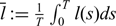 $ \overline{l}:=\frac{1}{T}\int_{0}^{T}l(s)ds$,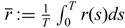 $\overline{r}:=\frac{1}{T}\int_{0}^{T}r(s)ds$, the T-periodic functions −l(t) and r(t) are the asymptotic spreading speeds of g(t) and h(t) respectively (furthermore, r(t) > 0 > −l(t) when 0 < β < α < α0; r(t) = 0 > −l(t) when 0 < β < α = α0; $0 \gt \overline{r} \gt -\overline{l}$ when 0 < β < α0 < α < α*); (i-2) vanishing, that is, $\lim\limits_{t \to \mathcal {T}}h(t) = \lim\limits_{t \to \mathcal {T}}g(t)$ and $\lim\limits_{t \to \mathcal {T}}\max\limits_{g(t)\leq x\leq h(t)} u(t,x)=0$, where $\mathcal {T}$ is some positive constant; (i-3) transition, that is, g(t) → −∞, h(t) → −∞, $0<\lim\limits_{t \to \infty}[h(t)-g(t)] \lt +\infty$ and u(t, ⋅) → V(t, ⋅), where V is a T-periodic solution with compact support. (ii) in case β ≥ α0 or α ≥ α*, vanishing happens for any solution.


Existence, Uniqueness and Qualitative Properties of Global Solutions of Abstract Differential Equations with State-Dependent Delay
- Part of
-
- Journal:
- Proceedings of the Edinburgh Mathematical Society / Volume 62 / Issue 3 / August 2019
- Published online by Cambridge University Press:
- 30 January 2019, pp. 771-788
-
- Article
- Export citation
Random initial conditions for semi-linear PDEs
- Part of
-
- Journal:
- Proceedings of the Royal Society of Edinburgh. Section A: Mathematics / Volume 150 / Issue 3 / June 2020
- Published online by Cambridge University Press:
- 29 January 2019, pp. 1533-1565
- Print publication:
- June 2020
-
- Article
- Export citation
On higher differentiability of solutions of parabolic systems with discontinuous coefficients and (p, q)-growth
- Part of
-
- Journal:
- Proceedings of the Royal Society of Edinburgh. Section A: Mathematics / Volume 150 / Issue 1 / February 2020
- Published online by Cambridge University Press:
- 26 January 2019, pp. 419-451
- Print publication:
- February 2020
-
- Article
- Export citation
-
We consider weak solutions $u:\Omega _T\to {\open R}^N$ to parabolic systems of the typewhere the function a(x, t, ξ) satisfies (p, q)-growth conditions. We give an a priori estimate for weak solutions in the case of possibly discontinuous coefficients. More precisely, the partial maps
 $$u_t-{\rm div}\;a(x,t,Du) = 0\quad {\rm in}\;\Omega _T = \Omega \times (0,T),$$ $x\mapsto a(x,t,\xi )$ under consideration may not be continuous, but may only possess a Sobolev-type regularity. In a certain sense, our assumption means that the weak derivatives $D_xa(\cdot ,\cdot ,\xi )$ are contained in the class $L^\alpha (0,T;L^\beta (\Omega ))$, where the integrability exponents $\alpha ,\beta $ are coupled byfor some κ ∈ (0,1). For the gap between the two growth exponents we assume
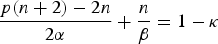 $$\displaystyle{{p(n + 2)-2n} \over {2\alpha }} + \displaystyle{n \over \beta } = 1-\kappa $$Under further assumptions on the integrability of the spatial gradient, we prove a result on higher differentiability in space as well as the existence of a weak time derivative
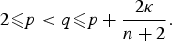 $$2 \les p < q \les p + \displaystyle{{2\kappa } \over {n + 2}}.$$ $u_t\in L^{p/(q-1)}_{{\rm loc}}(\Omega _T)$. We use the corresponding a priori estimate to deduce the existence of solutions of Cauchy–Dirichlet problems with the mentioned higher differentiability property.


Nodal solutions for the fractional Yamabe problem on Heisenberg groups
- Part of
-
- Journal:
- Proceedings of the Royal Society of Edinburgh. Section A: Mathematics / Volume 150 / Issue 2 / April 2020
- Published online by Cambridge University Press:
- 26 January 2019, pp. 771-788
- Print publication:
- April 2020
-
- Article
- Export citation
-
We prove that the fractional Yamabe equation ${\rm {\cal L}}_\gamma u = \vert u \vert ^{((4\gamma )/(Q-2\gamma ))}u$ on the Heisenberg group ℍn has [n + 1/2] sequences of nodal (sign-changing) weak solutions whose elements have mutually different nodal properties, where ${\rm {\cal L}}_\gamma $ denotes the CR fractional sub-Laplacian operator on ℍn, Q = 2n + 2 is the homogeneous dimension of ℍn, and $\gamma \in \bigcup\nolimits_{k = 1}^n [k,((kQ)/Q-1)))$. Our argument is variational, based on a Ding-type conformal pulling-back transformation of the original problem into a problem on the CR sphere S2n + 1 combined with a suitable Hebey-Vaugon-type compactness result and group-theoretical constructions for special subgroups of the unitary group U(n + 1).

Strong maximum principles for fractional elliptic and parabolic problems with mixed boundary conditions
- Part of
-
- Journal:
- Proceedings of the Royal Society of Edinburgh. Section A: Mathematics / Volume 150 / Issue 1 / February 2020
- Published online by Cambridge University Press:
- 26 January 2019, pp. 475-495
- Print publication:
- February 2020
-
- Article
- Export citation
Pseudo-differential operators with nonlinear quantizing functions
- Part of
-
- Journal:
- Proceedings of the Royal Society of Edinburgh. Section A: Mathematics / Volume 150 / Issue 1 / February 2020
- Published online by Cambridge University Press:
- 23 January 2019, pp. 103-130
- Print publication:
- February 2020
-
- Article
-
- You have access
- Open access
- Export citation
-
In this paper we develop the calculus of pseudo-differential operators corresponding to the quantizations of the form
where $$Au(x)=\int_{{\open R}^n}\int_{{\open R}^n}e^{{\rm i}(x-y)\cdot\xi}\sigma(x+\tau(y-x),\xi)u(y)\,{\rm d}y\,{\rm d}\xi,$$ $\tau :{\open R}^n\to {\open R}^n$ is a general function. In particular, for the linear choices $\tau (x)=0$, $\tau (x)=x$ and $\tau (x)={x}/{2}$ this covers the well-known Kohn–Nirenberg, anti-Kohn–Nirenberg and Weyl quantizations, respectively. Quantizations of such type appear naturally in the analysis on nilpotent Lie groups for polynomial functions τ and here we investigate the corresponding calculus in the model case of ${\open R}^n$. We also give examples of nonlinear τ appearing on the polarized and non-polarized Heisenberg groups.


Multiplicity and concentration results for a fractional Schrödinger-Poisson type equation with magnetic field
- Part of
-
- Journal:
- Proceedings of the Royal Society of Edinburgh. Section A: Mathematics / Volume 150 / Issue 2 / April 2020
- Published online by Cambridge University Press:
- 23 January 2019, pp. 655-694
- Print publication:
- April 2020
-
- Article
- Export citation
-
This paper is devoted to the study of fractional Schrödinger-Poisson type equations with magnetic field of the type
where ε > 0 is a parameter, s, t ∈ (0, 1) are such that 2s+2t>3, A:ℝ3 → ℝ3 is a smooth magnetic potential, (−Δ)As is the fractional magnetic Laplacian, V:ℝ3 → ℝ is a continuous electric potential and f:ℝ → ℝ is a C1 subcritical nonlinear term. Using variational methods, we obtain the existence, multiplicity and concentration of nontrivial solutions for e > 0 small enough. $$\varepsilon^{2s}(-\Delta)_{A/\varepsilon}^{s}u + V(x)u + {\rm e}^{-2t}(\vert x \vert^{2t-3} \ast \vert u\vert ^{2})u = f(\vert u \vert^{2})u \quad \hbox{in} \ \open{R}^{3},$$
A CLASS OF CRITICAL KIRCHHOFF PROBLEM ON THE HYPERBOLIC SPACE $\mathbb{H}^{{\it n}}$
- Part of
-
- Journal:
- Glasgow Mathematical Journal / Volume 62 / Issue 1 / January 2020
- Published online by Cambridge University Press:
- 21 January 2019, pp. 109-122
-
- Article
-
- You have access
- Export citation
-
We investigate questions on the existence of nontrivial solution for a class of the critical Kirchhoff-type problems in Hyperbolic space. By the use of the stereographic projection the problem becomes a singular problem on the boundary of the open ball $B_1(0)\subset \mathbb{R}^n$ Combining a version of the Hardy inequality, due to Brezis–Marcus, with the mountain pass theorem due to Ambrosetti–Rabinowitz are used to obtain the nontrivial solution. One of the difficulties is to find a range where the Palais Smale converges, because our equation involves a nonlocal term coming from the Kirchhoff term.


Strong maximum principles for fractional Laplacians
- Part of
-
- Journal:
- Proceedings of the Royal Society of Edinburgh. Section A: Mathematics / Volume 149 / Issue 5 / October 2019
- Published online by Cambridge University Press:
- 16 January 2019, pp. 1223-1240
- Print publication:
- October 2019
-
- Article
- Export citation
NEWTON’S METHOD FOR STOCHASTIC FUNCTIONAL EVOLUTION EQUATIONS IN HILBERT SPACES
- Part of
-
- Journal:
- Mathematika / Volume 65 / Issue 3 / 2019
- Published online by Cambridge University Press:
- 25 March 2019, pp. 542-556
- Print publication:
- 2019
-
- Article
- Export citation
Existence of normalized solutions for nonlinear fractional Schrödinger equations with trapping potentials
- Part of
-
- Journal:
- Proceedings of the Royal Society of Edinburgh. Section A: Mathematics / Volume 149 / Issue 3 / June 2019
- Published online by Cambridge University Press:
- 27 December 2018, pp. 617-653
- Print publication:
- June 2019
-
- Article
- Export citation
A mean field equation involving positively supported probability measures: blow-up phenomena and variational aspects
- Part of
-
- Journal:
- Proceedings of the Royal Society of Edinburgh. Section A: Mathematics / Volume 149 / Issue 2 / April 2019
- Published online by Cambridge University Press:
- 27 December 2018, pp. 325-352
- Print publication:
- April 2019
-
- Article
- Export citation
Continuous solutions and approximating scheme for fractional Dirichlet problems on Lipschitz domains
- Part of
-
- Journal:
- Proceedings of the Royal Society of Edinburgh. Section A: Mathematics / Volume 149 / Issue 2 / April 2019
- Published online by Cambridge University Press:
- 26 December 2018, pp. 533-560
- Print publication:
- April 2019
-
- Article
- Export citation
-
In this paper, we study the fractional Dirichlet problem with the homogeneous exterior data posed on a bounded domain with Lipschitz continuous boundary. Under an extra assumption on the domain, slightly weaker than the exterior ball condition, we are able to prove existence and uniqueness of solutions which are Hölder continuous on the boundary. In proving this result, we use appropriate barrier functions obtained by an approximation procedure based on a suitable family of zero-th order problems. This procedure, in turn, allows us to obtain an approximation scheme for the Dirichlet problem through an equicontinuous family of solutions of the approximating zero-th order problems on ${\bar \Omega}$. Both results are extended to an ample class of fully non-linear operators.

INFINITELY MANY SOLUTIONS FOR NONLOCAL SYSTEMS INVOLVING FRACTIONAL LAPLACIAN UNDER NONCOMPACT SETTINGS
- Part of
-
- Journal:
- Journal of the Australian Mathematical Society / Volume 107 / Issue 2 / October 2019
- Published online by Cambridge University Press:
- 21 December 2018, pp. 215-233
-
- Article
-
- You have access
- Export citation
-
In this paper, we study a class of Brezis–Nirenberg problems for nonlocal systems, involving the fractional Laplacian $(-\unicode[STIX]{x1D6E5})^{s}$ operator, for $0<s<1$, posed on settings in which Sobolev trace embedding is noncompact. We prove the existence of infinitely many solutions in large dimension, namely when $N>6s$, by employing critical point theory and concentration estimates.


HARDY AND RELLICH INEQUALITIES ON THE COMPLEMENT OF CONVEX SETS
- Part of
-
- Journal:
- Journal of the Australian Mathematical Society / Volume 108 / Issue 1 / February 2020
- Published online by Cambridge University Press:
- 21 December 2018, pp. 98-119
-
- Article
-
- You have access
- Export citation
-
We establish existence of weighted Hardy and Rellich inequalities on the spaces $L_{p}(\unicode[STIX]{x1D6FA})$, where $\unicode[STIX]{x1D6FA}=\mathbf{R}^{d}\backslash K$ with $K$ a closed convex subset of $\mathbf{R}^{d}$. Let $\unicode[STIX]{x1D6E4}=\unicode[STIX]{x2202}\unicode[STIX]{x1D6FA}$ denote the boundary of $\unicode[STIX]{x1D6FA}$ and $d_{\unicode[STIX]{x1D6E4}}$ the Euclidean distance to $\unicode[STIX]{x1D6E4}$. We consider weighting functions $c_{\unicode[STIX]{x1D6FA}}=c\circ d_{\unicode[STIX]{x1D6E4}}$ with $c(s)=s^{\unicode[STIX]{x1D6FF}}(1+s)^{\unicode[STIX]{x1D6FF}^{\prime }-\unicode[STIX]{x1D6FF}}$ and $\unicode[STIX]{x1D6FF},\unicode[STIX]{x1D6FF}^{\prime }\geq 0$. Then the Hardy inequalities take the form and the Rellich inequalities are given by
 $$\begin{eqnarray}\int _{\unicode[STIX]{x1D6FA}}c_{\unicode[STIX]{x1D6FA}}|\unicode[STIX]{x1D6FB}\unicode[STIX]{x1D711}|^{p}\geq b_{p}\int _{\unicode[STIX]{x1D6FA}}c_{\unicode[STIX]{x1D6FA}}\,d_{\unicode[STIX]{x1D6E4}}^{-p}|\unicode[STIX]{x1D711}|^{p}\end{eqnarray}$$with
 $$\begin{eqnarray}\int _{\unicode[STIX]{x1D6FA}}|H\unicode[STIX]{x1D711}|^{p}\geq d_{p}\int _{\unicode[STIX]{x1D6FA}}|c_{\unicode[STIX]{x1D6FA}}\,d_{\unicode[STIX]{x1D6E4}}^{-2}\unicode[STIX]{x1D711}|^{p}\end{eqnarray}$$ $H=-\text{div}(c_{\unicode[STIX]{x1D6FA}}\unicode[STIX]{x1D6FB})$. The constants $b_{p},d_{p}$ depend on the weighting parameters $\unicode[STIX]{x1D6FF},\unicode[STIX]{x1D6FF}^{\prime }\geq 0$ and the Hausdorff dimension of the boundary. We compute the optimal constants in a broad range of situations.


