Refine listing
Actions for selected content:
230 results in 35Rxx
EXISTENCE, UNIQUENESS AND APPROXIMATION OF SOLUTIONS TO THE STOCHASTIC LANDAU–LIFSHITZ–GILBERT EQUATION ON THE REAL LINE
- Part of
-
- Journal:
- Bulletin of the Australian Mathematical Society / Volume 107 / Issue 1 / February 2023
- Published online by Cambridge University Press:
- 02 December 2022, pp. 171-172
- Print publication:
- February 2023
-
- Article
-
- You have access
- HTML
- Export citation
Existence and stability of singular patterns in a fractional Ginzburg–Landau equation with a mean field
- Part of
-
- Journal:
- European Journal of Applied Mathematics / Volume 34 / Issue 6 / December 2023
- Published online by Cambridge University Press:
- 11 November 2022, pp. 1242-1268
-
- Article
-
- You have access
- Open access
- HTML
- Export citation
Borderline gradient continuity for fractional heat type operators
- Part of
-
- Journal:
- Proceedings of the Royal Society of Edinburgh. Section A: Mathematics / Volume 153 / Issue 5 / October 2023
- Published online by Cambridge University Press:
- 14 October 2022, pp. 1651-1682
- Print publication:
- October 2023
-
- Article
- Export citation
-
In this paper, we establish gradient continuity for solutions to
\[ (\partial_t - \operatorname{div}(A(x) \nabla ))^{s} u =f,\quad s \in (1/2, 1), \]when $f$
 belongs to the scaling critical function space $L\left (\frac {n+2}{2s-1}, 1\right )$
 . Our main results theorems 1.1 and 1.2 can be seen as a nonlocal generalization of a well-known result of Stein in the context of fractional heat type operators and sharpen some of the previous gradient continuity results which deal with $f$
 in subcritical spaces. Our proof is based on an appropriate adaptation of compactness arguments, which has its roots in a fundamental work of Caffarelli in [13].


A note on monotonicity and Bochner formulas in Carnot groups
- Part of
-
- Journal:
- Proceedings of the Royal Society of Edinburgh. Section A: Mathematics / Volume 153 / Issue 5 / October 2023
- Published online by Cambridge University Press:
- 05 September 2022, pp. 1543-1563
- Print publication:
- October 2023
-
- Article
-
- You have access
- Open access
- HTML
- Export citation
-
In this note, we prove two monotonicity formulas for solutions of $\Delta _H f = c$
 and $\Delta _H f - \partial _t f = c$
 in Carnot groups. Such formulas involve the right-invariant carré du champ of a function and they are false for the left-invariant one. The main results, theorems 1.1 and 1.2, display a resemblance with two deep monotonicity formulas respectively due to Alt–Caffarelli–Friedman for the standard Laplacian, and to Caffarelli for the heat equation. In connection with this aspect we ask the question whether an ‘almost monotonicity’ formula be possible. In the last section, we discuss the failure of the nondecreasing monotonicity of an Almgren type functional.

Harnack inequality for the nonlocal equations with general growth
- Part of
-
- Journal:
- Proceedings of the Royal Society of Edinburgh. Section A: Mathematics / Volume 153 / Issue 5 / October 2023
- Published online by Cambridge University Press:
- 23 August 2022, pp. 1479-1502
- Print publication:
- October 2023
-
- Article
- Export citation
-
We consider a class of generalized nonlocal $p$
 -Laplacian equations. We find some proper structural conditions to establish a version of nonlocal Harnack inequalities of weak solutions to such nonlocal problems by using the expansion of positivity and energy estimates.

Impacts of noise on quenching of some models arising in MEMS technology
- Part of
-
- Journal:
- European Journal of Applied Mathematics / Volume 34 / Issue 6 / December 2023
- Published online by Cambridge University Press:
- 09 August 2022, pp. 1209-1241
-
- Article
-
- You have access
- Open access
- HTML
- Export citation
Convergence to a self-similar solution for a one-phase Stefan problem arising in corrosion theory
- Part of
-
- Journal:
- European Journal of Applied Mathematics / Volume 34 / Issue 4 / August 2023
- Published online by Cambridge University Press:
- 09 August 2022, pp. 701-737
-
- Article
- Export citation
-
Steel corrosion plays a central role in different technological fields. In this article, we consider a simple case of a corrosion phenomenon which describes a pure iron dissolution in sodium chloride. This article is devoted to prove rigorously that under rather general hypotheses on the initial data, the solution of this iron dissolution model converges to a self-similar profile as $t\rightarrow +\infty$. We will do so for an equivalent formulation as presented in the book of Avner Friedman about parabolic equations (Friedman (1964) Partial Differential Equations of Parabolic Type, Prentice-Hall, Inc., Englewood Cliffs, NJ.). In order to prove the convergence result, we apply a comparison principle together with suitable upper and lower solutions.

Rate of convergence for particle approximation of PDEs in Wasserstein space
- Part of
-
- Journal:
- Journal of Applied Probability / Volume 59 / Issue 4 / December 2022
- Published online by Cambridge University Press:
- 28 July 2022, pp. 992-1008
- Print publication:
- December 2022
-
- Article
- Export citation
-
We prove a rate of convergence for the N-particle approximation of a second-order partial differential equation in the space of probability measures, such as the master equation or Bellman equation of the mean-field control problem under common noise. The rate is of order $1/N$ for the pathwise error on the solution v and of order $1/\sqrt{N}$ for the $L^2$-error on its L-derivative $\partial_\mu v$. The proof relies on backward stochastic differential equation techniques.


A Berestycki–Lions type result for a class of degenerate elliptic problems involving the Grushin operator
- Part of
-
- Journal:
- Proceedings of the Royal Society of Edinburgh. Section A: Mathematics / Volume 153 / Issue 4 / August 2023
- Published online by Cambridge University Press:
- 05 July 2022, pp. 1244-1271
- Print publication:
- August 2023
-
- Article
- Export citation
-
In this work we study the existence of nontrivial solution for the following class of semilinear degenerate elliptic equations
\[ -\Delta_{\gamma} u + a(z)u = f(u) \quad \mbox{in}\ \mathbb{R}^{N}, \]where $\Delta _{\gamma }$
 is known as the Grushin operator, $z:=(x,y)\in \mathbb {R}^{m}\times \mathbb {R}^{k}$
 and $m+k=N\geqslant 3$
 , $f$
, $f$ and $a$
 are continuous function satisfying some technical conditions. In order to overcome some difficulties involving this type of operator, we have proved some compactness results that are crucial in the proof of our main results. For the case $a=1$
 , we have showed a Berestycki–Lions type result.


Discounted optimal stopping problems in first-passage time models with random thresholds
- Part of
-
- Journal:
- Journal of Applied Probability / Volume 59 / Issue 3 / September 2022
- Published online by Cambridge University Press:
- 27 June 2022, pp. 714-733
- Print publication:
- September 2022
-
- Article
- Export citation
Fractional interpolation inequality and radially symmetric ground states
- Part of
-
- Journal:
- Proceedings of the Royal Society of Edinburgh. Section A: Mathematics / Volume 153 / Issue 3 / June 2023
- Published online by Cambridge University Press:
- 12 May 2022, pp. 937-957
- Print publication:
- June 2023
-
- Article
- Export citation
-
In this paper, we establish a new fractional interpolation inequality for radially symmetric measurable functions on the whole space $R^{N}$
 and a new compact imbedding result about radially symmetric measurable functions. We show that the best constant in the new interpolation inequality can be achieved by a radially symmetric function. As applications of this compactness result, we study the existence of ground states of the nonlinear fractional Schrödinger equation on the whole space $R^{N}$
 . We also prove an existence result of standing waves and prove their orbital stability.


Asymptotic and transient dynamics of SEIR epidemic models on weighted networks
- Part of
-
- Journal:
- European Journal of Applied Mathematics / Volume 34 / Issue 2 / April 2023
- Published online by Cambridge University Press:
- 26 April 2022, pp. 238-261
-
- Article
- Export citation
A FOURIER-TYPE CHARACTERISATION FOR GEVREY VECTORS ON HYPO-ANALYTIC STRUCTURES AND PROPAGATION OF GEVREY SINGULARITIES
- Part of
-
- Journal:
- Journal of the Institute of Mathematics of Jussieu / Volume 22 / Issue 5 / September 2023
- Published online by Cambridge University Press:
- 07 February 2022, pp. 2177-2198
- Print publication:
- September 2023
-
- Article
- Export citation
Macroscopic limit of a kinetic model describing the switch in T cell migration modes via binary interactions
- Part of
-
- Journal:
- European Journal of Applied Mathematics / Volume 34 / Issue 1 / February 2023
- Published online by Cambridge University Press:
- 23 December 2021, pp. 1-27
-
- Article
-
- You have access
- HTML
- Export citation
Liouville-type results for positive solutions of pseudo-relativistic Schrödinger system
- Part of
-
- Journal:
- Proceedings of the Royal Society of Edinburgh. Section A: Mathematics / Volume 153 / Issue 1 / February 2023
- Published online by Cambridge University Press:
- 13 December 2021, pp. 196-228
- Print publication:
- February 2023
-
- Article
- Export citation
-
In this paper, we are concerned with the physically engaging pseudo-relativistic Schrödinger system:
\[ \begin{cases} \left(-\Delta+m^{2}\right)^{s}u(x)=f(x,u,v,\nabla u) & \hbox{in } \Omega,\\ \left(-\Delta+m^{2}\right)^{t}v(x)=g(x,u,v,\nabla v) & \hbox{in } \Omega,\\ u>0,v>0 & \hbox{in } \Omega, \\ u=v\equiv 0 & \hbox{in } \mathbb{R}^{N}\setminus\Omega, \end{cases} \]where $s,t\in (0,1)$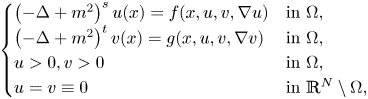
 and the mass $m>0.$
 By using the direct method of moving plane, we prove the strict monotonicity, symmetry and uniqueness for positive solutions to the above system in a bounded domain, unbounded domain, $\mathbb {R}^{N}$
 , $\mathbb {R}^{N}_{+}$
 and a coercive epigraph domain $\Omega$
 in $\mathbb {R}^{N}$
 , respectively.


Exact solutions and critical behaviour for a linear growth-diffusion equation on a time-dependent domain
- Part of
-
- Journal:
- Proceedings of the Edinburgh Mathematical Society / Volume 65 / Issue 1 / February 2022
- Published online by Cambridge University Press:
- 07 December 2021, pp. 53-79
-
- Article
-
- You have access
- Open access
- HTML
- Export citation
On a backward problem for nonlinear time fractional wave equations
- Part of
-
- Journal:
- Proceedings of the Royal Society of Edinburgh. Section A: Mathematics / Volume 152 / Issue 6 / December 2022
- Published online by Cambridge University Press:
- 24 November 2021, pp. 1589-1612
- Print publication:
- December 2022
-
- Article
- Export citation
NUMERICAL SOLUTIONS TO A FRACTIONAL DIFFUSION EQUATION USED IN MODELLING DYE-SENSITIZED SOLAR CELLS
- Part of
-
- Journal:
- The ANZIAM Journal / Volume 63 / Issue 4 / October 2021
- Published online by Cambridge University Press:
- 16 November 2021, pp. 420-433
-
- Article
- Export citation
Extrapolation to weighted Morrey spaces with variable exponents and applications
- Part of
-
- Journal:
- Proceedings of the Edinburgh Mathematical Society / Volume 64 / Issue 4 / November 2021
- Published online by Cambridge University Press:
- 09 November 2021, pp. 1002-1027
-
- Article
- Export citation
A REVIEW OF ONE-PHASE HELE-SHAW FLOWS AND A LEVEL-SET METHOD FOR NONSTANDARD CONFIGURATIONS
- Part of
-
- Journal:
- The ANZIAM Journal / Volume 63 / Issue 3 / July 2021
- Published online by Cambridge University Press:
- 23 September 2021, pp. 269-307
-
- Article
- Export citation
