To save content items to your account,
please confirm that you agree to abide by our usage policies.
If this is the first time you use this feature, you will be asked to authorise Cambridge Core to connect with your account.
Find out more about saving content to .
To save content items to your Kindle, first ensure no-reply@cambridge.org
is added to your Approved Personal Document E-mail List under your Personal Document Settings
on the Manage Your Content and Devices page of your Amazon account. Then enter the ‘name’ part
of your Kindle email address below.
Find out more about saving to your Kindle.
Note you can select to save to either the @free.kindle.com or @kindle.com variations.
‘@free.kindle.com’ emails are free but can only be saved to your device when it is connected to wi-fi.
‘@kindle.com’ emails can be delivered even when you are not connected to wi-fi, but note that service fees apply.
In the radiation hydrodynamic simulations used to design inertial confinement fusion (ICF) and pulsed power experiments, nonlinear radiation diffusion tends to dominate CPU time. This raises the interesting question of whether a quantum algorithm can be found for nonlinear radiation diffusion which provides a quantum speedup. Recently, such a quantum algorithm was introduced based on a quantum algorithm for solving systems of nonlinear partial differential equations (PDEs) which provides a quadratic quantum speedup. Here, we apply this quantum PDE (QPDE) algorithm to the problem of a non-equilibrium Marshak wave propagating through a cold, semi-infinite, optically thick target, where the radiation and matter fields are not assumed to be in local thermodynamic equilibrium. The dynamics is governed by a coupled pair of nonlinear PDEs which are solved using the QPDE algorithm, as well as two standard PDE solvers: (i) Python's py-pde solver; and (ii) the KULL ICF simulation code developed at Lawrence-Livermore National Laboratory. We compare the simulation results obtained using the QPDE algorithm and the standard PDE solvers and find excellent agreement.
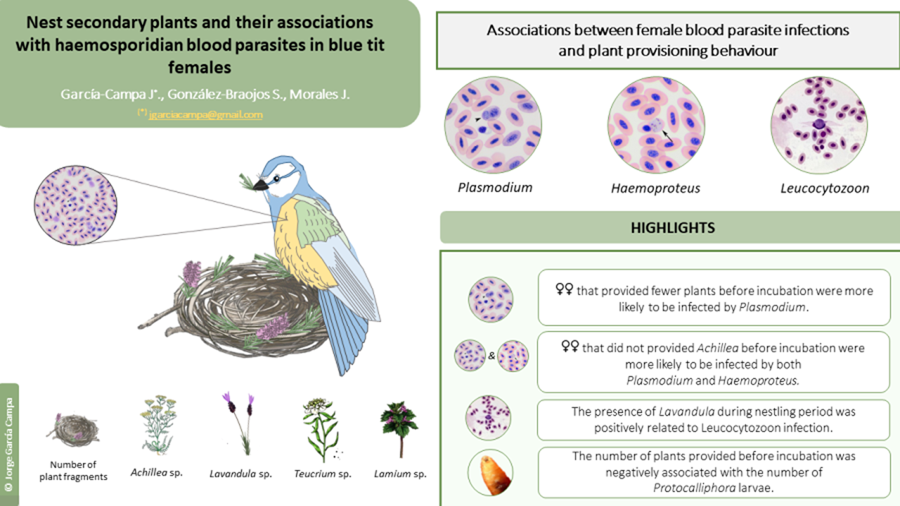
Avian nests often contain aromatic plant fragments, which has led to propose among others that they repel ectoparasites or vectors of blood parasites (‘nest protection hypothesis’). To date, the relationship between secondary plant provisioning and the parent's blood parasites remains unexplored. We investigated whether the presence of secondary plants in nests during different reproductive stages (before incubation, during incubation and nestling period) was associated with the presence of nest-dwelling ectoparasites and females’ blood-parasite infections in blue tits (Cyanistes caeruleus) during chick rearing. In this species, females are highly exposed to parasites, particularly at the beginning of the breeding season, since they build the nest and incubate alone. They also brood the nestlings while the male assists with provisioning. We found that females that provided fewer plants before incubation were more likely to be infected by Plasmodium. Specifically, Females that did not provide Achillea herbs before incubation were more likely to be infected by both Plasmodium and Haemoproteus, reinforcing the ‘nest protection’ hypothesis. Thus, secondary plants may create an early environment that masks the odour of hosts or repels vectors. Surprisingly, the presence of Lavandula during the nestling period was positively related to Leucocytozoon infection. Given its fastest development among haemosporidians, we speculate that Lavandula herbs are provided by females to reduce mother-to-offspring transmission or as a self-medication strategy. Finally, the number of plant fragments provided before incubation was negatively associated with the number of (Protocalliphora azurea) larvae, whereas there were no associations with the presence of mites (Dermanyssus gallinoides).
This response engages critically with Harzheim’s review of Thomas Fuchs’ In Defense of the Human Being: Foundational Questions of an Embodied Anthropology. Fuchs’ work offers a profound exploration of embodied cognition, arguing that human cognition and existence are deeply shaped by our physical interactions. Harzheim’s critique highlights significant aspects of Fuchs’ framework, including his critique of functionalist models, the impact of transhumanist technologies, and ethical concerns in healthcare technology. This paper extends Harzheim’s review by proposing an integration of functionalist and embodied cognitive models, emphasizing the need for a comprehensive evaluation of technological impacts, and advocating for a more robust ethical framework that considers social equity. Additionally, it addresses the is-ought distinction and explores the implications of technological advancements on human identity and mental health. Doede’s critique is also discussed, underscoring the importance of integrating diverse cognitive models and addressing technological determinism. Overall, this response calls for a more nuanced and inclusive approach to the discourse on embodied cognition, aiming to enrich the scholarly conversation and address the complexities and implications of Fuchs’ analysis.
Perfectionism, the view according to which the good for an x is constituted by flourishing as an x, is a venerable account of the good, the popularity of which has only grown in recent decades. In this paper, I assess the merits of perfectionism in its traditional form, and argue in favor of a refinement. Specifically, I focus on traditional perfectionism’s account of the Central Axiological Category (CAC)---the kind ("x") that subjects fall into for the purposes of determining their good. I argue that shifting our understanding of the CAC from the traditional human category to the category of valuer is faithful to the most significant perfectionist insights, and does not succumb to the numerous and substantial challenges for the traditional understanding.
The Mediterranean-Dietary Approach to Stop Hypertension (DASH) Intervention for Neurodegenerative Delay (MIND) diet is a dietary pattern designed to prevent cognitive decline. Dietary adherence is assessed with the MIND diet scoring system, which is currently based on the American diet and serving sizes. It is known that serving sizes and consumed food products differ between countries. Existing literature lacks reporting on food products included within the MIND diet and weight or volume equivalents corresponding to MIND diet servings, impeding accurate comparisons across studies. This study sought to overcome these limitations by evaluating MIND food products consumed in the Dutch context and developing a scoring system based on consumed quantities in weight or volume amounts rather than in standard serving amounts. The third objective was to modify an existing Dutch brief FFQ (Eetscore-FFQ) to evaluate adherence to the MIND diet. We translated nine of the fifteen MIND food groups directly to grams and volumes using the United States Department of Agriculture measurement conversion table. For the remaining food groups, we employed indirect translation to align them as closely as possible to the original MIND diet. These translated quantities in weight and volumes amounts were subsequently rounded to the nearest Dutch household measures, resulting in the culturally adapted MIND-NL diet scoring. The development of the MIND-NL-Eetscore-FFQ, comprising seventy-two food items (forty-one questions), is described. Our adaption approach is reproducible and can be used to customize the MIND diet scoring system to other cultures.
We often seek empathy from others by asking them to listen to our stories. But what exactly is the role of listening in empathy? One might think that it is merely a means for the empathizer to gather rich information about the empathized. We shall rather argue that listening is an embodied action, one that plays a significant role in empathic perspective-taking. We make our case via a descriptive analysis of a paradigm case of empathy mediated by listening or what we can call empathy through listening. On our view, empathy through listening involves three distinctive features: (1) dynamic unfolding, (2) collaboration, and (3) mutual perspective reshaping. Listening contributes to this process by initiating and sustaining a feedback loop of receptivity that occurs between empathizing and empathized agents.
Ponto-Caspian gobies became highly abundant in many regions outside their native distribution range (e.g. in the Rhine River system). In the newly invaded habitats, the parasite communities of the invasive gobies are characterized by a lower species richness compared to their native range. Interestingly, acanthocephalans of the genus Pomphorhynchus are highly abundant, although they do not become mature and mostly remain encapsulated in the abdominal cavity as preadults. Thus, gobiids could either represent a dead-end host for Pomphorhynchus sp. declining its population (dilution effect) or act as a paratenic host that could increase the infection pressure if the infected gobies are preyed upon by appropriate definitive hosts (spill back). To determine which of the 2 scenarios the gobiids contribute to, we conducted 2 infection experiments using smaller and larger individuals of the definitive host chub (Squalius cephalus), infected with preadults of Pomphorhynchus sp. collected from the abdominal cavity of Neogobius melanostomus. The results showed that preadults were able to complete their development and mature in the definitive host with mean recovery rates of 17.9% in smaller and 27.0% in larger chubs. Successful infections were observed in 62.0% and 80.0% of the smaller and larger chubs, respectively. Our study demonstrated that gobies can theoretically serve as a paratenic host for acanthocephalans of the genus Pomphorhynchus, and that infection might spill back into the local fish community if infected gobies are preyed upon by suitable definitive hosts of Pomphorhynchus sp. such as large barbel or chub.
Turbulent flows over rough surfaces can be encountered in a wide range of engineering applications. Despite the progress made after several decades of studies, the prediction of drag and roughness function from the surface geometrical parameters remains an open question. Several methods have shown encouraging results. However, they lack generality and present some scatter in the data. In this paper we propose a new parameter, the effective distribution ($ED$), which lays foundation on the effective slope with some changes to take into account the sheltering effect of large roughness elements and the drag induced by pinnacles higher than the average roughness elements. To develop this new correlation between geometrical features of the wall and the drag, we performed a set of simulations of the turbulent flow over a rough surface made of triangular elements varying their height and spatial distribution. The $ED$ correlates quite well both with the drag and the roughness function for a wide range of cases having different mean roughness height, skewness and kurtosis. To further validate the $ED$, and assessing how it can be generalized to real rough wall, an irregular wall made from the superposition of random sinusoidal function was considered. Results were consistent with the correlation here presented.
No study has validated questionnaires for assessing easily calculable diet quality scores in Japan. The Brief-type self-administered Diet History Questionnaire (BDHQ) is widely used to assess dietary intake in Japan, while the Meal-based Diet History Questionnaire (MDHQ) assesses dietary intake for each meal (breakfast, lunch, dinner and snacks) and overall dietary intake. This study examined the relative validity of the BDHQ and MDHQ for assessing three diet quality scores in Japanese adults. A total of 111 women and 111 men aged 30–76 years completed the web MDHQ and BDHQ, followed by 4-non-consective-day weighed dietary records. The diet quality scores examined included the Diet Quality Score for Japanese (DQSJ), Dietary Approaches to Stop Hypertension (DASH) score and Alternate Mediterranean Diet (AMED) score. The means of the three scores for overall diet from the BDHQ were not significantly different from those from the dietary records in both sexes, whereas those from the MDHQ were higher than those from the dietary records, except for the DASH and AMED in women. Pearson’s correlation coefficients between both questionnaires and dietary records were 0·57–0·63 for DQSJ, 0·49–0·57 for DASH and 0·31–0·49 for AMED across both sexes and both questionnaires. For each meal, Pearson’s correlation coefficients between the MDHQ and dietary records ranged from 0·01 (DASH for snacks in women) to 0·55 (DQSJ for breakfast in men), with a median of 0·35. This study showed that the ability of the BDHQ and MDHQ to rank individuals was good for DQSJ and DASH and acceptable for AMED.
The objectives of this experiment were to determine the digestible indispensable amino acid score (DIAAS) for eggs cooked in different forms and in traditional egg-bread or egg-hash brown combinations, and to test the hypothesis that DIAAS in eggs is greater than in breads or potatoes. Nine ileal cannulated gilts (average initial body weight: 51.1 ± 6.0 kg) were allotted to a 9 × 6 Youden square design with nine diets and six 7-day periods. Fried egg, boiled egg, scrambled egg, English muffin, Texas toast, and hash brown were included in the experiment. Six diets each contained one source of protein and three diets were combinations of fried eggs and English muffin, boiled eggs and Texas toast, or scrambled egg and hash brown. A nitrogen-free diet was also used and fed to all pigs in one period. The standardised ileal digestibility (SID) of crude protein (CP) and amino acids (AA) was calculated, and DIAAS was calculated for the individual ingredient and combined meals for children between 6 and 36 months and individuals older than 3 years. For both age groups, all cooked eggs had greater (P < 0.001) DIAAS compared with the other foods, and hash brown had greater (P < 0.001) DIAAS than both breads. All combined meals had DIAAS greater than 75 and there were no differences between measured and predicted DIAAS for the combined meals. In conclusion, eggs have ‘excellent’ protein quality for individuals older than 6 months and can compensate for the lower protein quality in plant-based foods, and DIAAS obtained from individual ingredients are additive in mixed meals.
This paper considers linear rational expectations models in the frequency domain. The paper characterizes existence and uniqueness of solutions to particular as well as generic systems. The set of all solutions to a given system is shown to be a finite-dimensional affine space in the frequency domain. It is demonstrated that solutions can be discontinuous with respect to the parameters of the models in the context of nonuniqueness, invalidating mainstream frequentist and Bayesian methods. The ill-posedness of the problem motivates regularized solutions with theoretically guaranteed uniqueness, continuity, and even differentiability properties.
This study tests the role of the full range leadership model’s leadership styles in employees’ job-stress-related presenteeism (JSRP). Further, the study tests a model that introduces mediating variables in the relationship between absent leaders and JSRP. Employees from four different types of organizations: police (N = 148), public service (N = 479, not-for-profit (N = 96), and construction (N = 214) completed the Multifactor Leadership Questionnaire on their direct supervisor, as well as a self-report measures of JSRP, psychological distress, and work–life balance. Correlations and hierarchical linear regression models showed that laissez-faire leadership had the strongest influence on JSRP for all four organizations. The parallel mediation model results showed that both employee psychological distress and work–life balance partially mediated the relationship between laissez-faire leadership style and employees’ JSRP. These results underscore the importance of looking at absent leaders and how they affect employees negatively.
This article investigates the potential of deliberative minipublics to provide a new set of institutions for democratic renewal. Using three preregistered and identical conjoint experiments in the United States, Ireland, and Finland, it first shows that minipublics are moderately attractive institutional innovations, but that in all three country contexts, citizens in general are very reluctant to grant them empowerment and autonomy as well as ask for additional provisions (such as large size or large majorities for recommendations). Subgroup analyses, however, reveal that especially participation in minipublics as well as trust in other citizens as decision-makers in combination with low political trust produces more support for empowered and autonomous minipublics. But what stands out in the empirical analysis is that most citizens want minipublics as additions to the representative system, not as a replacement of the existing democratic infrastructure, as some minipublic advocates have suggested.
In an era where artificial intelligence (AI) permeates every facet of our lives, the imperative to steer AI development toward enhancing human wellbeing has never been more critical. However, the development of such positive AI poses substantial challenges due to the current lack of mature methods for addressing the complexities that designing AI for wellbeing poses. This article presents and evaluates the positive AI design method aimed at addressing this gap. The method provides a human-centered process for translating wellbeing aspirations into concrete interventions. First, we explain the method’s key steps: (1) contextualizing, (2) operationalizing, (3) designing, and (4) implementing supported by (5) continuous measurement for iterative feedback cycles. We then present a multi-case study where novice designers applied the method, revealing strengths and weaknesses related to efficacy and usability. Next, an expert evaluation study assessed the quality of the case studies’ outcomes, rating them moderately high for feasibility, desirability, and plausibility of achieving intended wellbeing benefits. Together, these studies provide preliminary validation of the method’s ability to improve AI design, while identifying opportunities for enhancement. Building on these insights, we propose adaptations for future iterations of the method, such as the inclusion of wellbeing-related heuristics, suggesting promising avenues for future work. This human-centered approach shows promise for realizing a vision of “AI for wellbeing” that does not just avoid harm, but actively promotes human flourishing.
Regimes do not change consistently across territorial levels. There has been progress in understanding national democratic erosions and subnational regimes, but barring a few exceptions, these research strands have not engaged in a thorough dialogue. To bridge this gap, I contend that when democracy advances in one territorial level, but erodes in another, we observe multilevel regime decoupling (MRD). Using global data from the Varieties of Democracy project, I examine the 1990–2022 period, showing that the proportion of decoupled cases increased from 20% in the 1990s, to 43% in the first decade of the twenty-first century. Preliminary regression analyses and a descriptive exploration of Italy, South Africa, India, and the United States indicate the non-deterministic influence of structural factors and the potentially pivotal role of courts in facilitating decoupled change. Considering these findings, renewed data collection efforts and an actor-centred approach are needed to strengthen our understanding of the varieties of (de)coupled regime change that have become common over the last decade. Given that regimes across territorial levels increasingly move in separate directions, future assessments of autocratization and democratic change need to embed territorial considerations in their analysis to remain informative about citizens’ real-world experiences on the ground.
The aim of this study was to investigate factors associated with reported need of weight loss support among adults with overweight or obesity in the general population.
Design:
A cross-sectional population study based on a survey questionnaire sent to a random population sample. Multivariate odds ratios for reported need of weight loss support were calculated for socio-economic, lifestyle and health indicators, in total and by gender and age group.
Setting:
Five counties in Sweden in 2022.
Participants:
The study includes 10 069 persons with overweight or obesity (BMI ≥ 25 kg/m2) aged 30–69 years. BMI was based on self-reported weight and height.
Results:
In total, about 20 % reported needing weight loss support. The factors most strongly associated with reported need of weight loss support were obesity and female gender. Lack of social support, economic difficulties, physical inactivity, poor self-rated health, musculoskeletal pain and depression were also associated with reported need of weight loss support, whereas diabetes and hypertension were not. Some differences in these associations were observed between age groups.
Conclusion:
Reported need of weight loss support is more common among women than among men and associated with obesity, lack of social support, economic difficulties, physical inactivity, poor self-rated health, musculoskeletal pain and depression in both genders. These factors are important for planning preventive and weight-control measures among adults with overweight or obesity.
We show that, for any prime p, there exist absolutely simple abelian varieties over $\mathbb {Q}$ with arbitrarily large p-torsion in their Tate-Shafarevich groups. To prove this, we construct explicit $\mu _p$-covers of Jacobians of curves of the form $y^p = x(x-1)(x-a)$ which violate the Hasse principle. In the appendix, Tom Fisher explains how to interpret our proof in terms of a Cassels-Tate pairing.

The response tensor is derived for a relativistically streaming, strongly magnetized, one-dimensional Jüttner distribution of electrons and positrons, referred to as a pulsar plasma. This is used to produce a general treatment of wave dispersion in a pulsar plasma. Specifically, relativistic streaming, the spread in Lorentz factors in a pulsar rest frame and cyclotron resonances are taken into account. Approximations to the response tensor are derived by making approximations to relativistic plasma dispersion functions appearing in the general form of the response tensor. The cold-plasma limit, the highly relativistic limit and limits related to cyclotron resonances are considered. The theory developed in this paper has applications to generalized Faraday rotation in pulsars and magnetars.
Mounting cases of herbicide-resistant waterhemp [Amaranthus tuberculatus (Moq.) Sauer] in the U.S. Midwest have renewed the interest in nonchemical weed management strategies. Field experiments were conducted in 2021 and 2022 to quantify the effectiveness of a commercial combine equipped with a seed impact mill in preventing A. tuberculatus seed return to the soil seedbank in soybean [Glycine max (L.) Merr.]. Amaranthus tuberculatus seed shattering before crop harvest was quantified. Amaranthus tuberculatus started shattering seeds during the last week of August in both years. Overall, 51% of A. tuberculatus seeds were retained on the plant at harvest on October 23, 2021, compared with 61% at harvest on October 7, 2022. Viability of shattered A. tuberculatus seeds ranged from 84% to 94%. Additional seed shattering occurred when plants were disturbed by the combine header during soybean harvest, which caused 15% and 9% shattering in 2021 and 2022, respectively. Amaranthus tuberculatus seeds passed through the impact mill were grouped in three categories: no damage, moderate damage, and severe damage. In 2021, A. tuberculatus seeds with moderate damage had 26% lower germination and viability than seeds with no visible damage. In 2022, seed germination and viability of no-damage seeds did not differ from seeds with a moderate level of damage. No severely damaged seed germinated or tested viable in either year. Altogether, impact mill treatment reduced the number of germinable seeds by 87% compared with the no–impact mill treatment. These results indicate that seed impact mills can be a useful tool in Iowa soybean production to help manage multiple herbicide–resistant A. tuberculatus populations. However, A. tuberculatus seed shattering before crop harvest reduces the overall effectiveness of seed impact mills in preventing seedbank replenishments.
The flow field of a bluff body, a circular disk, that moves horizontally in a stratified environment is studied using large-eddy simulations. Five levels of stratification (body Froude numbers of ${{Fr}} = 0.5, 1, 1.5, 2$ and $5$) are simulated at Reynolds number of ${{Re}} = 5000$ and Prandtl number of $Pr =1$. A higher ${{Re}} = 50\,000$ database at ${{Fr}} = 2, 10$ and $Pr =1$ is also examined for comparison. The wavelengths and amplitudes of steady lee waves are compared with a linear-theory analysis. Excellent agreement is found over the entire range of ${{Fr}}$ if an ‘equivalent body’ that includes the separation region is employed for the linear theory. For asymptotically large distances, the velocity amplitude varies theoretically as ${{Fr}}^{-1}$ but a correction owing to the dependence of the separation zone on ${{Fr}}$ is needed. The wake waves propagate in a narrow band of angles with the vertical, and have a wavelength that increases with increasing ${{Fr}}$. The envelope of wake waves, demarcated using buoyancy variance, exhibits self-similar behaviour. The higher ${{Re}}$ results are consistent with the buoyancy effects exhibited at the lower ${{Re}}$. The wake wave energy is larger at ${{Re}} = 50\,000$. Nevertheless, independent of ${{Fr}}$ and ${{Re}}$, the ratio of the wake wave potential energy to the wake turbulent energy increases to approximately 0.6–0.7 in the non-equilibrium stage showing their energetic importance besides suggesting universality in this statistic. There is a crossover of energetic dominance of lee waves at ${{Fr}} <2$ to wake-wave dominance at ${{Fr}} \approx 5$.