To save content items to your account,
please confirm that you agree to abide by our usage policies.
If this is the first time you use this feature, you will be asked to authorise Cambridge Core to connect with your account.
Find out more about saving content to .
To save content items to your Kindle, first ensure no-reply@cambridge.org
is added to your Approved Personal Document E-mail List under your Personal Document Settings
on the Manage Your Content and Devices page of your Amazon account. Then enter the ‘name’ part
of your Kindle email address below.
Find out more about saving to your Kindle.
Note you can select to save to either the @free.kindle.com or @kindle.com variations.
‘@free.kindle.com’ emails are free but can only be saved to your device when it is connected to wi-fi.
‘@kindle.com’ emails can be delivered even when you are not connected to wi-fi, but note that service fees apply.
This paper makes the case for a discursive understanding of ontological security and demonstrates the utility of such an approach in an analysis of European Parliament (EP) debates between 1990 and 2020. We argue that articulations of ontological (in)security operate through the (re)inscription of a set of metanarratives in what we call ‘discursive nodal points’. Building on an extensive analysis of EP debates over 30 years, we demonstrate that in contrast to the prevailing view of the European Union (EU) as an ‘anxious community’, at least on the political level, EU actors remain surprisingly confident in the European project. While they do invoke challenges to the EU, they see these as incentives to strengthen the integration project and often consider operating in crisis mode as an essential EU characteristic. In doing so, they draw on modernist metanarratives of progress, control, and power to construct an ontologically secure EU. We argue that the future ontological security of the EU will partly depend on allowing for more ambiguity in this modernist narrative without accepting a nationalist counter-narrative that undermines the idea of European integration.
Tools based on generative artificial intelligence (AI) such as ChatGPT have the potential to transform modern society, including the field of medicine. Due to the prominent role of language in psychiatry, e.g., for diagnostic assessment and psychotherapy, these tools may be particularly useful within this medical field. Therefore, the aim of this study was to systematically review the literature on generative AI applications in psychiatry and mental health.
Methods:
We conducted a systematic review following the Preferred Reporting Items for Systematic Reviews and Meta-Analyses guidelines. The search was conducted across three databases, and the resulting articles were screened independently by two researchers. The content, themes, and findings of the articles were qualitatively assessed.
Results:
The search and screening process resulted in the inclusion of 40 studies. The median year of publication was 2023. The themes covered in the articles were mainly mental health and well-being in general – with less emphasis on specific mental disorders (substance use disorder being the most prevalent). The majority of studies were conducted as prompt experiments, with the remaining studies comprising surveys, pilot studies, and case reports. Most studies focused on models that generate language, ChatGPT in particular.
Conclusions:
Generative AI in psychiatry and mental health is a nascent but quickly expanding field. The literature mainly focuses on applications of ChatGPT, and finds that generative AI performs well, but notes that it is limited by significant safety and ethical concerns. Future research should strive to enhance transparency of methods, use experimental designs, ensure clinical relevance, and involve users/patients in the design phase.
Behavioural complexity is likely to reflect how animals cope with their environment. A large behavioural repertoire and the ability to flexibly apply these behaviours provide an individual with a greater likelihood of adapting to its (captive) environment. Here, we developed a procedure to aggregate different behavioural measures into a condensed measure of behavioural complexity based on 14 features, which were previously proposed (e.g. number of behaviours, Shannon diversity index) as well as some new features of behavioural complexity (e.g. variances of within and between transition durations). To test the measure, artificial behavioural sequences with potentially varying complexity were created using an individual-based modelling approach. With a Principal Component Analysis, the features extracted from these sequences could be reduced to two components (‘general complexity’ and ‘state variability’) explaining 59.64 and 27.68% of the total variance, respectively. The effect of the aspects of the artificial behavioural sequences on ‘general complexity’ and ‘transitions variability’ were analysed using linear mixed-effects models. The number of behavioural categories and the proportion of short behavioural states had the largest effect on the components. Both components were increasing with a greater number of behavioural categories, whereas the proportion of short behavioural states the opposite effect on the components. We also tested the approach on real data-sets. The principle components were not identical to the ones from the simulation. Yet, we found consistencies and similarities in the loadings. The approach for an aggregated measure of behavioural complexity developed here could form the basis of an individual-based animal welfare indicator for intensively kept animals.
This article addresses the recent interest in Black Internationalism in the history of political thought and related fields by engaging with a portion of W. E. B. Du Bois’s (1868–1963) work. It examines in particular how Du Bois treats Africa in his published and unpublished writings from the 1910s to the 1940s in light of the challenges of world war and continued imperial expansionism in the global South. I argue that through a rhetorical framing of problems on the continent, and by situating Africa in relation to global economic problems as well as the goal of long-lasting peace, Du Bois comes up with novel approaches to war and empire, as well as solutions to the problems that they pose. I conclude by reflecting on how he can contribute to debates on Black Internationalism today.
This article analyses the views of experts and political discourse on river regulation, its objectives, and flood prevention in the rural Demer-Dijle catchment areas, the 1840s–1880s – a period marked by climatological extremes and agricultural transition. Via a close read of state archives and parliamentary discussions, we unravel different opinions and interests and find that not all flooding was unwanted. While the Ministry of Public Works, at first, aimed to better regulate water discharge and to improve watercourses for navigational purposes, it later prioritised agricultural interests. However, managing rivers coherently and efficiently was challenging because river powers were dispersed over ministerial departments, provinces, and municipalities that made coordinating upstream and downstream river works difficult. Floods often resulted in the drawing up of new plans, but their implementation often failed to materialise because the government had other worries and insufficient resources available while parliamentarians prioritised the interests of their constituencies.
Multimodal imaging is crucial for diagnosis and treatment in paediatric cardiology. However, the proficiency of artificial intelligence chatbots, like ChatGPT-4, in interpreting these images has not been assessed. This cross-sectional study evaluates the precision of ChatGPT-4 in interpreting multimodal images for paediatric cardiology knowledge assessment, including echocardiograms, angiograms, X-rays, and electrocardiograms. One hundred multiple-choice questions with accompanying images from the textbook Pediatric Cardiology Board Review were randomly selected. The chatbot was prompted to answer these questions with and without the accompanying images. Statistical analysis was done using X2, Fisher’s exact, and McNemar tests. Results showed that ChatGPT-4 answered 41% of questions with images correctly, performing best on those with electrocardiograms (54%) and worst on those with angiograms (29%). Without the images, ChatGPT-4’s performance was similar at 37% (difference = 4%, 95% confidence interval (CI) –9.4% to 17.2%, p = 0.56). The chatbot performed significantly better when provided the image of an electrocardiogram than without (difference = 18, 95% CI 4.0% to 31.9%, p < 0.04). In cases of incorrect answers, ChatGPT-4 was more inconsistent with an image than without (difference = 21%, 95% CI 3.5% to 36.9%, p < 0.02). In conclusion, ChatGPT-4 performed poorly in answering image-based multiple-choice questions in paediatric cardiology. Its accuracy in answering questions with images was similar to without, indicating limited multimodal image interpretation capabilities. Substantial training is required before clinical integration can be considered. Further research is needed to assess the clinical reasoning skills and progression of ChatGPT in paediatric cardiology for clinical and academic utility.
Studies concerning twins with a sociological focus are scarce in Hungary as well as international research, although the number of twin births has increased dramatically worldwide. The raising and education of twins are tasks demanding special attention from both the family and institutions. In our study we examine these aspects, looking back from adulthood, using the narrow scope of the available data from research based on the ‘Hungarostudy 2021’ database (N total: 7000; n twins: 106). Our results, corresponding to the hypotheses of educational sociology, demonstrate how the relationships between family size and school career and increasing number of siblings reduces the chances of high educational attainment. A regression analysis confirmed that both the number of siblings and a later position in the birth order reduces the chance of obtaining a higher education. For the second child in a family, the chance of earning a university degree is reduced to to 0.743. The role of a large family concerning higher education showed a stronger relationship in the case of twins compared to nontwins. For twins, the sibling pattern has a decisive effect in educational attainment. Twins themselves have a 1.449 times higher chance of obtaining a higher education compared to nontwins (p = 0.101), and fraternal twins have half (0.517) the chance of obtaining a higher education compared to identical twins; but both results are not significant (p = 0.156).
People are frequently concerned about the impressions they make on others (referred to as metaperceptions), but their insights are often inaccurate. Illustrating the phenomenon called the liking gap, speakers interacting in their first language (L1) and second language (L2) tend to underestimate how much they are liked by their interlocutor, and these judgments often predict their desire to engage in future interaction and collaboration. To understand the scope of this bias and its consequences, we focused on L1–L2 dyadic interaction, examining metaperception as a potential barrier to conversations between university students. We recruited 58 previously unacquainted university students to perform a 10-min academic discussion task between one L1 and one L2 speaker. Afterward, the speakers (a) assessed each other’s interpersonal liking, speaking skill, and interactional behavior; (b) provided their metaperceptions of their interlocutor’s assessments of the same dimensions; and (c) estimated their interest in future interaction with the same interlocutor. All speakers showed a reliable metaperception bias to underestimate their interpersonal liking, speaking skill, and interactional behavior. However, only L1 speakers’ desire to engage in future interaction was associated with their metaperceptions of interpersonal liking. We discuss implications of this finding for understanding and promoting academic communication.
Ferrodimolybdenite with ideal formula FeMo3+2S4 (C2/c, a = 11.8249(8) Å, b = 6.5534(3) Å, c = 13.0052(10) Å, β = 114.474(9)°, V = 917.27(12) Å3 and Z = 8) was discovered in a differentiated sulfide nodule composed of troilite and pentlandite parts. The nodule was detected in the central zone of a diopside–anorthite–tridymite oval paralava body, ∼30 metres in diameter, within the pyrometamorphic Hatrurim Complex in Daba-Siwaqa, Jordan. Ferrodimolybdenite is the first trivalent molybdenum compound discovered in Nature. Its synthetic analogue crystallises in the C1c1 space group. Ferrodimolybdenite with the empirical formula (Fe2+0.99Cu2+0.07Ni2+0.04)Σ1.10Mo3+1.94(S2–3.98P3–0.02)Σ4.00 was identified in the troilite part of the differentiated sulfide nodule. The nodule contains inclusions of tetrataenite, nickelphosphide, molybdenite, galena and rudashevskyite. Ferrodimolybdenite forms platy crystals with dimensions ranging from 3×100 μm to 20×40 μm. The mineral exhibits a grey colour and a dark grey streak. It is opaque with a metallic lustre, and its Mohs hardness is ∼3. The cleavage observed in the mineral is perfect on {001}, good on {100} and poor on {010}. Its tenacity is sectile, and its fracture is smooth. The calculated density of 5.445 g·cm–3 was derived from the empirical formula and unit cell volume refined from single-crystal X-ray diffraction data. In reflected light, ferrodimolybdenite appears grey to light grey with a blueish tinge. It is anisotropic, with a reflectance in the range of 34–40%. The crystallisation of ferrodimolybdenite occurred in reduced conditions in monosulfide Fe(+Ni) melt at a temperature of 1000–1100°C and at low pressure.
Control of carbapenem-resistant Acinetobacter baumannii and Pseudomonas aeruginosa spread in healthcare settings begins with timely and accurate laboratory testing practices. Survey results show most Veterans Affairs facilities are performing recommended tests to identify these organisms. Most facilities report sufficient resources to perform testing, though medium-complexity facilities report some perceived barriers.
Interacting particle systems (IPSs) are a very important class of dynamical systems, arising in different domains like biology, physics, sociology and engineering. In many applications, these systems can be very large, making their simulation and control, as well as related numerical tasks, very challenging. Kernel methods, a powerful tool in machine learning, offer promising approaches for analyzing and managing IPS. This paper provides a comprehensive study of applying kernel methods to IPS, including the development of numerical schemes and the exploration of mean-field limits. We present novel applications and numerical experiments demonstrating the effectiveness of kernel methods for surrogate modelling and state-dependent feature learning in IPS. Our findings highlight the potential of these methods for advancing the study and control of large-scale IPS.
Giant coronary artery aneurysms are rare but potentially fatal complications of Kawasaki disease. The lack of evidence-based recommendations on their management and treatment cause guidelines and practices to differ. We aimed to assess these variations.
Methods:
An anonymous online survey regarding surveillance, imaging, pharmacological management, and interventional practices was distributed among 134 physicians attending to Kawasaki disease patients worldwide. A p-value of <0.05 was deemed significant.
Results:
The majority (60%) of respondents were general paediatric cardiologists, and 29% interventional specialists. The average years in practice was 15 ± 9.6. Physicians from Asia had the most experience with giant coronary artery aneurysms. American practitioners preferred combining anticoagulants with aspirin. Beta-blockers and statins were more likely used in teenagers versus younger children. Cardiac catheterisation was most (52%) chosen for coronary surveillance in patients with echocardiogram anomalies, followed by Coronary CT-angiography. The indications for coronary intervention were split among respondents, regardless of geographic region or experience. The preferred treatment of coronary stenosis was percutaneous intervention (69%) versus bypass surgery. For thrombosis, thrombolytics (50%) were preferred over percutaneous (39%) and surgical (11%) interventions. Most (92%) preferred intervening in young children in a paediatric facility but were split between a paediatric and adult facility for older children. Most chose combined management by adult and paediatric specialists for either age-scenarios (70, 82%).
Conclusion:
As identified by our study, the lack of large studies and evidence-based recommendations cause uncertainty and ambivalence towards certain treatments. International collaborative efforts are needed to provide more robust evidence in the management of these patients.
Evaluating the impact of patient involvement in health technology assessments (HTA) may help improve practices and avoid ineffective activities. Evaluation, however, continues to be infrequent, inconsistent, and often only relates to process quantity or quality. The Patient and Citizen Involvement in HTA Interest Group (PCIG) within Health Technology Assessment International set out to contextualize this impact to support evaluation.
Methods
Given the lack of established methodology to measure impact, the team performed a qualitative analysis of first-hand accounts about perceived changes in HTA due to involvement of patient stakeholders. A questionnaire was developed, piloted, and rolled out to collect personal perspectives from stakeholders with relevant experience. The stories were analyzed in the aggregate to identify themes in the data.
Results
From January 2019 to September 2021, twenty-four responses were collected through PCIG’s network. Responses (including one joint industry-HTA body submission) came from patient representatives (12), HTA bodies (11), and industry representatives (2) from North America (5), South America (3), Europe (13), and Asia Pacific (3). Based on themes commonly reported, a three-domain framework for evaluating impact is proposed: impact on basis of HTA result or recommendation, impact on HTA body, and impact on patient participants. The framework includes components under each domain to support reporting.
Conclusions
Using the Three-Domain Impact Framework may be useful in identifying, evaluating, and communicating the value of patient involvement in HTA. Enhancing and increasing reporting practices may improve transparency and facilitate process improvements for meaningful integration of patient stakeholders into HTA appraisals across jurisdictions.
Although the initial specimen diversion device (ISDD) has been shown to reduce blood culture contamination (BCC) rates, its impact on clinical outcomes remains unclear. This multicenter study showed that ISDD significantly decreased BCC. However, there was no reduction in length of stay, days of therapy, or central line-associated bloodstream infections.
Let ${\mathbf {x}}_{n \times n}$ be an $n \times n$ matrix of variables, and let ${\mathbb {F}}[{\mathbf {x}}_{n \times n}]$ be the polynomial ring in these variables over a field ${\mathbb {F}}$. We study the ideal $I_n \subseteq {\mathbb {F}}[{\mathbf {x}}_{n \times n}]$ generated by all row and column variable sums and all products of two variables drawn from the same row or column. We show that the quotient ${\mathbb {F}}[{\mathbf {x}}_{n \times n}]/I_n$ admits a standard monomial basis determined by Viennot’s shadow line avatar of the Schensted correspondence. As a corollary, the Hilbert series of ${\mathbb {F}}[{\mathbf {x}}_{n \times n}]/I_n$ is the generating function of permutations in ${\mathfrak {S}}_n$ by the length of their longest increasing subsequence. Along the way, we describe a ‘shadow junta’ basis of the vector space of k-local permutation statistics. We also calculate the structure of ${\mathbb {F}}[{\mathbf {x}}_{n \times n}]/I_n$ as a graded ${\mathfrak {S}}_n \times {\mathfrak {S}}_n$-module.
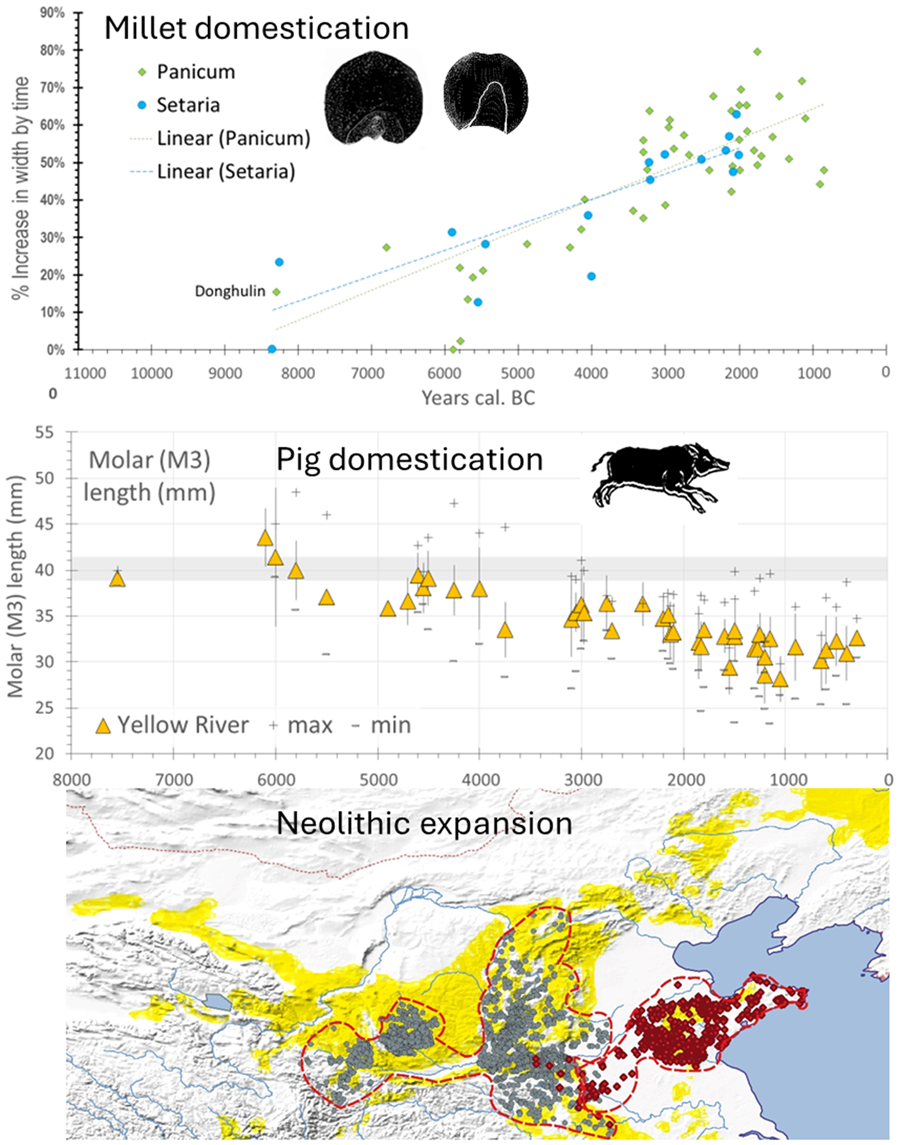
The transition to sedentary agricultural societies in northern China fuelled considerable demographic growth from 5000 to 2000 BC. In this article, we draw together archaeobotanical, zooarchaeological and bioarchaeological data and explore the relationship between several aspects of this transition, with an emphasis on the millet-farming productivity during the Yangshao period and how it facilitated changes in animal husbandry and consolidation of sedentism. We place the period of domestication (the evolution of non-shattering, initial grain size increase and panicle development) between 8300 and 4300 BC. The domestication and post-domestication of foxtail (Setaria italica) and broomcorn (Panicum miliaceum) millet increased their productivity substantially, with much greater rate of change than for rice (Oryza sativa). However, millets are significantly less productive per hectare than wet rice farming, a point reflected in the greater geographical expanse of northern Neolithic millet cultures (5000–3000 BC) in comparison with their Yangtze rice-growing counterparts. The domestication of pigs in the Yellow River region is evidenced by changes in their morphology after 6000 BC, and a transition to a millet-based diet c. 4500–3500 BC. Genetic data and isotopic data from dogs indicate a similar dietary transition from 6000 to 4000 BC, leading to new starch-consuming dog breeds. Significant population increase associated with agricultural transitions arose predominately from the improvement of these crops and animals following domestication, leading to the formation of the first proto-urban centres and the demic-diffusion of millet agriculture beyond central northern China between 4300–2000 BC.
Charisma, often seen as an innate trait, is now understood as leader signaling grounded in values, symbols, and emotions, suggesting it can be developed through interventions. However, the method for cultivating charisma remains unclear. This study examines nonverbal communication strategies, highlighting the potential of body language, facial expressions, and vocal modulation to enhance charisma. Additionally, we introduce a virtual reality training program focused on these cues and explore the role of audience presence in boosting the intervention’s effectiveness by fostering self-awareness and behavioral adjustments. Results of a controlled randomized experiment with virtual reality-trained participants and online charisma assessors demonstrated significant improvements in observer-rated charisma from pre- to post-training compared to the control group. Moreover, training in front of a virtual audience yielded the expected outcomes. This study sheds light on charisma theory, its potential virtual reality training application, and its implications for leadership development.
Jennifer Blumenthal-Barby (2024) has called for bioethics to end talk about personhood, asserting that such talk has the tendency to confuse and offend. It will be argued that this has only limited application for (largely) private settings. However, in other settings, theorizing about personhood leaves a gap in which there is the risk that the offending concept will get uptake elsewhere, and so the problem Blumenthal-Barby nominates may not be completely avoided. In response to this risk, an argument is presented in support of the idea that the role of philosophers and bioethicists, far from ending talk of personhood, ought to be to clarify the concept, and to do so in nuanced ways, given its application for specific kinds of impairments. The case of dementia is used to illustrate this in the context of person-centered care. Ironically, given the stigma attached to dementia, far from the need to end talk of personhood, bioethicists are needed to rescue the concept and clarify its role.