To save content items to your account,
please confirm that you agree to abide by our usage policies.
If this is the first time you use this feature, you will be asked to authorise Cambridge Core to connect with your account.
Find out more about saving content to .
To save content items to your Kindle, first ensure no-reply@cambridge.org
is added to your Approved Personal Document E-mail List under your Personal Document Settings
on the Manage Your Content and Devices page of your Amazon account. Then enter the ‘name’ part
of your Kindle email address below.
Find out more about saving to your Kindle.
Note you can select to save to either the @free.kindle.com or @kindle.com variations.
‘@free.kindle.com’ emails are free but can only be saved to your device when it is connected to wi-fi.
‘@kindle.com’ emails can be delivered even when you are not connected to wi-fi, but note that service fees apply.
Recent controversies over “woke” businesses have challenged traditional partisan political alignments, leading to increased criticism on the right of corporate political activity. This paper explores how the public evaluates corporate political activity, focusing specifically on whether individuals believe corporations are doing too much (or too little) to advance social and political goals. We are especially interested in how social identities and pocketbook considerations shape perceptions of corporate political activities not explicitly tied to social issues. Does racial resentment, for example, influence perceptions of corporate political activity designed to increase worker wages or improve health care? Or are the effects limited to efforts to achieve racial equality? We find that racial resentment and hostile sexism have spillover effects, affecting perceptions of corporate political activity across issue areas. Partisan affiliation, political ideology, and personal pocketbook considerations, in contrast, play a more limited role. Previous research has demonstrated the effect of racial resentment and sexism on support for welfare policies. We add to this literature by showing that racist and sexist opposition extends to corporate political activities that might not be explicitly identified as socially progressive.
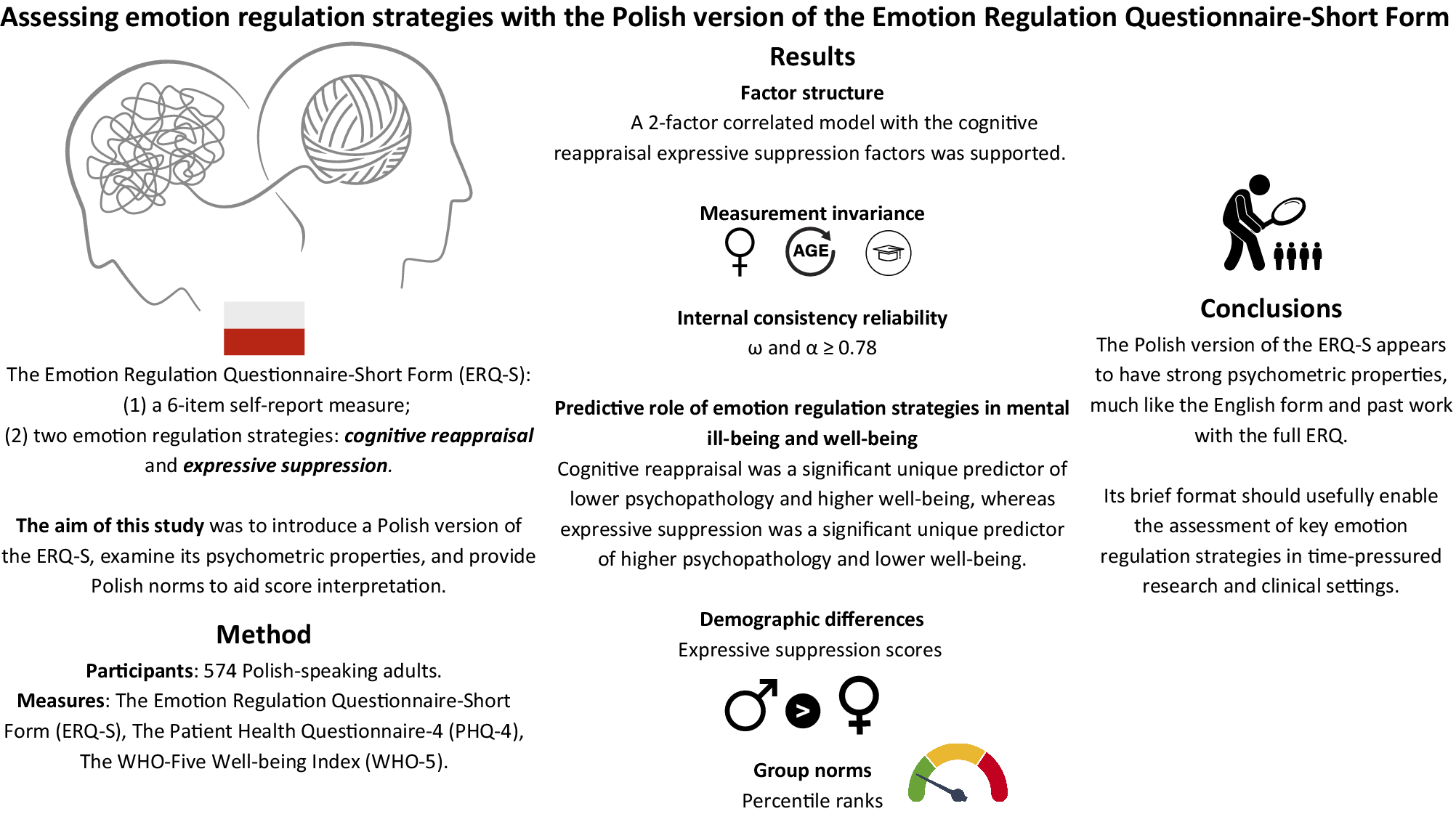
The Emotion Regulation Questionnaire-Short Form (ERQ-S) is a brief 6-item self-report measure of two emotion regulation strategies, cognitive reappraisal and expressive suppression. It is a short form of the most widely used emotion regulation measure in the field, but currently there are limited data on the performance of the ERQ-S. The aim of this study was to introduce a Polish version of the ERQ-S, examine its psychometric properties and provide Polish norms to aid score interpretation. Our sample was 574 Polish-speaking adults aged 18–69 from the general community in Poland. We examined the ERQ-S’s factor structure and measurement invariance with confirmatory factor analysis. We assessed the concurrent validity of the questionnaire via relationships with psychopathology symptoms and well-being. As expected, the Polish version of the ERQ-S demonstrated strong factorial validity with a theoretically congruent 2-factor structure (cognitive reappraisal and expressive suppression factors), which was invariant across gender, age and education categories. The ERQ-S’s concurrent validity and internal consistency reliability were good. As expected, cognitive reappraisal was significantly associated with lower psychopathology symptoms and higher well-being, whereas the opposite pattern was present for expressive suppression. Overall, the Polish version of the ERQ-S has strong psychometric properties and good clinical relevance.
Although the relationship between gaming addiction (GA) and attention deficit hyperactivity disorder (ADHD) is well established, the causal mechanism of this relationship remains ambiguous. We aimed to investigate whether common genetic and/or environmental factors explain the GA-ADHD relationship. We recruited 1413 South Korean adult twins (837 monozygotic [MZ], 326 same-sex dizygotic [DZ], and 250 opposite-sex DZ twins; mean age = 23.1 ± 2.8 years) who completed an online survey on GA and related traits. Correlational analysis and bivariate model-fitting analysis were conducted. Phenotypic correlation between GA and ADHD in the present sample was 0.55 (95% CI [0.51, 0.59]). Bivariate model-fitting analysis revealed that genetic variances were 69% (95% CI [64%, 73%]) and 68% (95% CI [63%, 72%]) for ADHD and GA respectively. The remaining variances (ADHD: 31%; GA: 32%) were associated with nonshared environmental variances, including measurement error. Genetic and nonshared environmental correlations between ADHD and GA were 0.68 (95% CI [0.62, 0.74]) and 0.22 (95% CI [0.13, 0.30]) respectively, which indicates that shared genes can explain 82% of the phenotypic correlation between ADHD and GA. Our study demonstrated that the ADHD-GA association was largely due to shared genetic vulnerability.
It is a reasonable worry that God would not truly love us and want our salvation if He fixed a definite point after which He will no longer offer us the graces to repent of our sins. I propose that Thomas Aquinas succeeds in showing us that God would not be cruel or arbitrary in setting up a world where embodied agents end up after death in a state where they will inevitably fail to repent of their sins. Aquinas proposes that being disembodied is to be in a state where a person cannot be mistaken about what they want, given that they know themselves perfectly. If the disembodied state were like this, it would not be surprising that being in that state makes repentance impossible, since a soul would become fully integrated around whatever one desired, without any conflicting desires that could prompt repentance. Thus, humans would persist in whatever desires they had at the moment of death and disembodiment. I conclude by arguing that, while this scenario stands in need of fuller theodicy, Aquinas’s scenario is helpful in defending a view that God is not cruel or arbitrary for creating a world in which post-mortem repentance is impossible.
Paternal exposures (and other non-maternal factors) around pregnancy could have important effects on offspring health. One challenge is that data on partners are usually from a subgroup of mothers with data, potentially introducing selection bias, limiting generalisability of findings. We aimed to investigate the potential for selection bias in studies using partner data.
We characterise availability of data on father/partner and mother health behaviours (smoking, alcohol, caffeine and physical activity) around pregnancy from three UK cohort studies: the Avon Longitudinal Study of Parents and Children (ALSPAC), Born in Bradford and the Millennium Cohort Study. We assess the extent of sample selection by comparing characteristics of families where fathers/partners do and do not participate. Using the association of parental smoking during pregnancy and child birthweight as an example, we perform simulations to investigate the extent to which missing father/partner data may induce bias in analyses conducted only in families with participating fathers/partners.
In all cohorts, father/partner data were less detailed and collected at fewer timepoints than mothers. Partners with a lower socio-economic position were less likely to participate. In simulations based on ALSPAC data, there was little evidence of selection bias in associations of maternal smoking with birthweight, and bias for father/partner smoking was relatively small. Missing partner data can induce selection bias. In our example analyses of the effect of parental smoking on offspring birthweight, the bias had a relatively small impact. In practice, the impact of selection bias will depend on both the analysis model and the selection mechanism.
The ice discharge from the grounded parts of marine ice sheets into the ocean is modulated by their floating extensions – ice shelves. The ice-shelf impact on the grounded ice is typically described as ‘backpressure’ or ‘buttressing’. Theoretical analyses of their effects have been restricted to one horizontal dimension. This study revisits the concepts of ‘backpressure’ introduced by Thomas (1977) and ‘buttressing’ numbers and ratios introduced by Gudmundsson (2013) and extends their theoretical analysis to two horizontal dimensions. Using the integral form of the momentum-balance formulation suitable for fast-flowing ice streams and ice shelves, our analysis provides a natural definition for the total backpressure force exerted by an ice shelf to the grounded ice upstream of its grounding line. The results of numerical analyses suggest that ice shelves whose second principal stress component is compressional over larger areas may provide more buttressing compared to ice shelves with smaller areas of compressional stresses or to ice shelves with both principal stresses being tensile.
Type 2 diabetes (T2D) is a global health burden, more prevalent among individuals with attention deficit hyperactivity disorder (ADHD) compared to the general population. To extend the knowledge base on how ADHD links to T2D, this study aimed to estimate causal effects of ADHD on T2D and to explore mediating pathways.
Methods
We applied a two-step, two-sample Mendelian randomization (MR) design, using single nucleotide polymorphisms to genetically predict ADHD and a range of potential mediators. First, a wide range of univariable MR methods was used to investigate associations between genetically predicted ADHD and T2D, and between ADHD and the purported mediators: body mass index (BMI), childhood obesity, childhood BMI, sedentary behaviour (daily hours of TV watching), blood pressure (systolic blood pressure, diastolic blood pressure), C-reactive protein and educational attainment (EA). A mixture-of-experts method was then applied to select the MR method most likely to return a reliable estimate. We used estimates derived from multivariable MR to estimate indirect effects of ADHD on T2D through mediators.
Results
Genetically predicted ADHD liability associated with 10% higher odds of T2D (OR: 1.10; 95% CI: 1.02, 1.18). From nine purported mediators studied, three showed significant individual mediation effects: EA (39.44% mediation; 95% CI: 29.00%, 49.73%), BMI (44.23% mediation; 95% CI: 34.34%, 52.03%) and TV watching (44.10% mediation; 95% CI: 30.76%, 57.80%). The combination of BMI and EA explained the largest mediating effect (53.31%, 95% CI: −1.99%, 110.38%) of the ADHD–T2D association.
Conclusions
These findings suggest a potentially causal, positive relationship between ADHD liability and T2D, with mediation through higher BMI, more TV watching and lower EA. Intervention on these factors may thus have beneficial effects on T2D risk in individuals with ADHD.
Internationally, stresses related to the COVID-19 pandemic negatively affected the mental health of family caregivers of adults with intellectual and developmental disabilities (IDDs).
Aims
This cross-sectional study investigated demographic, situational and psychological variables associated with mental wellbeing among family caregivers of adults with IDDs during the COVID-19 pandemic.
Method
Baseline data from 202 family caregivers participating in virtual courses to support caregiver mental well-being were collected from October 2020 to June 2022 via online survey. Mental well-being was assessed using total scores from the Warwick-Edinburgh Mental Wellbeing Scale. Demographic, situational and psychological contributors to mental well-being were identified using hierarchical regression analysis.
Results
Variables associated with lower levels of mental well-being were gender (women); age (<60 years old); lack of vaccine availability; loss of programming for their family member; social isolation; and low confidence in their ability to prepare for healthcare, support their family member's mental health, manage burnout and navigate healthcare and social systems. Connection with other families, confidence in managing burnout and building resilience and confidence in working effectively across health and social systems were significant predictors of mental well-being in the final regression model, which predicted 55.6% of variance in mental well-being (P < 0.001).
Conclusions
Family caregivers need ways to foster social connections with other families, and support to properly utilise healthcare and social services during public health emergencies. Helping them attend to their needs as caregivers can promote their mental health and ultimately improve outcomes for their family members with disabilities.
The crystal structure of cariprazine dihydrochloride has been solved and refined using synchrotron X-ray powder diffraction data and optimized using density functional theory techniques. Cariprazine dihydrochloride crystallizes in space group P21/n (#14) with a = 27.26430(14), b = 7.29241(1), c = 12.80879(4) Å, β = 99.5963(2)°, V = 2511.038(8) Å3, and Z = 4 at 295 K. The crystal structure consists of layers of cations parallel to the bc-plane. The cations stack along the b-axis. Each H atom on the two protonated N atoms participates in a discrete N–H⋯Cl hydrogen bond. One Cl anion acts as an acceptor in two of these bonds, while the other Cl is an acceptor in only one bond. The result is to link the cations and anions into columns parallel to the b-axis. The powder pattern has been submitted to the ICDD for inclusion in the Powder Diffraction File™ (PDF®).
In 1853, a Taiping army infiltrated North China, threatening Beijing and the Qing dynasty itself. Though this army never reached Beijing, its northern siege had acute and lasting impacts on communities in the capital region (jifu 畿輔). Attention to the capital region invites reflection on the temporality and strategic nature of commemoration. Focusing on Cangzhou 滄州, I examine how capital region communities memorialized the northern chapter of the Taiping Civil War, even as for the rest of the empire, the war remained unfinished until 1864. In gazetteers, private histories, and commemorative records, local authors reframed ambiguous realities to write their localities into a story of northern victory, regardless of the fate of the south. The timeline for commemoration in Cangzhou was interrupted, not seamless, and took place over decades. Initially addressed to Beijing and elites along the Grand Canal, Cangzhou's commemorative project was later brought into the orbit of ascendant Tianjin.
Perinatal malnutrition is a critical cause of diseases in offspring. Based on the different rates of organ development, we hypothesised that malnutrition at varying early life stages would have a differential impact on cardiovascular disease in middle-aged and older adults. This study sought to assess the long-term impact of exposure to the 1959–1961 Great Chinese Famine (GCF) during early developmental periods on risks of cardiovascular diseases in the late middle-aged offspring. A total 6, 662 individuals, born between 1958 and 1964, were divided into six groups according to the birth date. The generalised line model was used to control age and estimate differences with 95% confidence interval (CI) in blood pressure. Binary logistic regression was applied to evaluate the association between famine exposure and cardiovascular diseases. Compared to the unexposed late middle-aged persons, blood pressure was elevated in the entire gestation exposure group, regardless of postnatal exposure to GCF. Increased blood pressure was also found in the female offspring exposed to GCF during early and middle gestation. The early-childhood exposure was associated with the risk of bradycardia in the offspring. The risks of vertebral artery atherosclerosis were elevated in GCF famine-exposed groups except first trimester exposed group. The chronic influence of GCF in early life periods was specific to the developmental timing window, sexesand organs, suggesting an essential role of interactions among multiple factors and prenatal malnutrition in developmentally “programming” cardiovascular diseases.
Descriptions of various subsets of $\mathbb{SO}(3)$ are encountered frequently in robotics, for example, in the context of specifying the orientation workspaces of manipulators. Often, the Cartesian concept of a cuboid is extended into the domain of Euler angles, notwithstanding the fact that the physical implications of this practice are not documented. Motivated by this lacuna in the existing literature, this article focuses on studying sets of rotations described by such cuboids by mapping them to the space of Rodrigues parameters, where a physically meaningful measure of distance from the origin is available and the spherical geometry is intrinsically pertinent. It is established that the planar faces of the said cuboid transform into hyperboloids of one sheet and hence, the cuboid itself maps into a solid of complicated non-convex shape. To quantify the extents of these solids, the largest spheres contained within them are computed analytically. It is expected that this study would help in the process of design and path planning of spatial robots, especially those of parallel architecture, due to a better and quantitative understanding of their orientation workspaces.
This paper studies the spatio-temporal dynamics of a diffusive plant-sulphide model with toxicity delay. More specifically, the effects of discrete delay and distributed delay on the dynamics are explored, respectively. The deep analysis of eigenvalues indicates that both diffusion and delay can induce Hopf bifurcations. The normal form theory is used to set up an exact formula that determines the properties of Hopf bifurcation in a diffusive plant-sulphide model. A sufficiently small discrete delay does not affect the stability and a sufficiently large discrete delay destabilizes the system. Nonetheless, a sufficiently small or large distributed delay does not affect the stability. Both delays cause instability by inducing Hopf bifurcation rather than Turing bifurcation.
Hybrid MKNF Knowledge Bases (HMKNF-KBs) constitute a formalism for tightly integrated reasoning over closed-world rules and open-world ontologies. This approach allows for accurate modeling of real-world systems, which often rely on both categorical and normative reasoning. Conflict-driven solving is the leading approach for computationally hard problems, such as satisfiability (SAT) and answer set programming (ASP), in which MKNF is rooted. This paper investigates the theoretical underpinnings required for a conflict-driven solver of HMKNF-KBs. The approach defines a set of completion and loop formulas, whose satisfaction characterizes MKNF models. This forms the basis for a set of nogoods, which in turn can be used as the backbone for a conflict-driven solver.
This retrospective study provides insights on linguistic development in exceptional circumstances assessing 378 children (between 2;6 and 3;6) who lived their first years during the COVID-19 pandemic and comparing it with normative data collected before this period (CDI-III-PT; Cadime et al., 2021). It investigates the extent to which linguistic development was modulated by a complex set of factors, including sex, maternal education, book reading, language-promoting practices, COVID-19 infection, parental stress and sleeping problems, considering three periods (during lockdowns, out of lockdowns and at present). The results show a substantial negative effect of the pandemic on both lexical and syntactic development. Considering individual variation, structural equation modelling unveiled a complex scenario in which age, sex, book reading, language-promoting practices, sleeping problems and COVID-19 infection showed a direct effect on linguistic development. Maternal education and parental stress had an indirect effect on children’s language, mediated by book reading and sleeping problems, respectively.
Species-level delineation of digenetic trematodes is complex and can be best achieved by integrative taxonomy using both genetic characterisation and morphological analysis. Two new Bucephalidae species of the genus Rhipidocotyle Diesing, 1858 are described here based on specimens collected from the intestine of Sphyraena putnamae Jordan & Seale following this approach. Adults of R. siphonyaka n. sp. and R. nolwe n. sp. possess tentacles and a tegument with scales. They are distinguished from their congeners by the arrangement of the digestive structures, the extent of the uterus relative to vitelline fields, and the arrangement of the reproductive structures. Rhipidocotyle siphonyaka n. sp. differs from R. nolwe n. sp. in having the pharynx and mouth positioned in the pre-uterine field, tandem testes, longer body length, and shorter pre-vitelline and post-testicular distance. Rhipidocotyle siphonyaka n. sp. differs from its congeners in having a tube-like intestinal caecum, pharynx and mouth opening positioned in the pre-vitelline field. Rhipidocotyle nolwe n. sp. appears to be similar, morphologically and morphometrically, to Rhipidocotyle khalili (Nagaty, 1937). Despite their similarities, R. nolwe n. sp. has a shorter body length and egg size. Moreover, the molecular analysis of 28S and ITS rDNA fragments indicate that R. siphonyaka n. sp. and R. nolwe n. sp. are closely related phylogenetically but distinct from one another and other Bucephalidae for which molecular data are available.
The COVID-19 pandemic is a disaster event. Exposure to stressors during and after disaster events is associated with negative mental health symptoms. To inform targeted COVID-19 recovery efforts, data are needed to understand which stressors play a key role in this relationship.
Methods
Cross-sectional survey data (demographics, impacts of COVID-19, social determinants of health, depression, and anxiety) were collected online from adults living in New York state between May and June 2020. Differences in the proportion of stressors (COVID-19 and social determinants) experienced by race/ethnicity were assessed using chi-square analyses. Logistic regression was used to assess which factors were associated with increased odds of depression and anxiety.
Results
A majority (n = 258, 62.2%) of the 415 respondents reported being directly impacted by the pandemic. Non-white respondents reported a significantly larger proportion of stressors compared to white respondents. Under half of respondents reported depression (n = 171, 41.2%) and anxiety (n = 164, 39.5%). Healthcare and food concerns were associated with increased odds of depression and anxiety, and economic concerns were associated with increased odds of anxiety.
Conclusions
Findings underscore the need to respond to the COVID-19 mental health crisis by addressing social determinants of health.
The authors critique the NY Declaration on Animal Consciousness, which does not denounce continued captivity and invasive research in the pursuit of animal consciousness markers. They argue that such research often increases animal suffering by accepting harmful practices. Instead, they propose a nonanthropocentric, ethical framework aligned with the Belmont Report’s principle of beneficence, advocating for noninvasive methods in natural habitats. This approach prioritizes animal well-being, recognizing and safeguarding the intrinsic value of all conscious beings.