To save content items to your account,
please confirm that you agree to abide by our usage policies.
If this is the first time you use this feature, you will be asked to authorise Cambridge Core to connect with your account.
Find out more about saving content to .
To save content items to your Kindle, first ensure no-reply@cambridge.org
is added to your Approved Personal Document E-mail List under your Personal Document Settings
on the Manage Your Content and Devices page of your Amazon account. Then enter the ‘name’ part
of your Kindle email address below.
Find out more about saving to your Kindle.
Note you can select to save to either the @free.kindle.com or @kindle.com variations.
‘@free.kindle.com’ emails are free but can only be saved to your device when it is connected to wi-fi.
‘@kindle.com’ emails can be delivered even when you are not connected to wi-fi, but note that service fees apply.
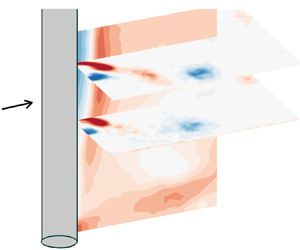
Free transverse oscillations of an elastically mounted circular cylinder with low mass-damping are studied with a focus on the effects of the cylinder end condition on structural oscillations and vortex shedding. While the top end of the cylinder pierces the free surface of a water channel, the lower end is changed to have three end conditions: an attached endplate, an endplate unattached from the cylinder at varying gaps and no endplate. All three response branches are examined, with the reduced velocity sweeping $2 \le {U^\ast } \le 15$ (corresponding to a Reynolds number range of $2000 \le Re \le 14\;700$). Although the cylinder oscillations are unaffected by the end condition in the initial and upper branches, they show significant dependency on the end condition in the lower branch. When the endplate is attached or unattached with a small gap, the upper-to-lower branch transition occurs with a sudden decrease in oscillation amplitude, after which the lower branch maintains a near-constant amplitude. For larger gaps or no endplate, with increasing reduced velocity, the oscillation amplitude decreases gradually from its peak without any discernible sign of transition between the upper and lower branches. The three-dimensional effects of the gap are the basis for these differences in oscillation. Atop the strong tip vortex, a low-magnitude streamwise velocity region develops downstream of the cylinder, which delays upper-to-lower branch transition over the cylinder span that sees this low-velocity region. With increasing gap, this low-velocity region and the delay in transition spread over larger spanwise extents, forcing the overall body to oscillate at larger amplitudes.

Reducing rehospitalization has been a primary focus of hospitals and payors. Recurrence of Clostridioides difficile infection (CDI) is common and often results in rehospitalization. Factors that influence rehospitalization for CDI are not well understood.
Objective:
To determine the risk factors that influence rehospitalization caused by CDI.
Design:
A retrospective cohort study from January 1, 2018, to December 31, 2018, of patients aged ≥18 who tested positive for C. difficile while hospitalized.
Setting:
Academic hospital.
Methods:
The risk of rehospitalization was assessed across exposures during and after the index hospitalization using a Cox proportional hazards model. The primary outcome of this study was 60-day CDI-related rehospitalization.
Results:
There were 559 hospitalized patients with a positive CD test during the study period, and 408 patients were included for analysis. All-cause rehospitalization was 46.1% within 60 days of the index hospital discharge. Within 60 days of discharge, 68 patients developed CDI, of which 72.5% (49 of 68) were rehospitalized specifically for the management of CDI. The risk of rehospitalization in patients with CDI was higher among patients who were exposed to systemic antibiotics ([adjusted hazard ratio] aHR: 2.78; 95% CI, 1.36–5.64) and lower among patients who had post-discharge follow-up addressing C. difficile (aHR: 0.53; 95% CI, 0.28–0.98).
Conclusions:
Exposure to systemic antibiotics increased the risk of rehospitalization due to CDI, while post-discharge follow-up decreased the risk of rehospitalization due to CDI. Comprehensive transitions of care for hospitalized patients with C. difficile may reduce the risk of CDI-related rehospitalization.
This article studies some major shifts in the relationship between law and Sufism in South Asian Islam between the eighteenth and the twentieth centuries. It does so by focusing on Shah Wali Allah of Delhi (d. 1762) to examine, first, how these two key facets of Islam interact with each other in his thought and, second, how some influential Muslim intellectuals of the late nineteenth and twentieth centuries have understood and positioned themselves in relation to this aspect of his thought. Though one would be hard pressed to know this from the sanitized modern image of Wali Allah as a scholar of the Quran and hadith, and of a Sufi piety uncompromisingly anchored in them, his Sufism reveals a wide and, from many a modern Muslim perspective, unwieldly range of ideas and practices. Yet it was precisely in that unwieldy breadth and depth that it was generative of some of his key insights into matters of the law. Even as many people have continued to insist on the imbrication of law and Sufism, a sanitization of Wali Allah’s Sufi image serves to highlight wider processes whereby an earlier era’s generative relationship between the two has come to be increasingly attenuated since the late nineteenth century.
Ruth Glacier is situated in the Central Alaska Range, with the Don Sheldon Amphitheater comprising much of its broad accumulation area, directly adjacent to North America's tallest mountain, Denali. From there it funnels through the ‘Great Gorge,’ flanked by steep valley walls reaching over 1500 m. We combine airborne and ground-based radar measurements of ice thickness with satellite-derived surface velocities to constrain ice flux above and below the gorge, and employ a mass conservation approach to estimate the glacier's thickness within the gorge. We measure ice thickness in the amphitheater to reach 950 m, and estimate centerline thickness in the gorge to range from 610 to 960 m. Our estimates are up to two times greater than those suggested by global models, and allow us to confirm that the Great Gorge rivals Hells Canyon as the deepest gorge in North America. We found that the geometry of the gorge prevents radar measurements of ice thickness there since returns from the subglacial valley walls would precede and potentially occlude nadir bed returns. The same may be true of other unmapped mountain glaciers; however, thickness may be determined using appropriately located flux gates where radar sounding is feasible, combined with mass conservation methods.
This article develops an account of territorial justice to understand what is owed to people at risk of climate displacement. I argue that the aim of territorial justice is to secure a globally recognized status, the status of being an equal common possessor of the earth. As a common possessor, every inhabitant of the globe has a claim to a “place” in the world where they can access minimally just material conditions and political institutions, securely pursue their located practices, and exercise self-determination together with others. I apply this theory to generate prescriptions for a just policy response to the risk of climate displacement. Where possible, I argue that a just response should focus on mandatory global taxation to support in situ adaptation. In cases where relocation becomes inevitable, I outline the implications for how just relocation regime should be structured.
Promising studies show that psilocybin-assisted therapy relieves existential distress in patients with serious illnesses, a difficult condition to treat with current treatment options. There is growing interest in this therapy in palliative care. Canada recently amended its laws to allow physicians to request psilocybin for end-of-life distress. However, barriers to access remain. Since implementing psilocybin-assisted therapy within palliative care depends on the attitudes of healthcare providers willing to recommend it, they should be actively engaged in the broader discussion about this treatment option. We aimed (1) to identify issues and concerns regarding the acceptability of this therapy among palliative care professionals and to discuss ways of remedying them and (2) to identify factors that may facilitate access.
Methods
A qualitative study design and World Café methodology were adopted to collect data. The event was held on April 24, 2023, with 16 palliative care professionals. The data was analyzed following an inductive approach.
Results
Although participants were interested in psilocybin-assisted therapy, several concerns and needs were identified. Educational and certified training needs, medical legalization of psilocybin, more research, refinement of therapy protocols, reflections on the type of professionals dispensing the therapy, the treatment venue, and eligibility criteria for treatment were discussed.
Significance of results
Palliative care professionals consider psilocybin-assisted therapy a treatment of interest, but it generates several concerns. According to our results, the acceptability of the therapy and the expansion of its access seem interrelated. The development of guidelines will be essential to encourage wider therapy deployment.
This article focuses on the discussions around female athletes and their emotions in the German and Austrian press of the 1920s. In the course of the sports boom of the interwar years, more and more women participated in public sports competitions and demanded their right to be taken seriously as sportswomen. Their public appearance aroused mixed feelings and heated social debates about how much and what kind of sport was appropriate for women, which were reflected in discussions and narratives around the figure of the “sportsgirl.” Sportsgirls were imbued with a novel emotional style to which ambition and audacity – ways of feeling that were cultivated during competitive sports and that contrasted with traditional bourgeois female feeling rules – were key. Sportsgirls and their emotional style were the subject of many stories, reports, pictures, and articles that were published in the growing sports press of the time – and they were judged and evaluated for the emotional style they embodied. The press was a potent platform and site of the formation of feeling rules; as such, discussions around sportsgirls point to the (embodied) experiences of the athletes and indicate how the emotional style that derived from them was turned into a tool to reshape social conventions and feeling rules for women beyond the sports arena.
Irregular migrants’ flows have, for several years now, been making the news headlines and are at the core of political debates. In a context of polycrisis—characterized by the post COVID-19 pandemic, climate change and its devastating impacts; the disruption of labor markets caused by the fourth industrial revolution and artificial intelligence; or geopolitical tensions in different parts of the globe that threaten the livelihoods of many communities—the desire to move from the developing and emerging world to the West can increase.
The transition from childhood to adolescence presents elevated risks for the onset of psychopathology in youth. Given the multilayered nature of development, the present study leverages the longitudinal, population-based Adolescent Brain Cognitive Development Study to derive ecologically informed risk/resilience profiles based on multilevel influences (e.g., neighborhood and family socioeconomic resources, parenting, school characteristics) and their transition pathways and examine their associations with psychopathology. Latent profile analysis characterized risk/resilience profiles at each time point (i.e., baseline, Year-1, Year-2); latent transition analysis estimated the most likely transition pathway for each individual. Analysis of covariance was used to examine associations between profile membership at baseline (i.e., ages 9–11) and psychopathology, both concurrently and at Year-2 follow-up. Further, we examined the associations between profile transition pathways and Year-2 psychopathology. Four distinct profiles emerged across time – High-SES High-Protective, High-SES Low-Protective, Low-SES High-Family-Risk, and Low-SES High-Protective. Despite reasonably high stability, significant transition over time among profiles was detected. Profile membership at baseline significantly correlated with concurrent psychopathology and predicted psychopathology 2 years later. Additionally, profile transition pathways significantly predicted Year-2 psychopathology, exemplifying equifinality and multifinality. Characterizing and tracing shifts in ecologically informed risk/resilience influences, our findings have the potential to inform more precise intervention efforts in youth.
This paper discusses competing visions of the decolonization of Ghana’s economy during the first decade of the country’s independence from Britain (1957–1966), and the agency and horizon of choice available to the Ghanaian decision-makers in charge of implementing these visions. It focuses on Ghana’s construction industry, both as an important part of the national economy and as a condition for Ghana’s broader social and economic development in the context of colonial-era path-dependencies and Cold War competition. By taking the vantage point of mid-level administrators and professionals, the paper shows how they negotiated British and Soviet technological offers of construction materials, machinery, and design. In response to Soviet claims about the adaptability of their construction resources to Ghana’s local conditions, the practice of adaptation became for Ghanaian architects and administrators an opportunity to reflect on the needs, means, and objectives of Ghana’s construction industry, and on broader visions of Ghana’s economic and social development. Beyond the specific focus on the construction industry, this paper conceptualizes the centrality of adaptation in enforcing technological hegemony during the period of decolonization, and discusses African agency beyond the registers of extraction and resistance that have dominated scholarship on the global Cold War.
Peanut (Arachis hypogaea L.) and maize (Zea mays L.) are essential crops for Ghana’s economy and food security, but weed infestation poses a significant threat to their cultivation. Crop rotations influence weed communities, but little is known about these processes in peanut-cropping systems in West Africa. This study investigated the impact of different crop rotations and input levels on weed communities in Ghana over 3 yr. Results showed that low inputs (absence of herbicide and fertilization) favored species richness, while higher input levels (weed control with herbicides and fertilizer use) reduced it. Diversity and evenness were also affected by inputs, with varying patterns across locations and seasons. Weed population growth rates (λ) varied significantly by location and treatment; all management programs resulted in increasing weed populations. Principal component analysis revealed distinct associations between weed species and crop management. The majority of weed species exhibited a generalist behavior and did not associate with a particular management. However, billygoat weed (Ageratum conyzoides L.) and Benghal dayflower (Commelina benghalensis L.) were positively associated with high-input systems, while purple nutsedge (Cyperus rotundus L.) exhibited strong associations with low and medium inputs. The weed–crop rotation dynamics described here demonstrate how management drives the selection of weed species that are more pervasive and interfere with important food crops in Ghanaian agriculture.
This article examines the theological and hermeneutical foundations and fault lines of Muslim modernism and traditionalism in South Asia. It does so through a close reading of a massively consequential but thus far unstudied debate on the normative sources and interpretive parameters of religion in colonial modernity between the scholars Sayyid Ahmad Khan (d. 1898) and Muhammad Qasim Nanautvi (d. 1877), founders of arguably the most prominent bastions of modernism and traditionalism in Muslim South Asia: the Aligarh Muslim University and the Deoband Madrasa, both established in the late nineteenth century.
This article examines two major recent CCTV documentaries on the Third Front and its afterlives. The Big Third Front (2017) and Vicissitudes of the Third Front (2016) construct strong narratives about the Third Front during the Mao era, depicting it as a heroic struggle against nature which was forced upon China by foreign enemies. However, both documentaries encounter difficulties in adhering to the usual presentation of the Deng era as a resoundingly successful transformation. Vicissitudes ambivalently characterizes the Deng era as one of relative decline in contrast to the glorious early years of the Third Front and the flourishing present. The Big Third Front, meanwhile, conflates historical footage of the 1950s–1990s in a way that undermines the usual official division of PRC history into Mao and reform eras. This paper concludes by suggesting that academic focus on the Third Front can serve as a methodological tool for complicating the periodization of PRC history.
The estimates of attention-deficit hyperactivity disorder (ADHD) prevalence across various studies are significantly variable, contributing to uncertainty in ADHD prevalence estimation. Previous systematic reviews and meta-analyses have attributed this variability primarily to the methodological characteristics of the studies, including the diagnostic criteria, source of information, and impairment requirement for the diagnosis.
Methods
Review identified studies reporting ADHD prevalence in representative samples of children and adults in Europe and worldwide. Studies that were conducted in the general population were included. We focused on studies that report ADHD prevalence based on clinical diagnosis (clinical diagnostic criteria based on the Diagnostic and Statistical Manual of Mental Disorders and International Classification of Diseases criteria, other diagnostic tools, such as various scales or interviews based on clinical diagnostic criteria). PubMed/Medline was searched to identify relevant articles published until 2024/2/01. The study was registered in PROSPERO (CRD42020200220) and followed Preferred Reporting Items for Systematic Reviews and Meta-Analyses 2020 guidelines for systematic review and meta-analysis.
Results
In total, 117 studies were subjected to full evaluation. In the meta-analysis, 103 studies representing 159 independent datapoints were included. The overall prevalence of ADHD in register studies was 1.6%, 95% CI [0.9; 3.0], in survey studies 5.0%, 95% CI [2.9; 8.6], in one-stage clinical studies 4.2%, 95% CI [2.9; 6.0], and in two-stage clinical studies 4.8%, 95% CI [4.0; 5.8].
Conclusions
Exact comparisons among studies with different diagnostic criteria and types of sampling can impact prevalence estimates. When comparing data from methodologically different studies, these factors need to be considered.
The camber morphing of an aerofoil in ground effect was investigated using the FishBAC method and Detached Eddy Simulations with the k-omega SST turbulence model at a Reynolds number of 320,000. The aerofoil was periodically morphed at a start location of 25% chord from the leading edge with a trailing edge deflection range of 0.1% to 3% and morphing frequencies between a Strouhal number of 0.45 to 4 at a constant ground clearance of 10%. Periodically morphing the aerofoil using a sinusoidal function showed that lift and drag increased on the downstroke and decreased on the upstroke in the cycle, resulting in periodic values of lift and drag throughout the cycle. The amplitude of lift and drag increased as the morphing frequency and/or trailing edge deflection increased. It was found that the wake characteristics varied as a function of trailing edge deflection and morphing frequency. For small trailing edge deflections below 0.4% and frequencies below a 2.2 Strouhal number, Kelvin Helmholtz shedding was observed, and above this the wake became chaotic. Large trailing edge deflections showed Von-Karman shedding, where the interaction between the lower counter-clockwise vortex and the ground plane resulted in a jet-like flow that caused forward thrust. For the maximum deflection and morphing frequency tested in this study, reversed Von-Karman shedding was observed, which caused forward thrust from the interaction of the two-shedding counter-rotating vortices. Von-Karman or reversed Von-Karman shedding shows positive thrust generation, however, chaotic shedding should be avoided due to large drag gains. Varying the Reynolds number caused the Strouhal number to change as they depend on the same variables. It was found that the Strouhal number variation had a large effect on the wake, however, the Reynolds number had a minimal effect.
Children with brain cancer and their families have complex care needs throughout diagnosis, active treatment, long-term survivorship, and the palliative phase of illness. This study aimed to explore the perspectives of Australian specialist clinicians on barriers and facilitators to health care for children with brain cancer and their families.
Methods
A qualitative approach was taken using semi-structured interviews. Eligible participants were clinicians of any discipline providing care to children with brain cancer and their families in Australia. Interviews were conducted by telephone and asked about perceived strengths and weaknesses in health care and available resources for this population. Qualitative content analysis used a directed approach with inductive refinement.
Results
Eleven clinicians participated, 5 of whom were medical, 3 nursing, and 3 allied health. The overarching theme was that the rarity and diversity of brain tumors in children confers challenges to care that lead to variation in practice. Participants reported having to adapt care from guidelines and patient/family resources designed for adults with brain cancer and children with other cancers, and rely on clinical and research networks. Specialist comprehensive cancer care was generally perceived to offer the best model for accommodating the unique needs of each child/family, but barriers to access were highlighted for children in remote Australia, and long-term follow-up was perceived to be inadequate regardless of where children lived. Significance of results. Until further brain cancer-specific paediatric guidelines become available, our findings highlight the need for communities of practice to share resources and reduce unwarranted variation.
Conclusion
Future research should focus on developing and evaluating guidelines and other resources specific to children with brain cancer, as well as informing suitable models for long-term follow-up care for survivors.
Speakers of different languages follow a three-way split in how they express motion events in speech—with a greater emphasis on manner in satellite-framed languages (English), path in verb-framed languages (Turkish), and comparable expression of manner and path in equipollently-framed languages (Chinese). According to the thinking-for-speaking account, these language-specific patterns can affect speakers’ representation of motion events but only when verbalizing the event. In this study, we asked whether language might influence learning novel words, particularly when the words were accompanied with gestures. We examined effects of language type (equipollent-framed: Chinese, satellite-framed: English, verb-framed: Turkish) and modality (speech-only, gesture+speech) on learning pseudowords for motion (manner, path). Our results showed that speakers of all three languages learned pseudowords for manner and path but with lower accuracy scores and slower rates of learning by Chinese speakers. Regardless of the language they spoke, participants learned manner words more accurately than path words, but with no added benefits of instruction with gesture+speech over speech-only. Taken together, our study extends the lack of language effect on nonverbal representation of events when not speaking to the domain of novel word learning across structurally different languages.