Refine listing
Actions for selected content:
142590 results in Open Access
Streamwise energy-transfer mechanisms in zero- and adverse-pressure-gradient turbulent boundary layers
-
- Journal:
- Journal of Fluid Mechanics / Volume 997 / 25 October 2024
- Published online by Cambridge University Press:
- 08 October 2024, A16
-
- Article
-
- You have access
- Open access
- HTML
- Export citation
-
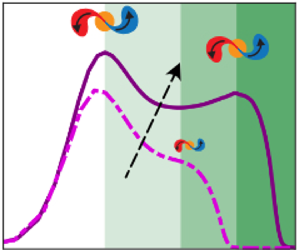
The present study investigates streamwise ( $\overline {u^2}$) energy-transfer mechanisms in the inner and outer regions of turbulent boundary layers (TBLs). Particular focus is placed on the $\overline {u^2}$ production, its inter-component and wall-normal transport as well as dissipation, all of which become statistically significant in the outer region with increasing friction Reynolds number ( $Re_{\tau }$). These properties are analysed using published data sets of zero, weak and moderately strong adverse-pressure-gradient (APG) TBLs across a decade of $Re_{\tau }$, revealing similarity in energy-transfer pathways for all these TBLs. It is found that both the inner and outer peaks of $\overline {u^2}$ are always associated with local maxima in the $\overline {u^2}$ production and its inter-component transport, and the regions below/above each of these peaks are always dominated by wall-ward/away-from-wall transport of $\overline {u^2}$, thereby classifying the $\overline {u^2}$ profiles into four distinct regimes. This classification reveals existence of phenomenologically similar energy-transfer mechanisms in the ‘inner’ and ‘outer’ regions of moderately strong APG TBLs, which meet at an intermediate location coinciding with the minimum in $\overline {u^2}$ profiles. Conditional averaging suggests existence of similar phenomena even in low $Re_{\tau }$ canonical and/or weak APG TBLs, albeit with the outer-region mechanisms weaker than those in the inner region. This explains the absence of their $\overline {u^2}$ outer peak and the dominance of $\overline {u^2}$ wall-normal transport away from the wall, which potentially originates from the inner region. Given that the wall-ward/away-from-wall transport of $\overline {u^2}$ is governed by the $Q_4$(sweeps)/ $Q_2$(ejections) quadrants of the Reynolds shear stress, it is argued that the emergence of the $\overline {u^2}$ outer peak corresponds with the statistical dominance of $Q_4$ events in the outer region. Besides unravelling the dynamical significance of $Q_2$ and $Q_4$ events in the outer region of TBLs, the present analysis also proposes new phenomenological arguments for testing on canonical wall-turbulence data at very high $Re_{\tau }$.


Mass transfer during drop impact on a thin film
-
- Journal:
- Journal of Fluid Mechanics / Volume 997 / 25 October 2024
- Published online by Cambridge University Press:
- 08 October 2024, A15
-
- Article
-
- You have access
- Open access
- HTML
- Export citation
Drivers of human Leptospira infection in the Pacific Islands: A systematic review
-
- Journal:
- Epidemiology & Infection / Volume 152 / 2024
- Published online by Cambridge University Press:
- 08 October 2024, e118
-
- Article
-
- You have access
- Open access
- HTML
- Export citation
Vorticity skewness of finite-amplitude rapidly rotating Rayleigh–Bénard convection
-
- Journal:
- Journal of Fluid Mechanics / Volume 997 / 25 October 2024
- Published online by Cambridge University Press:
- 08 October 2024, A3
-
- Article
-
- You have access
- Open access
- HTML
- Export citation
-
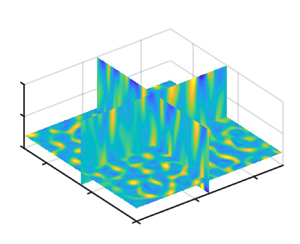
Rotating Rayleigh–Bénard convection denotes the convection between a warm plate and a cold plate in a rotating environment. It is a classic model for understanding convective vortices in the atmosphere and ocean. The influence of background rotation on fluid inertia breaks the symmetry between cyclones and anticyclones. Such a symmetry breaking could be represented by vorticity skewness, which still lacks a systematic theory. Rapidly rotating convection with stress-free boundaries and unit Prandtl number is a convenient starting point. The investigation starts from the convective onset stage, where the vortices grow stationarily. Asymptotic analysis shows that the volumetric vorticity skewness $S$ is produced by the interaction between the $n=0,1$ and $n=1,2$ vertical eigenmodes. The $n=0$ (barotropic) mode contributes positively to $S$ mainly by stretching the vertical relative vorticity, an ageostrophic effect. The $n=2$ mode makes a minor negative contribution to $S$ by preferentially intensifying the outflow over the inflow, a non-hydrostatic effect. The theory predicts $S$ to be proportional to the global Rossby number defined with the volumetric standard deviation of vorticity, ${Ro_g}$. The proportional factor does not depend on the Rayleigh and Ekman numbers, agreeing with direct numerical simulations. Then the system enters the equilibrium stage. The stretching of vertical vorticity still contributes to $S$ dominantly. At ${Ro_g}\gtrsim 0.5$, the emergent unsteady flow significantly suppresses the asymmetry between the inflow and outflow strength, and weakens its influence on $S$.
$S$.


The roots of the concept of depth art
- Part of
-
- Journal:
- Epidemiology and Psychiatric Sciences / Volume 33 / 2024
- Published online by Cambridge University Press:
- 08 October 2024, e45
-
- Article
-
- You have access
- Open access
- HTML
- Export citation
The k-core in percolated dense graph sequences
- Part of
-
- Journal:
- Journal of Applied Probability / Volume 62 / Issue 1 / March 2025
- Published online by Cambridge University Press:
- 08 October 2024, pp. 298-318
- Print publication:
- March 2025
-
- Article
-
- You have access
- Open access
- HTML
- Export citation
-
We determine the order of the k-core in a large class of dense graph sequences. Let $G_n$ be a sequence of undirected, n-vertex graphs with edge weights $\{a^n_{i,j}\}_{i,j \in [n]}$ that converges to a graphon $W\colon[0,1]^2 \to [0,+\infty)$ in the cut metric. Keeping an edge (i,j) of $G_n$ with probability ${a^n_{i,j}}/{n}$ independently, we obtain a sequence of random graphs $G_n({1}/{n})$. Using a branching process and the theory of dense graph limits, under mild assumptions we obtain the order of the k-core of random graphs $G_n({1}/{n})$. Our result can also be used to obtain the threshold of appearance of a k-core of order n.


Data Access and Automated Decision-Making in European Financial Law
-
- Journal:
- European Journal of Risk Regulation / Volume 16 / Issue 1 / March 2025
- Published online by Cambridge University Press:
- 08 October 2024, pp. 11-23
-
- Article
-
- You have access
- Open access
- HTML
- Export citation
Memory, post-fascism and the far-right
-
- Journal:
- Italian Political Science Review / Rivista Italiana di Scienza Politica / Volume 55 / Issue 2 / July 2025
- Published online by Cambridge University Press:
- 08 October 2024, pp. 186-199
-
- Article
-
- You have access
- Open access
- HTML
- Export citation
Misperception of maternal COVID-19 test status as a barrier to recruitment for an observational cohort study of mother–preterm infant dyads
-
- Journal:
- Journal of Clinical and Translational Science / Volume 8 / Issue 1 / 2024
- Published online by Cambridge University Press:
- 08 October 2024, e144
-
- Article
-
- You have access
- Open access
- HTML
- Export citation
Mechanism and application of immune interventions in intracerebral haemorrhage
-
- Journal:
- Expert Reviews in Molecular Medicine / Volume 26 / 2024
- Published online by Cambridge University Press:
- 08 October 2024, e22
-
- Article
-
- You have access
- Open access
- HTML
- Export citation
Maternal mental disorders and neonatal outcomes: Danish population-based cohort study
-
- Journal:
- The British Journal of Psychiatry / Volume 226 / Issue 1 / January 2025
- Published online by Cambridge University Press:
- 08 October 2024, pp. 31-38
- Print publication:
- January 2025
-
- Article
-
- You have access
- Open access
- HTML
- Export citation
Toward sustainable food consumption: an indicator framework for a food provisioning sustainable consumption corridor (SCC)
-
- Journal:
- Global Sustainability / Volume 7 / 2024
- Published online by Cambridge University Press:
- 08 October 2024, e43
-
- Article
-
- You have access
- Open access
- HTML
- Export citation
Informing estimates of probability of Clostridioides difficile infection for testing and treatment: expert consensus from a modified-Delphi procedure
-
- Journal:
- Antimicrobial Stewardship & Healthcare Epidemiology / Volume 4 / Issue 1 / 2024
- Published online by Cambridge University Press:
- 08 October 2024, e168
-
- Article
-
- You have access
- Open access
- HTML
- Export citation
Who cares? Measuring differences in preference intensity
-
- Journal:
- Political Science Research and Methods / Volume 13 / Issue 2 / April 2025
- Published online by Cambridge University Press:
- 08 October 2024, pp. 337-353
-
- Article
-
- You have access
- Open access
- HTML
- Export citation

A spectral cavalcade: Early Iron Age horse sacrifice at a royal tomb in southern Siberia
- Part of
-
- Article
-
- You have access
- Open access
- HTML
- Export citation
Catching-Up and Falling Behind: Russian Economic Growth, 1690s–1880s
-
- Journal:
- The Journal of Economic History / Volume 84 / Issue 4 / December 2024
- Published online by Cambridge University Press:
- 08 October 2024, pp. 997-1028
- Print publication:
- December 2024
-
- Article
-
- You have access
- Open access
- HTML
- Export citation
Superspreading of SARS-CoV-2: a systematic review and meta-analysis of event attack rates and individual transmission patterns
-
- Journal:
- Epidemiology & Infection / Volume 152 / 2024
- Published online by Cambridge University Press:
- 08 October 2024, e121
-
- Article
-
- You have access
- Open access
- HTML
- Export citation
Novel linkage of the Society of Thoracic Surgeons database and hospital electronic health records
-
- Journal:
- Cardiology in the Young / Volume 34 / Issue 12 / December 2024
- Published online by Cambridge University Press:
- 08 October 2024, pp. 2570-2576
-
- Article
-
- You have access
- Open access
- HTML
- Export citation
Downy brome (Bromus tectorum) management and herbicide resistance in dryland wheat production across northeastern Oregon
-
- Journal:
- Weed Science / Volume 72 / Issue 5 / September 2024
- Published online by Cambridge University Press:
- 08 October 2024, pp. 638-645
-
- Article
-
- You have access
- Open access
- HTML
- Export citation
The neural mechanisms of race priming in American politics
-
- Journal:
- Journal of Experimental Political Science / Volume 12 / Issue 1 / Spring 2025
- Published online by Cambridge University Press:
- 08 October 2024, pp. 1-16
-
- Article
-
- You have access
- Open access
- HTML
- Export citation
